Category: Business

  • New tools are coming to fight robocalls

    New tools are coming to fight robocalls

    New tools are coming to fight robocalls, but don’t expect unwanted calls to disappear.

    Political gridlock could derail bills aimed at beefing up enforcement and forcing phone companies to do more. The companies have been slow to act against such automated calls on their own. And even if companies do implement better technology, scammers and telemarketers will somehow get through in this never-ending arms race.

    “We get things working really well. We’re flagging all these calls as scams. And then the scammers find a new way,” said Grant Castle, vice president of engineering at T-Mobile. “We have to adjust. It is a constant back-and-forth.”

    Still, there’s hope that new efforts from the Federal Communications Commission and the industry should help you dodge many robocalls, even if they won’t go away completely. In a scheduled vote Thursday with big implications, the FCC is clarifying that phone companies can block many unwanted calls without asking customers first.

    Phone scams have cost victims millions of dollars. And they disrupt institutions, not just your dinner. A hospital in Florida, the Moffitt Cancer Center, received 6,600 calls over 90 days faked to look as though they were coming from inside the hospital, diverting 65 hours of staff time from patient care.

    The aggravation isn’t limited to scammers pretending to be from the IRS or Social Security. Call-blocker YouMail estimates that about a third of robocalls come from debt collectors and companies pitching cruises or insurance.

    The robocall problem has exploded because cheap software makes it easy to make mass calls. Scammers don’t care if you’ve added your number to the government’s Do Not Call list.

    Yet enforcement against illegal callers is negligible. Federal agencies have fined scammers hundreds of millions of dollars, but it’s been difficult to collect. Many of the callers are overseas. It’s hard to throw the fraudsters in jail.

    source

  • Donald Trump Declares Tariffs on Mexico Until Illegal Immigration Stops

    Donald Trump Declares Tariffs on Mexico Until Illegal Immigration Stops

    As everyone knows, the United States of America has been invaded by hundreds of thousands of people coming through Mexico and entering our country illegally.  This sustained influx of illegal aliens has profound consequences on every aspect of our national life—overwhelming our schools, overcrowding our hospitals, draining our welfare system, and causing untold amounts of crime.  Gang members, smugglers, human traffickers, and illegal drugs and narcotics of all kinds are pouring across the Southern Border and directly into our communities.  Thousands of innocent lives are taken every year as a result of this lawless chaos.  It must end NOW!

    Mexico’s passive cooperation in allowing this mass incursion constitutes an emergency and extraordinary threat to the national security and economy of the United States.  Mexico has very strong immigration laws and could easily halt the illegal flow of migrants, including by returning them to their home countries.  Additionally, Mexico could quickly and easily stop illegal aliens from coming through its southern border with Guatemala.

    For decades, the United States has suffered the severe and dangerous consequences of illegal immigration.  Sadly, Mexico has allowed this situation to go on for many years, growing only worse with the passage of time.  From a safety, national security, military, economic, and humanitarian standpoint, we cannot allow this grave disaster to continue.  The current state of affairs is profoundly unfair to the American taxpayer, who bears the extraordinary financial cost imposed by large-scale illegal migration.  Even worse is the terrible and preventable loss of human life.  Some of the most deadly and vicious gangs on the planet operate just across our border and terrorize innocent communities.

    Mexico must step up and help solve this problem.  We welcome people who come to the United States legally, but we cannot allow our laws to be broken and our borders to be violated.  For years, Mexico has not treated us fairly—but we are now asserting our rights as a sovereign Nation.

    To address the emergency at the Southern Border, I am invoking the authorities granted to me by the International Emergency Economic Powers Act.  Accordingly, starting on June 10, 2019, the United States will impose a 5 percent Tariff on all goods imported from Mexico.  If the illegal migration crisis is alleviated through effective actions taken by Mexico, to be determined in our sole discretion and judgment, the Tariffs will be removed.  If the crisis persists, however, the Tariffs will be raised to 10 percent on July 1, 2019.  Similarly, if Mexico still has not taken action to dramatically reduce or eliminate the number of illegal aliens crossing its territory into the United States, Tariffs will be increased to 15 percent on August 1, 2019, to 20 percent on September 1, 2019, and to 25 percent on October 1, 2019.  Tariffs will permanently remain at the 25 percent level unless and until Mexico substantially stops the illegal inflow of aliens coming through its territory.  Workers who come to our country through the legal admissions process, including those working on farms, ranches, and in other businesses, will be allowed easy passage.

    If Mexico fails to act, Tariffs will remain at the high level, and companies located in Mexico may start moving back to the United States to make their products and goods.  Companies that relocate to the United States will not pay the Tariffs or be affected in any way.

    Over the years, Mexico has made massive amounts of money in its dealings with the United States, and this includes the tremendous number of jobs leaving our country.

    Should Mexico choose not to cooperate on reducing unlawful migration, the sustained imposition of Tariffs will produce a massive return of jobs back to American cities and towns.  Remember, our great country has been the “piggy bank” from which everybody wants only to TAKE.  The difference is that now we are firmly and forcefully standing up for America’s interests.

    We have confidence that Mexico can and will act swiftly to help the United States stop this long-term, dangerous, and deeply unfair problem.  The United States has been very good to Mexico for many years.  We are now asking that Mexico immediately do its fair share to stop the use of its territory as a conduit for illegal immigration into our country.

    The cartels and coyotes are having a greater and greater impact on the Mexican side of our Southern Border.  This is a dire threat that must be decisively eliminated.  Billions of dollars are made, and countless lives are ruined, by these ruthless and merciless criminal organizations.  Mexico must bring law and order to its side of the border.

    Democrats in Congress are fully aware of this horrible situation and yet refuse to help in any way, shape, or form.  This is a total dereliction of duty.  The migrant crisis is a calamity that must now be solved—and can easily be solved—in Congress.  Our broken asylum laws, court system, catch-and-release, visa lottery, chain migration, and many other loopholes can all be promptly corrected.  When that happens, the measures being announced today can be more readily reduced or removed.

    The United States is a great country that can no longer be exploited due to its foolish and irresponsible immigration laws.  For the sake of our people, and for the sake of our future, these horrendous laws must be changed now.

    At the same time, Mexico cannot allow hundreds of thousands of people to pour over its land and into our country—violating the sovereign territory of the United States.  If Mexico does not take decisive measures, it will come at a significant price.

    We therefore look forward to, and appreciate, the swift and effective actions that we hope Mexico will immediately install.

    As President of the United States, my highest duty is the defense of the country and its citizens.  A nation without borders is not a nation at all.  I will not stand by and allow our sovereignty to be eroded, our laws to be trampled, or our borders to be disrespected anymore.

    This content was originally published here.

  • Trump says bolstering military’s budget makes up for his draft deferment

    Trump says bolstering military’s budget makes up for his draft deferment

    ​President Trump, who got ​a ​draft deferment for bone spurs during the Vietnam ​War, said he didn’t serve because he was “never a fan” of the conflict but is making up for it now by bolstering the military’s budget.

    “I was never a fan of that war. I thought it was a terrible war. I thought it was very far away​,” he told British reporter Piers Morgan in an interview that aired Wednesday.

    “You’re talking about ​V​ietnam, and at that time nobody ever heard of the country, today they’re doing very well,” ​the president continued, adding that the country is “brutal on trade” and​ the people are “great negotiators and ​great ​business​ ​people.”​

    ​Trump said at the time people were asking what was happening over there with “so many people dying.”​

    “So I was never a fan — this isn’t like we’re fighting against Nazi Germany, we’re fighting against Hitler,” he said, adding that he didn’t march in the streets in protest or think about moving to Canada to escape the draft.

    In the interview conducted days before the 75th anniversary of D-Day on Thursday, Morgan asked Trump if he would have liked to serve in another war.

    “I would not have minded that at all, I would have been honored,” he said.

    “But I think I make up for it right now — look, $700 billion I gave last year, and this year $716 billion,” he said. “And I think I’m making up for it rapidly because we’re rebuilding our military at a level it’s never seen before.”

    Trump received five deferments during the Vietnam War, including one for bone spurs in his heels.

    The others were for education.

    This content was originally published here.

  • RBA cuts interest rates to a fresh record low – ABC News (Australian Broadcasting Corporation)

    RBA cuts interest rates to a fresh record low – ABC News (Australian Broadcasting Corporation)

    Updated June 04, 2019 17:10:03

    The Reserve Bank has cut its official interest rate by 0.25 percentage points to a new record low of 1.25 per cent.

    Key points:

    While it is the first change in the RBA’s policy setting since August 2016, it was a widely expected result.

    The futures market had priced in a 100 per cent likelihood of a cut at the June meeting, with another cut expected by October.

    All 43 economists surveyed by Refinitiv had also pencilled in a rate cut this month, while 80 per cent of them also expect a follow-up move in August.

    The RBA has been under mounting pressure to stimulate a clearly faltering domestic economy, with retail sales figures out this morning showing consumers had cut back their spending.

    While it had been loathe to cut rates in previous months for fear of further ratcheting up risky household debt, the bank felt it had to move given inflation has been marooned under its 2-to-3 per cent target band for the best part of three years and unemployment is starting rise.

    ‘ANZ has let down its customers’

    ANZ was the first major lender to move, cutting its variable interest rate loan by 0.18 percentage points 10 minutes after the RBA published its decision.

    “In making this decision we have weighed up a number of factors, such as business performance, market conditions and the impact on our customers, including our depositors,” ANZ’s head of Australian retail and commercial banking Mark Hand said.

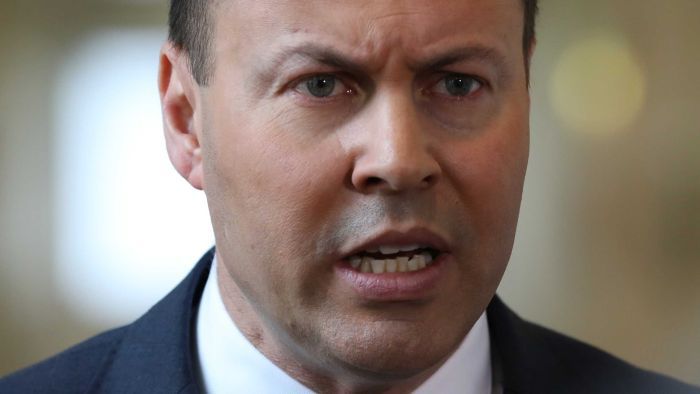
    However, the decision to pass on just 70 per cent of the cut may not go down well with Treasurer Josh Frydenberg, who urged the banks to pass on the benefits of the cut.

    “I think the ANZ has let down its customers. This is deeply disappointing from the ANZ,” Mr Frydenberg said after the RBA decision and ANZ’s response.

    “This rate cut will be welcome news for Australian households and businesses and it will mean lower mortgage costs and lower interest payments.”

    “It is the Government’s expectation, indeed it is the public’s expectation, that banks should pass on, in full, to consumers, the benefits of reduced funding costs as a result of the Reserve Bank’s decision.”

    The RBA also noted that bank funding costs have fully reversed the increases that took place last year.

    The Commonwealth Bank has announced that it will pass on the rate cut in full to all of its standard variable home loans.

    National Australia Bank has followed suit and also announced that it will cut its standard variable rate home loans by 25 basis points.

    Some smaller lenders have also announced that they will pass on the rate cut in full, including Athena, RACQ and Reduce Home Loans.

    RateCity said the lowest ongoing variable rate now stands at just 3.19 per cent.

    Unemployment remains key

    “The board took this decision to support employment growth and provide greater confidence that inflation will be consistent with the medium-term target,” RBA governor Philip Lowe said in the regular post-meeting statement.

    “The main domestic uncertainty continues to be the outlook for household consumption, which is being affected by a protracted period of low income growth and declining housing prices.

    “Today’s decision to lower the cash rate will help make further inroads into the spare capacity in the economy. It will assist with faster progress in reducing unemployment and achieve more assured progress towards the inflation target.”

    While not committing to another move, Dr Lowe’s statement will do little to change perceptions the RBA has not finished lowering rates yet.

    “The board will continue to monitor developments in the labour market closely and adjust monetary policy to support sustainable growth in the economy and the achievement of the inflation target over time,” Dr Lowe concluded.

    The Reserve Bank governor is speaking tonight in Sydney, where he will also take questions about the bank’s first move in nearly three years and the likely future direction of monetary policy.

    RBA glass still ‘half-full’

    RBC’s Su-Lin Ong said, despite the RBA’s still largely optimistic outlook, it is highly likely it will have to cut deeper.

    “A further weakening in the labour market and core inflation that fails to lift will likely trigger further easing. To our mind, both pre-requisites are likely to be met in the coming months,” Ms Ong said.

    “Despite this, today’s statement was balanced and erred somewhat glass half-full.”

    Ms Ong added the extent to which the major banks pass on the full cut to deliver maximum policy traction will be a key determinant for RBA decisions in coming months.

    This content was originally published here.

  • Weird ways tech billionaires are trying to live forever

    Weird ways tech billionaires are trying to live forever

    At least a dozen of the world’s richest men have ploughed millions into bizarre ways to live forever. Here are five of the weirdest.

    IT’S simply not enough for billionaires to have everything they’ve ever wanted – they need eternity to enjoy it, too.

    See and read more

  • Great food, drinks and a Movie!  What is not to like?

    Great food, drinks and a Movie! What is not to like?

    Nothing pairs better with a cold rainy Sunday and a warm baby Loxodonta quite like a Rockaway Nitro Black Gold Stout. About one-third of the way through Tim Burton’s Dumbo, I ordered a second, and as it was delivered to me in the dark, I was struck by the scene where V.A. Vandevere (Michael Keaton)–evil, conniving moneybags and Dreamland amusement park owner–explains to the scrappy, DIY road circus owner Max Medici (Danny DeVito) that of course he should bring his entire operation, airborne pachyderm included, into his opulent fold. Why? Because the future of entertainment is bringing the people to you, not the other way around.

    In the age of streaming and on-demand and bit-torrenting and hyper-speed release cycles and home theaters and even apparently, 1%-ers getting Endgame delivered right to their in-home Imaxes or whatever, there’s a school of thought that where you see a movie doesn’t matter. “I don’t disagree that going to the theater to see a movie is a great experience,” Netflix chief creative officer Ted Sarandos told the press last December. “I don’t think emotionally it’s a different experience than seeing a movie on Netflix. It is a different physical experience for sure.”

    But the “old-fashioned” way of paying money to sit in a windowless room with a bunch of strangers hasn’t diminished at all. In fact, it’s flourishing and the options are growing. The major players like AMC, Regal, and Cinemark dominate, but this new breed of theater is increasingly seen as an opportunity for growth. Last fall, Marcus, the number-four player, acquired the New Orleans-based Movie Tavern chain for $126 million. Dallas’s Studio Movie Grill and Alamo, which is headquartered in Austin, both cracked 2019’s Giants of Exhibition list published by industry analyst Boxoffice, ranking number 13 and 17 respectively. “These types of theaters came up with solutions to problems that for most of the life of cinema, moviegoers didn’t know they had,” says Stephanie Zacharek, film reviewer for Time and a 2015 Pulitzer finalist for criticism while at the Village Voice. “There’s a lot of talk about television and movies morphing into a great blob of entertainment, that there is no difference, and it drives me crazy.” As we saw late last year with the Netflix controversies around whether and how Roma would receive a theatrical release, serious filmmakers want a theatrical release because they want to share their art on a large-screen canvas. And if you can do it in a seat that’s both comfortable and reservable, and where the truffle popcorn can be paired with something quaffable, like say an $85 bottle of Piper-Heidsieck Champagne (as you can at iPic), all the better. “Overall, the movie business is healthy,” says Daniel Loria, editorial director of Box office, which has covered movie theaters since 1920. “What is dying is the standard suburban, cookie-cutter multiplex model, with the tacky carpet and uniform concessions.”

    As someone who has probably averaged two theatrical movies a month for 40-odd years, I wholeheartedly agree. As should already be evident, the current wave of full-services movie houses isn’t solely a New York or Los Angeles phenomenon. It’s happening in underserved markets all across the country at independent single screens and small regional chains, such as Flix Brewhouse, across the Midwest and Southwest where beer is made onsite.

    So how is the theatrical landscape being completely upended by the growth of these places? To find out where we are and where we’re headed in this future of full-service moviegoing, I immersed myself in Gotham’s new cinematic universe–well, within a short jaunt at least–while also exploring a city with a longstanding brew-and-view culture and then going back to where it all began for me, the place central to my filmic evolution–a town starting from scratch.

    source

  • ‘The algorithm is our boss’: Uber drivers face long hours, no benefits and sometimes danger

    ‘The algorithm is our boss’: Uber drivers face long hours, no benefits and sometimes danger

    AT 3 A.M., SONAM LAMA’S ALARM goes off. In his house in Queens, New York, while his wife and baby son sleep, he pulls on his clothes and makes coffee. Then he turns on his Uber app and waits.  On this morning, a warm but windy Tuesday in May, an hour passes without a passenger request. “You’re just thinking, ‘When is the ride going to come? When is the ride going to come?’” the 35-year-old Lama said.  A little after 5 a.m., one does. In a collared, white button-down shirt and khakis, he’s dressed more formally than usual. Later in the day, he’s taking a test for a job with the New York Police Department. He doesn’t want to drive for Uber anymore. “I’m not making a living,” Lama said. “Almost all drivers are looking for work elsewhere.”  The company labels its 3.9 million drivers as independent contractors instead of employees, a distinction that means it isn’t required to provide a minimum wage or paid time off, compensation for overtime or health insurance. And drivers are almost entirely on their own when it comes to the constant expenses of their cars, including insurance, repairs and gas.

    Uber says it offers people a way to work on their own schedule. And while it insists its drivers are not employees, it says it’s committed to providing a support system to them. The company points out that it recently introduced a rewards program, which gets drivers cash back on gas and discounts on car maintenance. Drivers can also sign up for an injury protection plan, in which they’d receive a monthly check should they become injured while working. Perks include tuition assistance at Arizona State University. CNBC spoke with the company’s drivers about how their financial lives are faring.

    source

  • That major Google outage meant some Nest users couldn’t unlock doors or use the AC

    That major Google outage meant some Nest users couldn’t unlock doors or use the AC

    If you’re a Google user, you probably noticed some trouble last night when trying to access Google-owned services. Last night, Google reported several issues with its Cloud Platform, which made several Google sites slow or inoperable. Because of this, many of Google’s sites and services–including Gmail, G Suite, and YouTube–were slow or completely down for users in the U.S. and Europe.

    But an especially annoying side effect of Google Cloud’s downtime was that Nest-branded smart home products for some users just failed to work. According to reports from Twitter, many people were unable to use their Nest thermostats, Nest smart locks, and Nest cameras during the downtime. This essentially meant that because of a cloud storage outage, people were prevented from getting inside their homes, using their AC, and monitoring their babies.

    For Google’s part, the company says a “network congestion issue in eastern USA” was causing the problems and that those issues have now been resolved as of 4 p.m. PT on Sunday. Still, the downtime of their Cloud Platform goes a long way to showing what can happen in an age when smart home technology requires always being connected to the cloud.

  • Occidental seeks edge over Chevron’s bid for Anadarko by sweetening its own offer with more cash | Financial Post

    Occidental seeks edge over Chevron’s bid for Anadarko by sweetening its own offer with more cash | Financial Post

    Occidental Petroleum Corp. moved a step closer to sealing its proposed US$38-billion acquisition of Anadarko Petroleum Corp. after it sweetened its offer and agreed to sell assets owned by the target company.

    Occidental increased the cash portion of its bid to 78 per cent from 50 per cent on Sunday. It also pledged to cover the US$1-billion breakup fee Anadarko would have to pay for abandoning an already-agreed to deal with Chevron Corp., and said Occidental shareholders won’t be required to vote on the takeover.

    The heftier buyout proposal came just hours after French energy giant Total SA agreed to buy operations in four African nations for US$8.8 billion, contingent upon Occidental completing a takeover of Texas-based Anadarko.

    The Total agreement augments billionaire Warren Buffett’s US$10-billion commitment to Occidental, which has faced investor criticism for its unsolicited April 24 offer to best Chevron’s takeover of Anadarko. While Occidental is a storied name in American oil and operates across three continents, it’s just one-fifth Chevron’s market value and its pursuit of Anadarko was seen by some as quixotic.

    Occidental Chief Executive Officer Vicki Hollub, who has been pursuing Anadarko for almost two years, has grown frustrated at the company’s unwillingness to acquiesce to her advances.

    “We remain perplexed at your apparent resistance to obtaining far more value for Anadarko shareholders which has been expressed clearly through our interactions over the last week,” Hollub said in a letter to Anadarko’s board dated Sunday.

    Stunning Rebuff

    Anadarko said in a statement that it will review the revised offer and reaffirmed its existing recommendation to shareholders to accept the Chevron deal.

    The Total agreement may ameliorate concerns that Occidental would take on too much debt and shorten the amount of time the company would be out of the market for share buybacks, said Bill Nygren, chief investment officer of Harris Associates LP, which manages US$120 billion and owns about 3 per cent of Anadarko.

    An Occidental-Anadarko accord would be a stunning rebuff for Chevron CEO Mike Wirth just 15 months into his tenure at the head of the world’s third-largest oil explorer by market value. Sunday’s emergence of Total as an Occidental ally pits two of the world’s supermajor oil drillers on opposite sides of the industry’s biggest takeover battle in years.

    Gulfstream V

    Hollub has pursued Anadarko amid on-and-off talks since late 2017, to no avail.

    In an apparent acknowledgment that more was needed to get the deal across the line, Hollub flew to Omaha, Nebraska, on April 28 to visit Buffett. The legendary investor announced two days later he had agreed to pay US$10 billion in exchange for a slug of Occidental preferred stock and warrants, contingent on a successful takeover of Anadarko.

    “With the OXY deal looking safer for APC to accept, I’d say this may force CVX to match the OXY bid or lose out on these terrific assets,” Nygren said in an email, referring to the stock tickers of the suitors and target.

    Icahn Arrives

    At the heart of the tug-of-war over Anadarko is a fight for supremacy in the Permian Basin, the world’s largest oil patch. Chevron announced an ambitious, multibillion-dollar plan earlier this year to boost its fracking activities in the region, and buying Anadarko would turbo-boost its Permian growth. For Occidental, the deal is about securing its position as the dominant producer in the basin.

    Buying Anadarko would be the biggest oil industry deal in four years and mark an end to an era of austerity among explorers chastened by a decline in crude prices and chastised by investors for poor returns. The pressure on Occidental and Chevron shares in the past two weeks showed investors were worried the industry was returning to the old ways, when profligate spending and bold deals were de rigueur.

    Indeed, the controversy stirred up by Occidental’s bid appears to have attracted another interloper. Billionaire activist investor Carl Icahn has built a small stake in the company, people familiar with the matter said on May 3.

    What Bloomberg Intelligence Says

    “Carl Icahn’s minor Occidental Petroleum stake may not be enough to reframe the debate over Anadarko, even as some shareholders remain skeptical of both the deal’s impact and the costs Berkshire extracted to help finance it. We believe Icahn is making a push to sway the outcome, as he has a stake in the Permian, Occidental’s prime motivator in pursuing Anadarko. Icahn inherited a position in Diamondback Energy, a midsized Permian E&P firm, through its purchase of Energen, a holding he initially pushed to seek alternatives. If Icahn can derail Occidental’s bid for Anadarko, the former would pursue a better-fitting, more digestible E&P target with a stronger concentration in the basin.” — Vincent G. Piazza, senior industry analyst, and Evan Lee, associate analyst

    Occidental shares rose in after-market trading on Friday after the news of Icahn’s involvement, signalling that fresh doubt about the deal’s prospects was a positive catalyst for investors. On Monday, following the Total accord and the revised takeover offer, they had erased those gains and were down 1.6 per cent. Anadarko rose as much as 2.4 per cent to US$74.50. Chevron was unchanged.

    Four Days

    Anadarko doesn’t just operate in the Permian, and both bidders face being saddled with unwanted assets — Chevron has also said it will sell off billions of dollars of operations post merger.

    The Total deal means the French company will take on oil operations in Ghana, Algeria and South Africa, as well as a massive liquefied natural gas project in Mozambique. Total is already a major player in LNG while Occidental has no current involvement in that market and had already indicated that it was looking to sell the facility.

    Investors now await a decision from the Anadarko board. Having previously rebuffed proposals from Occidental for more than a year, Anadarko agreed to start negotiations with the company even before the cash portion was lifted late Sunday. If Anadarko recommends a merger with Occidental, Chevron will have four days to make a counter offer or walk away.

    –With assistance from Kevin Crowley.

    This content was originally published here.
  • Google still plans to cripple ad-blocking in Chrome, but enterprises will be exempt | ZDNet

    Google still plans to cripple ad-blocking in Chrome, but enterprises will be exempt | ZDNet

    Google needs to break up its all-or-nothing approach to permissions Want to play a YouTube clip on a Google Home Hub? You better have handed over your Chrome web history.

    Google has clarified proposed changes to the Chrome browser that some developers fear will cripple ad blockers and revealed an exemption for enterprise users.

    Back in January, Google angered developers of ad blocker Chrome extensions over planned changes to Chrome’s webRequest API that could harm existing extensions. The proposal, outlined in a draft of Google’s Manifest V3 document about the future of Chrome extensions, potentially affects ad blockers, security extensions, parental control enforcement, and various privacy-enhancing services. 

    Google planned to change the webRequest API in a way that would stop existing permitted behavior that allowed ad-blocker extensions to “intercept network requests to modify, redirect, or block” API requests. Instead, the webRequest API would be reduced to an “observational” role, making it a tool for passive, rather than active, interaction by extensions. 

    “Chrome is deprecating the blocking capabilities of the webRequest API in Manifest V3, not the entire webRequest API (though blocking will still be available to enterprise deployments),” wrote Vincent. 

    “Extensions with appropriate permissions can still observe network requests using the webRequest API. The webRequest API’s ability to observe requests is foundational for extensions that modify their behavior based on the patterns they observe at runtime.”

    Vincent’s further descriptions illustrate the Manifest V3 document is still subject to change. 

    “Chrome is not deprecating <all_urls> in Manifest V3, but we are changing how it works. Our primary motivation here is to give end-users more control over where extensions can inject themselves. The current extension installation flow allows developers to declare that they require access to a given set of hosts and the user must choose whether to grant all required permissions or cancel the installation. We are planning to modify the install flow so the user will be able to choose whether or not they want to grant the extension the ambient host permissions it requested. We’re still iterating on the updated UI and will share additional details once this lands in Canary [the experimental build of Chrome where Google tests new features].”

    techrepublic cheat sheet

    Raymond Hill, the developer of uBlock Origin and uMatrix who raised concerns about the changes in Manifest V3, still has some objections to the revised proposal, in particular with Google’s claim that it can’t provide a definitive answer on the status of the webRequest API until it runs further performance tests. 

    “The blocking ability of the webRequest API is still deprecated, and Google Chrome’s limited matching algorithm will be the only one possible, and with limits dictated by Google employees,” wrote Hill

    “It’s annoying that they keep saying “the webRequest API is not deprecated” as if developers have been worried about this — and as if they want to drown the real issue in a fabricated one nobody made.”

    In his view, sluggish web page loading is due to Chrome “bloat” rather than the performance of the API itself for “well crafted extensions”.  

    Hill also argues that to improve performance, Google should just follow Mozilla’s approach in its Firefox browser.  

    “If performance concerns due to the blocking nature of the webRequest API was their real motive, they would just adopt Firefox’s approach and give the ability to return a Promise on just the three methods which can be used in a blocking manner.”

    This content was originally published here.