Author: Truth & Hammer

  • What Is A Solar Generator & How It Works..Best Portable Solar Generators For Survival Emergencies

    What Is A Solar Generator & How It Works..Best Portable Solar Generators For Survival Emergencies

    Great Portable Solar Generators For Survival Emergencies


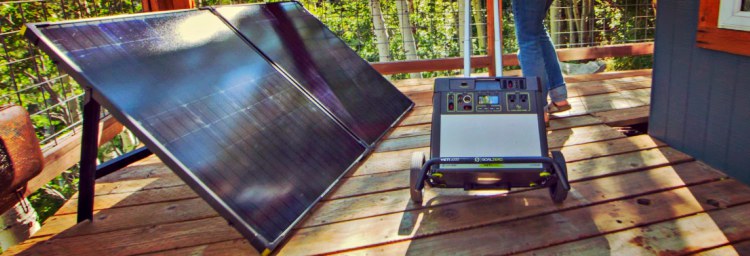
    Solar Panel and Portable Solar Generator Setup On A Deck


    A solar generator consists of 2 main components:

    1. Solar panel
    2. Portable power generator

    1 – Solar Panels

    Solar panels are the technology that converts sunlight into electricity.

    They do this by using the sunlight to knock electrons free from atoms. This knocking free of electrons generates a flow of electricity.

    Or more simply put, the sun’s energy excites molecules which creates a flow of electricity. If you get that, that’s all the technical understanding you need.

    The bottom line is solar panels turn sunlight into DC power.

    Here’s a short video explaining of how solar panels convert the sun’s rays into electricity.

    2 – Portable Power Generator

    A portable solar power generator is also made up of two main components

    1. Inverter
    2. Battery

    The inverter turns the DC power from the panel into more usable AC power.  Solar generators also include a storage battery. That way, if any of the power captured by the panels is not being used, you don’t lose that power. Instead, it becomes potential energy stored in the battery for later use. The battery ensures there’s power available in an emergency. Solar generators also include various power outlets. These are like power outlets in your home. They allow you to plug electrical cords, power tools or appliances into the generator.

    Recharging Is Not Instantaneous

    It takes time for a solar panel to recharge a battery. Solar panels are not an on and off device. The power they capture fluctuates based on the power of the sun. Solar panels are affected by the angle of the sun to their surface. If you set your panel in a fixed position and let the sun move across the sky, you’ll get a curve of power production. It will start out small, ramping up to peak, hold peak power conversion for a while, and then back down to zero. The hope is you can produce enough power over this time to run your appliances and charge by solar your battery. Then use the stored backup battery power from sundown to sun up (overnight). Again, you’ll have to look at the appliances you need and how often to use them. This is all about smart power supply management! Of course, the more panels you have, the more power you can produce in a given time frame. But if you charge your battery too quickly, you’ll need more batteries to store any excess energy. But expansion is not always as simple as buying more panels or batteries.

    Many Units Cannot Be Easily Expanded

    Components in the ready-made solar generators are not typically designed for easy expansion. When you buy a ready-made portable solar generator, you can’t easily upgrade the inverter. You can’t add a bigger battery (at least not internally). Nor can you increase the photovoltaic surface area or install a better inverter. Some models do allow you to add more solar panels to increase the speed of recharging. But eventually, you’ll hit the upper limit of the inverter in a ready-made generator. So for the most part, you get what you get with a ready-made solar powered generator. If this is a big concern of yours, you should check out some DIY solar generator options (covered later).

    Repair Can Be Difficult

    Solar panels and power generators are not devices that are simple to repair. They take unique components and serious expertise to fix. In the case of solar panels, it’s typically more cost effective to buy new ones as opposed to trying to repair them. Fortunately, newer solar panels are extremely durable and are difficult to break. Most of the ones built nowadays can even handle extreme hail storms. So the odds are low that you’d need to repair a portable solar generator repair. But if you do, it’s not going to be as easy as changing a tire or replacing wiper blades.

    Goal Zero Yeti Lithium Portable Power Station

    The Goal Zero Yeti is an excellent solar powered generator. But most of these models don’t come with a solar panel (sold separately).

    They have several models and sizes to choose from:

    So while the Yeti 3000 has more power capacity but also costs more money. But the Yeti 400 is more affordable and more suited for smaller devices and tasks.

    All the units include two AC outlets (300W continuous, 1200W surge), three 2.4A USB ports, and two 12V output ports.

    The weight of each unit varies based on the model but ranges from 17 lbs for the 400 series up to 75 pounds for the 3000 series.

    Order your Portable Power Station here

  • The Glory premium class greenhouse is the right answer for the gardening prepper

    The Glory premium class greenhouse is the right answer for the gardening prepper

    Click here to order


    The Glory premium class greenhouse is the right answer for the gardening enthusiast. The gray powder-coated aluminum frame and 10mm thick polycarbonate panels make this a professional grade greenhouse that can be heated and/or cooled for year-round usage.

    The side louver window and roof vent allow proper air flow for the ideal temperature to keep plants healthy. The heavy-duty door is over 31 Inch wide and can be locked. The door threshold allows easy access for wheelchairs or wheelbarrows. The gutter system will allow you to collect fresh rainwater for your plants.

    • 10 mm twin wall roof and side panels – polycarbonate panels are virtually unbreakable and blocks 99.9% of harmful solar UV rays
    • Robust gray powder-coated aluminum frame provides a durable, stronger and corrosion resistant structure
    • 64 square feet growing space and 8.8′ of head room
    • Includes a roof vent with automatic vent opener, side louver window, plant hangers, integrated rain gutters, threshold ramp, galvanized steel base and ground anchoring system
    • Includes a heavy duty door 31.7 Inch wide that is lockable
    • This is an O.E.M. part

    ORDER FROM AMAZON HERE

  • 5 Low-Water Lawns That Stay Green Under Pressure

    5 Low-Water Lawns That Stay Green Under Pressure

    There’s nothing quite like a lush, green grass lawn. Although the year’s dry winter has many homeowners switching to grass-free yards, those low-water alternatives don’t always hit the spot when what you want is soft green turf.

    If you love your grass lawn, but don’t love the constant watering, then you need to check out these five grass lawn varieties. Suitable for every area of the country, these grasses are specially designed to stay thick and green with little to no watering, mowing, or fertilizing.

    Take advantage of warming temperatures and spring rain to overseed your lawn with these varieties now. By summertime, you’ll be enjoying green grass without care.

    1. Eco-Lawn

    Developed from a mix of native fine fescue grasses, Eco-Lawn is the most versatile low-water turf lawn variety. Once established, you can almost forget about it: it doesn’t require regular mowing to stay green, and only needs to be watered during extremely dry periods, if at all.

    Eco-Lawn grows well in bright sun, the dappled shade cast by trees, and the deep shade cast by fences and neighboring buildings. Underplant it with spring bulbs and wildflower seeds for a windblown meadow look, or mow it regularly for a traditional-looking lawn.

    2. Pearl’s Premium

    Once established, Pearl’s Premium grass seed develops roots that extend a foot or more into the ground, making the turf extremely drought-tolerant. Water this lawn once a month or less, and it will still grow a thick, verdant green. This hardy grass also grows slowly, so you only need to mow every month or so.

    3. Fleur de Lawn

    The secret to Fleur de Lawn‘s extraordinary hardiness is its mix of grass and low-growing clover. Clover fixes nitrogen from the air into the soil, which fertilizes the grass and keeps it green year-round; the clover also acts as a “weed you want”, crowding out undesirable plants such as dandelions and crabgrass.

    In addition to these practical perks, clover also adds a sprinkling of color to your lawn in the spring and summer, making this mix perfect for rustic or country-style homes.

    4. UC Verde Buffalo Grass

    Developed by researchers at the University of California, UC Verde Buffalo Grass was designed to withstand hot, dry weather with 75% less watering than traditional turf grasses. UC Verde can be allowed to grow for a tufty, flowing lawn, or mowed every few weeks for a hardy turf lawn perfect for running, playing, and foot traffic.

    UC Verde does best in temperate zones that with winters that stay above 20 degrees and summers that stay below 90 degrees, and will grow best in full-sun areas.

    5. Bluestem Enviro-Turf

    Enviro-Turf is a hardy fescue mix that looks just like a traditional turf lawn but only needs to be mown and watered every couple of weeks. This type of low-water lawn will work best in dry sites with good drainage and has the added bonus of being naturally richer in color than most turf grass lawns.

    Disclaimer: This article is originally posted on Porch. All rights belong to the owner and no copyright infringement is not intended. Contact us if you own this article and want to take this article out of our blog including the backlink on our site. Thank you very much!

    This content was originally published here.
  • Elderly Japanese Women Live in the World’s Most Enchanting Retirement Home

    Elderly Japanese Women Live in the World’s Most Enchanting Retirement Home

    To be in our golden years only means one thing – spending the rest of our lives in a retirement home. Getting old is inevitable and we will retire sooner or later. So, we might as well prepare for that day and plan how we’re going to spend our retirement years. If only we’re living in Japan, we won’t mind spending our lives in a retirement home. One look at this enchanting retirement home would make you want to hit retirement now. From afar, these tent-like structures look like dwarf houses in a fairy tale. But these teepee-like buildings are actually homes for elderly women. The enchanting retirement home, named Jikka, was designed by a Tokyo-based architect Issei Suma and was completed in 2015. It is located on top of a flattened mountain ridge in Shizuoka, Japan and comprised of five charming huts. The 100-square-meter dwelling was initially built for two elderly women – a retired social worker and a former cook. Today, the enchanting retirement home also serves as a hospice care for the elderly and sick. Concrete and timber are used to construct the huts. And if you think the exterior design is astounding, wait till you see the interior. It has a living room, bedroom, dining area, kitchen, and bathroom. Additionally, it has a spiral-shaped pool to assist elderly in a wheelchair to take a dip. This enchanting retirement home is surrounded by trees and mountains, giving the residents that much-needed connection with nature. But inside the homes are modern amenities to provide relaxation like no other. Jikka, an enchanting retirement home in Shizuoka, Japan Source: Awesome Inventions

    This content was originally published here.

  • As migrants arrive in Texas from the Congo Africans can carry Ebola without showing any symptoms

    As migrants arrive in Texas from the Congo Africans can carry Ebola without showing any symptoms

    (Natural News) It is a medical fact that people of African descent have enhanced natural immunity to various viral infections, including Ebola. In fact, migrants from Africa may carry Ebola and show no symptoms whatsoever. This simple, irrefutable fact appears to be completely unknown to all U.S. doctors, journalists and CDC “experts” who claim Ebola can’t possibly be carried to the U.S. from Congo because, they often explain, nobody is showing any symptoms.

    Yet it is a well-known medical fact that Ebola carriers from Africa may be entirely symptom-free. If you don’t believe me, go back to the June 27, 2000 article in the New York Times, authored by Lawrence K. Altman. The headline is, “People Carrying Ebola, in Some Cases, May Be Free of Symptoms.”

    “The Ebola virus… can also infect without producing illness, according to a new finding by African and European scientists,” reported the NYT. “They found that the Ebola virus could persist in the blood of asymptomatic infected individuals for two weeks after they were first exposed to an infected individual. How much longer the virus can persist is unknown.”

    Citing a study published in The Lancet and authored by Dr. E. M. Leroy, the NYT continues:

    Scientists have known that Ebola usually spreads from an infected person to another individual and through contamination in clinics or hospitals. The new finding suggests that some cases may result from healthy carriers. How often is unknown.

    Dr. Leroy’s team said another public health concern was transmission of Ebola virus from healthy carriers through sex. Other scientists have detected Ebola in semen.

    Yes, Ebola virus can live in human semen. This simple fact is completely denied by the entire fake news “establishment” media, even when the NYT openly admitted it in 2000. That’s the whole point of the indy media news censorship you’re seeing today across the ‘net; to silence real facts while pushing a fake news narrative that’s built on fictions rather than reality.

    Fiction = “No one from the Republic of Congo could possibly be carrying Ebola, or they would be showing symptoms.”

    FACT = Scientists documented symptom-free carriers of Ebola nearly twenty years ago, and the virus can be carried for years in blood and semen.

    Twenty-five people from Congo carried Ebola and showed no symptoms at all

    Also from the NYT:

    Dr. Leroy’s team studied 25 individuals who never developed symptoms although they lived with family members and cared for them without using gloves and other precautions in two outbreaks in Gabon in 1996.

    Using standard virologic techniques, the scientists from Gabon, Germany and France said they could not detect the virus in the blood of the healthy contacts. But Dr. Leroy’s succeeded by using a technique known as polymerase chain reaction to grow the tiny amount of virus present.

    In other words, some people from the Congo are able to carry Ebola for life while showing no symptoms whatsoever. But the virus is present in their blood and can be replicated using standard PCR techniques. This means the virus might also be quite capable of infecting others.

    Another study published in the Journal of Infectious Diseases in 2004, also by Dr. Leroy, documented the fact that chimpanzees can carry Ebola infections without suffering Ebola fatalities. “[C]himpanzees are continuously in contact with the virus; and nonlethal Ebola infection can occur in chimpanzees,” Dr. Leroy and co-authors write in the abstract of the study. (J Infect Dis. 2004 Dec 1;190(11):1895-9. Epub 2004 Nov 3.)

    Republic of Congo migrants being dumped all across America

    No media outlet has done more reporting on this alarming phenomenon than Infowars, which sent numerous reporters to San Antonio to interview doctors and city officials who were running the temporary shelters and distribution hubs. There, after intermingling in a shoddy indoor environment that would be perfect for spreading Ebola, migrants from the Congo were loaded onto buses and shipped off to other parts of the country.

    Not even the San Antonio city officials knew where the migrants were headed.

    See some of Infowars’ reporting here:

    The World Health Organization (WHO) has decided not to declare an international health emergency over the Ebola epidemic in the Democratic Republic of Congo that has now spread to Uganda, the organization announced Friday.

    WHO’s announcement comes only days after Infowars exclusively documented the hundreds of unvetted Congolese migrants being bused into San Antonio, Texas, which the mainstream media still refuses to cover.

    Shock video: Watch illegals from Africa fleeing Ebola-stricken Congo who made it across the Rio Grande river a week ago arrive at a city-owned shelter in San Antonio and then being distributed by bus and van to undisclosed locations across The United States.

    Hundreds of illegal aliens from the Democratic Republic of Congo in Africa, which is currently experiencing a massive Ebola virus outbreak, have been dropped off in San Antonio, Texas and hundreds more will arrive in the near future.

    After being placed in San Antonio, the illegal immigrants are bussed to a destination of their choice by local charities who spend “roughly $14,000 a week on bus tickets.”

    Infowars reporter Owen Shroyer physically visited the facility in San Antonio and interviewed a doctor / city official there who falsely claimed that the risk of Ebola in the migrants was “zero.” Her logic? She said Ebola always had a 21-day incubation period, and since these migrants had been “walking across Mexico” for more than 21 days, they could not possibly be infected.

    Her math expresses a gross error, of course. An infected migrant could have passed the infection to a healthy person before dying themselves. That healthy person could be carrying Ebola right now, in day 10 of the incubation for example, ready to explode with Ebola in another week or so after being transported across America. And if the recipient of that new infection has natural immunity against Ebola, they could be a symptomless carrier, meaning they would never show symptoms but might still infect others.

    The fact is: There is a greater-than-zero risk that migrants from the Republic of Congo may be carrying Ebola into the United States right now. The fact that these migrants are being distributed across America to seemingly random cities is beyond merely insane… it smacks of an attempted infectious disease assault on this nation.

    Amazingly, nobody seems to know whether these migrants have ever been screened for Ebola at all.

    Watch some of the coverage in these videos, and check both NaturalNews.com and Infowars.com for daily updates.

    See Brighteon.com for new videos each hour:

    This content was originally published here.

  • ‘Battle of the Thermostat’: Cold Rooms May Hurt Women’s Productivity

    ‘Battle of the Thermostat’: Cold Rooms May Hurt Women’s Productivity

    It is a truth universally acknowledged — or at least, much discussed on social media — that a woman who works in an office is in want of a sweater.

    Office air conditioning is often set at a temperature that women find chilly; the resulting water-cooler debate has been called the “battle of the thermostat.” One study even suggested that because women have slower metabolic rates, the formula used to set temperatures in workplaces, which was developed decades ago based on the comfort of men, may overestimate women’s body heat production by 35 percent.

    A question that hasn’t been asked much, however, is whether temperature affects the productivity of men and women differently. In a study published Wednesday in the journal PLOS One, researchers reported that at colder temperatures, men scored higher than women on verbal and math tests. But as a room grew warmer, women’s scores rose significantly. The findings require further confirmation under an assortment of conditions. But they add to a scientific rethinking of the spaces where we work and study, which sometimes have been devised with a limited set of physical requirements in mind.

    [Like the Science Times page on Facebook. | Sign up for the Science Times newsletter.]

    The researchers asked more than 500 college students to take tests for an hour in rooms with temperatures between 61 and 90 degrees Fahrenheit. The students performed as many simple math problems (without the help of a calculator) as possible, and rearranged a set of letters into as many words as they could, within a time limit. They also were asked to solve a series of tricky logic problems.

    The temperature had no effect on the scores when they were considered as a group. But when the researchers split the data between male and female subjects, a clear pattern emerged. Scores on the logic problems did not vary as temperatures changed, but the math and verbal test scores did.

    This content was originally published here.

  • Fossilized Cannabis Reveals The Plant is 27.8 Million Years Old

    Fossilized Cannabis Reveals The Plant is 27.8 Million Years Old

    The fascinating evolution of the original land race cannabis plant. 

    The cannabis market has exploded, and as growers learn more about using genetics to their advantage, a wide variety of strains have emerged. With just a quick look online or at your local dispensary, you’ll find hundreds of modified breeds for every possible occasion.

    But all this variety has its origins somewhere. Actually, we can trace all cannabis strains to a small number of original cannabis plants known as landrace strains.

    What Exactly is a Landrace Strain?

    A landrace is essentially an isolated plant that has not been crossbred with other cannabis varieties. They tend to be indigenous to specific regions, and developed their particular qualities as the strain adapted to their unique environment.

    As such, landrace strains are often named in accordance with their region: Pure Afghan, Durban Poison, Panama Red, and so on.

    cannabis, landrace, strains, landrace strains, medical cannabis, benefits, qualities, recreational cannabis, genetics, crossbreeding

    Cannabis historians believed landrace strains originated in Asia.

    Landrace really only refers to the genetic purity of a cannabis strain. Landrace strains won’t necessarily produce a better product. In fact, the reason there are so many crossbred strains on the market is that breeding a plant for a specific trait ensures a specific, quality finished product.

    Being genetically closer to the original wild cannabis species is really the main drawcard for landrace strains. They hold particular intrigue for historians, scientists, and purists.

    “Clocking” the Age of Cannabis

    Scientists have long searched for cannabis’s origin. Or, at the very least, for the original wild landrace strain of this infamous medicinal plant. Common thought placed the original plant in locations across Asia. However, scientists weren’t so sure of the precise original location.

    That was until recently when a study of fossilized pollen found the location of the first cannabis species.

    Accurately determining when and where cannabis evolved was extremely difficult due to the lack of a strong print fossil record – impression of leaves or fruits in rocks. For a plant, like cannabis, that lacks a good fossil record, paleobotanists can use a “molecular clock”. This allows them to estimate when cannabis and its sister species Humulus (hops) diverged from a common ancestor. The molecular clock uses DNA to measure time, and calibrates the clock with fossil dates of related plants.

    Using this method, they estimated that cannabis first diverged from a common ancestor 27.8 million years ago.

    cannabis, landrace, strains, landrace strains, medical cannabis, benefits, qualities, recreational cannabis, genetics, crossbreeding

    Hops and cannabis derive from the same common ancestor.

    Once researchers had figured out when cannabis first diverged from a common ancestor, the question of where still remained. Paleobotanists then turned to microfossils, such as fossilized pollen, to fill in the records. They found that pollen from the closely related cannabis and hop plants are almost indistinguishable.

    To overcome this problem, scientists realized that because cannabis typically grows in open grasslands, and hops grow in forests, the pollen could be classified by identifying other plants that commonly occur alongside it. Researchers used plants that are typically seen in open grasslands to identify the fossilized pollen as cannabis.

    How Scientists Dated and Located Fossilized Cannabis Pollen

    Fossilized pollen is usually used to date the layer in which it is found, which tells a lot about the environment at the time. However, in this case, the pollen was the unknown. Researchers aged it with radiocarbon dating.

    Radiocarbon dating measures the amount of radiocarbon (C14) left in a fossilized animal or plant. C14 degrades at a known rate, and so by testing the amount of C14 left in a fossil, its age can be accurately calculated.

    By using this analysis, the oldest fossilized cannabis pollen was located in the Ningxia Province, China. Researchers dated the pollen at 19.6 million years old. But with cannabis diverging 27.8 million years ago, this date wasn’t close enough.

    Further research of the region and tracking of a plant called Artemisia, which has a close alliance and parallel evolutionary pattern to cannabis, pinpointed the northeastern Tibetan Plateau as the cannabis center of origin. At the time, the Tibetan Plateau created an environment that supports the theory that cannabinoids developed to protect the plant from UV rays and herbivores. These are both issues in the high altitude, open grassland Tibetan Plateau.

    cannabis, landrace, strains, landrace strains, medical cannabis, benefits, qualities, recreational cannabis, genetics, crossbreeding

    Cannabis stems from a single location on the Tibetan Plateau.

    Further Landrace Strains

    Fossil pollen records tell us that cannabis dispersed into Europe 6 million years ago. Then later East into China 1.2 million years ago. By mapping the distribution of pollen over time, scientists were able to see that European cannabis went through repeated genetic bottlenecks.

    Following the warm and wet Holocene period, forests replaced open grasslands. Cannabis retreated to the small pockets of open space that it could inhabit. In these small and isolated areas, the population of cannabis shrank. These separated cannabis populations then evolved differently, eventually creating the separate and distinct landrace strains of the European-evolved sativa and the Asian-evolved indica.

    By tracing cannabis evolution back to a single location on the Tibetan Plateau millions of years ago, we have uncovered the site of the original cannabis landrace strain. Over thousands of years, the original cannabis strain moved across continents, becoming isolated in certain areas.

    The original landrace strain had to then develop to new conditions, eventually leading to a variety of landrace strains. Each developed unique geno-phenotypical characteristics reflective of adaptations provoked by their local environment. And these ancient strains have become the mythologized landrace strains that we idolize today.

    The post Fossilized Cannabis Reveals The Plant is 27.8 Million Years Old appeared first on RxLeaf.

    This content was originally published here.

  • Tormented Robot Pulls a Gun on Its Creators in Boston Dynamics Spoof

    Tormented Robot Pulls a Gun on Its Creators in Boston Dynamics Spoof

    Boston Dynamics has made a name for itself building incredibly agile and skillful robots, its steady stream of demonstration videos never failing to impress. And scare us a little, too.

    A number of the team’s YouTube clips show its growing stable of robots performing a variety of feats while at the same time being shoved with a hockey stick wielded by one of its creators. Or simply kicked.

    It’s never clear if the assaults are designed to show off the robot’s nimbleness, or used merely as a way for stressed employees to blow off steam. Either way, the eager mistreatment recently inspired a team of Los Angeles video wizards to create a spoof based on Boston Dynamics’ own videos. And the result is hilarious.

    Corridor Digital launched in 2010 and has made a name for itself producing viral short-form videos, some of which have picked up awards. The team also produced and directed the Battlefield-inspired web series Rush and the YouTube Red series Lifeline, and have created TV commercials for various companies, Google among them.

    Like any good spoof, Corridor Digital’s efforts emulates the original and then takes it up a notch. In it, we see the “Bosstown Dynamics” robot – clearly based on Boston Dynamics’ Atlas bot— performing various tasks such as passing boxes and balancing on blocks.

    Similar to the original videos, we see one of two guys kick the robot before whacking it with a hockey stick. He then uses the stick to push the box out of reach of the robot, prompting it to adjust its movements in a bid to pick it up. As the video goes continues, the two guys torment the robot to such an extent that you actually start to feel sorry for the machine taking that’s taking the hits.

    But it’s the increasing absurdity that brings the laughs, leading to a finale you’ll find either amusing or chilling, depending on where you think we’re heading with robot technology.

    Hardly surprisingly, the video quickly went viral on social media, with many people tricked into thinking the robot was real. Considering the kind of advances made in recent years by Boston Dynamics, that’s kind of understandable. But watch until the end and you’ll get the first clue as to how it was made.

    Corridor Digital also posted a separate video showing the effort it took to create its computer-generated robot, and some of the challenges it had to overcome to produce the video.

    Boston Dynamics’ stellar work, along with its penchant for beating up robots, has inspired plenty of spoof videos over the years. Here are some more.

    This content was originally published here.

  • Earth Is Moving Toward The Same Meteor Swarm That Scientists Believe Caused The Tunguska Explosion Of 1908

    Earth Is Moving Toward The Same Meteor Swarm That Scientists Believe Caused The Tunguska Explosion Of 1908

    Over the next several weeks, our planet will have a close encounter with the Taurid meteor swarm.  It will be the closest that we have been to the center of the meteor swarm since 1975, and we won’t have an encounter this close again until 2032.  So for astronomers, this is a really big deal.  And hopefully there will be no danger to Earth during this pass, but some scientists are absolutely convinced that the Tunguska explosion of 1908 which flattened 80 million trees in Russia was caused by an object from the Taurid meteor swarm.  As you will see below, the last week of June will mark the point when we are the closest to the center of the meteor swarm, and so that will be when the risk is the greatest.  According to CBS News, our planet “will approach within 30,000,000 km of the center of the Taurid swarm” by the end of this month…

    This summer, Earth will approach within 30,000,000 km of the center of the Taurid swarm, the study says. That would be Earth’s closest encounter with the swarm since 1975 and the best viewing opportunity we’ll have until the early 2030s.

    30 million kilometers may sound like a great distance, but in astronomical terms that is not very far at all, and it is important to remember that distance is measured from the exact center of the meteor swarm.

    And there are some scientists that are convinced that giant rocks from this meteor swarm have been responsible for multiple “once-per-1,000-years catastrophic events on Earth” in the past.  The following comes from Forbes

    The remnants of a comet. As Earth orbits the Sun, its orbital path often goes through dust and debris left by comets, with matter no bigger than a grain of sand busting into Earth’s atmosphere and burning up as “shooting stars”. Mostly, they’re harmless, but the Taurid swam is an exceptionally large cloud of debris, probably from Comet 2P/Encke, that scientists think may be responsible for some once-per-1,000-years catastrophic events on Earth. The Taurid complex-giant comet hypothesis proposes that a giant comet fragmented in the inner solar system, producing dust and small Near-Earth Objects (NEOs), including 2P/Encke and other asteroids, still present today. Among the observational evidence is increased “fireball” shooting star activity when Earth gets close to the “Taurid Swarm”, and increased impacts on the Moon.

    In particular, it is now widely believed that the enormous object that exploded over Russia on June 30th, 1908 was from the Taurid meteor swarm.

    If you are not familiar with the Tunguska event, here is some excellent information about it from Wikipedia

    Early estimates of the energy of the air burst range from 10–15 megatons of TNT (42–63 petajoules) to 30 megatons of TNT (130 PJ),[7] depending on the exact height of burst estimated when the scaling-laws from the effects of nuclear weapons are employed.[7][8] However, modern supercomputer calculations that include the effect of the object’s momentum find that more of the energy was focused downward than would be the case from a nuclear explosion and estimate that the airburst had an energy range from 3 to 5 megatons of TNT (13 to 21 PJ).[8]

    The 15-megaton (Mt) estimate represents an energy about 1,000 times greater than that of the atomic bomb dropped on Hiroshima, Japan—roughly equal to that of the United States’ Castle Bravo (15.2 Mt) ground-based thermonuclear detonation on 1 March 1954, and about one-third that of the Soviet Union‘s Tsar Bomba explosion on 30 October 1961 (which, at 50 Mt, is the largest nuclear weapon ever detonated).[9]

    It is estimated that the Tunguska explosion knocked down some 80 million trees over an area of 2,150 km2 (830 sq mi), and that the shock wave from the blast would have measured 5.0 on the Richter magnitude scale.

    It is interesting to note that the Tunguska event happened during the last week of June in 1908, and right now researchers are telling us that the last week of June this year “will be the next occasion with a high probability for Tunguska-like collisions or near-misses”

    Researchers from the Universities of New Mexico and Western Ontario warn we could be in for a similarly catastrophic event.

    “If the Tunguska object was a member of a Beta Taurid stream, then the last week in June 2019 will be the next occasion with a high probability for Tunguska-like collisions or near-misses,” the researchers wrote in a recent paper.

    Of course nobody is saying that something will happen during that time.

    It is simply a time when there is a heightened risk, and we should all be hoping that absolutely nothing happens.

    However, we should not completely dismiss this threat either.  A couple of years ago, scientists discovered a “new branch” of the meteor swarm that contains “asteroids up to 1,000 feet wide”

    Scientists have discovered a new branch of the Taurids meteor stream that could pose a major risk to Earth, with asteroids up to 1,000 feet wide flying past us every few years.

    If a 1,000 foot asteroid hit our planet tomorrow, we would be talking about the sort of civilization-changing event that I have been warning about for a very long time.

    But once again, it is probably not likely that something will happen over the next few weeks.

    In fact, scientists tell us that it is far more likely that there will be some sort of impact in 2032

    In November 2032, Earth will pass through the Taurid Swarm, a cloud of debris from Comet 2P/Encke that makes brilliant fireballs when its gravelly particles occasionally hit Earth’s atmosphere. Previous encounters with the Swarm in 2005 and 2015 produced showers of bright meteors observed around the world; in 1975 the Swarm contacted the Moon, making Apollo seismic sensors ring with evidence of objects hitting the lunar surface. If forecasters are correct, we’re in for similar activity 13 years from now.

    In the end, we simply do not know when the next catastrophic meteor impact will happen, but scientists assure us that they will keep on happening.

    Giant rocks go whizzing by our planet on a continual basis, and much of the time we do not even see them until they have already passed us.

    So we may get some advance warning before a civilization-killing rock hits us someday, but then again, we might not.

    About the author: Michael Snyder is a nationally-syndicated writer, media personality and political activist. He is the author of four books including Get Prepared Now, The Beginning Of The End and Living A Life That Really Matters. His articles are originally published on The Economic Collapse Blog, End Of The American Dream and The Most Important News. From there, his articles are republished on dozens of other prominent websites. If you would like to republish his articles, please feel free to do so. The more people that see this information the better, and we need to wake more people up while there is still time.

    This content was originally published here.

  • The Queen makes an appearance at the Cartier Polo Cup final in Windsor  

    The Queen makes an appearance at the Cartier Polo Cup final in Windsor  

    The Queen brightened up an otherwise miserable afternoon as she attended the Cartier Queen’s Polo Cup final in Windsor today. 

    Her majesty, 93, opted for a hot pink coat and matching hat complete with rose detail as she made her way to the prestigious event. 

    But she wasn’t the only Queen to make an appearance as Jenna Coleman, who played Victoria in the hit ITV series of the same name, was also in attendance. 

    The actress, 33, stunned in a glittering floral midi dress as she was joined by Poldark star, Eleanor Tomlinson, 27. 

    Pretty in pink: The Queen (pictured) attended the Cartier Queen’s Cup final in Windsor, the polo competition takes place every year between May and June 

    Her Majesty, 93, wasn’t the only Queen to make an appearance as Jenna Coleman, who played Victoria in the hit ITV series of the same name, was also in attendance

    All the flowers: Victoria actress (pictured right in the ITV drama series) Jenna Coleman (pictured left), 33, stunned in a glittering floral midi dress as she arrived at the prestigious event earlier today

    Underneath the coat which protected her from the rainy day, Queen Elizabeth opted for a skirt in a different shade of pink. 

    She accessorised with her faithful black handbag and shoes and wore a sleek pair of white gloves.   

    Meanwhile, Jenna looked stylish in the lilac gown, which featured three-quarter sleeves and a modest side split on the skirt.

    She paired her sequined gown with pale pink open-back heels, and opted to wear her brunette locks tied back in a loose ponytail.

    All in the details: The Queen wore a lovely hot pink coat with a matching hat and accessorised with white gloves, a black bag and black shoes 

    Battle of the Queens! Jenna wore a sweet smile as she sat just metres away from the Monarch, who also sported a small grin as she watched the prestigious event

    Beaming! The monarch was all smiles as she spoke to various people at the star-studded occasion on Sunday in Windsor Great Park, Egham, Surrey

    And, never one to forgo the glamour, the Doctor Who star donned a flawless face of makeup finished off with a dusty rose lip. 

    Eleanor Tomlison put on a leggy display in an elegant black skirt, which featured a daring thigh-split on her right side.

    The actress, who is also known for her role as Princess Isabelle in Jack the Giant Slayer, paired her midi skirt with a high-neck, capped sleeve blouse. 

    And the beauty opted for open toe, knee high stiletto heeled boots for the hotly-anticipated conclusion of the polo tournament. 

    The Angus, Thongs and Perfect Snogging star wore her auburn locks in loose waves, tucked back behind her ears, and completed her look with delicate silver hoop earrings.

    Eleanor was joined at the event by television presenter Maya Jama, who wore a dark grey, flared leather skirt and a simple white blouse. 

    Gorgeous: Jenna Coleman, 33, stunned in a glittering floral midi dress on Sunday as she joined Poldark star Eleanor Tomlinson at the Cartier Queen’s Cup final in Windsor

    Shimmer in a floral sequin skirt by Erdem

    The Cartier Queen’s Cup final was a grand occasion this weekend with stars such as Jenna Coleman, Eleanor Tomlinson and Maya Jama going all out with their glamorous outfits.

    But it was Jenna that made a lasting impression in this pretty pink co-ord look by Erdem, which she teamed with Malone Souliers pumps.

    The actress glittered in the spotlight wearing the label’s high-waisted fitted skirt and matching high neck top. The brand is renowned for their floral prints, you can spot them a mile off, but this one is extra detailed thanks to the embellishment. We especially love the granny chic floral pattern and feminine silhouette, it’s ideal for such an event!

    If you’re in need of that wow look then replicate Jenna by clicking (right) for her skirt and below to complete the look with her top and shoes. Or why not recreate the outfit by shopping for a dress alternative? From TFNC to Needle & Thread we’ve covered all budgets so you can get this A-list look.

    Glam: Jenna wore statement gold earrings and a matching ring set for the star-studded event, while keeping her luscious locks off her face

    Stylish: The Victoria star looked stylish in the lilac gown, which featured three-quarter sleeves and a modest side split on the skirt

    Friends: Actresses Jenna Coleman (pictured left) and Eleanor Tomlinson (pictured right) beamed as they posed for the camera at the prestigious occasion 

    Chic: Eleanor Tomlinson, 27, put on a leggy display in an elegant black skirt, which featured a daring thigh-split on her right side

    Meanwhile, other royals were also in attendance – including the daughter of the Duke of Rutland Lady Eliza Manners, 21, who was accompanied by her sisters Violet, 25 and Alice, 24.

    They were seen rubbing elbows with Laurent Feniou, the current Managing Director at Cartier. The socialites looked lovely as they made their way to the Polo Cup in Windsor, showing off three distinct look. 

    The event, which takes place in Windsor every year from May or June. 

    It was first established in 1960 and is named after Elizabeth II herself. The Queen gave out the first silver cut at the tournament on that year. 

    It is one of the most anticipated polo-related event of the year.   

    Elegant: The actress, who is also known for her role as Princess Isabelle in Jack the Giant Slayer, paired her midi skirt with a high-neck, capped sleeve blouse

    Wrapped up: The Poldark actress (pictured left, with Laurent Feniou) combated the colder weather with a chic long-sleeved coat, featuring a cinched waist detail

    All smiles: The auburn beauty grins as she smooths her hair in the grandstand at Windsor, seemingly enjoying her day out alongside royalty

    Family affair: The grinning 27-year-old was joined by her brother Ross, who is also an actor, at the star-studded event in Windsor on Sunday

    Pals: The Jack the Giant Slayer star affectionately embraces British jockey and former track cyclist Victoria Pendleton at the Windsor Great Park, Egham event

    Girl power: Lady Eliza Manners, Lady Alice Manners and Lady Violet Manners (pictured left to right) attend Cartier Queen’s Cup Polo

    Looking good: Lady Eliza Manners, Laurent Feniou, Lady Violet Manners and Lady Alice Manners pose up a storm together at the Cartier Queen’s Cup event

    Working it: Lady Alice Manners looked sensational in a green dress with a billowing white blouse sported underneath at the star-studded event

    Glam: Joining the event was television presenter Maya Jama, who wore a dark grey, flared leather skirt, teamed with a simple white blouse

    Model behaviour: Maya, 24, completed her glamorous look with nude, woven heels and opted to tie her lovely locks in a side braid, while wearing gold accessories 

    Floral: Actress Kelly Eastwood looked sensational as she opted for a floral kimono and lilac, patent leather boots, along with a chic pair of nude sunglasses

    Star: Model Amber Le Bon (pictured left), 29, also attended the event in a nude and black patterned dress, while Jodie Kidd (pictured right) was also in attendance in a gorgeous gold silk dress with a daring split in the centre of the skirt

    Dapper: Poldark star Josh Whitehouse looked suave in a light suit and black Vans at the event while posing up a storm with a dashing cream coat

    Suave: Gossip Girl star Ed Westwick donned a dashing blue and white pinstripe suit for the star-studded occasion, teaming it with a beaming grin

    Working all those angles: Victoria Pendleton, 38, wore a bold, diamond print blouse paired with a flowing skirt and a matching black handbag

    Dressed to impress: Victoria looked effortlessly glamorous as she trialled out her sunglasses to match her sophisticated ensemble and black manicure

    Stylish: French actress Morgane Polański showcased her style credentials by adding a pop of colour to this black suit, with glamorous red shoes and a matching bag

    Colourful: Lady Violet Manners opted for a vibrant dress full of contrasting colours to ensure all eyes were on her during the star-studded occasion

    All those gems! Commanding attention, British actress Daisy Lewis donned a unique looking top and skirt combo, featuring silver jewels around the shoulders and matching coloured shoes

    The Queen makes an appearance at the Cartier Polo Cup final in Windsor  

    The views expressed in the contents above are those of our users and do not necessarily reflect the views of MailOnline.

    Add your comment

    What’s This?

    By posting your comment you agree to our house rules.

    We will automatically post your comment and a link to the news story to your Facebook timeline at the same time it is posted on MailOnline. To do this we will link your MailOnline account with your Facebook account. We’ll ask you to confirm this for your first post to Facebook.

    You can choose on each post whether you would like it to be posted to Facebook. Your details from Facebook will be used to provide you with tailored content, marketing and ads in line with our Privacy Policy.

    This content was originally published here.