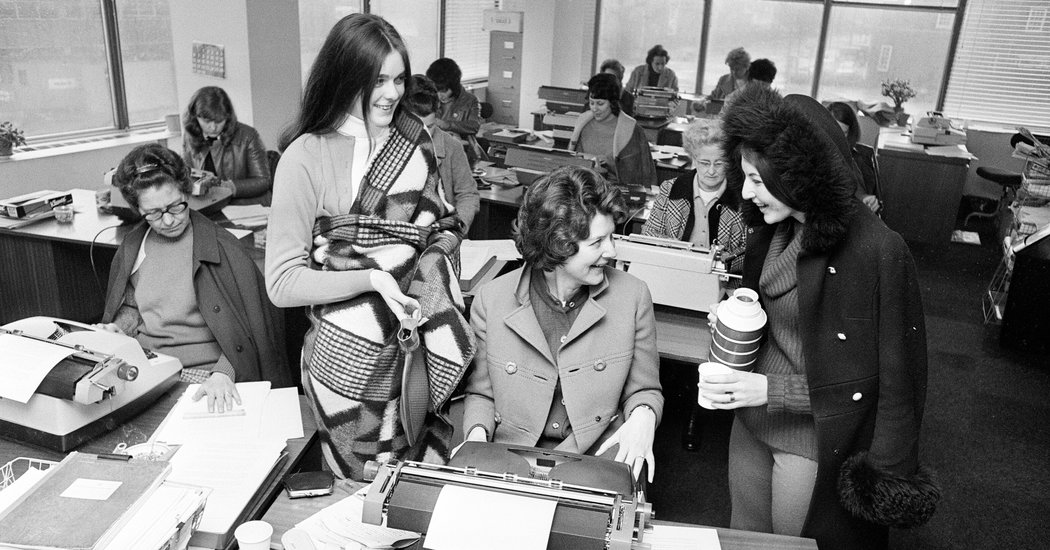
It is a truth universally acknowledged — or at least, much discussed on social media — that a woman who works in an office is in want of a sweater.
Office air conditioning is often set at a temperature that women find chilly; the resulting water-cooler debate has been called the “battle of the thermostat.” One study even suggested that because women have slower metabolic rates, the formula used to set temperatures in workplaces, which was developed decades ago based on the comfort of men, may overestimate women’s body heat production by 35 percent.
A question that hasn’t been asked much, however, is whether temperature affects the productivity of men and women differently. In a study published Wednesday in the journal PLOS One, researchers reported that at colder temperatures, men scored higher than women on verbal and math tests. But as a room grew warmer, women’s scores rose significantly. The findings require further confirmation under an assortment of conditions. But they add to a scientific rethinking of the spaces where we work and study, which sometimes have been devised with a limited set of physical requirements in mind.
[Like the Science Times page on Facebook. | Sign up for the Science Times newsletter.]
The researchers asked more than 500 college students to take tests for an hour in rooms with temperatures between 61 and 90 degrees Fahrenheit. The students performed as many simple math problems (without the help of a calculator) as possible, and rearranged a set of letters into as many words as they could, within a time limit. They also were asked to solve a series of tricky logic problems.
The temperature had no effect on the scores when they were considered as a group. But when the researchers split the data between male and female subjects, a clear pattern emerged. Scores on the logic problems did not vary as temperatures changed, but the math and verbal test scores did.
This content was originally published here.