Great Portable Solar Generators For Survival Emergencies

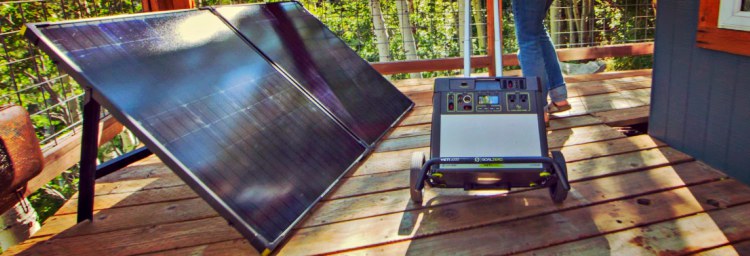
A solar generator consists of 2 main components:
- Solar panel
- Portable power generator
1 – Solar Panels

They do this by using the sunlight to knock electrons free from atoms. This knocking free of electrons generates a flow of electricity.
Or more simply put, the sun’s energy excites molecules which creates a flow of electricity. If you get that, that’s all the technical understanding you need.
The bottom line is solar panels turn sunlight into DC power.
Here’s a short video explaining of how solar panels convert the sun’s rays into electricity.
2 – Portable Power Generator
A portable solar power generator is also made up of two main components
- Inverter
- Battery
The inverter turns the DC power from the panel into more usable AC power. Solar generators also include a storage battery. That way, if any of the power captured by the panels is not being used, you don’t lose that power. Instead, it becomes potential energy stored in the battery for later use. The battery ensures there’s power available in an emergency. Solar generators also include various power outlets. These are like power outlets in your home. They allow you to plug electrical cords, power tools or appliances into the generator.
Recharging Is Not Instantaneous
It takes time for a solar panel to recharge a battery. Solar panels are not an on and off device. The power they capture fluctuates based on the power of the sun. Solar panels are affected by the angle of the sun to their surface. If you set your panel in a fixed position and let the sun move across the sky, you’ll get a curve of power production. It will start out small, ramping up to peak, hold peak power conversion for a while, and then back down to zero. The hope is you can produce enough power over this time to run your appliances and charge by solar your battery. Then use the stored backup battery power from sundown to sun up (overnight). Again, you’ll have to look at the appliances you need and how often to use them. This is all about smart power supply management! Of course, the more panels you have, the more power you can produce in a given time frame. But if you charge your battery too quickly, you’ll need more batteries to store any excess energy. But expansion is not always as simple as buying more panels or batteries.
Many Units Cannot Be Easily Expanded
Components in the ready-made solar generators are not typically designed for easy expansion. When you buy a ready-made portable solar generator, you can’t easily upgrade the inverter. You can’t add a bigger battery (at least not internally). Nor can you increase the photovoltaic surface area or install a better inverter. Some models do allow you to add more solar panels to increase the speed of recharging. But eventually, you’ll hit the upper limit of the inverter in a ready-made generator. So for the most part, you get what you get with a ready-made solar powered generator. If this is a big concern of yours, you should check out some DIY solar generator options (covered later).
Repair Can Be Difficult
Solar panels and power generators are not devices that are simple to repair. They take unique components and serious expertise to fix. In the case of solar panels, it’s typically more cost effective to buy new ones as opposed to trying to repair them. Fortunately, newer solar panels are extremely durable and are difficult to break. Most of the ones built nowadays can even handle extreme hail storms. So the odds are low that you’d need to repair a portable solar generator repair. But if you do, it’s not going to be as easy as changing a tire or replacing wiper blades.
Goal Zero Yeti Lithium Portable Power Station

They have several models and sizes to choose from:

So while the Yeti 3000 has more power capacity but also costs more money. But the Yeti 400 is more affordable and more suited for smaller devices and tasks.
All the units include two AC outlets (300W continuous, 1200W surge), three 2.4A USB ports, and two 12V output ports.
The weight of each unit varies based on the model but ranges from 17 lbs for the 400 series up to 75 pounds for the 3000 series.