Category: Science&Technology

  • Scientists seek out limit to human endurance

    Scientists seek out limit to human endurance

    Washington (AFP) – US scientists who studied the performance of myriad athletes — including adventurous souls who spent five long months running across the United States — have come up with an estimate of the absolute physiological boundary of human endurance. The conclusions are pretty technical but the study published Wednesday in the journal Science Advances highlights one feature in particular that makes people unique among primates: their physical endurance is indeed extraordinary. It is probably something we inherited from hunter-gatherers over the course of two million years, the researchers say. In a nutshell, when it comes to pushing one’s body to the limit, humans run circles around monkeys. The limit to human endurance is measured in multiples of something called basal metabolism, which is the minimum energy, counted in calories, that is expended by the body to keep itself going for one minute. And the limit to human endurance is about 2.5 times this basal metabolism, says the team, led by Herman Pontzer, a professor of evolutionary anthropology at Duke University. In athletic events defined as short — races that last anywhere from hours to weeks, such as a triathlon, a marathon or the Tour de France — people can crank their metabolism up to five or even 10 times their resting metabolic rate.

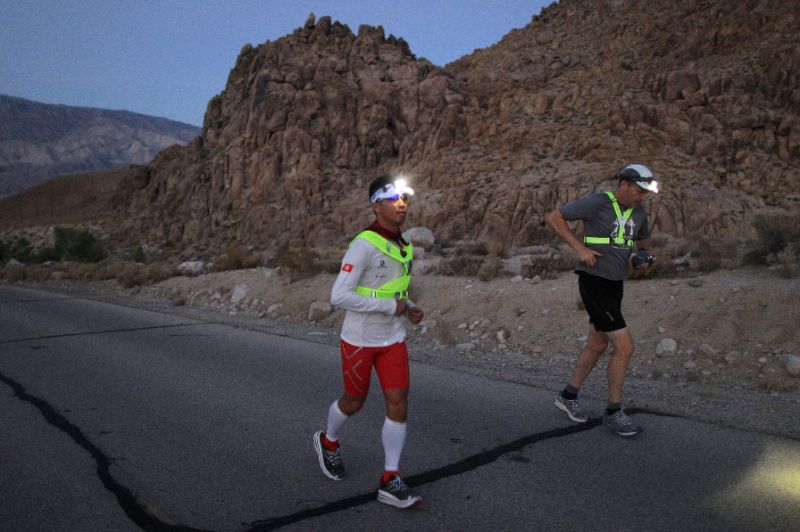
    But there comes a point in which performance will fall back down to about three times that rate, these scientists say. It is simply impossible for humans to stay above that level for more than a few weeks. To arrive at this figure the team followed five men and one woman who are considered extreme runners. From January to June of 2015 they took part in the Race Across the USA — 4,957 km (3,080 miles) from Los Angeles to Washington, DC. That’s the equivalent of doing a marathon a day, six days a week, for 20 weeks. “All of those people are losing weight. They’re burning away their fuel faster than they can put it back in,” Pontzer said. “What point do I hit where I can finally put as many calories back in as I burn each day?” The answer, Pontzer said, is 2.5 BMR — which stands for basal total metabolic rate. “That’s about 4,000 calories a day,” he said.

    – Crazy humans –

    Die-hards who ran across America drank eight liters of water a day in the first week and burned up 6,000 calories per day. But they kept losing weight all the way through to the end of the race and never reached a state of equilibrium. “You cannot really take in more than 4,000 calories a day,” said Pontzer. “You can burn more than that, but you’re losing weight every day. So that’s not really sustainable forever. You can do it for a couple of days, a couple of weeks, but you can’t do it forever.” His team says the limit to human endurance is probably linked to people’s digestive activity, rather than their muscles or heart, because this was the least common denominator in all of the sports that were studied. To wit: cycling, running and triathlons cause people to use different muscles. But they all have the same stomach. While humans stand out among primates in their ability to perform physically, other animals are also good at extreme endurance, such as migratory birds. But this part of the picture has not been studied as thoroughly. Pontzer notes an important difference between people and animals. “The other animals are too smart to do all these crazy things that people do,” he said.

    source

  • Boston Dynamics’ cool commercial robot Spot is about to go on sale

    Boston Dynamics’ cool commercial robot Spot is about to go on sale

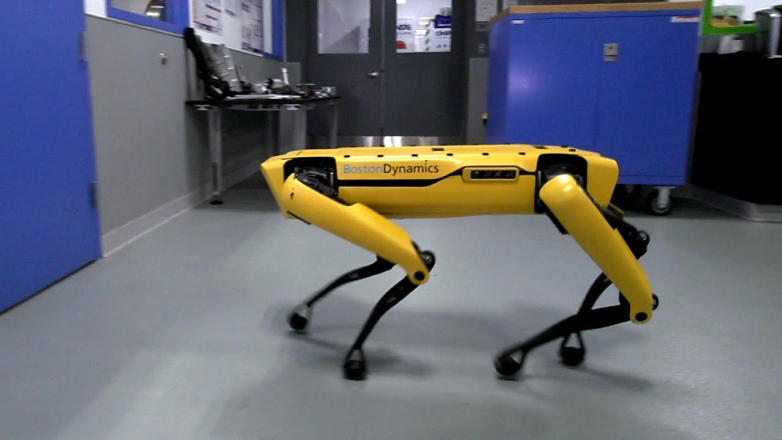
    Boston Dynamics’ ambitions in the field of robotics have been the stuff that Internet virality is made of. The engineering and robotics company has already produced incredibly skillful machines that will haunt your nightmares if you’re one of those who’s convinced humanity is doomed and that the rise of the robots is at hand. The company’s robots have, for example, already shown an ability to navigate obstacles Parkour-style, easily manipulate boxes in a warehouse, deftly handle stairs and other barriers, along with much more. And now, it seems, the company’s designs are about to move from controlled test environments to the real world. The company’s four-legged, dog-like robot Spot — its first commercial robot — is going on sale soon.

    That’s according to a new piece from The Verge, which was told by Boston Dynamics’ CEO Marc Raibert that although there’s no firm launch date yet, Spot should start to be available for purchase “within months” and before the end of the year. “We’re just doing some final tweaks to the design,” the CEO told the news site. “We’ve been testing them relentlessly.” This follows a series of public appearances for the company and the robot, which was shown off in recent days at Amazon’s Re:MARS conference in Las Vegas. A pair of Boston Dynamics employees were seen shepherding Spot through the crowd on the first night of the event.

    Raibert went on to say the company is aiming to start churning out 1,000 robots a year. What will be interesting to watch is whether Boston Dynamics can turn this into a commercially viable enterprise. The company is not alone in this field, with a number of rivals to contend with, and it remains to be seen whether and why companies will buy robots like Spot enough to represent significant revenue for the manufacturer.

    source


  • Google Fed a Language Algorithm Math Equations. It Learned How to Solve New Ones. – ExtremeTech

    Google Fed a Language Algorithm Math Equations. It Learned How to Solve New Ones. – ExtremeTech

    Many people think of computers as “math experts” compared with us humans. While we can’t solve equations as quickly as a machine, we shouldn’t put too much faith in their accuracy because computers can’t know, understand, or calculate every possibility in an infinite series of numbers no matter how much time they have available. This limitation of computational hardware leads to strange quirks in how computers perform math, but Google’s new method of training AI to both understand and solve complex math problems may result in a sharp increase in future computational accuracy.

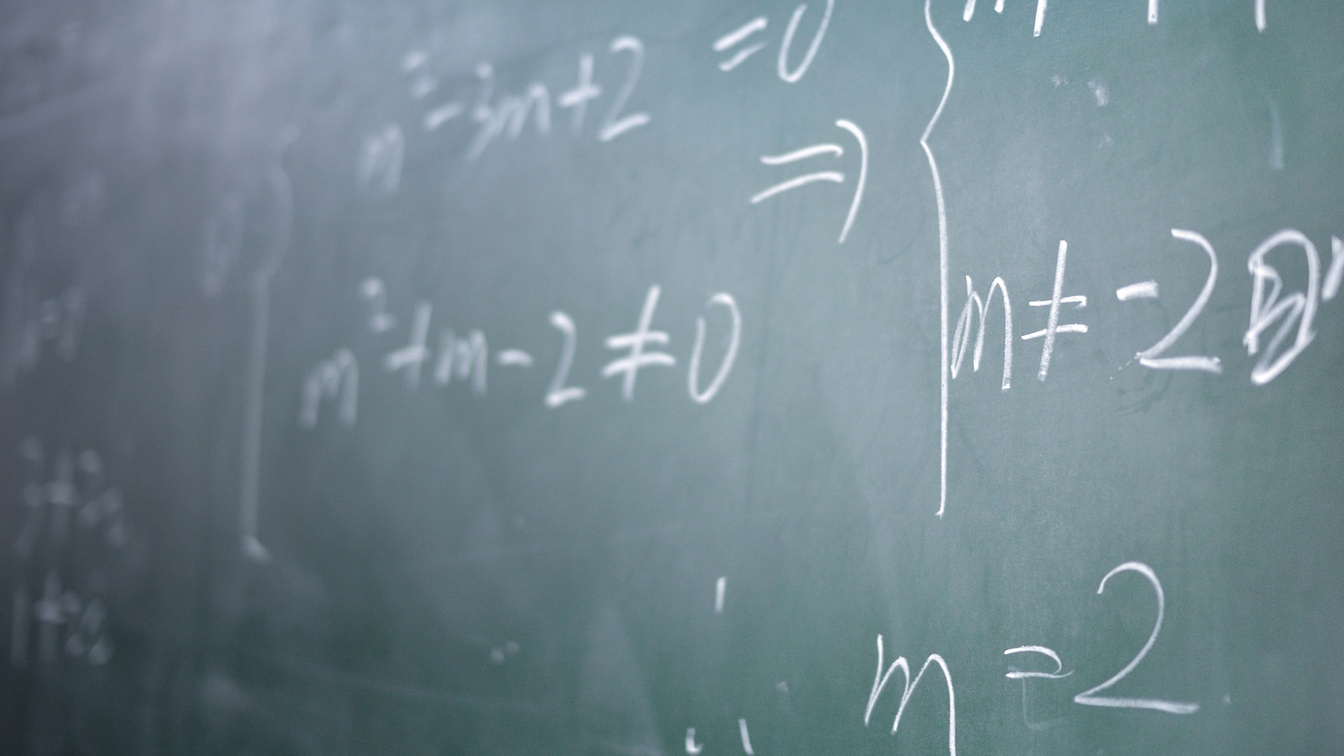
    First, let’s take a look at what Google did because it’s an impressive approach in and of itself.  For training data, DeepMind received a series of equations along with their solutions—like a math textbook, only without any explanation of how those solutions can be reached. Google then created a modular system to procedurally generate new equations to solve, with a controllable level of difficulty, and instructed the AI to provide answers in any form. Without any structure, DeepMind had to intuit how to solve new equations solely based on seeing a limited number of completed examples.

    Challenging existing deep learning algorithms with modular math presents a very difficult challenge to an AI and existing neural network models performed at relatively similar levels of accuracy. The best-performing model, known as Transformer, managed to provide correct solutions to 50 percent of the time and it was designed for the purpose of natural language understanding—not math. When only judging Transformer on its ability to answer questions that utilized numbers seen in the training data, its accuracy shot up to 76 percent.

    While the best results represent a failing grade and a solid C, they’re nevertheless extremely impressive. Aside from this method offering a simple and effective means of gauging a model’s aptitude at certain types of tasks, it could lead to a solution to the biggest flaw in computer math proficiency.

    To understand that problem, let’s take a quick look at how computers make mathematical errors by design. Consider the following example. Despite two very large numbers, you can probably solve the following equation in a near instant:

    999999999999999 – 999999999999998

    While you should have no trouble determining that the second number is just a single digit smaller than the first, and therefore the answer is 1, a calculator (like Google’s) will present an obviously incorrect result.

    The reason for this flaw lies at the core of computational architecture.  While we understand math through the base-10/decimal numeral system, computers see things differently through base-2/binary.  You can see the difference when you take a look at the real number line as you know it.

    Image credit: Wikipedia

    If you count whole numbers in a sequence you’ll find yourself speaking the real number line aloud. We can create all the numbers we need from the digits that range from 0 to 9. Computers, on the other hand, only have 0 and 1 to determine numbers and that can result in some unusual errors like the one pictured above. All the data in our computers exist as a series of ones and zeros and that doesn’t exempt numbers. Here’s a look at how the real number line gets translated to binary for computers.

    Image credit: ResearchGate

    To put it lightly, things become a bit more complicated.

    Imagine making a copy of the Oxford English Dictionary when you can only represent its contents using two letters in the alphabet. Computers can accomplish this because alphabets only contain a finite number of symbols and they only require order and representation. The real number line, on the other hand, is an infinite series.  No human or computer can record and display the entirety of an infinite series or that series would become finite. If you understand that impossibility, it’s not hard to imagine why a computer can only manage to calculate a fraction of that number. After all, it has to understand all those numbers in its own binary system. Where we see 9, computers see 1001. Take a look at how computers see the number 85:

    Image credit: Brett Barry

    Computers use sums of multiples of two to successfully represent a significant segment of the real number line—just not all of it. The decimal numeral system works in the same way—just with 10s instead of 2s—but it takes significantly fewer base 10 digits to represent any given number when compared to the same value in binary. All number systems, by nature, can represent smaller numbers more precisely than larger ones, but because binary offers fewer unique digits to represent each number it runs out of space faster (when compared to the decimal numeral system/base 10).

    This prevents computers from representing every possible number on the number line—something you’ve experienced in base 10 if you’ve ever encountered the fraction of one-third. You know that the sum of 1/3 + 1/3 + 1/3 equals 1, but if you represent 1/3 as a decimal it becomes 0.3333333 and continues on infinitely. Unlike the fractional representation of 1/3, the decimal version appears to add up to 0.9999999 (etc.) and never reach 1 because the decimal numeral system cannot represent the fraction of 1/3 with the necessary precision.

    The same thing happens with computers and so they employ strategic rounding to get to the closest number they can represent. This results in reduced precision but allows for a greater range of calculations. As a result, specific equations can exploit the weaknesses in the binary numeral system and cause rounding errors that make the computer yield an incorrect result.

    By the way, you’ve just read a major oversimplification of how computer rounding errors work. Check out the video above if you want a more precise explanation of how all the math shakes out.

    Just as fractional notation (e.g. 1/3) can help us overcome the limitations of base 10, engineers have provided special logic to help machines overcome the more problematic limitations of base 2. However, the processing limitations of CPUs, the larger number of representative digits required, and the high number of decimals with infinite representations in binary combine to present a problem without a perfect solution.

    Computers aren’t alone in experiencing these rounding errors.  You can see the core of this dilemma represented literally everywhere you look when you consider how your proximity to other things determines the level of detail you can perceive about them. To the human eye, precision of detail diminishes with distance. That distance, however, can allow us to see a fuller picture by sacrificing precision.  The same reality presents itself in different ways across all known number systems.

    By creating an artificial intelligence training method that determines an algorithm’s ability to approach computation using its own abstracted methodology, Google created a framework for achieving a much higher level of computational accuracy in the future. With the Transformer language model landing first prize for accuracy out of the gate, even though it only managed to get half the questions right it provides a clue that suggests the direction of the model that could someday achieve perfect accuracy throughout the spectrum of math that today’s computers solve with imperfections. Given Transformer’s much higher score for solving equations through interpolation (76 percent), increased accuracy may arrive through a combination of algorithmic changes and a more significant set of training data.

    In any case, we won’t have a perfect machine calculator that can understand all math by next week. Right now, that remains barely more than a pipe dream. After all, the modular set of equations already limit themselves to school-level difficulty and no model can achieve anywhere near perfect accuracy. With the code that generates these equations publicly available, we may have a way to get there someday.

    Top image credit: Getty Images

    This content was originally published here.
  • Sleeping giant: Scientists warn Russian volcano could cause destruction on scale of Pompeii  — RT Russia News

    Sleeping giant: Scientists warn Russian volcano could cause destruction on scale of Pompeii — RT Russia News

    Deemed inactive for decades, the Bolshaya Udina volcano has come back to life, according to recent research, prompting concern about a potentially cataclysmic natural disaster.

    When a volcano is silent for a long time, its first explosion can be catastrophic,” said Ivan Kulakov, the head of the seismic tomography lab at the Russian Institute of Petroleum Geology and Geophysics, in an article for the Russian Academy of Sciences’ Siberian branch. “A large amount of ash is thrown into the air, it is carried far away, and not only the surrounding settlements, but also large territories all over the planet, can suffer.”

    Recall Pompeii,” the researcher added ominously: the ancient Roman settlement was wiped off the map by the eruption of Mount Vesuvius, which laid dormant for thousands of years prior. The city was buried in over 10 feet of ash and most of its inhabitants are thought to have been killed in the disaster.

    Kulakov headed up a study in 2017 to measure what he called “seismic unrest” around Bolshaya Udina; his team’s findings led to a reclassification of the volcano from ‘extinct’ to ‘active’ the same year.

    While the researchers warned of the volcano’s huge destructive potential, it may be too early to begin preparing for the apocalypse. It is impossible to predict whether an eruption would occur, Kulakov said, but added “undoubtedly, now we need to closely monitor Udina.”

    Bolshaya Udina makes up half of the Udina volcanic massif, which also includes Malaya Udina (‘big’ and ‘small’ Udina, respectively). It stands at just over 9,500 feet on Russia’s Kamchatka Peninsula.

    If you like this story, share it with a friend!

    This content was originally published here.
  • Walmart turns to robots, it’s the human workers who feel like machines

    Walmart turns to robots, it’s the human workers who feel like machines

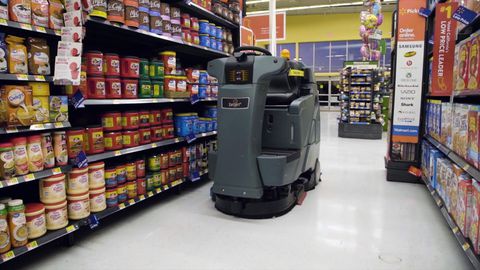
    Walmart executives, the Auto-C self-driving floor scrubber is the future of retail automation – a multimillion-dollar bet that advanced robots will optimize operations, cut costs and revolutionize the American superstore. But to the workers of Walmart Supercenter No. 937 in Marietta, Georgia, the machine has a different label: “Freddy,” named for a janitor the store let go shortly before the Auto-C rolled to life. Workers there said it has suffered nervous breakdowns, needed regular retraining sessions and taken weird detours from its programmed rounds. Shoppers are not quite sure how to interact with Freddy, either. Evan Tanner, who works there, recalled the night he says a man fell asleep on top of the machine as it whirred obediently down a toy aisle. Walmart executives said they are skeptical that happened, because the Auto-C is designed to stop if someone interferes with its work. But Tanner insists Freddy dutifully stuck to the job at hand. “Someone had to pull [the sleeping man] off,” he said. Freddy “was going to swing toward groceries, just cleaning away.”

    Over the past 50 years, Walmart has recast the fabric of American life, jostling mom-and-pop shops, reshaping small towns and transforming how millions work and shop. But the superstore titan’s latest gamble is an entirely new kind of disruption – the biggest real-world experiment yet for how workers, customers and robots will interact. The nation’s largest private employer has unleashed an army of robots into more than 1,500 of its jumbo stores, with thousands of automated shelf-scanners, box-unloaders, artificial-intelligence cameras and other machines doing the jobs once left to human employees. The swarm is already remaking how the retailer’s more than 1 million U.S. “associates” go about their daily work. Given the chain’s ubiquity across the country, the local Walmart store also is likely to become the first place millions of Americans meet a real-life, working robot. Walmart executives have promised the all-hours robot workhorses will let employees endure less drudgery and enjoy “more satisfying jobs,” while also ensuring shoppers see cleaner stores, fuller shelves and faster checkouts.

    But the rise of the machines has had an unexpected side effect: Their jobs, some workers said, have never felt more robotic. By incentivizing hyper-efficiency, the machines have deprived the employees of tasks they used to find enjoyable. Some also feel like their most important assignment now is to train and babysit their often inscrutable robot colleagues. Customers, too, have found coexisting with machines to be confusing, if not alarming. Some shoppers have been spooked, for example, by the Auto-S scanner, which stands six feet tall and quietly creeps down the aisles, searching for out-of-place items by sweeping shelves with a beam of light. Other shoppers, store workers said, have made a game of kicking the things.

    source

  • New Surveillance Tool Is Coming to U.S. Skies

    New Surveillance Tool Is Coming to U.S. Skies

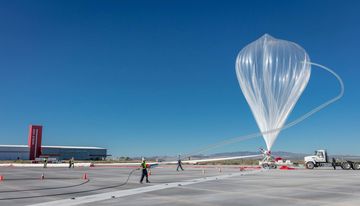
    An Arizona company developing a new type of high-altitude, long-range surveillance platform just completed a 16-day mission during which massive balloons floated over four western U.S. states, all part of an effort to someday keep them aloft for months at a time. World View Enterprises Inc. builds what it calls Stratollites, a system designed to offer the type of coverage satellites afford but without the need to launch incredibly expensive rockets into space. Effectively unmanned balloons, the untethered platforms operate with surveillance equipment payloads of as much as 220 pounds (100 kg) at altitudes of 50,000 feet to 75,000 feet, far above commercial air traffic. They will be able to monitor mines, pipelines, transit infrastructure—and perhaps the contents of your fenced-off backyard—in hyper-accurate detail. The company plans to start selling its commercial product early next year and has spoken with several potential commercial and military customers, Chief Executive Officer Ryan Hartman said Tuesday in an interview. World View sees its customer base as companies that operate critical industrial and commercial infrastructure.

    The platform, navigated remotely using a unique altitude control system, can provide imagery that’s superior to orbiting vehicles, Hartman contends, because “we’re five times closer to the earth than the nearest satellite.” He said “our imagination is sort of our limit with regards to where and how these systems can be used. Certainly there is a market in target surveillance and reconnaissance on a global scale.” “There’s a very real potential here that these kinds of systems will lead to a pervasive aerial surveillance.” Given that satellites have the capacity to read license plates, World View’s product may have implications for privacy and civil liberties. Asked if the company would sell access to police departments, Andrew Antonio, director of business development for World View, said “flying a Stratollite is no different” than how “domestic law enforcement agencies leverage aerial technologies like helicopters and aircraft.” Jay Stanley, a senior policy analyst with the American Civil Liberties Union, isn’t so sure. “Everything depends on how expansive it is and how high resolution it is and how wide of an area it can surveil,” Stanley said of World View’s Straollite. “There’s a very real potential here that these kinds of systems will lead to a pervasive aerial surveillance of cities where our every move will be tracked.”

    He pointed to a sweeping 2012 ruling by the U.S. Supreme Court that limited police power to track people using GPS devices. The reasoning used by some of the justices in that unanimous ruling could easily be expanded to other types of surveillance technology, Stanley said. Jeramie Scott, senior counsel for the Electronic Privacy Information Center’s Domestic Surveillance Project, said that while high-altitude surveillance balloons may have beneficial uses, “they will also pose a serious threat to our privacy and civil liberties. “The balloons will likely drive down the cost of surveillance, making persistent aerial surveillance of all our public movements a real possibility,” Scott said. “Traditionally, our privacy in public has been protected by the limitations of technology and the exorbitant costs of tracking everyone’s public movements, but surveillance balloons potentially remove these barriers.”World View’s own test showed that the ability for surveillance technology to linger overhead for long periods of time, covering a wide swath of America, is indeed in reach.

    The company’s 16-day test flight started near the company’s Tucson headquarters and spanned more than 3,000 miles over Nevada, Utah and southern Oregon, ending Monday in the Nevada desert. The company said it plans to extend its next test flight to 30 days, and then 60 days.Several satellite firms do offer similar data to a range of clients, from agriculture to meteorologists to hedge funds. Meanwhile, Alphabet Inc.’s Project Loon also uses balloons in the stratosphere, designed to provide Internet and communications services. The company said it’s worked with AT&T Inc. and T-Mobile US Inc. to provide infrastructure to Puerto Rico following its devastation by a hurricane.

    As for World View, the company said it expects to station its systems at multiple locations worldwide, offering customers quick access to flight launches and data. To contact the author of this story: Justin Bachman in Dallas at jbachman2@bloomberg.netTo contact the editor responsible for this story: David Rovella at drovella@bloomberg.net

    For more articles like this, please visit us at bloomberg.com

  • Why Computer Science Should Be a High School Graduation Requirement

    Why Computer Science Should Be a High School Graduation Requirement

    Computing is an integral part of every aspect of our lives, from how we connect with each other to the way we do our jobs and get around. Computing is the number one source of all new wages in the U.S. economy and there are currently 500,000 open computing jobs across the country.

    Yet, according to a Code.org report, only 15 states require all high schools to offer computer science. Many parents, educators, and education institutions are calling for computer science to be a high school graduation requirement. As one commentator pointed out: Schools teach math to students regardless of whether they want to become mathematicians because it is foundational. The same is true of computer science. There are a number of benefits to taking computer science in high school.

    1. Develop analytical thinking skills

    Computing requires logic, algorithmic thinking and practices problem-solving skills, all of which develop analytical thinking, a skill that is useful in life and any career. Analytical skills are in high demand in the job market by many industries. Once a student has developed analytical thinking skills, these skills can be applied to investigate and solve complex issues in any field.

    •  Increased earning potential

    Being a growth industry, a qualification in computer science offers higher earning potential. Certified coders earn 20 – 40 % more than the median salaries in other professions. According to the U.S. Bureau of Labor Statistics, the median annual wage for computer and information research scientists was $118,370 in May 2018.

    • Increased job opportunities

    Because of the rise of technology, the demand for technical professionals is increasing. Software developers are needed to respond to an increased demand for computer software. In fact, the role of a software developer is the reigning “best job” in the U.S. According to data from the U.S. Bureau of Labor Statistics, employment of software developers is projected to grow 24 % from 2016 to 2026, much faster than the average for all occupations.

    • Diverse options

    Computing is integral to all jobs today. Computing is not just about sitting in front of a PC writing code. A computer science background can lead to a range of career options, including programming, database management, cybersecurity and more. Computing skills can be applied in a truly diverse range of fields, anything a student is interested in, from nanotechnology to robotics.

    • A chance to change the world

    With knowledge of computer coding, students put themselves in a position to change the world. Think about Mark Zuckerberg who started his road to fame as a sophomore at Harvard, working quietly away on a program called “Facemash”. Look where he and Facebook are today. Think about Uber. Uber is just a software tool. No car ownership is involved, yet Uber has become the biggest taxi company in the world.

    • Close the diversity gap

    Underrepresented groups in computer science degrees and jobs include women, Blacks, and Hispanics. If computer science becomes a high school graduation requirement, more teens will be exposed to the discipline, including girls who often don’t opt to take computer classes. This might lead to a more diverse group of people going on to study computer science and closing the diversity gap in the workplace.

    With new technologies emerging constantly, the future of computer science holds a lot of promise. The subject is key to solving many of the world’s most pressing problems. Training in computer science can give an individual the power to contribute to solutions and help shape the future.

    The post Why Computer Science Should Be a High School Graduation Requirement appeared first on The Tech Edvocate.

    This content was originally published here.
  • China launches its 1st space rocket from a sea platform (PHOTO)

    China launches its 1st space rocket from a sea platform (PHOTO)

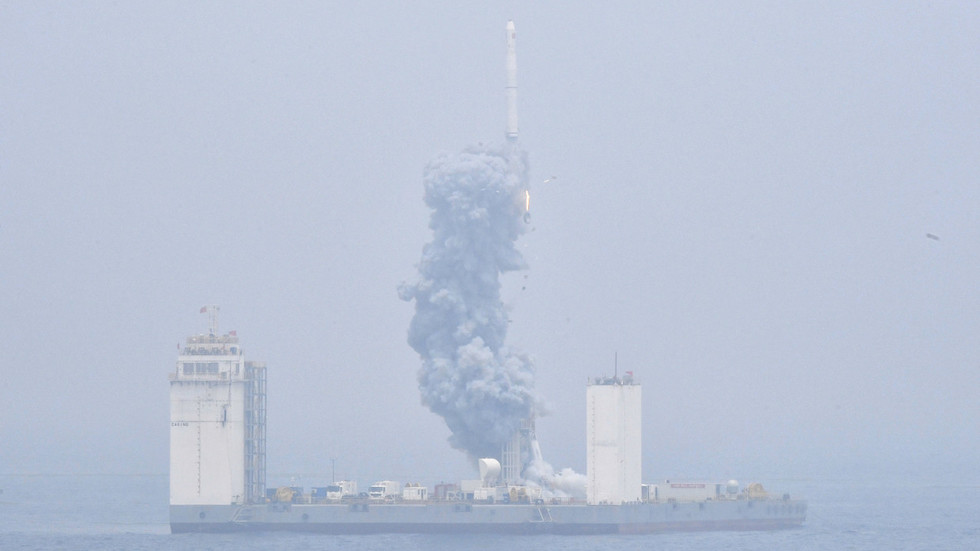
    A Long March 11 carrier rocket lifted off from the pad installed on a civilian ship in the Yellow Sea on Wednesday, the country’s National Space Administration announced.

    The launch vehicle successfully delivered five commercial satellites into Earth’s orbit as well as two scientific modules, which are expected to monitor winds on the ocean surface, and to forecast typhoons and other extreme weather conditions.

    China’s first seaborne space launch.! China launched a Long March-11 carrier rocket around 12:00 Beijing time on Wednesday in the Yellow Sea. (CCTV) pic.twitter.com/NtTVp74Ucs

    — 東南傳媒 Southeast Media (@media_southeast)

    The 20.8 meters-long carrier rocket –featuring a lift-off weight of 58 tons– is capable of delivering up to 350 kg cargo. It made its maiden flight in 2015 and, since then, it has been launched five more times from the Jiuquan Satellite Launch Center in northwestern China.

    Sea launches are more cost-efficient and flexible than conventional ones, Chinese space authorities said in a statement and would provide better aerospace commercial services for countries involved in the Belt and Road Initiative – Beijing’s plan to boost the global economy.

    China’s pioneering seaborne space launcher has also become the first of its kind since 2014, the year that a Russian-Ukrainian Zenit-3SL rocket took off from a floating launch pad in the Pacific Ocean. That flight was operated by Sea Launch, a multinational project founded by companies from Norway, Russia, Ukraine and the United States. Since its establishment in the late 1990s, the joint venture conducted over 30 seaborne launches but halted operations five years ago, amid tensions between Moscow and Kiev.

    Meanwhile, Chinese officials claim that their launch platform and rockets are for the first time in the world entirely owned by one state, which means the project would not be affected by any international disputes.

    Like this story? Share it with a friend!

    This content was originally published here.
  • Internet shutdowns don’t make anyone safer

    Internet shutdowns don’t make anyone safer

    Around the world, governments are hitting on a modish new idea: Turn the internet off. Sometimes they mean it literally.

    Methods vary, but the trend is clear enough. Countries are increasingly ordering telecoms and other companies to block network access, shut down messaging services, or otherwise restrict digital applications or websites, usually citing public order or national-security concerns. In extreme cases, internet access can be “blacked out” entirely. Worldwide, such shutdowns rose to 188 last year, up from 75 in 2016.

    Expect that regrettable figure to rise. For autocrats, the appeal is obvious. They can use such restrictions to suppress inconvenient news or unwanted opinions, censor political rivals, prevent activists from organizing, and stifle talk of government misdeeds. For instance, after voters cast ballots last year in an election widely seen as corrupt, the government of the Democratic Republic of the Congo blocked all internet access for nearly three weeks. The stated goal — which cost the impoverished country roughly US$3 million a day, according to one calculation — was to prevent “chaos.”

    Even in democracies, such bans can be tempting. When terrorists killed more than 250 people in Sri Lanka in April, authorities shut down access to multiple social-media services for more than a week. That might have seemed justified in the moment: Messaging apps can accelerate the spread of disinformation, and further violence appeared imminent.

    source

  • The Stars you See are Really Satellites

    The Stars you See are Really Satellites

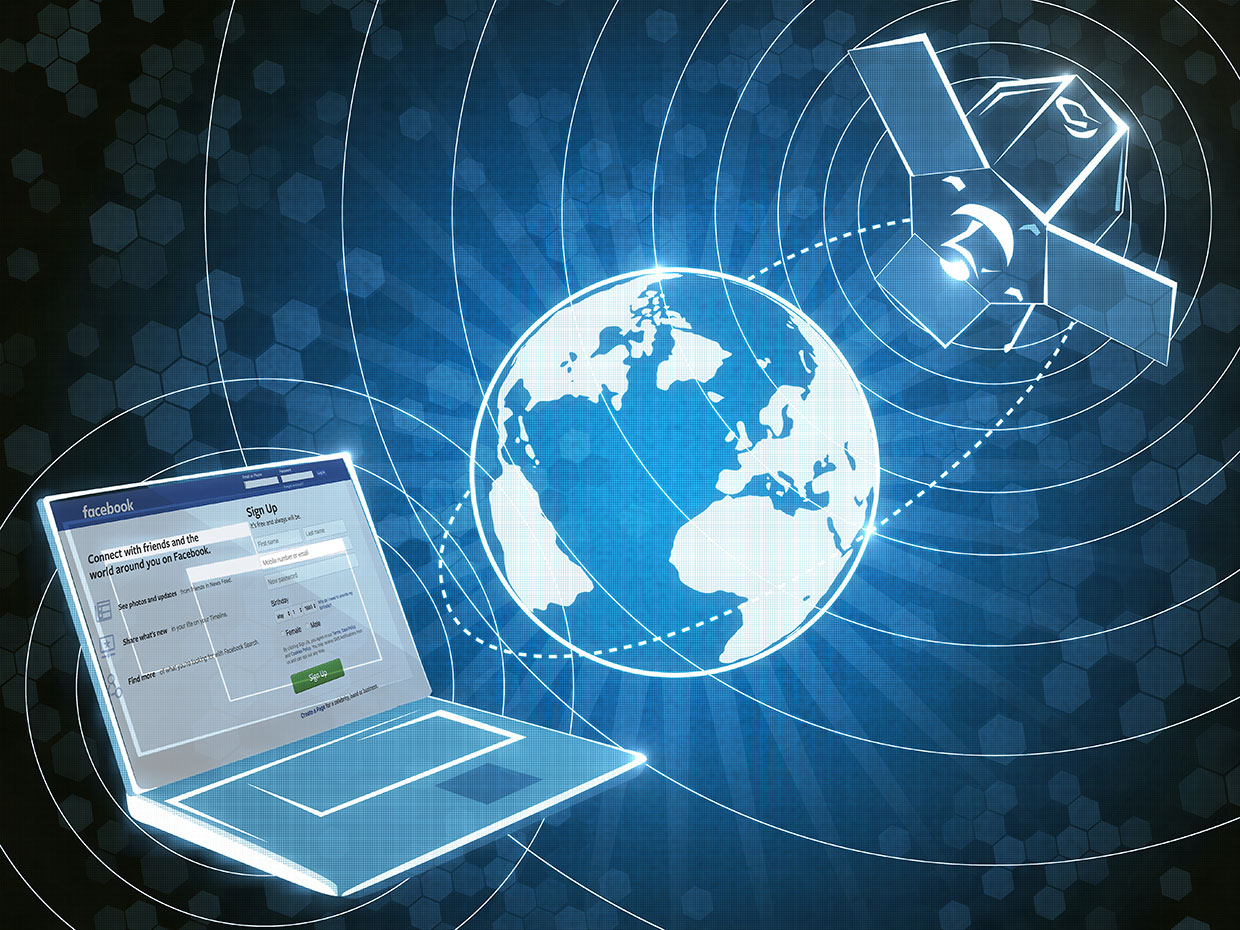
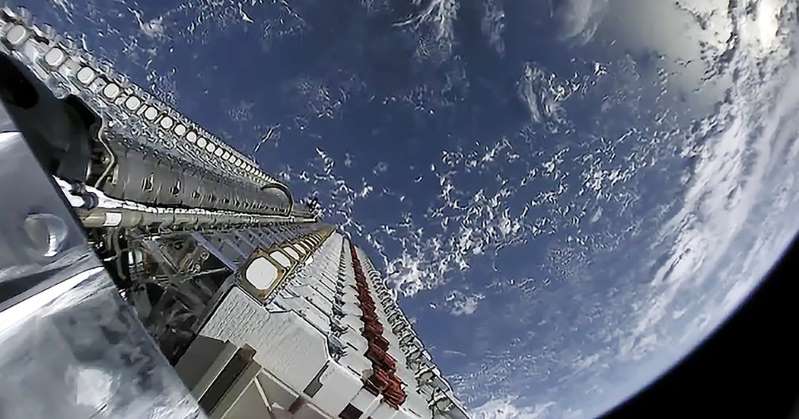
    Last month, SpaceX successfully launched 60 500-pound satellites into space. Soon amateur skywatchers started sharing images of those satellites in night skies, igniting an uproar among astronomers who fear that the planned orbiting cluster will wreak havoc on scientific research and trash our view of the cosmos. The main issue is that those 60 satellites are merely a drop in the bucket. SpaceX anticipates launching thousands of satellites — creating a mega-constellation of false stars collectively called Starlink that will connect the entire planet to the internet, and introduce a new line of business for the private spaceflight company.  While astronomers agree that global internet service is a worthy goal, the satellites are bright — too bright.  “This has the potential to change what a natural sky looks like,” said Tyler Nordgren, an astronomer who is now working full-time to promote night skies. And SpaceX is not alone. Other companies, such as Amazon, Telesat and OneWeb, want to get into the space internet business. Their ambitions to make satellites nearly as plentiful as cellphone towers highlight conflicting debates as old as the space age about the proper use of the final frontier.  While private companies see major business opportunities in low-Earth orbit and beyond, many skygazers fear that space will no longer be “the province of all mankind,” as stated in the Outer Space Treaty of 1967.

    The Starlink launch was one of SpaceX’s most ambitious missions to orbit. Each of the satellites carries a solar panel that not only gathers sunlight but also reflects it back to Earth. Elon Musk, SpaceX’s founder and chief executive, has offered assurances that the satellites will only be visible in the hours after sunset and before sunrise, and then just barely. But the early images led many scientists to question his assertions. The first captured images, for example, revealed a train of spacecraft as bright as Polaris, the North Star. And while a press officer at SpaceX said the satellites will grow fainter as they move to higher orbits, some astronomers estimate that they will be visible to the naked eye throughout summer nights. The satellites can even “flare,” briefly boosting their brightness to rival that of Sirius, the brightest star in the sky, when their solar panels are oriented just right. Astronomers fear that these reflections will threaten stargazing and their research.

    Whenever a satellite passes through a long-exposure picture of the sky, it causes a long bright streak — typically ruining the image and forcing astronomers to take another one. While telescope operators have dealt with these headaches for years, Starlink alone could triple the number of satellites currently in orbit, with the number growing larger if other companies get to space.

    source