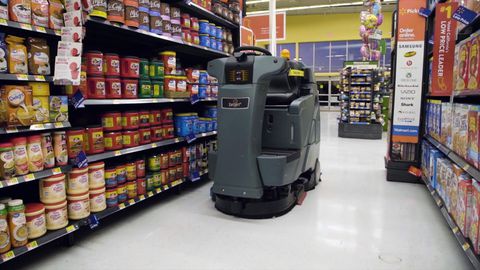
Walmart executives, the Auto-C self-driving floor scrubber is the future of retail automation – a multimillion-dollar bet that advanced robots will optimize operations, cut costs and revolutionize the American superstore. But to the workers of Walmart Supercenter No. 937 in Marietta, Georgia, the machine has a different label: “Freddy,” named for a janitor the store let go shortly before the Auto-C rolled to life. Workers there said it has suffered nervous breakdowns, needed regular retraining sessions and taken weird detours from its programmed rounds. Shoppers are not quite sure how to interact with Freddy, either. Evan Tanner, who works there, recalled the night he says a man fell asleep on top of the machine as it whirred obediently down a toy aisle. Walmart executives said they are skeptical that happened, because the Auto-C is designed to stop if someone interferes with its work. But Tanner insists Freddy dutifully stuck to the job at hand. “Someone had to pull [the sleeping man] off,” he said. Freddy “was going to swing toward groceries, just cleaning away.”
Over the past 50 years, Walmart has recast the fabric of American life, jostling mom-and-pop shops, reshaping small towns and transforming how millions work and shop. But the superstore titan’s latest gamble is an entirely new kind of disruption – the biggest real-world experiment yet for how workers, customers and robots will interact. The nation’s largest private employer has unleashed an army of robots into more than 1,500 of its jumbo stores, with thousands of automated shelf-scanners, box-unloaders, artificial-intelligence cameras and other machines doing the jobs once left to human employees. The swarm is already remaking how the retailer’s more than 1 million U.S. “associates” go about their daily work. Given the chain’s ubiquity across the country, the local Walmart store also is likely to become the first place millions of Americans meet a real-life, working robot. Walmart executives have promised the all-hours robot workhorses will let employees endure less drudgery and enjoy “more satisfying jobs,” while also ensuring shoppers see cleaner stores, fuller shelves and faster checkouts.
But the rise of the machines has had an unexpected side effect: Their jobs, some workers said, have never felt more robotic. By incentivizing hyper-efficiency, the machines have deprived the employees of tasks they used to find enjoyable. Some also feel like their most important assignment now is to train and babysit their often inscrutable robot colleagues. Customers, too, have found coexisting with machines to be confusing, if not alarming. Some shoppers have been spooked, for example, by the Auto-S scanner, which stands six feet tall and quietly creeps down the aisles, searching for out-of-place items by sweeping shelves with a beam of light. Other shoppers, store workers said, have made a game of kicking the things.