Category: Home & Garden

  • 9 Of The Most Uniquely Beautiful Houseplants That You Never Knew Existed

    9 Of The Most Uniquely Beautiful Houseplants That You Never Knew Existed

    Common houseplants like Dracaenas, Orchids, Pothos and Bamboo are beautiful, but just wait until you see the likes of Marimo Moss Balls, Hoya Kerrii, and Trachyandra – your houseplant collection will never be the same again.

    1. Black Succulents

    Do you prefer the darker things in life? Get ready to expand your succulent collection with these handsome black succulents.

    The perfect treat for your dark soul, Sinocrassula yunnanensis is a dark variety of succulent that grows in tightly packed rosette clumps.

    The pointed leaves are reminiscent of pine cones or hedgehogs, whichever you prefer, and they are actually a very dark green, so dark they look black.

    2. Hoya Kerii

    The Hoya plant comes in several varieties, all of which make great houseplants. The Kerii assortment, also known as the Sweetheart Plant, is our favorite by far thanks to its unique shape that looks like a heart.

    The quirky heart-shaped leaves have made this plant an instant sensation that is easy to grow and cheap to buy – win-win!

    This plant is very comparable to the Lucky Bamboo. It makes a great gift for friends, or for yourself.

    3. Trachyandra

    Native to southern and eastern Africa, the Trachyandra resembles tentacles or spaghetti and will certainly spark conversation.

    4. Rose Succulent

    Yet another incredible succulent to add to your list of must-have houseplants, the Rose Succulent looks like a perfect rose.

    Technically known as Greenovia Dodrentalis, the curved layers look like rose petals. Only, unlike roses, they’ll stay in bloom for much longer and are easier to care for.

    Largely found in the Canary Islands, this plant will make your home look like it came from the pages of a storybook.

    5. Crassula Umbella

    Reddit

    The Crassula, also known as ‘Wine Cup’ succulents, grow up to 6 inches tall when in bloom, Yet, the most unique part of this plant is the little upside-down umbrellas they have.

    While they are easy to grow, you’ll have to watch out for mealy bugs and fungal diseases. Don’t overwater this plant, like any succulent, it prefers dry conditions.

    This plant is typically started by division, leaf cuttings, or offsets.

    “Plants can be easily propagated from a single leaf: sprout leaves by placing them into a succulent or cacti mix, then covering the dish until they sprout,” explains .

    6. Euphorbia Obesa

    The Euphorbia Obesa, also known as the baseball plant, is grouped with succulents and woody plants. It gets its nickname from the fact that it looks like a ball with little sprouts coming out of the top.

    This low maintenance houseplant does well in hot and arid climates. There’s a water reservoir at the center to help it survive droughts.

    It is endangered in the wild due to poaching and over-collection, as well as the fact it grows slowly, and the pod only contains two to three seeds.

    7. Marimo Moss Balls

    This plant may look like those cheap fake plants you see at Home Goods, but it’s the real deal. These small squishy balls of algae resemble moss but are strikingly beautiful.

    In the wild, they are found rolling at the bottom of rivers, hence how they become round in shape. In Japan, they are often treated as pets and considered a lucky charm.

    Typically found at stores that carry aquatic plants, you can grow them yourself by placing the baby moss balls into warm, clean water. You don’t need a large container, just make sure they aren’t crowded and have plenty of space.

    They need some light; even regular household light is adequate. Just make sure they don’t have direct sunlight, or they will turn brown.

    8. Living Stones

    Lithops Plants, also known as Living Stones, look like cloven hooves or hearts with a plant that sprouts from the center.

    These small plants are a type of succulent that is native to South African deserts, yet they are easy to find at local nurseries and plant stores.

    They thrive in well-compacted and sandy soil. All they need is a little water and prefer hot temperatures, so if your house is an ice box this might not be the plant for you.

    9. Fishbone Cactus

    Technically known as Selenicereus Anthonyanus, this cool looking plant is better known simply as the Fishbone Cactus.

    Also known as Ric Rac and Zigzag Cactus, the Fishbone Cactus has a unique pattern that resembles the spine of a fish skeleton.

    When in bloom, the low maintenance plant produces a pretty pink flower.

    Even if you tend to kill every plant you’re tasked with caring for, this plant is hardy enough to survive under your care.

    Source:

    The post 9 Of The Most Uniquely Beautiful Houseplants That You Never Knew Existed appeared first on The Powerful Mind.

    This content was originally published here.

  • Best water leak detectors of 2019: Reviews and buying advice | TechHive

    Best water leak detectors of 2019: Reviews and buying advice | TechHive

    Fire might be a homeowner’s greatest fear, but any insurance company will tell you that water is the far more common cause of property damage, even if you don’t live in an area subject to flooding. And it can come from many sources: A failing water heater, a burst pipe, a broken supply line under your sink, a clogged toilet, or even a split hose connected to your washing machine. Just as it’s essential to have a smoke detector in each of your home’s bedrooms and common areas, you’d be wise to install leak detectors in places where water damage could start: The laundry room, water heater closet, the bathroom, under your kitchen sink, and so on. Leak alerts are arguably less important for renters, but it’s something landlords might want to consider—although that raises the issue of how the sensors would connect to the internet. More on that later. If you think a leak sensor is something your home should have, here are our top picks. If you want more information on this topic and want to read more reviews, scroll down a bit. Updated April 9, 2019 to add our take on the Sinopé Sedna water-leak protection kit . This system combines water sensors with an electronic valve that mounts on your main water supply, so it might  react faster to a water leak than “smarter” valves—such as the Flo by Moen —that rely on algorithms analyzing water pressure and flow rates. On the other hand, if a pipe bursts far from one of Sinopé’s sensors, your home could suffer a lot of water damage before any of those sensors trigger the valve to shut off the water. Best water leak detector: Honeywell Lyric Wi-Fi Water Leak and Freeze Detector Honeywell’s Lyric Water Leak and Free Detector alerts you to three conditions that can cause problems in your home: water leaks, freezing temperatures, and high humidity. It’s dead-simple to deploy, but its biggest drawback is that it can’t be integrated into any smart-home systems. Although it’s the most expensive sensor we tested ($80), the Honeywell Lyric Wi-Fi Water Leak and Freeze detector is the most powerful and the easiest to set up. It operates over Wi-Fi and connects directly to your router without requiring a smart-home hub. And in addition to warning you about a water leak, the Lyric can also alert you to freezing temperatures and high humidity levels that can lead to other problems. Jared Newman The Honeywell Lyric Wi-Fi Water Leak and Freeze Detector is our current favorite in this category. The Lyric has one major shortcoming that could be a deal breaker for enthusiasts: It can’t be integrated into a broader smart-home system. So it can bring a water leak to your attention, but it can’t communicate with a smart water valve to shut the water off at the source. But Honeywell’s sensor can’t be beat on the basics. Runner-up water leak detector: Utilitech Wireless Water Leak Detector The Utilitech water leak detector is very inexpensive and can be incorporated into any Z-Wave smart-home hub. But its own siren is too quiet to be of any use, and it must be mounted to a vertical surface. This was a tough call, because the Utilitech Water Leak Detector has some major downsides. Its battery life only lasts for a year, and the sensor must be mounted on a wall or other vertical surface, making setup a hassle and limiting your placement options. Jared Newman There are a few downsides to our next-best pick, but you can’t beat the price. On the other hand, it costs just $30, it you can deploy them in multiples, and it works with most Z-Wave smart-home hubs (we tested it as part of an Iris by Lowe’s system; Utilitech is a Lowe’s brand ). Honorable mention: LeakSmart Water Leak Detector It’s pricey, but the LeakSmart’s ability to integrate into broader smart-home systems and its relatively inexpensive optional water shutoff valve help this leak detector stand out. What sets LeakSmart’s hub-based sensor apart from others is that the company also manufactures a smart water shut-off valve ($159 at Lowe’s), which we did not test (most people would want to have that component professionally installed). Still, it’s a huge draw over other sensors that either require more elaborate valve setups or don’t offer those controls at all. Jared Newman You can pair the LeakSmart sensor with a smart shut-off valve from the same manufacturer. Aside from that perk, the LeakSmart Sensor works with both Wink and Iris by Lowe’s hubs (the latter also able to sound its own alarm, and it call you in case of emergency). This is also is one of a few options we tested that measures temperature as well as moisture. But at $69, it’s pricey for a sensor that requires a separate hub device. How we tested To measure each sensor’s effectiveness, we placed it on a bathroom tile, and then poured enough water to cover the surface of that tile. Most sensors responded immediately, though the Honeywell Lyric routinely delayed its alarm by around 30 seconds, which we noted in our full review. We measured alarm volume using the Decibel 10th app on an iPhone 6 Plus, with the microphone pointed toward the sensor from six inches away. Empirical testing aside, the Honeywell Lyric’s volume was subjectively much louder than the other sensors. We didn’t directly test integrations with other smart home devices, but inspected each companion app and the online service IFTTT for available features. We consulted manuals and product listings for battery life estimates and device dimensions. Editors’ note: This testing methodology does not apply to leak detection systems that monitor your water supply line, such as the Flo by Moen  and the Sinopé Sedna . Jared Newman What to look for when shopping You might be surprised by the diverse approaches to what seems like a simple task: detecting the presence of water where it shouldn’t be. Some operate on Wi-Fi, others require a hub to communicate. Some plug into an AC outlet, others require a battery. Some come with external sensor cables and mount to the wall, others lay on the floor. Most, but not all, have onboard sirens. If the recommendations above don’t work for you, here are the specs and features you’ll want to consider when shopping for a smart home water leak detector. Hub requirements: Honeywell’s Lyric and D-Link’s sensor both operate on Wi-Fi, so you don’t need additional products to make them work. Other products, such as the Fibaro Flood Sensor and Insteon Water Leak Sensor, require a hub to connect to the internet and the apps on your phone. Jared Newman Hub-based sensors, such as this Fibaro Flood Sensor, can be integrated into broader smart-home systems. Connection protocols: If you own a hub already, you must make sure the sensor uses a compatible connection protocol. Fibaro, for instance, uses Z-Wave, which works with SmartThings and Wink hubs. Insteon sensors only work with Insteon hubs (one of which is compatible with Apple’s HomeKit technology). If you own a well-known hub such as Wink, SmartThings, or Iris by Lowe’s, you’ll likely see those names on the sensor’s box. Integrations: Some hubs, such as Wink, SmartThings, and Insteon, allow you automate actions on other devices when a leak occurs. That way, you can trigger lights, turn on cameras, or sound an alarm. (Iris by Lowe’s supports this as well, but only with a $10-per-month subscription.) Wink, SmartThings, and D-Link also support IFTTT, a service that lets you automate tasks between connected devices and services. Sensors that communicate with water valves can turn off your main water supply to stop a leak. Size and extendability: Where do you plan to put your leak sensor? If it’s a tight space, make sure the sensor is either small enough to fit, or that it offers a sensor cable to extend its reach. Built-in siren: Unless you plan to put the sensor far from where you might normally hear it, it’s helpful to have a siren onboard. That way, you’ll still get alerted at home even when the internet is down. Additional onboard sensors: Some leak sensors can also measure other environmental conditions that can lead to problems at their extremes, such as temperature (a frozen pipe can burst and cause catastrophic water damage) and humidity (excess moisture in the air can allow mold to grow). Power source: Most leak sensors are battery powered, but some, such as D-Link’s Wi-Fi Water Sensor, depend on AC power. An outlet-powered sensor with battery backup in the event of a blackout would be ideal; unfortunately, they are rare. Editor’s note: Mel Nussbaum, the owner of Water Works Plumbing in Overland Park, Kansas, emailed this useful tip for preventing water damage due to frozen pipes bursting: “If you shut off your main water service valve [you’ll] never have the issue, and two minutes of your time [will] cost you nothing. By the time you’re alerted and get someone to take action you still will incur huge damages.”

    This content was originally published here.

  • Tulip Festival at West Side Community Garden | I Love The UWS

    Tulip Festival at West Side Community Garden | I Love The UWS

    The 45th annual tulip festival at West Side Community Garden will be kicking off on April 20th ! The West Side Community Garden (located at 123 West 89th Street) will be displaying more than 13,000 tulips, blossoming trees, and other plant life. Each spring, many West Siders find themselves enjoying the outdoors once again and strolling amongst the garden’s beautiful flowers. The annual tulip festival is one of our favorite springtime events to attend and a wonderful way to reconnect with the magic that nature brings with it. Not only does the festival attract plenty of New Yorkers but also flower enthusiasts from all around the world. It’s the perfect place to snap some Instagram-worthy photos of the tulips and their vibrant colors while walking around in a serene environment. The community garden is open from dawn until dusk during the blooming season and admission is free through the entrance found between Columbus and Amsterdam Avenues. View this post on Instagram A post shared by iLovetheUpperWestSide.com (@ilovetheupperwestside) on Mar 31, 2018 at 9:53am PDT It’s hard to imagine this green landscape used to be nothing more than a large vacant lot filled with garbage and dirt. Most of the flowers and vegetables showcased in the garden now are raised at the greenhouse of St. John the Divine found a few blocks away on Amsterdam Ave. The Tulip Festival is funded through the donations and generosity of many Upper West Siders. The Community Garden also receives support from the Greenacre Foundation and the Lily Auchincloss Foundation. It is a privately owned and not-for-profit entity which comes with an all-volunteer staff and is completely accessible to those who suffer from disabilities. Make a donation, become a member and tell your friends and family about this gem of a garden to keep it blossoming year after year. Learn more here!  Join our newsletter for more community events!  Email *

    This content was originally published here.

  • Best smart thermostats for 2019: Reviews and buying advice | TechHive

    Best smart thermostats for 2019: Reviews and buying advice | TechHive

    The best smart thermostat will have an outsize impact not only how comfortable you are in your home, but also on your household budget. Heating and cooling your home accounts for nearly half of the average home’s utility bills, according to the U.S. Department of Energy. A programmable thermostat can help reduce those costs by turning your HVAC system on when you anticipate being home, and off when you don’t think you’ll need indoor climate control. A smart thermostat goes far beyond relying on a simple schedule. It will not only enable you to create more sophisticated schedules for every day of the week, and give you complete control over your HVAC system, even when you’re away from home. We continually test and evaluate smart thermostats and can help you find the right one for your home. Updated April 2, 2019  to add our review of the  Sinopé smart thermostat for line-voltage heaters . If you heat your home using electric baseboard, convector, or radiant (in the floor or ceiling) heaters, the more commonly known smart thermostats (Nest and Ecobee, for instance) won’t work. This model from Sinopé is the first of its type that we’ve reviewed, and we like it. But since it is our first, we’re not quite ready to name it the best in its category.  [ Further reading: A smart home guide for beginners ] Ecobee remains our favorite thermostat, but adding Alexa functionality seems rather extraneous. Nest usually gets all the attention—and the company deserves credit for shaking up a once sleepy market—but we think the Ecobee4 is the best choice when it comes to smart thermostats. The big change over the Ecobee3? The new model harbors an Amazon Echo clone. We’re not sure the addition was absolutely necessary, but it doesn’t inflate the thermostat’s cost over our previous pick (and there’s really no reason to upgrade if you already own one). Most of the other smart thermostats we’ve tested rely on measuring a home’s temperature in just one spot: Where the thermostat is located. Trouble is, that spot is usually in a hallway or somewhere else that you never spend any time in. The Ecobee4 lets you place sensors in multiple rooms in your home, so you’ll always be comfortable where you do spend most of your time. The Ecobee4 is also compatible with just about every other smart home device you can imagine, including Samsung’s SmartThings, Wink, Haiku ceiling fans, and Apple’s HomeKit ecosystem. The Nest is still the best for users who don’t want to think about their thermostat, but it’s no longer our top pick. Don’t count Nest out of the thermostat game. The Google division has worked harder than anyone to build out a comprehensive smart home ecosystem with its own products—the Nest Cam security camera series and the Nest Protect smoke and carbon-monoxide detectors—as well as a wide array of third-party products: Everything from ceiling fans to lighting controls and even smart appliances. The recent addition of the Nest Temperature Sensor makes this device even smarter. So why does it garner runner-up status here? Nest counts on your buying other Nest products to help determine when you’re home and away, for starters. And anyone investing—or planning to invest—in Apple’s up-and-coming HomeKit ecosystem should steer clear of Nest products. Best budget smart thermostat The Lyric T5 is less sophisticated than many other smart thermostats, but you might not care given its price tag. If you don’t need all the bells and whistles that fancier smart thermostats offer (and you don’t need to control a humidifier, dehumidifier, or ventilator), Honeywell’s Lyric T5 is a great choice. It’s not as sophisticated as our top picks in this category, but it’s considerably less expensive. The lower price tag for most of the same functionality should put a Nest thermostat in more homes. Building the Nest Thermostat E with plastic, instead of glass and stainless steel, helped the company shave $80 on its price tag. While it’s designed to blend into its surroundings, versus calling attention to itself in the way its pricier stablemate does , the model E has most of the same smarts, and it’s compatible with the Nest Temperature Sensor . It is not, however, capable of controlling some of the more sophisticated HVAC systems on the market. Make sure it’s compatible with yours before you purchase one. What to look for when shopping C-wire requirement Most smart thermostats require more electrical power than a set of batteries can provide. Fortunately, they don’t require so much power than they need to be plugged into the wall. They rely instead on low-voltage power provided by your HVAC system. Many smart thermostats require the presence of a dedicated C (common) wire for this purpose, while others can siphon electricity from another source, typically the R (power) wire. But the latter practice is known to cause problems with some HVAC systems, including permanent damage. If you pull out your existing thermostat to install a smart model and find no C wire connected to it, look inside the wall to see if there’s one that hasn’t been connected. If there’s no C wire, our advice is to have one installed. Only a couple of the thermostats reviewed here require a C wire, but all the manufacturers highly recommend using one. Ease of installation A thermostat shouldn’t be difficult to install, even if you’re only moderately handy. The manufacturer should provide comprehensive, yet easy-to-understand instructions with plenty of photographs or illustrations to guide you through the process. The thermostat itself should be clearly indicate which wires go where, and most companies provide labels that you can attach to the wires coming out of the wall as you disconnect and remove your old model. The wires themselves should be color coded, but a good practice is to photograph your old thermostat for reference before you take it down. Honeywell Geofencing This feature uses the thermostat’s app and your smartphone’s GPS chip to establish a perimeter around your home. When you leave the perimeter, you presumably no longer need to heat and cool your home, or you can at least have the thermostat adjust the temperature so that it’s not running unnecessarily. When you cross the perimeter again as you come home, your HVAC system can kick into action so your house is comfortable when you walk in the door. Remote Access Remote access enables you to control your thermostat from afar, so that you can check in and adjust the temperature from wherever you have a connection to the internet. System complexity Each of the thermostats we tested support multi-stage heating, ventilation, and air conditioning (HVAC) systems, as well as heat pump systems. If your home is divided into zones that are heated and cooled independently of each other, you’ll probably need one thermostat for each zone. A single app should be able to control multiple zones. Sensors Geofencing is great—provided everyone who lives in the home has a smartphone. Motion and proximity sensors offer an alternative means of determining if your home is occupied and therefor in need of climate control. The original Nest thermostat was often criticized for relying too much on its motion sensor. If no one walked past it often enough, it would decide that the house was empty and it would stop heating or cooling. Some smart thermostats can also tap into door and window sensors as well as the motion sensors for your home security system. And proximity sensors on the thermostat itself can trigger a thermostat’s display to turn on when you walk past it, making the screens a handy feature in their own right, even if for no other reason than providing a nighttime pathway light. Samsung The best smart thermostats can be integrated into broader smart home systems, such as Samsung’s SmartThings. Smart-home system integration Every smart thermostat comes with an app so you can control it with your smartphone or tablet, but the best models can also be integrated with other smart-home devices and broader smart-home systems. This can range from being able to adjust the temperature with a voice command via an Amazon Echo or Google Home digital assistant, to linking to your smoke detector so that your fan automatically turns off when fire is detected, preventing smoke from being circulated throughout your home. Other options to consider include IFTTT and Stringify support, Apple HomeKit compatibility, smart-vent connectivity, and tie-ins with home security systems. User interface Long gone are the days when a thermostat’s user interface consisted of numbers on a dial. The more sophisticated a device becomes, the more difficult it can be to learn to use. The last thing you want to be doing is staring at inscrutable hieroglyphics on the wall when all you really want is to be warmer or cooler. A smart thermostat should convey important information at a glance and should easily adapt to your specific needs. How we test smart thermostats We install thermostats in a single-family home with a conventional HVAC system and use each one for a week or more to determine how effective it is at maintaining a comfortable environment. The home’s existing thermostat was wired with G, R, W, and Y wires. There was also a C wire in the wall that was connected to the furnace, but that had not been previously used. While there is no regulated standard for color-coding HVAC wires, industry practice has the G wire connecting the thermostat to the fan. This wire is typically green. The R wire, typically red, is for power. Some systems have separate power wires for heating and cooling and are labeled RH and RC respectively. The typically white W wire is for auxiliary heat; i.e., a second source of heat. The Y wire, which is typically yellow, connects the thermostat to your air conditioner. Finally, the C or “common” wire is used to carry power and is typically blue (think cerulean if you need a mnemonic). Our smart thermostat reviews

    This content was originally published here.
  • Select the Perfect Standing Coat Racks

    Select the Perfect Standing Coat Racks

    Here is list of some unique and one of a kind standing coat racks. These coat racks are beautiful and would make a great addition to your home. They can be used for an office, bedroom, or hallway. Standing coat racks are perfect for keeping your home from getting messy and out of hand. I love these coat racks!

    The first product is the 1 X Black Metal Walnut Wood Hall Tree Coat Hat Rack. This coat rack is wood and metal and is designed with 9 small and large racks for coats and hats. Simple assembly is required. This coat rack is simple and adorable!

    The next coat rack is the Roundhill Furniture Vassen Coat Rack with 3-Tier Storage Shelves, white finish. This coat rack is not only stylish, but it was built for storage also. This coat rack is white so that it can blend in with any decoration. It was made with three storage shelves. This rack was also made with silver hooks on the top designed for scarves and hats. This coat rack was made with durable wood, and it great for extra storage.

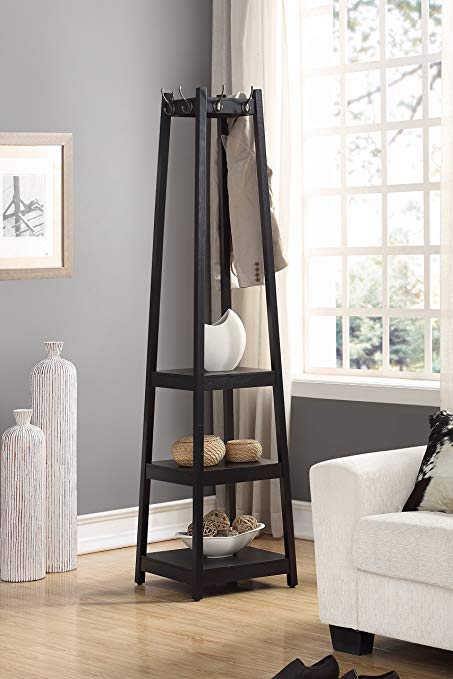
    Kings Brand Black Finish Wood Coat Rack Stand is absolutely beautiful. This coat rack was made with real wood and the black finish gives it a beautiful look. This rack also comes with 6 pegs and is very sturdy. It is a great product!

    The Songmics Metal Coat Rack Purse Rack Hall Tree With 16 Rotating Plastic Hooks Espresso URCR19Z is unique and one of a kind. This rack was designed sturdy with 4 legs with 4 rubber adjustable feet so that it stays balanced, and to protect your floors. This product is easy to set up, and the best part is that you don’t need tools! There are 8 small hooks on the top, and 6 larger ones on the body. The hooks are adjustable and you can control the height of this rack. The hooks are removable and you can choose where to assembly them. This coat rack is high quality.

    The Kings Brand Black Metal Corner Entryway Hallway Rack With Bench & 6 Hooks is the next coat rack. This is an absolutely fantastic coat hanger. This coat rack was made with a shelf a bench seating. It is metal and the seat is microfiber. It was built with 6 hooks. This coat rack is very stylish and would be a great finishing touch to your home!

    The next coat rack is the SONGMICS Metal Coat Rack Free Standing Display Hat Rack Hall Tree Black URCR18B. This free standing coat rack is durable and features caps on each of the pipes to protect your clothes and floors. This coat rack was made with 12 hooks to hang your coats and garments. This coat hanger is classic and beautiful.

    The Addison 67″ Free Standing Metal Coat Rack – Stainless Steel, CR37-354403 is made of stainless steel and is very durable. This coat rack was made with 6 metal hooks, and the rack has a steel brushed finish look. It would be the perfect touch for an office, hallway, or bedroom!

    The Cortesi Home CH-CR420740 Lava Coat Rack With Marble Base, Chrome/Dark Walnut is stunning. It was made with a marble base and is very stable. This product is great for families because the hooks are child proof. There are also multiple hooks for coats and garments. The coat rack was made with dark walnut wood, and is beautiful!

    The next coat rack is the Coat Stand Wood and Metal (EXPRESSO). This coat rack is metal and wood. There are 20 hooks altogether which is perfect for more storage and less of a mess. This coat rack is unique and very sturdy.

    The next coat rack is beautiful! The Homelegance Deluxe Hall Tree with Umbrella Rack. Oak Finish is an oak finished wood rack with 6 hanging hooks and an umbrella rack. It would look beautiful with any home decor. This coat rack is also available in cherry and natural finishes. This coat rack is unique and stunning!

    This content was originally published here.

  • To “leave” or not to “leave” – Precision Landscape Management

    To “leave” or not to “leave” – Precision Landscape Management

    Fall is here and the leaves are beginning to drop.  Here are some reasons why fallen leaves should be removed from your landscape   –       Removing fallen leaves will give your landscape a neat uncluttered appearance. –       Accumulation of dead leaves can suffocate/damage your turf. –       Dry leaves can be a fire hazard. –       Leaves…

    This content was originally published here.

  • Swedish Couple Builds Greenhouse Around Home to Stay Warm and Grow Food All Year Long

    Swedish Couple Builds Greenhouse Around Home to Stay Warm and Grow Food All Year Long


    Greenhouse keeps home in the 60’s, even when it’s freezing outside; allows family to grow Mediterranean fruit in Sweden

    Marie Granmar and Charles Sacilotto literally live in a bubble, insulated from the cold and the harshness of the elements, while taking in the best of what nature has to offer.

    Their house is built inside of a greenhouse, providing them free heat and free food in the winter.

    In Stockholm, Sweden, where winter lasts 9 months out of the year, that’s a huge asset.

    The average temperature in Stockholm in January is below freezing. But step into Marie and Charles’ bubbled-in “backyard,” and you’ll be much warmer.

    “For example at the end of January it can be 28°F outside and it can be 68°F upstairs,”  says in the video below:

    A normal family in Stockholm switches on their heater on sometime around mid-September, and doesn’t turn it off again until mid-May or so, Marie says.

    The greenhouse allows them to reduce the number of months they need to heat their home from 9 to 6 months per year, and reduces the amount of energy they use doing so. Any supplemental heat they need, that is not provided by the sun, is provided by a wood-burning stove.

    Marie says she is more or less immune to the winter blues many of her friends experience during cold weather. Rain or snow, she can sit out on her balcony or her roof-top terrace and gaze at the stars, or any glimpses of sun she can catch.

    Then, during the warmest parts of the summer, her glass roof automatically opens up when it hits a certain temperature, to let the heat out so it doesn’t get too hot.

    “It can get warm a few days in the summer,” she says, “but that’s not really a problem because we open the windows and we enjoy the heat. We like the sun!”

    The family’s favorite hangout is the rooftop deck. Since they built a glass ceiling, they no longer needed a roof, so they removed it to create a large space for sunbathing, reading, gardening or playing with their son on swings and bikes.

    In addition to keeping their bodies warmer, the greenhouse also keeps their plants warmer.

    The footprint of the greenhouse is nearly double that of the home, leaving plenty of room for a wrap-around garden. And since they’ve created a Mediterranean climate for themselves, the couple grows produce that typically isn’t grown in Sweden, like figs, grapes, tomatoes, cucumbers and herbs. Outside the glass they have cherry and apple trees.

    “Growing things here is not easy,” Marie says in the video. “We need all the extra energy we can get.”

    On top of free heat, the couple has also installed a rainwater collection system for free water, and a composting toilet system that provides free fertilizer for their plants. Also, the plants that thrive in their home return the favor by cleaning the air and providing more oxygen.

    It starts with a urine-separating toilet and uses centrifuges, cisterns, ponds and garden beds to filter waste water and compost the remains.

    For the future, the couple is working on designing a system to capture excess solar energy during the summer and store it for the winter.

    “If you want to be self sufficient, and not dependent on bigger systems, you can have this and live anywhere you like,” Marie said.

    “It’s all a philosophy of life, to use nature, sun and water to live in a another world,” Charles said.

    Charles and Marie weren’t the first ones to build a house-inside-a-greenhouse. Their idea was inspired by Swedish architect Bengt Warne who built the first “Naturhus” (Nature House) in Stockholm in 1974:

    Since then a handful of others have been built in Sweden and Germany.

    The post Swedish Couple Builds Greenhouse Around Home to Stay Warm and Grow Food All Year Long appeared first on Return to Now.

    This content was originally published here.

  • The Mayonnaise House Plant Trick | The Creek Line House

    The Mayonnaise House Plant Trick | The Creek Line House

    If you love the idea of having beautiful, healthy plants around your home, but can’t quite seem to get your plants to thrive, try this mayonnaise house plant trick!

    If you love the idea of having beautiful, healthy plants around your home, but can't quite seem to get your plants to thrive, try this mayonnaise house plant trick!OK, this mayonnaise house plant trick is going to sound downright crazy to some of you, but just hear me out! This trick is used by professionals and it just may be the thing to perk your plants up!

    One mistake a lot of new plant owners make is that they think house plants are kind of a “set-it-and-forget-it” type of home decor item. Or maybe rather at, “set it, water it occasionally, but mostly forget it” type. This is especially true with all these super low-maintenance succulents that are so popular now.

    The problem is that we often go a little too far in the low-maintenance direction and then are disappointed when our plants look a little lacklustre. So here’s what to do!

    MY LATEST VIDEOS


    First of all, every 2 weeks or so, you need to wipe down your leaves. To do this, take a damp, slightly soapy cloth and gently wipe the underside and the top side of each leaf. Follow up with another damp, soap-free cloth to remove the soap.

    Dust build-up on plants not only looks yucky, it can also clog your plant’s pores and prevent transpiration. Plants need their leaves to be clean so they can enjoy the sunshine as well!

    Want your cut flowers to look great too? How to Make Cut Flowers Last LongerThe Creek Line House

    The Mayonnaise House Plant Trick

    Now here’s where the mayo comes in! This is especially good for plants with wide, smooth leaves.

    Put a small amount of mayo in a dish and using another clean, dry cloth, wipe the top of each leaf of your houseplants. Not only will this give you those amazing super-shiny leaves that you see on plants at the florist’s, mayonnaise is also super effective at breaking down and removing any built-up sticky gunk like sap, so it will make sure your plant’s leave are really extra clean.

    And wow does it ever make those leaves shine!

    This may be just the ticket to keep your houseplants looking beautiful and healthy!

    Have you ever heard of the mayonnaise house plant trick before?

    If you enjoy little tips like this one, visit my subscribe page and I’ll keep you updated whenever I post a new one!

  • 20 Cut & Come Again Veggies For An Endless Supply Of Free Food

    20 Cut & Come Again Veggies For An Endless Supply Of Free Food

    People who reside in places with a shorter growing season have come up with many clever ways to extend the harvest –from row covers to cold frames to greenhouses.

    Succession planting is another way to maximize your vegetable garden’s productivity. Varying by approach, succession planting involves careful consideration of crop type, maturity dates, space, and timing.

    Cut and come again gardening offers a similar boost to yields as succession planting, but without any extra planning. It’s definitely the easiest way to get a succession of harvests throughout the season, and all from a single plant.

    Any plant that grows in a rosette is a good candidate for cut and come again. For example, leafy greens are terrific cut and come again plants. Snip the outer leaves while leaving the younger inner leaves intact for fresh salads throughout the summer. Many herbs can handle repeated harvests too.

    Best of all, many cut and come again plants are super nutrient dense, providing you with plenty of vitamin and mineral rich foods throughout the summer.

    20 Cut & Come Again Veggies For Endless Harvests

    Amaranth (Amaranthus spp.)

    Grown for its edible leaves and seeds, amaranth also features a gorgeous display of tightly packed purplish flowers that grow in spikes.

    Amaranth greens can be plucked as they grow. Smaller leaves will be tender and mild in taste while more mature greens have a deeper, nuttier flavor.

    Arugula (Eruca sativa)

    Arugula is a tangy leafy green vegetable, excellent in homemade mesclun mixes. It is a fast growing, cool season crop that can be harvested just four weeks after sowing.

    Arugula leaves taste best when still young, so pick greens when they are 2 to 3 inches long, working from the outside of the plant in.

    Asparagus (Asparagus officinalis)

    A perennial vegetable that returns year after year, asparagus takes two to three growing seasons to become established enough for its first harvest.

    Once matured, check up on your asparagus plants every other day. When shoots are at least six inches tall, snip off at the soil line. Cutting asparagus will encourage more growth for new shoots.

    Basil (Ocimum basilicum)

    Basil is a fast growing, heat loving herb that yields plenty of leaves for making pesto, soups, flavored oils, and more. It is also a fantastic companion plant for tomatoes and peppers, all while naturally repelling many garden pests.

    To keep basil plants compact and productive, snip tops off ¼ inch above the node – like so.  

    Beet Greens (Beta vulgaris)

    Beets are fantastic producers in the garden. Not only will beet plants provide you with healthful root vegetables at the end of the season, they also produce an abundance of nutrient rich leafy greens as the beetroots grow.

    For the tastiest beet greens, continually harvest throughout the season. Snip outer leaves when they are no more than 6 inches tall – the smaller the leaf, the more tender. Take a cutting or two from each plant, leaving an inch of stem still attached to the beetroot.

    Bok Choy (Brassica rapa var. chinensis)

    A shade loving Chinese cabbage, bok choy grows in a celery like habit with a bulbous base and broad green leaves.

    Remove outer leaves for on the go harvesting. Or cut the entire plant back, leaving a couple of inches of growth – bok choy will resprout a new plant.

    Celery (Apium graveolens)

    Celery requires a longer growing period (130 to 140 days) in cooler summer temperatures. If you reside in a good climate for growing celery, you will be rewarded with a bountiful harvest.

    Snip outer celery stalks and work your way inwards when the plant is 8 inches tall. Store stalks in the fridge and they will keep for several weeks.

    Chicory (Cichorium intybus)

    Great sautéed or eaten fresh in salads, leaf chicory very much resembles a dandelion in its growth habit. Since it forms rosettes as it grows, pluck a few outer leaves from each plant for a bountiful harvest.

    Chives (Allium schoenoprasum)

    Chives are an easy to grow perennial herb with a spiky grass like appearance. You can receive a multitude of harvests throughout the summer months by pruning the entire plant back, leaving an inch or two of growth at the soil line. Be sure to cut often and regularly to keep chives productive and prevent them from going to seed.

    Collard Greens (Brassica oleracea)

    Closely related to kale and broccoli, collard greens are a loose leaf cabbage with broad green leaves that grow in a rosette.

    Like other cruciferous vegetables, collards are a cool season crop that can take more than 60 days to mature. In the meantime, take leaf cuttings by snipping them off at the base of the thick stalk.

    Corn Salad (Valerianella locusta)

    A pint sized leafy green, corn salad (also called mâche, lamb’s lettuce, nut lettuce, and rapunzel) is a tiny annual with deep green leaves and a distinctive nutty flavor.

    Harvest outer leaves when they are 3 inches in length, working from the outside in.

    Cress (Lepidium sativum)

    Garden cress is one of the fastest growing foods, ready to be harvested in just two weeks. It is a spicy herb that adds a delectable zing to salads and soups.

    Once cress is about 4 inches tall, you can take your first cutting. Leave a ½ inch stem behind and garden cress will quickly regrow.

    Dandelion (Taraxacum officinale)

    A wildflower with many uses, dandelions have long been considered a weed due to its amazing ability to persist. Thanks to its deep taproot, it can be cut all the way down to the ground and will happily regrow.

    Harvest dandelions flowers to make tea and botanical oils, and use the green leaves for salads.

    Kale (Brassica oleracea)

    Available in varying shades of green and purple, kale is a type of non-heading cabbage with crinkly or flat leaves. Kale becomes bitter when exposed to too much heat so seeds should be planted in spring and fall.

    Taking around two months to mature, you can pluck young leaves from the plant for fresh salads or wait for larger leaves to use in cooking.

    Radicchio (Cichorium intybus var. foliosum)

    A type of leaf chicory, radicchio is well known for its striking purple-red leaves and bright white veins. It has a somewhat bitter, spicy, and nutty flavor raw but becomes much sweeter when touched by frost or roasted.

    Though the more common varieties grow similarly to cabbage, there are other types of radicchio that form upright heads that resemble romaine lettuce. Either type can be a cut and come again plant. Carefully peel back and remove the outer leaves for heading varieties.  

    Romaine Lettuce (Lactuca sativa)

    With tall upright heads and firm ribs, romaine (or cos) lettuce spans far more varieties than the common green leaf type used in Caesar salads.

    Because they bunch together as they grow, cut the outer leaves for easy greens on the go.

    Scallions (Allium fistulosum)

    Also known as green onions or spring onions, scallions are quick growing plants with tubular, hollow green shoots that emerge from a small bulb.

    Because they grow so rapidly, snip greens an inch or two above the soil line when plants are about six inches tall. Scallions will continue to send out shoots from the bulb.

    Spinach (Spinacia oleracea)

    Spinach requires six weeks of cooler temperatures to thrive. As it grows, keep an eye on its leaves and pick them before they have fully matured. If you wait too long, spinach becomes bitter with age.

    To get the most out of your crop, harvest outer leaves and let the center continue to grow.

    Swiss Chard (Beta vulgaris subsp. vulgaris)

    Swiss chard is essentially a beet, but without the edible bulb. It grows crinkly, deep green leaves on colorful stems.

    Keep Swiss chard productive by snipping outer leaves as soon as they are mature.

    Turnip Greens (Brassica rapa)

    As with beets, turnips produce tasty and nutritious greens above the soil. Cut these when they are about 4 inches in length, taking just a couple leaves from each plant at a time.

    Cut & Come Again Gardening Tips

    There inevitably comes a time where cut and come again vegetables will have expended all their energy and exhausted their capacity to produce new growth.

    Although you should be able to get several harvests per plant each growing season, you can help replenish their energy stores by fertilizing regularly. Use a well rounded fertilizer, such as compost tea.

    Each time you take from a plant, give it a thorough watering. A good drink after cutting will aid in the plant’s recovery while also boosting growth.

    Pin This To Save For Later