Category: Business

  • Electronics exports hit 10-year low, heralding further pain ahead, Government & Economy

    Electronics exports hit 10-year low, heralding further pain ahead, Government & Economy

    SINGAPORE’S electronics exports in May posted their sharpest contraction since 2009, dragged down by the US-China trade conflict, the fading of the semiconductor cycle and weakening external demand.

    Economists warn that electronics players should brace themselves for a long winter, as the ongoing US-China trade tension – the biggest wildcard – remains unresolved and the global appetite for chips wanes.

    Overall, non-oil domestic exports or NODX, of which electronics is a subset, posted a dismal showing in May, plunging by 15.9 per cent, the biggest fall in more than three years. Enterprise Singapore, in the release of the monthly trade data, noted that this was due to the high base in May last year.

    Market voices on:

    The fall follows two straight months of double-digit declines: It was a 10 per cent drop in April and an 11.8 per cent contraction in March. But it was slightly less gloomy than what economists had predicted earlier; they had expected an 18.7 per cent plunge in exports.

    While the lacklustre performance in May came on the back of declines in both electronic and non-electronic shipments, it was the former that was the main drag.

    Electronics plummeted 31.4 per cent in May, following a 16.3 per cent fall in the previous month. Integrated circuits (ICs or chips), disk media products and parts of ICs contributed the most to the drop.

    OCBC Bank economist Howie Lee said the sharp fall in electronics exports was “mostly a result of poor demand”, which was expected, given the continued sluggishness in the global electronics sector, particularly in China.

    “We do not expect a quick turnaround in the fortunes of the electronics sector,” he said.

    “The multiple trade barriers by the US are likely to crimp global disposable income, dampening worldwide demand for smartphones and PCs and pushing the highly cyclical electronics industry into an even deeper downturn.”

    Maybank Kim Eng economists Chua Hak Bin and Lee Ju Ye pointed out that the trade numbers underscored the fragility of Singapore’s export growth this year.

    They noted that US export controls on tech goods to China, including Huawei, will worsen disruption to supply chains.

    They wrote in a report: “With the broadening of the US-China trade war to a tech war, Singapore may face increasing pressure and collateral damage, given the widening reach of US export controls on emerging and foundational technologies.”

    Many multinational companies that abide by US export controls such as Intel, Micron, Broadcom and Panasonic have a presence in Singapore, the Maybank Kim Eng economists noted.

    Non-electronics exports also weighed on NODX in May, marking its third straight month of contraction.

    It fell by 10.8 per cent last month, with civil engineering equipment parts, non-monetary gold and petrochemicals contributing the most to the fall.

    In comparison, exports of pharmaceuticals, which tend to be volatile, surged.

    Non-oil exports to the majority of Singapore’s top markets shrank in May, with the exception of the US. The largest contributors to the NODX decline were China, Taiwan and Hong Kong.

    Total trade shrank by 2.1 per cent in May as both imports and exports declined, after the 3.2 per cent growth in the preceding month.

    With the release of the latest NODX figures, several economists lowered their export forecasts for the year against the backdrop of a deteriorating external environment.

    This follows last month’s downgrading of the official NODX full-year forecast from zero to 2 per cent growth to -2 to zero per cent growth.

    Some of the latest downgrades came from UOB, which lowered its projection to between -1 and -3 per cent in 2019 (from -1 per cent previously); OCBC lowered its forecast from -2.2 per cent to -2.6 per cent.

    With exports hard hit, economists are speculating that Singapore could experience a severe economic downturn down the road.

    Maybank Kim Eng’s Mr Chua and Ms Lee are among those entertaining this possibility: “A full blown trade war, if (President Donald) Trump applies tariffs to the remaining trade items with China, could see Singapore slip into recession.”

    With so much at stake, all eyes will be on the leaders of the world’s two biggest economies at the upcoming Group of 20 Summit in Osaka this month, when the US and China are expected to try to iron out a trade deal.

    But economists are not holding their breath.

    Dr Tan Khay Boon, senior lecturer at SIM Global Education, said: “With no deal between the US and China in sight, as well as the continuation of the messy Brexit and increasing instability in the Gulf region, the trade environment is unlikely to turn around in the immediate future.”

    This content was originally published here.

  • Google to invest $1 billion in San Francisco Bay Area housing

    Google to invest $1 billion in San Francisco Bay Area housing

    Google will invest $1 billion toward efforts to develop at least 15,000 new homes in the San Francisco Bay Area.

    “Across the region, one issue stands out as particularly urgent and complex: housing,” CEO Sundar Pichai wrote in a blog post. “As Google grows throughout the Bay Area — whether it’s in our home town of Mountain View, in San Francisco, or in our future developments in San Jose and Sunnyvale — we’ve invested in developing housing that meets the needs of these communities. But there’s more to do.”

    The announcement comes as tech companies, especially Google and its parent company Alphabet, face increased pressure from local communities claiming their expansion encroaches on the Bay Area’s already-tight housing market and displaces long-time residents. The move could also be an attempt to preempt protests planned for the Alphabet shareholders meeting Wednesday, as some activists are concerned about Google’s effects on housing prices and local communities.

    More than 45,000 Google employees live in the San Francisco Bay Area, according to Pichai.

    The $1 billion will be broken up into a few different funding types.

    Google will, over the next 10 years, rezone $750 million worth of its property, most of which is currently zoned for commercial and office space. That means Google could knock down existing offices to enable housing.

    Nonprofits focused on homelessness and displacement will get $50 million, and $250 million will go toward an investment fund for developers specifically to build affordable housing.

    WATCH NOW: How tech IPO could impact San Francisco real estate

    This content was originally published here.

  • Data Indicate There’s No Need to Panic About Rising Seas

    Data Indicate There’s No Need to Panic About Rising Seas

    Those who argue human greenhouse gas emissions are causing dangerous climate change regularly point to rising seas as one of the most certain and devastating impacts on human communities.

    According to environmental activists, mainstream media outlets and some scientists—who routinely cite Intergovernmental Panel on Climate Change (IPCC) reports—unless governments take drastic action to transform the world’s economic system, including ending the use of fossil fuels for energy in a very short period, entire island nations will disappear beneath the seas and low-lying coastal cities will be swamped, forcing a great migration of populations inland.

    The threat of rising seas to various communities is not, in the words of the immortal Shakespeare, “Much Ado About Nothing.” However, alarming claims made about humanity’s contribution to rising seas by government bureaucrats, environmental lobbyists and scientists with a vested interest in imposing their socialist vision of society on a largely unwilling public are, also in the words of Shakespeare, “tale[s] told by …  idiot[s], full of sound and fury, signifying nothing.”

    The IPCC asserts it is “very likely” sea level rise has accelerated since the middle of the twentieth century in response to warming caused by rising greenhouse gas emissions, and “it is very likely that the rate of global mean sea level rise during the 21st century will exceed the rate observed during 1971–2010 … due to increases in ocean warming and loss of mass from glaciers and ice sheets.”

    However, hard data show, contrary to IPCC claims, ocean levels are not rising at either an unusually rapid rate on average globally, nor by an abnormal amount in historical terms.

    A new report by Drs. Craig Idso, David Legates, and S. Fred Singer, released by The Heartland Institute, proves this point beyond any doubt. The scientists examined long-term data from tidal gauges and other sources and concluded the amount of sea-level increase Earth has experienced over the past century is not unusual historically, nor has the rate of rise increased significantly over the past few decades. As Idso, Legates, and Singer put it, “the highest quality coastal tide gauges from around the world show no evidence of acceleration since the 1920s.”

    The disconnect between data recorded by the global tidal gauge system and projections made by IPCC is due, according to the authors, to the fact that “[l]ike ice melting, sea-level rise is a research area that has recently come to be dominated by computer models. Whereas researchers working with datasets built from long-term coastal tide gauges typically report a slow linear rate of sea-level rise, computer modelers assume a significant anthropogenic forcing and tune their models to find or predict an acceleration of the rate of rise.”

    A 2017 report released by The Heartland Institute, authored by geophysicist Dennis Hedke, analyzed data collected from 10 coastal cities with relatively long and reliable sea-level records, including Ceuta, Spain; Honolulu, Hawaii; Atlantic City, New Jersey; Sitka, Alaska; Port Isabel, Texas; St. Petersburg, Florida; Fernandina Beach, Florida; Mumbai/Bombay, India; Sydney, Australia; and Slipshavn, Denmark. Hedke found there was no correlation between changes in sea levels at these locations and rising carbon dioxide levels.

    For some cities, the rate of sea level rise has remained virtually constant, neither increasing nor declining appreciably from the rates experienced before humans began adding substantial amounts of greenhouse gases to the atmosphere. By contrast, some cities, such as Ceuta, Spain, have experienced very little sea-level rise over the past century, exhibiting almost a flat trend line, below the historic rate of global sea level rise of approximately seven inches per century. Other cities, such as Sitka, Alaska have actually experienced falling sea levels. Still other cities, such as Atlantic City, have experienced a large, rapid increase in sea levels.

    The point is that different areas around the world are having different experiences with sea levels, none of which correspond well either with the projections made by IPCC based on computer models or the steady increase in atmospheric greenhouse gas concentrations. Rather than responding to rising greenhouse gas levels, changes in sea levels seem to reflect localized conditions.

    Matt Vespa

    Although, on average, global sea levels have risen by approximately 400 feet since the beginning of the end of the most recent ice age—approximately 20,000 years ago—the rate of sea level rise has risen and fallen at various times, slowing and increasing on the order of tens, hundreds, and thousands of years over the past 20,000 years, having nothing whatsoever to do with human activities.

    Human activities, such as the construction of barriers, the channelization of rivers, installing pumps, the conversion of coastal wetlands to densely populated metropolitan areas, filling in shallow water bays, replenishing eroded beaches and the draining of coastal aquifers for human consumption have undoubtedly contributed to making some coastal regions and populations more vulnerable to rising seas and other cities and populations less vulnerable. However, when analyzing the causes and consequences of changing sea levels, there is little evidence increased greenhouse gas emissions are contributing to higher ocean levels.

    Our knowledge of previous interglacial cycles indicates seas are going to continue rising unless and until the next ice age comes, notwithstanding any efforts humanity makes to stem the rising tides; like the efforts of the apocryphal story of King Canute, they are bound to fail.

    It makes sense to prepare for rising seas by hardening coastal areas, discouraging poorly designed coastal development, and making people living along coasts aware it is hazardous and investments made there could be swallowed by rising water. However, ending the use of fossil fuels, and giving ever larger government increasing power over peoples’ lives will not stop seas from rising, but instead will only serve to make the world’s people poorer and less free.

    This content was originally published here.

  • This Same-Sex Couple are giving them all a bad image and avoid any of them at all cost!

    This Same-Sex Couple are giving them all a bad image and avoid any of them at all cost!

    These people are just mean!  What on earth is wrong with them.  Really!!  You want a cake for your special day to be created by people who do not want to make it?  Why?  You think you are making a point?  The point I get here, is you are a mean, vindictive, cruel, selfish and full of a need for political drama.  You do not care about helping others understand.  We must follow your rules, and you do not have to follow any yourself.  Let people be!  Do you think you are so much better than anyone else?

    The Supreme Court is throwing out an Oregon court ruling against bakers who refused to make a wedding cake for a same-sex couple. The justices’ action Monday keeps the high-profile case off the court’s election-year calendar and orders state judges to take a new look at the dispute between the lesbian couple and the owners of a now-closed bakery in Gresham.

    The case involves bakers Melissa and Aaron Klein, who paid a $135,000 judgment to the couple for declining to create a cake for them in 2013. The owners of Sweet Cakes by Melissa, who closed their shop months after the controversy began, refused to sell a wedding cake to a lesbian couple, citing a conflict with their religious beliefs. “I asked for the name of the bride and groom. She informed me that it was two brides. And I literally apologized to her. I said I’m sorry, I didn’t’ mean to waste your time,” said Aaron Klein.

    The justices already have agreed to decide whether federal civil rights law protects people from job discrimination because of their sexual orientation or gender identity.

    However, a little advice to the couple that bakes the cake.  Do you believe in the power of the Holy Spirit and Jesus?  You really need to check  this site  https://unveiledlife.org/.You have an opportunity to bless your cake creation with the power of the Holy Spirit.  Get that wedding crowd anointed with the Spirit of Christ with every bite they eat.  You are blessed to have this event and many more, it sounds like, to invade this group with the taste of goodness!

    source

  • Tormented Robot Pulls a Gun on Its Creators in Boston Dynamics Spoof

    Tormented Robot Pulls a Gun on Its Creators in Boston Dynamics Spoof

    Boston Dynamics has made a name for itself building incredibly agile and skillful robots, its steady stream of demonstration videos never failing to impress. And scare us a little, too.

    A number of the team’s YouTube clips show its growing stable of robots performing a variety of feats while at the same time being shoved with a hockey stick wielded by one of its creators. Or simply kicked.

    It’s never clear if the assaults are designed to show off the robot’s nimbleness, or used merely as a way for stressed employees to blow off steam. Either way, the eager mistreatment recently inspired a team of Los Angeles video wizards to create a spoof based on Boston Dynamics’ own videos. And the result is hilarious.

    Corridor Digital launched in 2010 and has made a name for itself producing viral short-form videos, some of which have picked up awards. The team also produced and directed the Battlefield-inspired web series Rush and the YouTube Red series Lifeline, and have created TV commercials for various companies, Google among them.

    Like any good spoof, Corridor Digital’s efforts emulates the original and then takes it up a notch. In it, we see the “Bosstown Dynamics” robot – clearly based on Boston Dynamics’ Atlas bot— performing various tasks such as passing boxes and balancing on blocks.

    Similar to the original videos, we see one of two guys kick the robot before whacking it with a hockey stick. He then uses the stick to push the box out of reach of the robot, prompting it to adjust its movements in a bid to pick it up. As the video goes continues, the two guys torment the robot to such an extent that you actually start to feel sorry for the machine taking that’s taking the hits.

    But it’s the increasing absurdity that brings the laughs, leading to a finale you’ll find either amusing or chilling, depending on where you think we’re heading with robot technology.

    Hardly surprisingly, the video quickly went viral on social media, with many people tricked into thinking the robot was real. Considering the kind of advances made in recent years by Boston Dynamics, that’s kind of understandable. But watch until the end and you’ll get the first clue as to how it was made.

    Corridor Digital also posted a separate video showing the effort it took to create its computer-generated robot, and some of the challenges it had to overcome to produce the video.

    Boston Dynamics’ stellar work, along with its penchant for beating up robots, has inspired plenty of spoof videos over the years. Here are some more.

    This content was originally published here.

  • Woman in wheelchair fires Taser at Detroit McDonald’s worker

    Woman in wheelchair fires Taser at Detroit McDonald’s worker

    A woman in a wheelchair tired of waiting for her food at a Detroit McDonald’s fired a Taser at an employee Thursday night. Wayne State Police Lt. Keith Morris said the woman fired her Taser at the employee, who dodged the dart, at the location near WSU at Woodward and Canfield, at about 5:30 p.m.  The employee was not injured and called police to the location, where officers found the irate customer with the Taser tucked in her shirt. Officers confiscated the Taser and requested an out of custody warrant. If the Wayne County Prosecutor’s Office allows it, the woman will be arrested.

  • Amazon’s Life-Size Inflatable Speedboat Will Make You Feel Like A Millionaire

    Amazon’s Life-Size Inflatable Speedboat Will Make You Feel Like A Millionaire

    So, since summer is already here (sorry, Australians) it’s time to plan your weekend getaways with your best friends and family. But if you want to have some relaxing vacation time, it almost always comes at a price. Luckily, there are still ways to spend your holidays like royalty without losing all of your hard earned money. If you’re still not rich enough to get an actual speedboat (you’ll get there), you can spend this summer by replacing it with an inflatable one that is available on Amazon. Honestly, it’s just as good.

    Not all of us can afford a yacht or a speedboat, but luckily, with the inflatable boat market booming, we can afford something that will definitely be fun, relaxing as well as a great option for you and all of your friends to enjoy a sunny day out in the lake.

    This speedboat is designed to fit six people

    The boat also includes an inflated rear swim platform, eight cup holders, an inflatable bench seat and five handles for easy mounting and dismounting.

    And the best part, there is even a built-in cooler for your drinks so you could enjoy your day off even more.

    It also measures about 20 feet long x 10 feet wide and 3 feet tall.

    The inflatable speedboat is available on Amazon

  • Starting a Python blog

    Starting a Python blog

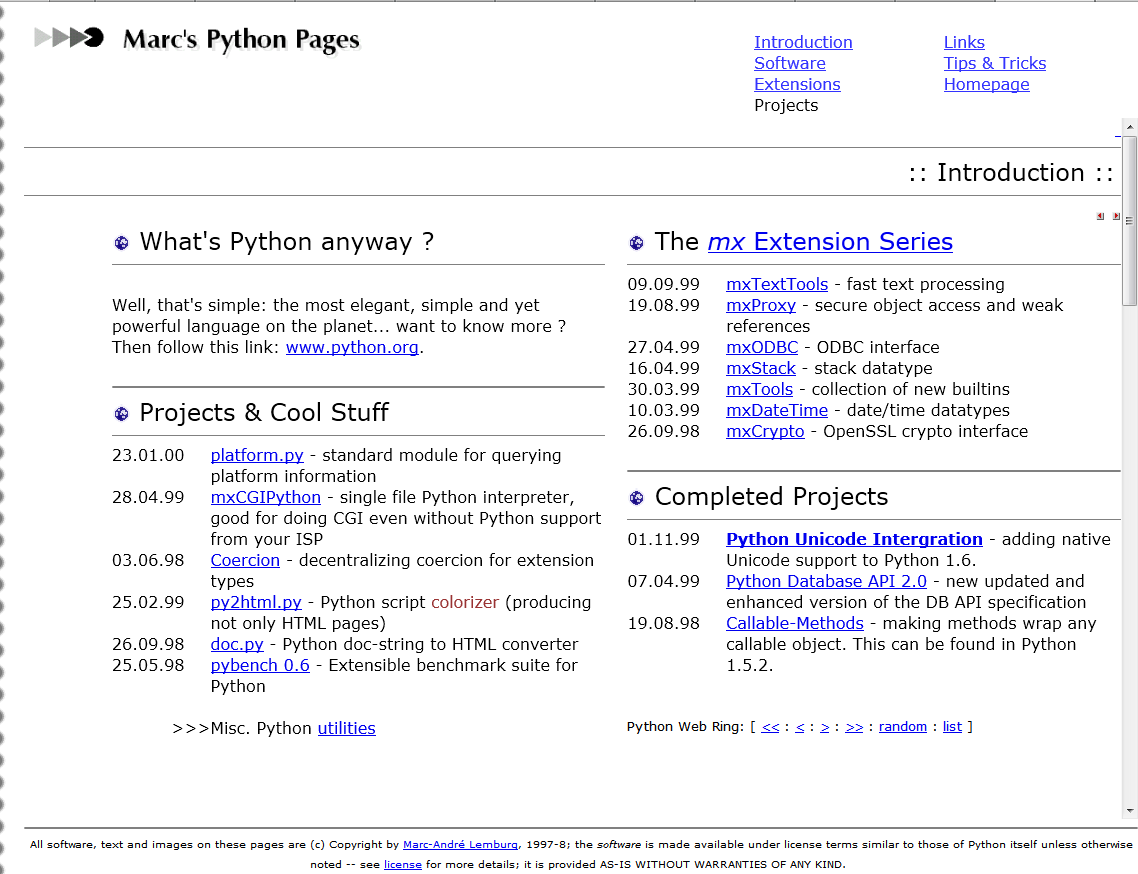
    Long ago, in the late 1990s, I had a website on Christian Tismer’s Starship Python to show my Python projects to the community and report on new developments, provide tips, hints and small utilities. The site was called “Marc’s Python Pages”:

    image

    Turning a hobby into business

    I then launched my company eGenix.com Software, Skills and Services GmbH in 2000 to market a web application server I had been working on for a couple of years. As it turned out, I was too early with the product. The market was still thriving using CGI scripts, Perl and a couple of static pages to run websites. At the same time, the Internet bubble burst, so it wasn’t exactly perfect timing for starting a DotCom company.

    I eventually sold a single license of the application server to Steilmann in Bochum and then turned to consulting work, using the eGenix mx Extensions I had written for the application server as a way to market the company and myself to companies using Python.

    This worked reasonably well and I have since run several projects, in-house at clients or outsourced to eGenix, and continued to add new useful commercial products to our portfolio – mostly around the commercial ODBC database Python interface mxODBC I had originally written for the application server.

    Commercial and Open Source Software

    Incidentally, the development in 1997 also triggered the development of a date/time library at the time, since Python had no way of storing date/time values as objects apart from using Unix ticks values. Since it was a basic building block, I open-sourced it, in the same spirit as Python itself was open source (even though the term wasn’t known at the time). mxDateTime became the de facto standard for date/time storage, until Python itself received a datetime module.

    I also open sourced several other C extensions for Python, which were all used in the application server, such as , , , etc. – what was then to become the eGenix mx Extensions.

    Still enjoying Python and it’s community

    Over 15 years later, I still haven’t lost interest in Python, which I think means something. I continue to enjoy working with it, for it and enjoy the community that has developed around Python every single day.

    I usually write lots of emails on mailing lists to discuss and stay in touch with people. Lately, I found I was missing a more persistent way of writing down ideas and snippets, something along the lines of what once were the Starship pages, so here you go… hope you’ll enjoy the ride.

    If you want to follow the blog, please see the contact page. It’s currently possible to use RSS, Twitter and Tumblr for this.

    Enjoy,

    Marc-André

    PS: The website is not yet complete, e.g. the project pages don’t work yet. I’ll add more content over the next few weeks.

    This content was originally published here.

  • US concerned about NKorean activities

    US concerned about NKorean activities

    Kathmandu, June 14

    Amidst reports of growing activities of North Koreans in Nepal, Mark Lambert, special US envoy for North Korea, has asked the Nepal government and politicians not to entertain North Koreans in the country, stating that Nepal as a member of the United Nations should respect the decision taken by the global body to impose sanctions on the country.

    Lambert, who is on a three-day visit to Nepal, made this appeal to lawmakers, senior government officials and ruling Nepal Communist Party (NCP) Co-chair Pushpa Kamal Dahal.

    He expressed concerns about growing business activities of North Koreans in Nepal. “He also expressed fear that North Koreans might have been using Nepal as a base to commit cyber crimes,” a lawmaker, who met Lambert, said.

    Lambert met four lawmakers Pabitra Niraula Kharel, Deepak Prakash Bhatta, Dibya Mani Rajbhandari and Sarala Kumari Yadav, during his visit. Kharel is the chairperson of the parliamentary International Relations Committee, while the other three are members of the same panel. Lambert also met NCP Co-chair Dahal.

    Lambert’s message during these meetings was clear — the United Nations Security Council has placed sanctions on North Korea, and Nepal, as a member country, should respect this decision.

    Nepal became a member country of the UN in 1955. The UN has imposed a number of sanctions on North Korea after the country started developing nuclear weapons, in violation of the UN charter. These sanctions, among others, bar UN member countries from hosting citizens of North Korea.

    “Nepal is a member of the UN and it has the obligation to follow resolutions passed by the UN Security Council,” said US Embassy Spokesperson Andie De Arment, who confirmed that Lambert was in Nepal to discuss growing activities of North Koreans in the country.

    Earlier, US Secretary of State Mike Pampeo had also raised the North Korean issue during Foreign Minister Pradeep Kumar Gyawali’s visit to the US in December.

    The issue was also raised by David J Ranz, acting deputy assistant secretary for US State Department’s Bureau of South and Central Asian Affairs, during his visit to Nepal in May.

    The post US concerned about NKorean activities appeared first on The Himalayan Times.

    This content was originally published here.

  • Golden Tips to Learn Any Programming Language Faster

    Golden Tips to Learn Any Programming Language Faster

    Learning a new programming language is never an easy task for anyone. You have to go through a lot of new concepts, resources, and tools and work on them for the first time. In this article, I will be giving some important tips that every programmer should keep in mind while learning any programming language.

    Tips to Learn Any Programming Language Faster

    1. Organize Your Goal

    Computer programming languages include Javascript, SQL, Python, C++, Java, PHP, Ruby and many more. Each of these languages has its specific applications. Therefore, you will take a great step forward by trying to know your goal so that you will be able to learn the right programming language. Conversely, if you fail in setting your direction right, you will be beating the air.

    2. Become a self-taught programmer

    This is important, first and foremost motivate yourself to become a self-taught coder. Most of the successful programs are self-taught, i.e., they choose a programming language like Python or Java (Python is mostly recommended because it is extremely high-level language) and start learning about its syntax with reference to documentation or ebook. According to 2018’s stack Overflow Survey, more than 86% of programmers taught themselves coding.

    3. Focus on the fundamentals

    One of the most common mistakes people do — is they try to finish the fundamentals as quickly as possible and start the coding part. In this process, they skip a few chapters at the beginning and spend less time with the fundamentals of the subject.

    First, you’ll have to understand that this doesn’t work in learning computer programming. You might finish the tutorial or reach the actual coding section fast but it will create a lot of troubles for you in the future. People who learn this way usually stuck at higher levels, easily lost and ultimately have to go back to learn basics.

    4. Use the right tools

    The primary tool is a computer with the required configuration to run programming software. The software includes bug databases, debuggers, build tools, disassemblers, interface generators, Notepad++ and much more. However, the tools you need depends on the type of programming language you want to learn.

    5. Dry Run Your Code

    Dry run means iterating through each line of your code on the paper before running it on the machine. This habit is known to improve logical thinking and makes the next levels of learning easier and faster. Dry running code is the best way to learn how to program. If you are planning to make a career in programming, try to adopt this habit in the early stage of learning.

    6. Code as you learn

    Make your learning process active rather than passive. Start juggling with the lines of code as you learn. Do not just sit back and watch tutorials or read notes hoping to implement what you are learning later. You will encounter many roadblocks that will be forcing you to go back and start learning again.

    The earlier you start trying out what you are learning, the faster you will learn. In fact, your coding environment should be running concurrently as you learn. The most recommended way of learning is to build a project as you read through the learning material. This way you will be able to learn faster and in a systematic way.

    7. Practice with Patience

    Practicing is the best way you can improve your coding skill. However, if you skip the basics, the advanced stages will be alerting you that you have missed some parts, in the long run, you may quit. Hence, begin by learning the basics before you forge ahead to a more advanced stage.

    8. Stay Motivated

    Programming is no doubt an exciting task but it’s also known to be exhaustive. Many times people spend hours on a single bug with no solution. It has the ability to affect your complete schedule of meals and speed, which is definitely not a healthy situation especially if you are young.

    You’ll have to remain calm in those days. Our brain also needs some refreshment from time to time. It could be meeting with friends, going on a trip, some sort of exercise or just playing games on your smartphone. Always focus on maintaining a balance between everything and never forget your cool. This will ultimately help you improve focus and learn things fast.

    9. Make use of Online Resources

    There are many free online sites that provide free resources, including video tutorials, that will teach you computer programming. Therefore, you can start learning the basics of programming from free coding sites, such as Codecademy, FreeCodeCamp, Coursera, edX, Codewars and much more.

    Start using StackOverflow, the community which helps you in any of the coding-related issues. You can find many solutions for code and errors. Here is the list of 5 Best Online Communities for Programmers.

    This content was originally published here.