Category: Business

  • Trump’s Economy Makes Michael Novogratz ‘More Bullish’ on Bitcoin

    Trump’s Economy Makes Michael Novogratz ‘More Bullish’ on Bitcoin

    By CCN: Go right ahead lefties with your monetary policies. You’re rallying crypto bulls. And you right leaners who are calling for lower interest rates are as good as gold for crypto, too.

    That’s the message from former hedge fund manager Michael Novogratz. The bitcoin bull weighed in on monetary policies being bandied about that are essentially making the case for crypto. Novogratz is the CEO of cryptocurrency merchant bank Galaxy Digital.

    In a tweet this weekend, he pointed to calls for interest rate cuts being made by Vice President Mike Pence as well as former Fed contenders Stephen Moore and Herman Cain. While nominated by Trump, Moore and Cain eventually withdrew their names from consideration.

    Then there’s the controversial Modern Monetary Theory (MMT) that Rep. Alexandria Ocasio-Cortez has proposed as a way to fund her Green New Deal. She is the gift that keeps on giving. For the crypto space, her push for MMT does just that.

    This makes me more bullish Bitcoin. Stephen Moore, Herman Cain, and Mike Pence all make me bullish hard money. To be fair, MMT and some of the far left’s policies also makes me bullish crypto. https://t.co/BdKCUUnhEX

    — Michael Novogratz (@novogratz) May 4, 2019

    To Cut or Not to Cut

    The Federal Reserve decided to leave interest rates unchanged last week. This was disappointing to Pence and others who see the strong economy as one reason rates should be cut. Pence recently told CNBC:

    “I think it might be time for us to consider lowering interest rates. We just don’t see any inflation in this economy at all. We’re seeing jobs being created all over the country; that should be an encouragement to every American and also to people that operate our monetary policies.”

    President Trump sharply criticized the Fed’s move last December to raise rates. He, along with his administration’s economic adviser Larry Kudlow and Treasury Secretary Steven Mnuchin, has long championed lower interest rates.

    The constant worry is, “what happens when there is a recession?” The Federal Reserve’s toolbox that includes quantitative easing (QE) may not do the trick to stop the bleeding from a slowing economy.

    Bring It, MMT Zealots

    The basic idea behind MMT is that a government that issues its own money can never fail to meet its obligations because it can simply print money to cover them.

    However, critics of MMT charge it could result in an inflationary spiral. The policy doesn’t account for a scenario where too much money chases too few goods causing inflation. Governments would have to raise taxes to suppress inflationary pressure.

    The policy began making headlines this spring when Ocasio-Cortez started pushing it to pay for her $93 trillion Green New Deal. As reported by CCN, the idea, which has been regarded as a borderline lunatic one, is making a serious comeback into the political and economic conversation.

    Still, it may be the future of US economic theory, said hedge fund manager Ray Dalio, the founder of Bridgewater Associates, the world’s largest hedge fund.

    That’s just fine for crypto bulls like Michael Novogratz.

    This content was originally published here.
  • Cafe in Ireland supposedly adds 15% surcharge to bill for screaming children

    Cafe in Ireland supposedly adds 15% surcharge to bill for screaming children

    One cafe in Dublin, Ireland, has had enough of noisy children.

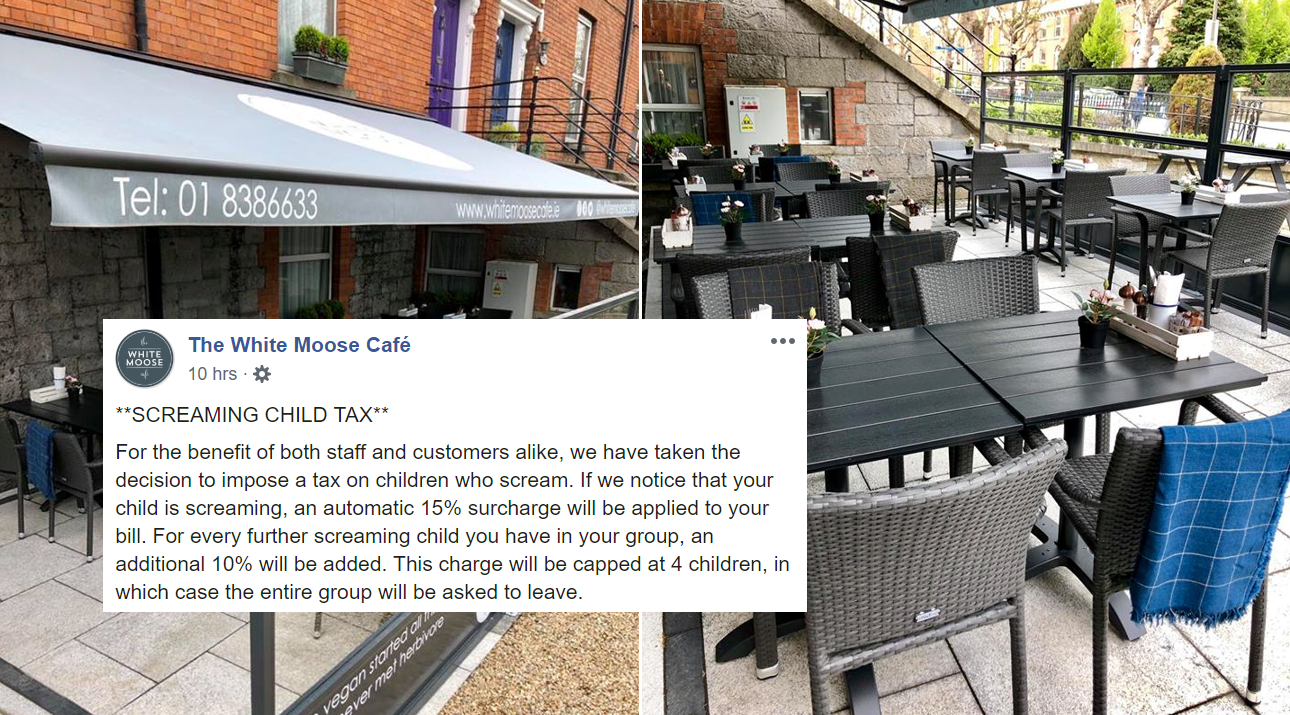
    On May 5, The White Moose Cafe announced that they would be implementing a “screaming child tax” for the “benefit of both staff and customers”.

    15 per cent surcharge

    According to their Facebook post, a 15 per cent surcharge will be applied to the bill if they notice that “your child is screaming”.

    Apparently, an additional 10 per cent will be added for every further screaming child in the group.

    However, the charge will supposedly be capped at four children, in which case the entire group will be asked to leave.

    “We trust you understand our position,” they added.

    Cafe known for being tongue-in-cheek

    It is unclear if this policy will actually be implemented, given that the cafe is known for its snarky, tongue-in-cheek responses to issues.

    For instance, this is what they had to say about breastfeeding in their cafe, as stated in their menu:

    Contrary to popular belief, breastfeeding is allowed in our café. There is a corkage charge payable of €5 for one breast or a special deal of €7.50 for two. You can’t be bringing in your own milk when we have perfectly good milk here for sale.

    And their food being cooked-to-order:

    All our food is cooked to order. This can take time. If you want fast food, there’s a McDonalds in Phibsborough village. I wouldn’t advise going there as you may be eaten alive by some local zombies.

    People supportive of new policy

    Following the “screaming child tax” announcement, however, several commenters expressed their support for this move:

    One person had a perfectly legit question, though:

    Here is their Facebook post:

    Top photo via FB/White Moose Cafe

    This content was originally published here.

  • BONOKOSKI: Trudeau’s Canada, where almost half of us are $200 from bankruptcy

    BONOKOSKI: Trudeau’s Canada, where almost half of us are $200 from bankruptcy

    When almost 50% of Canadians were figuratively wearing Depends on Wednesday, praying that Bank of Canada Governor Stephen Poloz would not inflict them with a raised interest rate, it speaks to very scary times.

    It speaks to the undeniable fact that the Trudeau Liberals and our nation’s economy are total strangers.

    Prime Minister Justin Trudeau is all about image wrapped in purple prose, international trips and enviro-lecturing, feminism and gender equality (now questioned), and bad-rash scandals like SNC-Lavalin.

    Unlike his predecessor, Stephen Harper, he is not an economist.

    He’s a snowboard instructor and a geography teacher, and it is getting more obvious by the minute as October’s federal election looms large.

    In the 2015 federal election campaign, the Conservatives accused Trudeau of “not being ready” to lead our country.

    They were not wrong.

    Canadians who were sitting on the edge of their seats Wednesday got their prayers answered by Poloz when word went out that the Bank of Canada had abandoned its warning that future interest-rate hikes would likely be unavoidable, and held its benchmark overnight rate steady at 1.75%.

    But it is bad out there, really bad.

    As Bloomberg reported Monday, an Ipso survey commissioned by the insolvency firm, MNP Ltd., said the number of Canadians only $200 away from financial bankruptcy rose this year to 48%.

    Not $2,000 away, which is bad enough, but $200 away.

    The reason Poloz gave for holding the interest rate steady, and having half of the population sighing in relief, was slower than expected global growth as well as a sluggish housing and oil sectors in Canada that saw the economy with all its feet on the brakes over the last six months.

    When it comes to those who are $200 shy of insolvency, MNP president Grant Bazian stated that “Canadians appear to be maxed out with no real plan for paying back what they have borrowed.

    “This raises many alarming questions about how and if consumer debt will be repaid, particularly if conditions deteriorate or interest rates rise.”

    But it gets even scarier.

    Despite the economic downturn—and there was nothing in Finance Minister Bill Morneau’s recent budget to turn on the “sunny ways” lamp and light the way to prosperity—Canadians continue to add to their already over-stressed debt load.

    The MNP survey, in fact, had four out of 10 respondents stating they will be unable to cover off their living and family expenses over the next 12 months without taking on even more debt.

    “This isn’t simply a matter of people living beyond their means,” said Bazian. “The reality is that too many households simply can’t make ends meet, no matter how they try.”

    The loudest cries, unsurprisingly, come from Albertans who, because of low oil prices forced upon them for the lack of Trans Mountain pipeline, get little thought and no action from the Trudeau Liberals.

    Bankruptcies in Alberta, in fact, led the way in Canada, up 21% in 2018 over the year before because there remains no pipeline to get the oilsands to the tidewater of British Columbia, and on to more lucrative markets overseas.

    This is what happens when the federal government that could bring them and the country better financial fortunes—i.e. the Trudeau Liberals—is best described as an “ineptocracy.”

    It’s a word that defines itself.

    This content was originally published here.

  • Burly Man Coffee Co. donates 100 Cars for Single Moms

    Burly Man Coffee Co. donates 100 Cars for Single Moms

    A South Florida coffee company says it’s fighting back against the message of “toxic masculinity” by donating their profits to help struggling single mothers.  Back in March, Burly Man Coffee launched their charitable giving campaign by giving a vehicle to a single mom in Lake Worth, Fla.  The company’s ultimate goal is to donate 100 cars to single mothers.  The first recipient was Celeste Bokstrom, who’s a full-time caretaker for her severely non-verbal, autistic 16-year-old son, Logan.  She has spent four years without a vehicle, making it difficult to buy groceries or get to doctors’ appointments.  It took Bokstrom two years to save enough money to purchase a used car online. Then she faced utter disappointment when she went to register the vehicle and found out the car was stolen.  “I was shocked and extremely disappointed,” Bokstrom said in a press release. “It took me a long time to save up enough money to buy a car. I lost it all in a moment. I was devastated.”  Burly Man Coffee learned about the single mother’s struggles and decided to give her a new car, an iPad for her son to communicate, and many other resourceful tools for his care. The company also provided her with a shopping spree and a makeover.  In addition, Mike Cohen, director of the Center for Brain in Jupiter, Fla., partnered with the coffee company to provide Logan with Neurofeedback therapy. Using this innovative technology, Cohen has helped autistic individuals to be able to speak and has also improved the quality of life for numerous other people suffering from brain trauma.  When representatives of the coffee company came to give her the gifts, Bokstrom couldn’t believe it.

    source

  • The Newest Trend in Bars: No Booze

    The Newest Trend in Bars: No Booze

    It was around 9 p.m. at a corner bar off a main drag in Greenpoint, Brooklyn. Two good friends and I raised froth-filled cocktail glasses, the loudest among us punctuating our cheers with a bellowing, “Yaas!” It was an entirely unexceptional scene that could have taken place in any one of New York’s thousands of bars. But there was one crucial difference.  We were imbibing at Getaway, a two-week-old bar where no alcohol is served. Our highball and coup cups were filled not with the usual whiskey or mezcal, but a hodgepodge of gussied-up mocktail ingredients like coconut milk and elderflower syrup.  Call us squares, suckers, or both, but we left the bar laughing, arms around each other. In that grand, drunk tradition, I told one friend how much I love her. We did not need alcohol to get to that happy place, but I’m sure our sugar high helped.  Getaway is just one of the latest sober bars to open in New York. One pop up, Listen Bar, with faux beer and kombucha on tap, is currently crowdfunding for a permanent space. Ambrosia Elixirs, which promises “the taste of sacred intention” in every zero-proof sip, has been in Bushwick for three years, but will expand to spaces in Williamsburg and Manhattan this spring.

    Across the pond in London, even famously beer-happy Brits can turn to he dramatically named Redemption Bar for beetroot martinis and “Pious Pina Coladas.” The bar’s founders, entrepreneurs Catherine Salway and Andrew Waters, were reportedly inspired to open Redemption after wondering, “Why should socializing always be at the expense of your health?”  A few weeks before the opening of Getaway, Amanda Mull wrote in The Atlanticthat there is quite a bit of anecdotal evidence to suggest that “millennials are sick of drinking.” While statistics still show that more than 60 percent of 22 to 37 year olds drink alcohol every month, they might be drinking less.  “What some have been quick to characterize as an interest in being sober might actually be more like a search for moderation in a culture that has long treated alcohol like a dichotomy: Either you drink when the opportunity presents itself, or you don’t drink at all,” Mull wrote.  In this way, a kind of sober tourism has emerged. Think of friends who have gone alc-free for the 31 days of “Dry January” as a testament to willpower or made a point to buy less beer as a way to feel healthy. Regardless of how truly popular these subtle movements truly are, booze-less buzz has garnered enough interest for the wellness industry to take note.

    read more

  • San Francisco Bay Area home prices fall for the first time in 7 years

    San Francisco Bay Area home prices fall for the first time in 7 years

    The median price of a San Francisco Bay Area home sold last month fell slightly compared to the prior-year period, marking the first annual drop since the bottom of the last housing crash, seven years ago, according to CoreLogic.

    In March, the median price was $830,000, down 0.1% compared with March 2018. The decline came as price gains had been shrinking for several months. Before last month, the median sale price had risen annually for 83 consecutive months since April 2012. Both May and June 2018 had the highest ever median sale price: $875,000.

    Prices follow sales, and sales have been running extraordinarily low since last summer, when mortgage rates spiked.

    “It reflects a trend that began in mid-2018 when home sales slowed and inventory grew, forcing sellers to be more competitive,” Andrew LePage, a CoreLogic analyst, wrote in a release. “The year-over-year increase in the region’s median sale price was 16.2% in March last year. But after that, the gains in the median gradually decreased each month and fell to the 2 to 3% range early this year and then disappeared this March.”

    Sales of San Francisco homes – including Alameda, Contra Costa, Marin, Napa, Santa Clara, San Francisco, San Mateo, Solano and Sonoma counties – were nearly 15% lower in March compared with a year ago. That was the lowest March reading in 11 years. Sales have been at 11-year lows since December and have fallen on a year-over-year basis for the past 10 months.

    These numbers are based on closings, so they were likely deals signed in January and February. The market should have been improving, as mortgage rates were falling, the government shutdown was over, and the stock market was surging.

    “Those factors bode well for stronger sales than we’ve seen in recent months, but any impending upswing in activity wasn’t evident in the March data,” LePage said. “Beginning in late spring last year, some potential buyers got priced out and others simply stepped out of the market amid concerns prices were near a peak.”

    Buyers overall, and especially in high-priced markets like San Francisco, are extremely interest rate-sensitive. The average rate on the 30-year fixed spiked to just over 5% last November, according to Mortgage News Daily, and then fell back again in December. In March it took a deep dive to around 4%, but has since climbed back to around 4.5%.

    The next two months will be key to understanding whether all the weakness in prices and sales is due to fluctuations in interest rates, or whether the market has simply hit an affordability wall. Inventory is rising, but largely because homes are sitting on the market longer, not because there are a ton of new listings.

    This tech-heavy housing market could also be impacted to the up or downside from new IPOs including Lyft, Uber, Slack and Airbnb.

    This content was originally published here.

  • Canada’s economy unexpectedly shrinks as resource sector stalls | Financial Post

    Canada’s economy unexpectedly shrinks as resource sector stalls | Financial Post

    Canada’s economy returned to its sluggish ways in February, with a drop in output that will reinforce expectations of a slow start to the year.

    Gross domestic product fell 0.1 per cent, taking back some of the 0.3 per cent gain in January in part due to poor weather, Statistics Canada said Tuesday from Ottawa. Economists were estimating output would be unchanged.

    The February data are consistent with an economy that continues to grapple with a number of headwinds and may have barely grown in the first quarter of 2019, extending a slump that began at the end of last year.

    Key Insights

    The monthly numbers are in line with the Bank of Canada’s pared back expectations for the quarter. Without any more growth in March, Canada’s economy may have come to another near halt in the first three months of the year, as the central bank is now predicting. Policy makers expect the economy to pick up from the second quarter on.

    Falling resource production was the main culprit in February, with the mining and oil and gas sector down 1.6 per cent — its sixth consecutive drop. While the oil and gas sector continued to show weakness, the big decline was in mining and quarrying outside of energy. That component fell 4.4 per cent, driven by reduced output of most types of metals.

    A tough winter in much of the country also played a role in the contraction, adding to the economy’s woes. This was evident in a 1.6 per cent drop in transportation and warehousing sector, the largest one-month decline for the sector since June 2011. On the flip side, February was a great month for utilities, which saw output jump 1.5 per cent because of the cold.

    Get More

    About half of the sectors tracked by Statistics Canada actually posted gains, with increases also recorded by builders, retailers and wholesalers. While conventional oil dropped, the situation in the oilsands seems to be stabilizing. That sector dropped just 0.1 per cent in February, after a 4.1 per cent drop a month earlier. Manufacturing contracted 0.4 per cent, after a 2.1 per cent gain in January that was the largest in nearly to 15 years.
    With assistance from Erik Hertzberg
    Bloomberg.com

    This content was originally published here.

  • Armenian Genocide Remembrance Day: Revisiting Islam’s Greatest Slaughter of Christians | Faith

    Armenian Genocide Remembrance Day: Revisiting Islam’s Greatest Slaughter of Christians | Faith

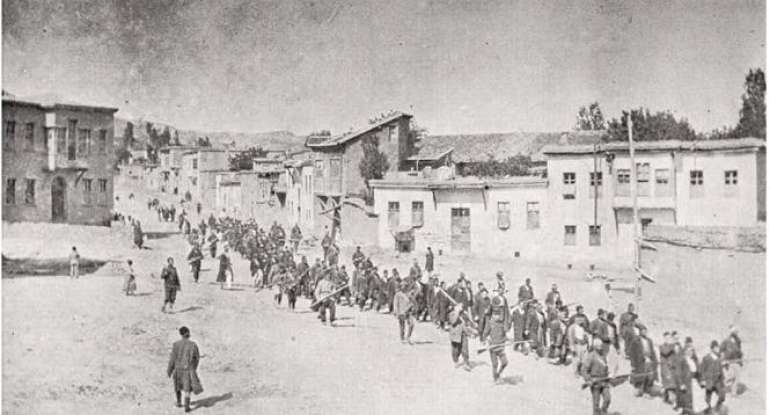
    Today, April 24, marks the “Great Crime,” that is, the genocide of Christians—mostly Armenians but also Assyrians—that took place under the Islamic Ottoman Empire throughout World War I.  Then, the Turks liquidated approximately 1.5 million Armenians and 300,000 Assyrians.  Similarly, in 1920, U.S. Senate Resolution 359 heard testimony that included evidence of “[m]utilation, violation, torture, and death [which] have left their haunting memories in a hundred beautiful Armenian valleys, and the traveler in that region is seldom free from the evidence of this most colossal crime of all the ages.”

    In her memoir, Ravished ArmeniaAurora Mardiganian described being raped and thrown into a harem (consistent with Islam’s rules of war).  Unlike thousands of other Armenian girls who were discarded after being defiled, she managed to escape. In the city of Malatia, she saw 16 Christian girls crucified: “Each girl had been nailed alive upon her cross,” she wrote, “spikes through her feet and hands, only their hair blown by the wind, covered their bodies.”  Such scenes were portrayed in the 1919 documentary film Auction of Souls, some of which is based on Mardiganian’s memoirs.

    Whereas the genocide is largely acknowledged in the West, one of its primary if not fundamental causes is habitually overlooked: religion.  The genocide is usually articulated through a singularly secular paradigm, one that factors only things that are intelligible from a secular, Western point of view—such as identity and gender politics, nationalism, and territorial disputes. Such an approach does little more than project modern Western perspectives onto vastly different civilizations and eras.

    War, of course, is another factor that clouds the true face of the genocide.  Because these atrocities mostly occurred during World War I, so the argument goes, they are ultimately a reflection of just that—war, in all its chaos and destruction, and nothing more.  But as Winston Churchill, who described the massacres as an “administrative holocaust,” correctly observed, “The opportunity [WWI] presented itself for clearing Turkish soil of a Christian race.”  Even Adolf Hitler had pointed out that “Turkey is taking advantage of the war in order to thoroughly liquidate its internal foes, i.e., the indigenous Christians, without being thereby disturbed by foreign intervention.”

    It’s worth noting that little has changed; in the context of war in Iraq, Syria, and Libya, the first to be targeted for genocide have been Christians and other minorities.  But even the most cited factor of the Armenian Genocide, “ethnic identity conflict,” while legitimate, must be understood in light of the fact that, historically, religion accounted more for a person’s identity than language or heritage.   This is daily demonstrated throughout the Islamic world today, where Muslim governments and Muslim mobs persecute Christian minorities who share the same race, ethnicity, language, and culture; minorities who are indistinguishable from the majority—except, of course, for being non-Muslims, or “infidels.”  As one Armenian studies professor asks, “If it [the Armenian Genocide] was a feud between Turks and Armenians, what explains the genocide carried out by Turkey against the Christian Assyrians at the same time?”  Indeed, according to a 2017 book, Year of the Sword: The Assyrian Christian Genocide:

    To understand how the historic genocide of Armenians and Assyrians is representative of the modern-day plight of Christians under Islam, one need only read the following words written in 1918 by President Theodore Roosevelt; however, read “Armenian” as “Christian” and “Turkish” as  “Islamic,” as supplied in brackets:  Indeed, if we “fail to deal radically” with the “horror” currently being visited upon millions of Christians around the Islamic world—which in some areas reached genocidal proportions—we “condone it” and had better cease talking “mischievous nonsense” of a utopian world of peace and tolerance.  Put differently, silence is always the ally of those who would liquidate the “other.”  In 1915, Adolf Hitler rationalized his genocidal plans, which he implemented some three decades later, when he rhetorically asked: “Who, after all, speaks today of the annihilation of the Armenians?”  And who among today’s major politicians speaks—let alone does anything—about the ongoing annihilation of Christians by Muslims, most recently (but not singularly) seen in the Easter Sunday church bombings of Sri Lanka that left over 300 dead?

    Note: See author’s recent book, Sword and Scimitar: Fourteen Centuries of War between Islam and the West, for more on Turks and Armenians — including how the first “genocide” of Armenians at the hands of Turks actually began one-thousand years ago, in the year 1019.  

    This content was originally published here.
  • The elderly are finding their own Finance for Retirement

    The elderly are finding their own Finance for Retirement

    If the government is thinking it can not afford to have social security or medicare, they may want to think again.  The older generation is very capable of finding their own finances for retirement.  I will end up costing the government more to keep an eye on the old folks.  Even if they do get caught, the prison does may for all their needs.  So, what is the bad side of this program.  Being in prison maybe nicer than living in nothing.

    Some senior citizens with too much time on their hands pick up bocce or dominoes as a hobby. And then there are the “Bad Grandpas”: Eight old men who pulled off one of Britain’s most audacious jewel heists, capturing some $20 million in precious goods.  The plan began coming together over fish and chips at the Castle, a North London pub, in 2012. Ranging in age from 52 to 73 at the time, the friends were some of the UK’s most notorious break-in artists and had served prison time for armed robbery, jumping bail, fencing stolen goods and other offenses. At this point, however, they were generally out of the game — although they still enjoyed hanging out and reminiscing about their bad old days.  Brian “The Guv’nor” Reader, 73, started complaining about being tight on cash (despite living in a home valued at nearly $1 million) and wondered what it would take to pull off one last job. His white whale? Hatton Garden Safe Deposit in London’s diamond district.  It housed nearly 1,000 security boxes where local jewelers stowed a fortune in gems, gold and cash. Although a fat target, the place had not been successfully fleeced in decades.  Somehow, the fanciful musing metastasized into a bona fide plan, largely masterminded by Reader. As chronicled in the new book “The Last Job: The ‘Bad Grandpas’ and the Hatton Garden Heist” (Norton), the friends — who dubbed themselves The Firm — spent three years plotting their ­career-topping caper.  “This represented a final hurrah,” author Dan Bilefsky told The Post. “They were motivated by cash, but, at a time in life when many of their contemporaries lived in nursing homes, the excitement of a final heist got their hearts going.”

    The FIRM started preparing.

    They invested in a copy of “Forensics for Dummies” to learn about DNA detection at crime scenes. (One tip they used: scrub down the area with bleach before fleeing.) Member Danny Jones, 60, researched the best diamond-tipped drill for breaking through the vault’s reinforced concrete wall: a $5,200 Hilti DD350 with the capacity of 667 rotations per minute.  YouTube videos for pointers on how to use the tool, and planned to bring along a battering ram for the final push. They allegedly practiced at the plumbing shop of plumber Hugh Doyle, 47, whose neighbors heard The Firm trying out their drill.  It was the Thursday start of the long Easter weekend in 2015 when Reader embarked on a 20-mile bus ride from his Kent home to the Hatton Garden Safety Deposit building, not far from the Castle pub.  There he convened with Jones and four others: lock and alarm specialist Michael “Basil” Seed, then 54; getaway driver John “Kenny” Collins, 74; and “extra pairs of hands” Carl Wood, 58, and Terry Perkins, 66. (After the fact, they would enlist the help of William “Billy the Fish” Lincoln, 59, who would provide transportation and storage of the stolen goods.) . At around 8:30 p.m., the men smashed security cameras, disabled alarms and lugged their equipment — including an assortment of tools and rolling trash cans to be loaded with jewels — inside.

    They spent hours drilling into the wall. Perkins had to take a break for an insulin shot. Getaway driver Collins dozed while serving as lookout in a building across the street.  Finally they broke through — only to come up against the steel backs of safety deposit boxes. Jones punched at them with the ram until the tool shattered into pieces. On Friday morning, frustrated by their failure, the old-timers decided to head home for a nap.  They planned to meet up again in the wee hours of Easter, enough time for them to get their hands on a more powerful hydraulic ram. But by the time Sunday rolled around, Reader had lost faith and backed out. Wood showed up, changed his mind and left.  Undaunted, the remaining Firm members were pleased that there would be two fewer people sharing in the take.  “They felt that they had nothing to lose,” said Bilefsky. “There was a brazenness that was born of age.”  Finally, with the cheerleading Jones urging, “Smash that up!” they penetrated the steel backings. Climbing through the narrow hole, the robbers emptied some 70 boxes, stopping only when they’d gathered more loot than they could roll out in the trash cans.  On Tuesday morning, a jeweler with offices on the same floor as the vault encountered the trashed premises. “The Last Job” quotes a security guard: “It was like a bomb hit the place.”  Outraged customers tried to assess the financial damage. The London Metropolitan Police’s elite law-enforcement division, the Flying Squad, swooped in to investigate. But the “Forensics for Dummies” bleach tip had worked: Not a single fingerprint remained.  Still, the crime was far from perfect. As Bilefsky put it, the old men had failed in one big way: “By not understanding technology.”

    source and more

  • Kansas Supreme Court Strikes Down Ban on ‘Gruesome’ Dismemberment Abortions

    Kansas Supreme Court Strikes Down Ban on ‘Gruesome’ Dismemberment Abortions

    The Kansas Supreme Court ruled Friday blocking a 2015 ban on dismemberment abortions.  The decision prevents the state from enforcing a previously passed law that greatly limited second-trimester abortions.  The Unborn Child Protection from Dismemberment Abortion Act (SB 95) was the first in the nation to ban the procedure known as “dilation and evacuation abortions.”  “Dismemberment abortion kills a living unborn baby by tearing her apart limb from limb,” said Ingrid Duran, the National Right to Life director of state legislation. “It is unconscionable that the Kansas Supreme Court would allow living unborn babies to be killed in such a gruesome manner.”

    Now the state’s highest court has ruled the state’s constitution protects abortion rights.  Pro-life advocates are now calling for an effort to amend the state constitution to add an abortion ban that could withstand a court ruling.  National Right to Life says all the evidence is clear that unborn babies, so far along in their development, should be treated as human life.  “Before the first trimester ends, the unborn child has a beating heart, brain waves, and every organ system in place,” Duran added. “Dismemberment abortions occur after the baby has reached these milestones.”

    source