Category: Business

  • Gold – In a Complex Corrective Structure, which will be its Long-term Fate?

    Gold – In a Complex Corrective Structure, which will be its Long-term Fate?

    In our last Silver analysis (read more), we talked about the potential rally and the corrective sequence that should finish soon. This time, we analyse Gold’s technical situation for the following weeks.

    The Big Picture

    The golden metal started a bullish cycle in November 2015, when the price touched $1,045.4 and finished at $1,376.5. After its completion, GC began to develop a complex corrective structure, which still is active. The long-term vision for Gold calls for more upsides. The underlying condition for the next impulsive movement is for it to be similar in length to the first bullish leg.

    Following the Bearish Sequence

    Once GC has reached the $1,349.8 level on Feb. 19, the golden metal started a corrective sequence as an A-B-C structure. The Gold’s daily chart shows that a wave C is in progress.

    Equal Legs Completion

    As said in the previous analysis, the second leg completion does not imply a reversal movement. On the 4-hour chart, in the internal wave C, we observe that the second leg has reached 100% of equal waves. But this is not enough to determine what the next move could be.

    What Next?

    The internal segment which topped at $1,314.7, is developing a consolidation formation, which we foresee should be a complex structure. We expect that the bullish move will be limited within the last swing zone ($1,285.6), then, starting a new bearish move. Short-term, our bearish target is $1,264.3.

    Remember that the price is not compelled to move as our forecast implies. The charts released corresponds to the Elliott Wave Theory application.

    This content was originally published here.

  • ‘Lighter-than-air’ aircraft has first test flight

    ‘Lighter-than-air’ aircraft has first test flight

    An innovative aircraft that turns into a “lighter-than-air” balloon to propel itself forward has been flown for the first time.  The Phoenix is designed to repeatedly switch between being lighter and heavier than air to generate thrust and allow it to stay in the skies indefinitelyOfficially known as an “ultra-long endurance autonomous aircraft,” it was developed by scientists in Scotland and flown over a distance of 120 meters (394 feet) during its first test flight in March.  The blimp-like aircraft, which is 15 meters long and has a wingspan of 10.5 meters, has been designed for businesses and scientific use, and its creators hope it will revolutionize the telecommunications industry.  “The Phoenix spends half its time as a heavier-than-air aeroplane, the other as a lighter-than-air balloon,” explains Andrew Rae, professor of engineering at the University of the Highlands and Islands Perth College, who was involved in the project. “The repeated transition between these states provides the sole source of propulsion.  “This system allows the Phoenix to be completely self-sufficient,” he adds in a statement. “Vehicles based on this technology could be used as pseudo satellites and would provide a much cheaper option for telecommunication activities.”  The team behind the aircraft also believe it could be used to provide Wi-Fi coverage to remote areas.  The vehicle’s fuselage contains helium, allowing to to ascend, as well as an air bag that inhales and compresses air, enabling it to descend.  It also features solar cells on its wings and tail, which charge the battery that powers its valves and pumps.  Gas-filled dirigible-style aircraft have been making a return to the skies in recent years. The Airlander 10, a massive helium-filled airship claimed as the world’s biggest aircraft, is hoping to make its commercial debut in the next few years.

    source

  • Bitcoin (BTC) Price Starts Much Awaited Rally To $6K

    Bitcoin (BTC) Price Starts Much Awaited Rally To $6K

    • Bitcoin price broke the main resistance at $5,400 and rallied sharply against the US Dollar.
    • The price traded to a new 2019 high and it remains in an uptrend above $5,350.
    • There is a major bullish trend line forming with support at $5,360 on the hourly chart of the BTC/USD pair (data feed from Kraken).
    • The pair has likely started a strong upward move towards the $5,800 and $6,000 resistance levels.

    Bitcoin price rallied sharply above $5,400 and $5,600 against the US Dollar. BTC is likely to extend gains and it may continue to grind higher towards the $5,800 and $6,000 resistance.

    Bitcoin Price Analysis

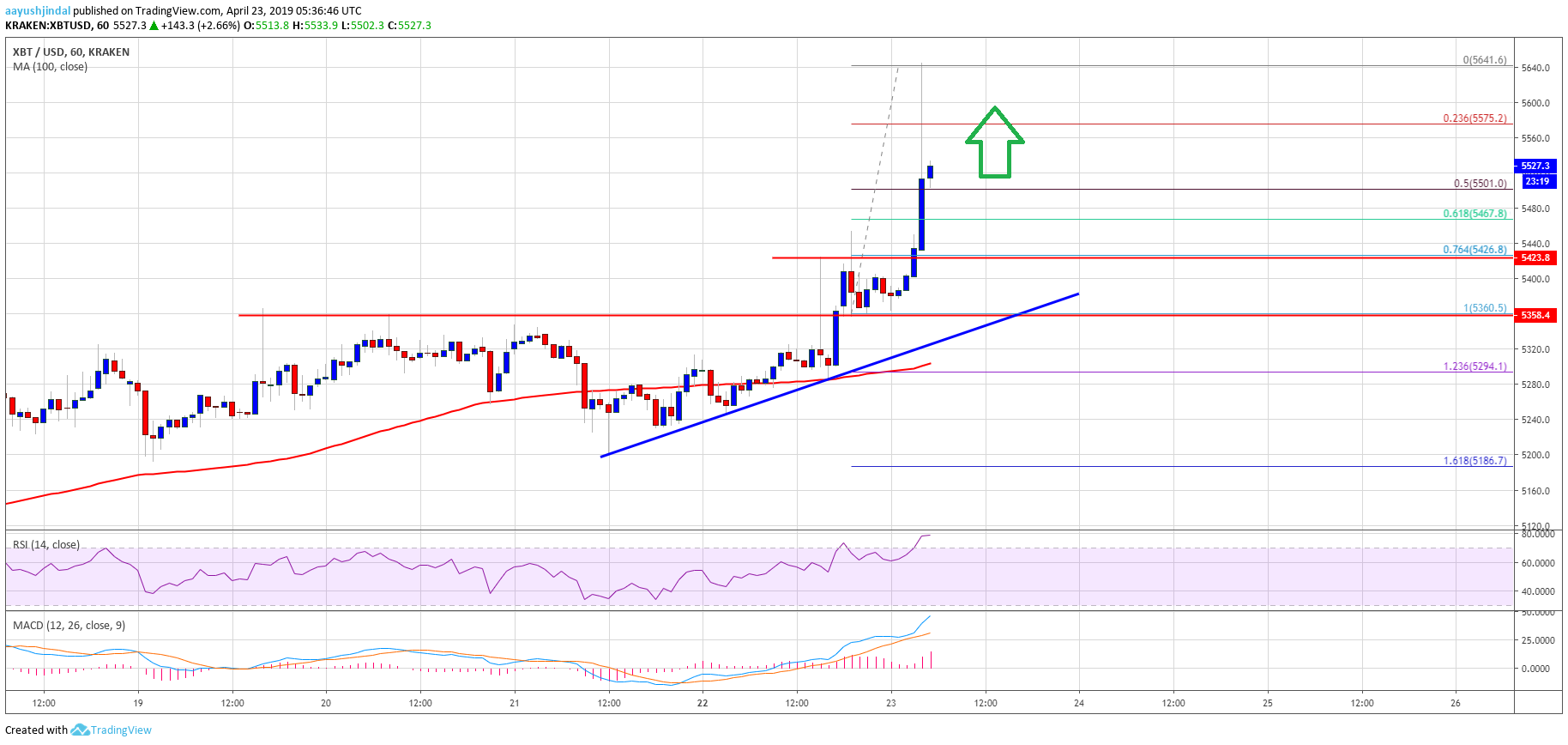
    After a short term downside correction, bitcoin price found support near the $5,200 level against the US Dollar. The BTC/USD pair formed a strong support base above $5,200 and later started a steady rise. There was a break above the $5,300 resistance and the 100 hourly simple moving average. The price traded in a range for a few hours and recently broke the key $5,350 resistance to start a strong rally. The bulls came into action and pushed the price above the $5,400 and $5,500 resistance levels (as discussed in the previous analysis).

    The price even broke the $5,600 level and traded to a new 2019 high at $5,641. Recently, it corrected gains below the $5,600 level and the 23.6% Fib retracement level of the recent rise from the $5,360 low to $5,641 high. However, the $5,500 level is currently acting as a decent support. The 50% Fib retracement level of the recent rise from the $5,360 low to $5,641 high is also near the $5,500 level.

    If there is a downside extension, the next key support is near the $5,420 level. It also coincides with the 76.4% Fib retracement level of the recent rise from the $5,360 low to $5,641 high. Moreover, there is a major bullish trend line forming with support at $5,360 on the hourly chart of the BTC/USD pair. Therefore, dips from the current levels are likely to face a strong buying interest near $5,400 and $5,360.

    Looking at the chart, bitcoin price started a strong rally above the $5,400 resistance (as per our weekly analysis post). The bulls are clearly in control and they could aim further gains above $5,600 and $5,650. The next stop could be near the $5,800 level. If there are further gains, the price is likely to test the all-important $6,000 resistance area.

    Technical indicators:

    Hourly MACD – The MACD is gaining momentum in the bullish zone.

    Hourly RSI (Relative Strength Index) – The RSI for BTC/USD climbed higher sharply above the 60 and 70 levels.

    Major Support Levels – $5,500 followed by $5,420.

    Major Resistance Levels – $5,600, $5,640 and $5,800.

    The post Bitcoin (BTC) Price Starts Much Awaited Rally To $6K appeared first on NewsBTC.

    This content was originally published here.

  • Arizona city overwhelmed by migrants declares state of emergency

    Arizona city overwhelmed by migrants declares state of emergency

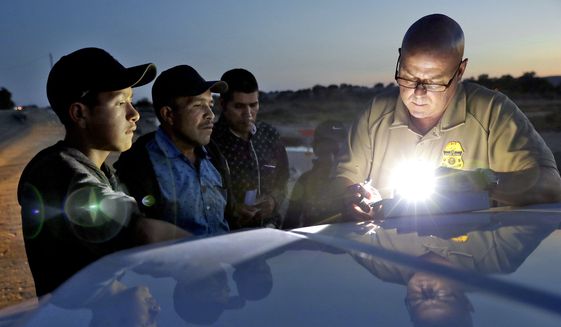
    Yuma, a city on the U.S.-Mexico border in Arizona, declared a state of emergency Tuesday, saying it cannot handle the crush of illegal immigrants the government is being forced to release onto its streets.  Mayor Douglas Nicholls said the migrants are being released by the Border Patrol into his community faster than they can leave, and local shelters are already at capacity.  He warned of mobs of people “roaming the streets looking to satisfy basic human needs,” clashing with citizens looking to protect their own property.  “There is an imminent threat on having too many migrant releases into our community,” he said. “It’s above our capacity as a community to sustain.”  The move was designed to draw the attention of the country to what locals said was an untenable situation and to beg for solutions from the federal government, which has been at a political stalemate over what to do.

    Mr. Nicholls said he is trying to get other Arizona communities to issue similar declarations, hoping a critical mass of voices will cut through the partisan gridlock.  The migrants are overwhelmingly families and unaccompanied children from Central America. They are fleeing rough conditions at home and are drawn north by lax enforcement policies that virtually guarantee they can be quickly released into communities, where most disappear into the shadows.  Of the children and families that came in 2017, more than 98% were still in the U.S. as of the beginning of this year.  The Trump administration has been searching for ways to change the incentives that draw the migrants to the U.S. On Tuesday, Attorney General William Barr announced that migrants who take the first step toward asylum claims will no longer have an automatic right to be released on bond while their cases are proceeding. The ruling, though, won’t generally affect the children and families, who are quickly released under other court rulings and laws. Also Tuesday, a Homeland Security Department advisory council issued an emergency report calling for the government to take new steps.

    One solution was to set up regional processing centers along the border to centralize the flow of migrants, with new and better facilities to care for the children and families.  The council also pleaded with Congress to pass emergency legislation to speed up asylum cases so a decision can be issued within a month and asked for a fix to the Flores court settlement that imposes a 20-day limit on how long illegal immigrant families can be held in detention.  In the meantime, the council said, the administration should issue an emergency regulation allowing migrant families to be held.  Yuma sits on the line between Arizona and California, surrounded by rough, vacant terrain to its east and west. That means it has become the drop-off point for thousands of illegal immigrants each week streaming into the remote parts of California and Arizona, guided by smugglers who bus them north and then leave them to walk across the border and demand attention from U.S. authorities.  Border Patrol agents arrest them en masse — a group of 360 people was apprehended near Lukeville, Arizona, earlier Tuesday.  But with no ability to hold them, agents engage in what is called “catch-and-release,” processing the migrants and then letting them go at a local bus terminal.

    Communities along the border have issued desperate pleas for help, but Yuma’s state of emergency is the most striking reaction.  Mr. Nichollls said the local shelter’s normal capacity is 150 people but it can stretch to accommodate 250. It began Tuesday with 200 people, and Border Patrol agents said they were going to deliver 120 more people during the day, putting the facility well beyond its limits.  The mayor said even if the city had a bigger building, the number of people swamps the capacity for volunteers and supplies — though he did issue a call for donations of coloring books, diapers, snacks and bottled water.  He said the issue is transportation in a town of about 100,000 people, where bus links aren’t extensive and there isn’t enough capacity to ship people out as fast as they are being dropped off by the Border Patrol.  President Trump has proposed siphoning the illegal immigrants from the border into sanctuary cities elsewhere, saying it’s only right those communities step up, given their policies and proclamations about welcoming migrants. That idea has ignited a firestorm in Washington, where Democrats called it unbecoming.  Yet some sanctuary cities have stepped forward to say they would embrace the migrants.

    Oakland Mayor Libby Schaaf over the weekend said she would be happy to do so. “Oakland welcomes all, no matter where you came from or how you got here,” she wrote in response to Mr. Trump.  Pittsburgh Mayor Bill Peduto also accepted the challenge this week, saying his city “would welcome all.”  Mr. Trump cast his proposal as political payback, but others have said it’s a necessity, at least so far as releasing the migrants away from the border, where the communities are already overwhelmed.

    source

  • Washington may become first state to legalize human composting

    Washington may become first state to legalize human composting

    Washington is just a governor’s signature away from becoming the first state in the U.S. to legalize the “natural organic reduction” of human remains, colloquially known as “composting.”  On Friday, the state Senate and House of Representatives finalized their approval of bill 5001 (titled “concerning human remains”), which enshrines “organic reduction” and alkaline hydrolysis, a dissolving process sometimes called “liquid cremation,” as acceptable alternatives to traditional burial and cremation.  Gov. Jay Inslee’s office said the governor hasn’t had a chance to review the final legislation yet. (Once it crosses his desk, he’ll have five days to act.) If Inslee signs the bill, the law would take effect May 1, 2020.

    “I am very much in favor of the composting of human bodies!” said Wes McMahan, a retired cardiovascular intensive-care nurse who lives in Randle, Lewis County, and testified in support of the bill this week.  “When I’m done with this body that served me very well for the past 64 years, do I want to poison it with formaldehyde and other embalming chemicals? No,” McMahan said. “Burned? Not my first choice. But what about all the bacteria I’ve worked with so long in this body — do I want to give them a chance to do what they do naturally? I believe in doing things as naturally as possible.”  Passage of the bill fulfills a longtime hope for Seattle-based Katrina Spade, and is another step in a years-long effort to realize her vision for an urban, soil-based, ecologically friendly death-care option. She is the founder and CEO of Recompose, which aspires to be the first “natural organic reduction” funeral home in the U.S.

    source

  • Sneakers are now assets trading like stocks

    Sneakers are now assets trading like stocks

    Like many traders, Johan Aguirre makes a daily check on his holdings’ ups and downs across an electronic spreadsheet.

    Aguirre, however, isn’t analyzing stocks, bonds or cryptocurrencies. He specializes in an increasingly tradable asset class — sneakers — on his favorite shoe reseller platform, StockX.Sometimes, he’ll pick up only one pair; at other times, he’ll buy in bulk.

    “If it’s a shoe that I know I can sell,” he said, “typically I’ll buy the whole inventory that’s presented to me. And from the moment I know the sizes and the styles and the product code, I list it on StockX and it’s live right away.”

    Aguirre, 31, is part of the evolution of the multibillion-dollar worldwide sneaker resale market, which is looking less like a hobby these days and more like an occupation.

    Most are small-time entrepreneurs hoping to earn some spending money on one or two pairs, maybe dreaming of snagging once-in-a-lifetime kicks that might bring five figures in the thriving secondary market for basketball-inspired shoes.

    But for Aguirre, this is a serious second-income business. Aguirre says he sold $50,000 in sneakers last year and estimates he cleared about $7,000 in profit.

    “The sales depend on the shoes I list,” Aguirre said, “but it can get to the point that I’m selling more than a hundred pairs of shoes a month. It’s almost become a full-time job.”

    Dedicated resellers like Aguirre drive the action at StockX, which Chief Executive Josh Luber helped found in 2016 with the idea of bringing Wall Street to streetwear.

    Now Luber’s pushing the investment angle even harder by striking exclusive deals with manufacturers to sell products through blind auctions in something StockX is calling a “sneaker IPO,” for initial product offering. There’s benefit for shoe companies and deep-pocketed buyers, but the product-drop-via-auction approach could leave behind the small-time sneakerhead that was the core of the resale market.

    Sneaker resellers have been around for decades, but it took the likes of Ebay, Craig’s List, Facebook and Instagram to enable a vibrant secondary market, said Matt Powell, vice president and senior industry advisor for the research firm NPD Group.

    NPD’s last study of the global reseller market estimated sales at $1 billion in 2016, a total that Powell said could be as high as $3 billion today but “no one really knows.”

    That compares with a retail sneaker industry of about $100 billion in sales worldwide, up from $55 billion in 2016, Powell said.

    Investors lately have been showering money on resale platforms.

    In February, retail giant Foot Locker announced a $100-million equity investment in Culver City-based GOAT Group, which a year earlier had raised $60 million and acquired Flight Club, another sneaker sales marketplace.

    source

  • As cashless stores grow, so does the backlash

    As cashless stores grow, so does the backlash

    So he was surprised to learn the dollar bills in his pocket were no good at Dos Toros Taqueria in Manhattan, one of a small but growing number of establishments across the U.S. where customers can only pay by card or smartphone.  Cash-free stores are generating a backlash among some activists and liberal-leaning policymakers who say the practice discriminates against people like Figueroa, who either lack bank accounts or rely on cash for many transactions.  Figueroa, an ironworker, had to stand to the side, holding his taco, until a sympathetic cashier helped him find another customer willing to pay for his meal with a card in exchange for cash.

    “I had money and I couldn’t pay,” he said.  The issue got some high-profile attention this week when retail giant Amazon bowed to pressure from activists and agreed to accept cash at more than 30 cashless stores, including its Amazon Go convenience stores, which have no cashiers, and its book shops. Amazon declined to say when the change would happen.  There is no federal law that requires stores to accept cash, so lawmakers are working on the issue at the state and city level.  Earlier this year, Philadelphia became the first city to ban cashless stores, despite efforts by Amazon to dissuade it. New Jersey passed a statewide ban soon after, and a similar ban is working its way through the New York City Council. Before this year there was only one jurisdiction that required businesses to accept cash: Massachusetts, which passed a law nearly 40 years ago.

    source

  • Detroit couple creates Netflix-like service with pro-socialist programming

    Detroit couple creates Netflix-like service with pro-socialist programming

    A young Detroit couple who helped controversial New York congresswoman Alexandria Ocasio-Cortez win election last year as a democratic socialist are now launching a pro-socialism media company from their house on the city’s east side.

    Their company, Means TV, is an Internet-only web streaming service that, for a monthly $10 subscription, would offer entertainment programming with “pro-worker” and “anti-capitalist” viewpoints, including original TV shows, talk shows, comedy sketches, reality TV and on-the-ground reporting.

    The service is the brainchild of filmmakers Naomi Burton, 29, and Nick Hayes, 22, a girlfriend-boyfriend duo who gained national attention last year for producing a campaign video for Ocasio-Cortez that went viral and helped to propel the formerly unknown candidate to an upset Democratic primary victory.

    Means TV began releasing preview videos last month and Burton and Hayes are aiming to raise $500,000 through the website by May 30. That amount could finance an initial year of programming, which would roll out late this year or early 2020, they said.

    Read more

  • Decades after nuclear disaster, tourism is booming in Chernobyl

    Decades after nuclear disaster, tourism is booming in Chernobyl

    Climbed 16 flights of slippery, icy stairs in an abandoned apartment building — the iron railings long ago pilfered, balcony doors stuck open — until we reached the roof and peered over the ghost town of Pripyat, the once-hailed Soviet “futuristic city” where Chernobyl nuclear plant workers and their families lived.  Thirty-three years after the Chernobyl nuclear reactor explosion, Pripyat’s broad boulevards are crowded with tangles of overgrown trees. Its once gleaming buildings are dark and brooding — windows gone, interiors looted, hallways littered with crumbling books.  It was twilight, and from our rooftop perch, the only light we could see came from the silver dome encasing the Chernobyl reactor, lit up as if it were still on fire. Someone in our group blasted music from an iPhone, and suddenly a dozen Americans broke out dancing. We were among the only humans in this deserted city.

    “What else do you do at the end of the world?” someone yelled.  Welcome to the apocalypse vacation: a weekend in Chernobyl.  Ever since the Ukrainian government opened Chernobyl to tourists in 2011, the number of annual visitors continues to climb. Last year, the government reported nearly 72,000 visitors, up from 50,000 the year before. “Travel to Ukraine has become cheap,” said Sergii Ivanchuk, owner of SoloEast, a company that last year shuttled nearly 12,000 tourists to the site of the infamous nuclear disaster.  “We don’t have Crimea anymore, and less and less people are interested in religion and churches,’’ he added. “But we have cheap beer and Chernobyl!”  In the early morning of April 26, 1986, when this area belonged to the Soviet Union, nuclear reactor No. 4 exploded during a safety test at this power plant north of Kiev. The deadly accident, initially cloaked in Soviet secrecy, spewed radioactive fallout over much of Europe. More than 115,000 people were evacuated from a 1,000-square-mile area known as the Chernobyl Exclusion Zone.

    Years later, stories and photos from Chernobyl continue to stoke the world’s curiosity — horses born with eight legs, giant catfish found in the waters near the plant, octogenarian “self-settlers” who seemingly thrived after returning to the Exclusion Zone, eating vegetables grown in contaminated soil. Even now, interest in Chernobyl shows no signs of ebbing. Journalist Adam Higginbotham’s book, “Midnight in Chernobyl: The Untold Story of the World’s Greatest Nuclear Disaster,” hit shelves earlier this year, and HBO’s new drama miniseries “Chernobyl” debuts May 6.  I first visited Chernobyl in late October 2016, not long before a massive silver containment shield designed to prevent radiation leaks was rolled over the crumbling sarcophagus encasing reactor No. 4. A hundred yards from the sarcophagus, our Geiger counters shot off readings several times higher than the suggested safe levels; our guide discouraged us from lingering.

    source

  • Public Universities to Provide ‘Free’ Chemical Abortions to Students

    Public Universities to Provide ‘Free’ Chemical Abortions to Students

    If your taxes are high enough the state keeps thinking of better ways to spend your money!  Where is our freedom of choice?  Our freedom to religion?  This does not reflect beliefs of many.  Why do they insist it does?   When will be responsible adults, we need to quit acting like animals, and step up to the amazing opportunities there are out there instead of creeping around sex issues all the time.

    The California Senate Health Committee recently voted 7-2 to force all taxpayer-funded universities in the Golden State to appropriate the funding needed to provide “free” chemical abortions to students on campus by 2023.  The legislation, SB 24, was introduced in December by state Senator Connie Leyva.  It would require student health centers on all University of California and California State University campuses to offer chemical abortions to students up to 10 weeks of pregnancy, beginning in January 2023.  To fund the mandate, the measure allocates $200,000 in grant money to each of California’s 33 public university student health centers, covering the costs of “medication abortion readiness” which includes the purchase of equipment, facility and security upgrades, and training staff members.

    The bill is a revised version of a similar bill that former Gov. Jerry Brown vetoed last September stating “it was not necessary.”  SB 24 now goes to the full state Senate for a vote and Gov. Gavin Newsom said he would support the SB 24 bill if it reaches his desk.  “California schools should be focused on educating students to make a positive difference in this nation, not handing out abortion drugs so it’s easy for them to end the lives of future generations,” Mat Staver, founder and chairman of Liberty Counsel said in a press release. “California laws already are some of the most hostile to unborn babies and young women in America. This horrendous bill would only ensure that more precious lives are ended,” said Staver.

    According to research from the pro-abortion Bixby Center for Global Reproductive Health, and the Advancing New Standards in Reproductive Health, at the University of California, San Francisco, chemical abortions are already widespread among students. The groups estimate that California public college students undergo approximately 300-500 chemical abortions each month, and with serious risks.  The drug Mifepristone/RU-486, which ends the life of the unborn child, and Misoprostol which causes severe cramping, contractions, and bleeding to expel the baby from the womb, are used together in chemical abortions.  Approximately 3.4 million women have used Mifepristone in the US for the medical termination of pregnancy through the end of December 2017, an increase of approximately 163,000 since June 2017. The FDA has documented at least 4,000 cases of serious adverse events, including more than 1,000 women who required hospitalization; in addition, at least 22 women died after using the drug.

    source