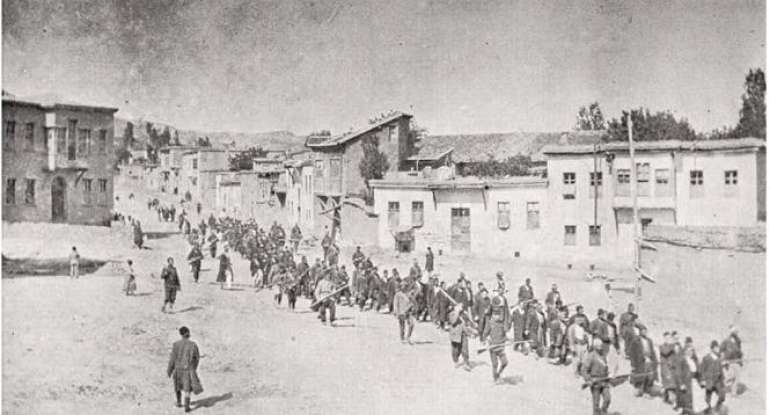
Today, April 24, marks the “Great Crime,” that is, the genocide of Christians—mostly Armenians but also Assyrians—that took place under the Islamic Ottoman Empire throughout World War I. Then, the Turks liquidated approximately 1.5 million Armenians and 300,000 Assyrians. Similarly, in 1920, U.S. Senate Resolution 359 heard testimony that included evidence of “[m]utilation, violation, torture, and death [which] have left their haunting memories in a hundred beautiful Armenian valleys, and the traveler in that region is seldom free from the evidence of this most colossal crime of all the ages.”
In her memoir, Ravished Armenia, Aurora Mardiganian described being raped and thrown into a harem (consistent with Islam’s rules of war). Unlike thousands of other Armenian girls who were discarded after being defiled, she managed to escape. In the city of Malatia, she saw 16 Christian girls crucified: “Each girl had been nailed alive upon her cross,” she wrote, “spikes through her feet and hands, only their hair blown by the wind, covered their bodies.” Such scenes were portrayed in the 1919 documentary film Auction of Souls, some of which is based on Mardiganian’s memoirs.
Whereas the genocide is largely acknowledged in the West, one of its primary if not fundamental causes is habitually overlooked: religion. The genocide is usually articulated through a singularly secular paradigm, one that factors only things that are intelligible from a secular, Western point of view—such as identity and gender politics, nationalism, and territorial disputes. Such an approach does little more than project modern Western perspectives onto vastly different civilizations and eras.
War, of course, is another factor that clouds the true face of the genocide. Because these atrocities mostly occurred during World War I, so the argument goes, they are ultimately a reflection of just that—war, in all its chaos and destruction, and nothing more. But as Winston Churchill, who described the massacres as an “administrative holocaust,” correctly observed, “The opportunity [WWI] presented itself for clearing Turkish soil of a Christian race.” Even Adolf Hitler had pointed out that “Turkey is taking advantage of the war in order to thoroughly liquidate its internal foes, i.e., the indigenous Christians, without being thereby disturbed by foreign intervention.”
It’s worth noting that little has changed; in the context of war in Iraq, Syria, and Libya, the first to be targeted for genocide have been Christians and other minorities. But even the most cited factor of the Armenian Genocide, “ethnic identity conflict,” while legitimate, must be understood in light of the fact that, historically, religion accounted more for a person’s identity than language or heritage. This is daily demonstrated throughout the Islamic world today, where Muslim governments and Muslim mobs persecute Christian minorities who share the same race, ethnicity, language, and culture; minorities who are indistinguishable from the majority—except, of course, for being non-Muslims, or “infidels.” As one Armenian studies professor asks, “If it [the Armenian Genocide] was a feud between Turks and Armenians, what explains the genocide carried out by Turkey against the Christian Assyrians at the same time?” Indeed, according to a 2017 book, Year of the Sword: The Assyrian Christian Genocide
To understand how the historic genocide of Armenians and Assyrians is representative of the modern-day plight of Christians under Islam, one need only read the following words written in 1918 by President Theodore Roosevelt; however, read “Armenian” as “Christian” and “Turkish” as “Islamic,” as supplied in brackets: Indeed, if we “fail to deal radically” with the “horror” currently being visited upon millions of Christians around the Islamic world—which in some areas reached genocidal proportions—we “condone it” and had better cease talking “mischievous nonsense” of a utopian world of peace and tolerance. Put differently, silence is always the ally of those who would liquidate the “other.” In 1915, Adolf Hitler rationalized his genocidal plans, which he implemented some three decades later, when he rhetorically asked: “Who, after all, speaks today of the annihilation of the Armenians?” And who among today’s major politicians speaks—let alone does anything—about the ongoing annihilation of Christians by Muslims, most recently (but not singularly) seen in the Easter Sunday church bombings of Sri Lanka that left over 300 dead?
Note: See author’s recent book, Sword and Scimitar: Fourteen Centuries of War between Islam and the West
This content was originally published here.