
Author: Truth & Hammer

  • Raised in a log cabin in Canada, Slack chairman is now worth $1.3 billion | Financial Post

    Raised in a log cabin in Canada, Slack chairman is now worth $1.3 billion | Financial Post

    Canadian entrepreneur Stewart Butterfield helped found Slack Technologies Inc. after selling his earlier startup, Flickr, to Yahoo for more than US$20 million. The latest venture is bringing a bigger windfall.

    His 8 per cent stake in the workplace communication company would be worth US$1.3 billion if Slack goes public this week at US$16 billion, the low end of Wall Street’s expected range. Slack co-founder Cal Henderson, 38, owns 3 per cent worth about US$533 million.

    Butterfield, the 46-year-old chairman and chief executive officer, has come a long way from the log cabin where he lived in a remote part of Canada without electricity and running water for the first few years of his life. He was introduced to computers in the second grade but lost interest in the technology as he got older and went on to study philosophy in college.

    “By the time I finished my master’s degree I really had no idea of what I was going to do except for be an academic because, you know, the big five philosophy firms aren’t always hiring,” Butterfield told Bloomberg last year.

    After brief stints in the startup world at Communicate.com and Gradfinder.com, Butterfield came up with the idea for Flickr, a photo and video hosting service that he sold to Yahoo in 2005. Butterfield worked at Yahoo until 2008 and later founded Glitch, which became the multibillion-dollar company now called Slack.

    Slack, an acronym for “Searchable Log of All Conversation and Knowledge,” will begin trading Thursday on the New York Stock Exchange under the ticker symbol WORK.

    This content was originally published here.

  • You may soon be able to buy petrol, diesel from supermarket

    You may soon be able to buy petrol, diesel from supermarket

    The government is likely to soon permit supermarkets to retail petrol and diesel in its bid to ease fuel access to end consumers. The Ministry of Petroleum and Natural Gas in this regard may come up with a Cabinet note to relax existing norms, the Business Standard reported, citing sources.

    The government is expected to ready the note within the first 100 days of it coming to power. As it was sworn in on May 30 that means the note might be finalised in the first week of September.

    It is likely to suggest bringing down the minimum requirement for companies trying to get into the retail fuel segment. This means that the government could lower the basic infrastructure investment of about Rs 2,000 crore in the domestic market, or providing bank guarantees for 3 million tonnes (30 lakh tonnes) or equivalent amount, the report said.

    If the government goes ahead with the changes, it could open the gates for multi-brand retail majors such as Future Group and Reliance Retail as well as global majors of the likes of Saudi Aramco to enter the lucrative Indian fuel retail space.

    A committee led by economist Kirit Parikh had proposed relaxing norms in India. The other members on the committee were former petroleum secretary GC Chaturvedi, former Indian Oil (IOC) Chairman MA Pathan, and Ashutosh Jindal, joint secretary in charge of marketing under the petroleum ministry, the report added.

    Meanwhile, the government on March 16 last year had launched the concept of fuel home delivery in Pune. At present, state-run fuel retailers such as Indian Oil Corp (IOC), Bharat Petroleum Corporation (BPCO) and Hindustan Petroleum Corporation (HPCL) provide home delivery of diesel in Pune, Delhi, Jaunpur, Chennai, Bengaluru, Aligarh, Dudaipur, Rewari and Navi Mumbai.

    ALSO READ:Expert panel suggests scrapping investment norm for setting up petrol pumps

    The conception of this idea to allow supermarkets to retail fuel comes from the successful model undertaken by the United Kingdom (UK). As per the evaluation of the Petrol Retailers Association (PRA), a trade association which represents the independent fuel retailers in the UK, supermarket sites comprise around 49% of the petrol and 43% of all diesel retailed in the country in April 2019.

    The government is hoping to replicate the same model in India given the sheer size of the country’s fuel consumption appetite.

    This content was originally published here.

  • The one issue every economist can agree is bad: Rent control

    The one issue every economist can agree is bad: Rent control

    There aren’t that many things you can get economists to agree on. Fiscal stimulus, minimum wages, monetary policy, health care, bank regulation — on almost all the major issues of the day, you can find a respected economist to argue for either side.

    But there are a few questions where there’s near unanimity, and rent control is one of them. Pretty much every economist agrees that rent controls are bad. And in the last decades of the 20th century, economists had some success persuading state and local governments to curb these policies.

    Now the policy appears to be making a comeback. Two rent-control bills have cleared the housing committee in California’s state legislature, and New York state looks like it’s about to stiffen New York City’s rent-stabilization regime and offer other cities the option to copy it. City governments may have to relearn why their predecessors pruned back rent-control policies.

    Rent control is supposed to protect poor, deserving tenants from the depredations of greedy landlords. And it does, up to a point. Research on rent control shows that many of the beneficiaries are low-income, and that controlling their rents makes it more likely that they’ll stay in their apartments for a good long time.

    The problem is that rent control doesn’t do anything about the reason that rents are rising, which is that there are more people who want to live in desirable areas than there are homes for them to live in. Housing follows the same basic laws of economics as other goods that consumers need: When the demand for a product consistently exceeds the supply, prices will rise until the quantity demanded is equal to the amount that suppliers have available.

    As long as there’s no new construction, controlling that natural increase is just a game of musical chairs. You can change which people get to live in a city, but you still leave just as many people out in the cold. Actually, a few more, because rent control also reduces the incentive to supply rental housing.

    All this suggests an actual solution to skyrocketing rents: Build more housing, so that the rent controls won’t be necessary, and offer subsidies to the smaller number of low-income people who simply can’t afford decent housing. To do that, cities would need to ease the costly land-use regulations that make it so difficult for developers to fill the unmet demand. And in many cases, cities would also need to get rid of rent control, both to reassure potential landlords that they can build without fear of new controls and to encourage landlords to tear down smaller buildings and put up bigger ones, something that rent protections often prevent.

    Alas, that’s not going to happen, so coastal urbanites should brace for what will. Declining housing stock is just one of the many potential costs of rent controls; others include a deteriorating housing stock as landlords stop investing in their properties, and higher rents. Yes, higher, because rent control creates a two-tier housing market. There are cheap, price-stabilized apartments that rarely turn over, because why would you give up such a great deal? Then there are the uncontrolled apartments, which everyone else in the city has to fight over, bidding up the price.

    Perversely, the people paying above-market rent are often worse off than the people enjoying a hefty subsidy from their landlords. There’s no means test for rent-stabilized housing, and while the average income of people in New York’s rent-stabilized apartments is somewhat lower than that of people in market-rate housing, a recent analysis by The Wall Street Journal showed that the people getting the biggest benefit are white, affluent Manhattanites who presumably landed the apartments decades ago and held on while rents rose around them.

    That could be an argument for controlling the rent on all the housing stock. But cities don’t do that for a reason: If you force the price of something below market level, people will supply less of it. Since cities tend not to impose rent controls unless they’re already experiencing a severe housing shortage, that would be bad. Thus, rent control usually applies only to older buildings, since you can’t go back and unbuild an apartment house that was constructed before 1947. It doesn’t completely solve the problem, since landlords still withdraw less-profitable units from the market, shrinking the housing stock over time. But it turns what would be a disastrous policy into one that is merely terrible.

    “Merely terrible” is a low aspiration for something as important as housing policy, but at this point it’s probably the best that New Yorkers and Californians can hope for.

    This content was originally published here.

  • Forex- The Dollar Has Hit A Two

    Forex- The Dollar Has Hit A Two

    The dollar has reached a two-week high. This happened today when strong and economic data led investors to thinking about the Federal Reserve. This is going to be impacted by the monetary policy meeting and it could mean very interesting things for the industry in general. The broader markets appeared to be much quieter. Traders are now way more hesitant because they don’t want to put out on large positions before the two-day meeting. The meeting is going to involve some of the EU Central Bank policymakers who are in Portugal, and then the Bank of England’s decision regarding interest rates.

    The strong US retail sales that happened on Friday really did show that the reduced rates are present and that they are lifting the dollar. The FED chairman may however choose to lay down the groundwork so that a rate cut could happen later on in the year.

    The expectations of a rate cut at the meeting have fallen to around 20%. The bets of a monetary easing however do appear to be high right now. The market’s pricing over the last 24 hours are now cutting from the current rate. Investors are scaling back some of their dollar-long positions according to the data that has been published by the CFTC data. That being said, analysts are not convinced about the Euro, and they are not sure that it can seize on the dollar to try and move higher. Even though this should be a softer environment for the dollar this time around, there are some EUR negatives out there and there is a high chance that this could break out later on this year. The index is going to measure against an entire basket of currencies and it has also reached a two-week high of well over 97.603.

    The euro doesn’t look to have changed much. It stands at $1.1213 and investors and even policymakers are all waiting to make their decision. They are going to attend an ECB meeting which is going to be held at the Sintra in Portugal, and this is going to be done using the Euro inflation zone data. Sure, fears have protracted that a Sino and US standoff could actually tip the whole economy into recession. They have also progressed rate cuts with the prospect of being more stimulus overall.

    Markets are now pricing at a very high level of probability and there is even an unusually high level of uncertainty regarding trade. That being said, it’s safe to say that there isn’t a high chance of them cutting rates if there is a post-G20, or de-escalation with China. The sterling has slid to a 2019 low and now it is at 1.2573. This is the weakest that it has been since January and investors are worried that if Boris Johnson was to replace Theresa May, this could put Britain on the long and winding path of the dreaded no-deal Brexit.

    This content was originally published here.

  • Michaels’ Retail Sales Down 5% in First Quarter

    Michaels’ Retail Sales Down 5% in First Quarter

    The Michaels Companies, North America’s largest craft retailer, reported a 5.3% slump in sales in the first quarter of 2019, dropping from $1,155.5 million in the first quarter of 2018 to $1,093.7 million in the same time period this year, all but ensuring its full-year sales result will be less than 2018.

    The company blames the drop in sales primarily on its closing 36 Pat Catan’s and 94 Aaron Brothers stores over the past year. Michaels also reported $5.6 million of expenses in the first quarter could be attributed to the departure of former CEO Chuck Rubin, who left that role Feb. 28.

    “While our first quarter results were within our range of expectations for the quarter, we are not satisfied and are taking steps to improve our performance, said interim CEO Mark Cosby.

    Rubin made a sudden but “mutually agreed” exit, according to the company, and board member Cosby stepped up to take the reins for the interim. Fortune notes that the former CEO had not so long ago played down the threat of e-commerce to the chain, and Michaels only launched its own online store in 2014. E-commerce grew last year by 77%, but still only accounted for $210 million of last year’s $5.2 billion in sales — just 4%.

    Cosby made improving the company’s e-commerce capabilities a major goal of his work this year. The company’s annual report noted the intention of bringing e-commerce fulfillment in-house in 2019.

    But that doesn’t mean the bricks-and-mortar stores are going away any time soon. At the end of March, Michaels had 1,260 retail outlets in operation after opening four new stores, closing two stores and relocating seven stores in the first quarter. By the end of 2019, Michaels expects to open 20 new stores, including as many as 12 former Pat Catan’s retail outlets that will be rebranded and reopened, and relocate 13 Michaels stores.

    Michaels also took a $5 million write-off of investment in Darby Smart, a project kit company that shifted to how-to videos, after the company was sold this spring.

    The impact of tariffs

    In its 2018 annual report, Michaels noted the threat of additional tariffs as a real risk to the business. The Trump administration is pushing to raise taxes on some consumer goods imported to the U.S. from China from 10% to 25%. If that happens, “our costs could increase, and we may be required to raise our prices, which could result in the loss of customers and adversely affect our operating performance,” the company wrote. To mitigate that risk, Michaels might move production outside of China, which would raise costs and disrupt operations.

    President Donald Trump is expected to decide his next move after talks with China’s premier later in June. Retailers across the United States are increasingly worried about the impact tariffs would have on the holiday retail season. For most retailers, including Michaels, the fourth quarter is the most important of the year. For the rest of the 2019 fiscal year, Michaels expects total sales to reach $5.19 billion to $5.24 billion, slightly less than 2018.

    This content was originally published here.

  • Donald Trump attacks ECB for ‘currency manipulation’

    Donald Trump attacks ECB for ‘currency manipulation’

    Donald Trump has accused the European Central Bank (ECB) of unfairly manipulating the euro, further raising the stakes for Washington in its trade and diplomatic disputes around the world.

    The US president suggested in a tweet that comments by Mario Draghi, the head of the ECB, had triggered an immediate slide in the value of the euro versus the dollar, “making it unfairly easier for them to compete against the USA”.

    Reopening a spat over transatlantic trade with the EU that has repeatedly flared up during Trump’s presidency, he warned Brussels it had been “getting away with this for years, along with China and others”.

    Mario Draghi just announced more stimulus could come, which immediately dropped the Euro against the Dollar, making it unfairly easier for them to compete against the USA. They have been getting away with this for years, along with China and others.

    Trump’s comments come after Draghi used one of his last major speeches before stepping down as ECB president to say the central bank could act to loosen monetary policy – cutting interest rates or revamping its quantitative easing bond-buying programme – to stimulate the eurozone economy.

    Economic growth in the single currency area has struggled to generate momentum in the past 18 months, while inflation across the bloc has stayed below the ECB’s target level of 2%.

    Growth in key member states, including Germany, Europe’s largest economy, has come close to stalling, while Italy slid into recession.

    “In the absence of improvement, such that the sustained return of inflation to our aim is threatened, additional stimulus will be required,” Draghi said, speaking at the ECB’s annual meeting in Sintra, Portugal.

    The euro weakened across the board on foreign exchanges straight after the speech, dropping by 0.3% against the dollar to trade a two-week low of $1.1182 on Tuesday.

    With just four months of his eight-year term left, the slowdown in the eurozone may threaten to unpick Draghi’s legacy. The Italian is widely seen as having saved the euro after a promise in 2012 to do “whatever it takes” during the sovereign debt crisis.

    Growth in the eurozone has stuttered in recent months in part because of the Trump administration’s trade war with China, which has sapped global trade and cut demand for EU exports.

    Draghi warned that trade disputes were among factors affecting growth in his speech advocating potential stimulus. “The risks that have been prominent throughout the past year, in particular geopolitical factors, the rising threat of protectionism and vulnerabilities in emerging markets have not dissipated,” he said.

    The US is also approaching a period of weaker growth, after repeated interest rate hikes from the US Federal Reserve served as a headwind, and as support from tax cuts introduced by Trump gradually fades.

    Financial market investors believe the Fed could be forced into interest rate cuts this year as a consequence.

    This content was originally published here.
  • China stockpiles gold while letting US bond holdings slide

    China stockpiles gold while letting US bond holdings slide

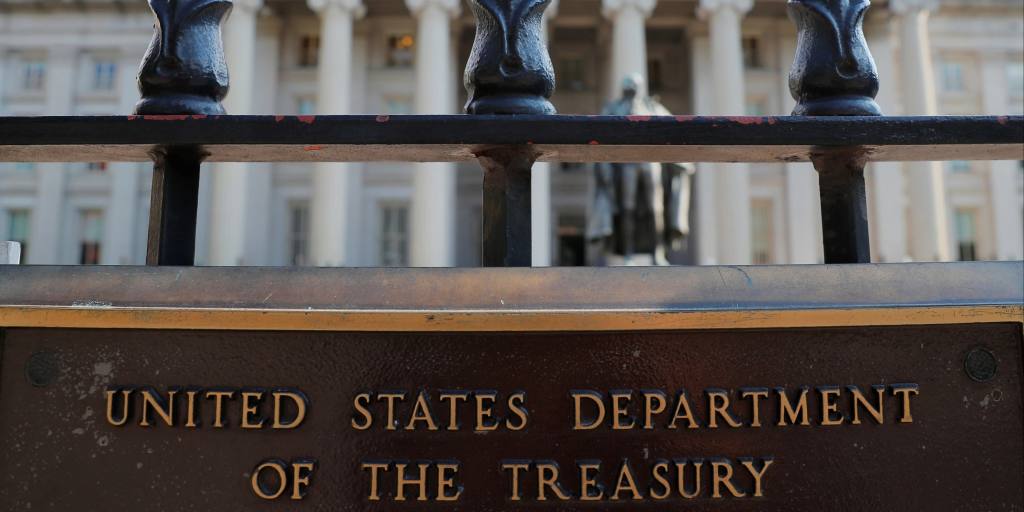
    SHANGHAI — China reduced its holdings of U.S. government debt again in April even as Beijing’s gold reserves continued to grow, diversifying away from the dollar as ties with Washington fray.

    The $7.5 billion dip on the month brought China’s total Treasury stockpile to $1.11 trillion, down $90 billion from the most recent peak in August 2017. This follows a roughly $10 billion decline in March.

    The downtrend in recent months parallels the escalation of the trade war between Beijing and Washington, even as the latest data precedes the breakdown in talks last month that led to another round of tariffs. A shrinking current-account surplus has left China with less wherewithal to buy Treasurys, and Beijing appears to have decided that overextending itself to do so is unnecessary given the souring bilateral relationship.

    But few other options are available for stashing large amounts of capital, and selling off U.S. government debt too quickly would risk further antagonizing Washington. Such a move also would drive up long-term yields, reducing the value of China’s remaining holdings.

    Rather than dumping Treasurys as a way to gain leverage in trade negotiations, Beijing seems to be taking a subtler approach through trimming its holdings by $20 billion or less per month.

    Some of this capital is going into gold. China’s gold reserves have grown for six straight months since December, the first time the country increased its holdings of the precious metal in more than two years. Russia has made similar moves, slashing its dollar-denominated assets while purchasing gold as essentially a borderless currency.

    China’s Treasury stockpile long stayed above $1.2 trillion, but after the yuan’s sharp depreciation in 2015, Beijing is believed to have sold some of the securities to fund intervention to shore up its currency.

    The country’s overall foreign-exchange reserves dropped below $3 trillion, though the bleeding was stemmed by controls aimed at curbing capital flight, including restrictions on overseas acquisitions. Chinese Treasury holdings bottomed out in January 2017 and returned to $1.2 trillion that August.

    This content was originally published here.

  • Till debt do us part: Russia’s holdings of US Treasuries plunge to 12-year low — RT Business News

    Till debt do us part: Russia’s holdings of US Treasuries plunge to 12-year low — RT Business News

    Russia cropped its stockpile of US debt by $1.6 billion. The country’s holdings decreased from $13.7 billion in March to $12.1 billion in April. That’s the lowest figure since May 2007 when Russia’s ownership of US debt stood at $11.8 billion.

    Once a leading holder of US Treasury bonds, Russia has been sharply reducing its holdings in recent years. It has cut nearly 85 percent of the holdings from $96.9 billion in January 2018. The drop is even more significant from 2010, when Russia held over $170 billion in US debt bonds.

    Data showed that the largest US creditor, China, has also trimmed its holdings in April to the lowest level since May 2017. Chinese holdings of Treasury securities declined for a second straight month, to $1.113 trillion in April, from $1.120 trillion the previous month. The country still remains the largest foreign holder of US Treasuries.

    The second-largest non-US holder of American debt, Japan, also reduced holdings in April, to $1.064 trillion, from $1.078 trillion the previous month.

    Statistics showed that overall foreign holdings of US Treasuries dropped to $6.433 trillion in April, from $6.473 trillion in March.

    For more stories on economy & finance visit RT’s business section

    This content was originally published here.

  • Pakistan’s economic crises over, future is bright

    Pakistan’s economic crises over, future is bright

    KARACHI: Governor, State Bank of Pakistan (SBP), Dr. Reza Baqir on Monday assured that the country has come out of the economic crises as it has achieved economic stability including financial one, which has created investors’ confidence that is very positive signal.”Uncertainty and instability was a serious challenge to the country, which is now over as the economic team tackled the situation very effectively. Pakistan’s future is bright,” he said while speaking at his first interaction with media here at the SBP Building.He also answered questions by journalists in Islamabad through a video link.Dr Reza said the present government had assigned two major tasks to its economic team that is, bringing economic stability and ensuring inclusive economic growth in the country; where there is improvement in the life of the common man.“The two main reasons for the economic instability were: external deficit and fiscal deficit. Now, these were being addressed effectively and in credible manner.”The external/trade deficit situation was improving.He said it was very positive development that the government had pledged not to borrow from State Bank of Pakistan.Instead, he added, it would borrow from the money market. This would save State Bank of Pakistan from printing new notes which pushed inflation.About the exchange rate, SBP Governor said a fixed rate or free float currency policy were not in favour of the country.Rather, SBP had adopted the market-based policy for it.Regarding the key interest rate, Dr. Reza said SBP’s Monetary Policy Committee did take into account the projected inflation before fixing it.”We shall be fighting inflation to our best,” he reassured, adding the interest rate was the best tool to control inflation.He said the state bank had to work for three objectives including financial stability, maintaining exchange rate and for sustained economic growth.The SBP Governor defended the agreement being signed with IMF maintaining that it had sent positive signals to the entire world about financial stability in Pakistan that had also built confidence among the local and foreign investors.After that, Pakistan Stock Exchange also strengthened.”Going for IMF loan, everything was being done in the interest of the country,” he said and that all IMF conditions were dully fulfilled.He informed the media that on July 3, 2019 IMF Board of Directors’ meeting would be held and all details would be dully published which would make the things clear about the deal with the world credit body.

    This content was originally published here.
  • Global Economic Growth Is Already Slowing. The U.S. Trade War Is Making It Worse.

    Global Economic Growth Is Already Slowing. The U.S. Trade War Is Making It Worse.

    Data increasingly suggest trade tensions are weighing on economic confidence, globally and in the United States.

    A Federal Reserve Bank of New York manufacturing survey registered its worst drop ever on Monday, which many economists blamed on Mr. Trump’s threats earlier this month to impose tariffs on Mexican imports as punishment for failing to curb illegal immigration. While those tariffs were averted, the chance that Mr. Trump could make a similar move against another trading partner has caught the attention of global companies and foreign leaders.

    The trade war is having “a much bigger impact” on business hiring and investment in the United States than most analysts think, Deutsche Bank wrote in a research note on Monday. Several measures of policy uncertainty, compiled by economists Scott R. Baker of Northwestern University, Nicholas Bloom of Stanford University and Steven J. Davis of the University of Chicago, have spiked with the increased tensions.

    On Tuesday, Mr. Trump said in a tweet that he had spoken by phone to President Xi Jinping of China and that the two leaders would have an “extended” meeting next week at the G-20 summit in Japan. Those comments could help calm global trade fears, which had risen after the United States accused China of breaking a trade deal last month and Mr. Trump raised tariffs on $200 billion worth of Chinese goods as punishment.

    But no agreement is guaranteed, and Mr. Trump has threatened to impose tariffs on an additional $300 billion of Chinese goods if Mr. Xi does not agree to the original deal. The president has already placed import taxes on $250 billion worth of products from China and has hit trading partners with steel and aluminum tariffs and threatened tariffs on foreign autos from Europe and Japan.

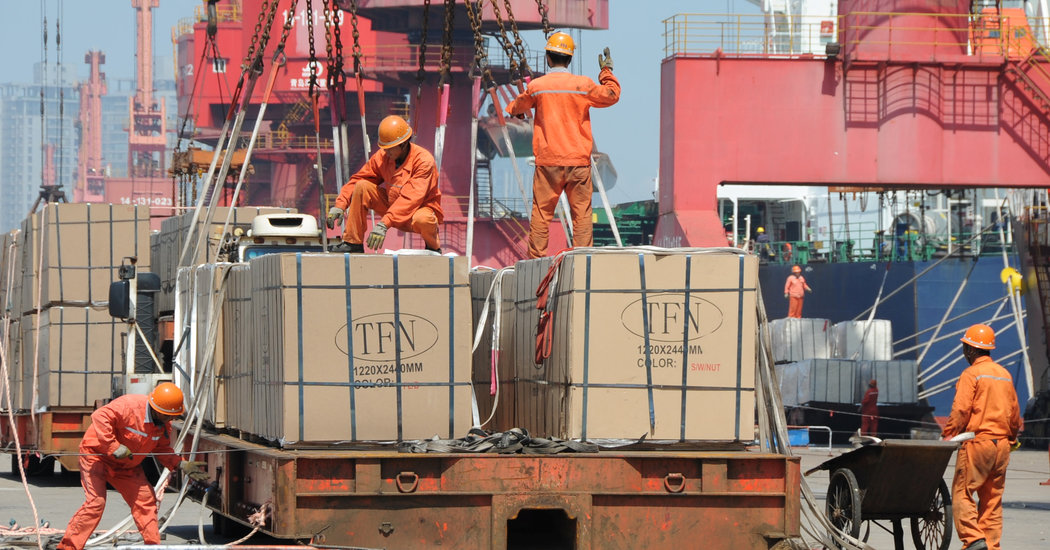
    The World Bank cut its forecast for global growth by 0.3 percentage points for this year in response to unexpected weakness in trade and manufacturing across advanced and developing economies. Global trade growth has slowed to its lowest rate since the 2008 financial crisis as exports from Europe and Japan have plummeted, particularly to China.

    The bank noted that heightened policy uncertainty, including trade tensions, have been accompanied by slowing global investment and weakening confidence. It warned in a report this month that risks to its outlook are “firmly on the downside, in part reflecting the possibility of destabilizing policy developments, including a further escalation of trade tensions between major economies.”

    This content was originally published here.