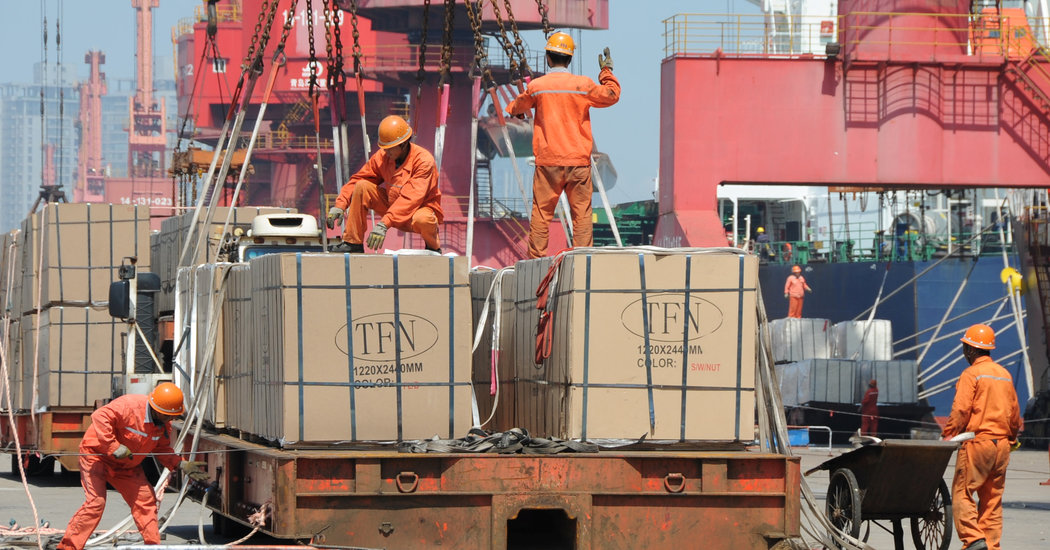
Data increasingly suggest trade tensions are weighing on economic confidence, globally and in the United States.
A Federal Reserve Bank of New York manufacturing survey registered its worst drop ever on Monday, which many economists blamed on Mr. Trump’s threats earlier this month to impose tariffs on Mexican imports as punishment for failing to curb illegal immigration. While those tariffs were averted, the chance that Mr. Trump could make a similar move against another trading partner has caught the attention of global companies and foreign leaders.
The trade war is having “a much bigger impact” on business hiring and investment in the United States than most analysts think, Deutsche Bank wrote in a research note on Monday. Several measures of policy uncertainty, compiled by economists Scott R. Baker of Northwestern University, Nicholas Bloom of Stanford University and Steven J. Davis of the University of Chicago, have spiked with the increased tensions.
On Tuesday, Mr. Trump said in a tweet that he had spoken by phone to President Xi Jinping of China and that the two leaders would have an “extended” meeting next week at the G-20 summit in Japan. Those comments could help calm global trade fears, which had risen after the United States accused China of breaking a trade deal last month and Mr. Trump raised tariffs on $200 billion worth of Chinese goods as punishment.
But no agreement is guaranteed, and Mr. Trump has threatened to impose tariffs on an additional $300 billion of Chinese goods if Mr. Xi does not agree to the original deal. The president has already placed import taxes on $250 billion worth of products from China and has hit trading partners with steel and aluminum tariffs and threatened tariffs on foreign autos from Europe and Japan.
The World Bank cut its forecast for global growth by 0.3 percentage points for this year in response to unexpected weakness in trade and manufacturing across advanced and developing economies. Global trade growth has slowed to its lowest rate since the 2008 financial crisis as exports from Europe and Japan have plummeted, particularly to China.
The bank noted that heightened policy uncertainty, including trade tensions, have been accompanied by slowing global investment and weakening confidence. It warned in a report this month that risks to its outlook are “firmly on the downside, in part reflecting the possibility of destabilizing policy developments, including a further escalation of trade tensions between major economies.”
This content was originally published here.