Author: Truth & Hammer

  • Plant Trees that Turn Your Yard Into a Bird Oasis—and Carbon Sponge

    Plant Trees that Turn Your Yard Into a Bird Oasis—and Carbon Sponge

    Editor’s note: Want a climate-friendly home? Your yard is a good place to start. This is the fourth in a five-part series of guides on how to manage your outdoor turf to reduce your carbon footprint, all while creating bird-friendly habitat. Read part onetwo, and three.

    One of the best ways to combat climate change is to fill your garden with as many trees, shrubs, and other plants as possible. Whether a tiny orchid or towering oak, all plants have the amazing ability to remove carbon dioxide from the atmosphere during photosynthesis and store it in their wood, shoots, and roots.

    Because they’re the giants of the plant kingdom, trees are also powerhouses of carbon storage. In one year, a mature tree can absorb 48 pounds of CO2—about the amount emitted by driving 150 miles in a hybrid plug-in car. Collectively, according to the U.S. Forest Service, trees offset 10 to 20 percent of U.S. emissions from burning fossil fuels each year. The carbon benefits really begin to add up when you consider that trees fight global warming in other ways. For example, carefully placed trees can reduce the energy required to heat and cool a home by 25 percent (see tips here on how to place trees). Because they cool the air by casting shade and releasing water vapor when they breathe, trees also alleviate one of the most underestimated health threats of climate change—heat waves.  

    Of course, while they’re helping to reset the earth’s thermostat, trees in towns and cities provide critical habitat. These so-called urban forests, the sum total of trees along streets and in parks, commercial landscapes, and residential yards, “support a lot of native [avian] species and even species of conservation concern,” says Susannah Lerman, a U.S. Forest Service wildlife ecologist. New York City’s Central Park, for example, is a refuge for several at-risk birds, including resident Common Nighthawks and migrants such as Wilson’s Warblers, both species in decline.

    The bad news is that, at a time when urban forests are needed most, they are also declining across the country. According to a recent U.S. Forest Service study, nationally, about 36 million trees per year were lost in towns and cities due to pests, diseases, and development from 2009 to 2014.

    Typically, only a small percentage of a city’s forest is located on public land, which means home gardeners have a vital role to play in efforts to enhance and maintain urban forests—both for their carbon-trapping and wildlife habitat benefits. “It comes down to some simple decisions,” Lerman says, “such as what kind of tree to plant for birds like chickadees that prefer to forage in neighborhoods with a high percentage of native trees.” The native species, she explains, “support more caterpillars, which are baby food for birds.”

    The following are some tips for choosing and using plants to maximize their climate and habitat benefits.

    Regional Needs 

    For the biggest greenhouse gas reduction and the best wildlife habitat, plant as many trees as appropriate for your region. If you live in an East Coast or Northwest state, where water is plentiful, your landscape can support more trees than if you live in the desert Southwest.  

    For example, Lerman and her colleagues examined the habitat potential of 10 northeastern cities for nine birds with different habitat needs, from the relatively common American Robin to the declining Wood Thrush. A habitat feature that’s important for most of the birds in this forested region, they found, is the percentage of tree canopy cover in an area—that is, the “footprint” occupied by the combined leaves, branches, and trunks of all standing trees on a particular plot of land. The more canopy cover, the better the habitat was for most native birds. 

    Resilience and Maintenance

    Choose native trees, which provide the best wildlife habitat. For help in selecting the most bird-friendly species, consult Audubon’s Native Plant Database. But even native species need to be matched to the amount of soil moisture and other conditions on your planting site, or they won’t prosper and reach their full carbon-trapping potential. Because the climate is changing rapidly and trees live a long time, talk to tree experts at a nearby botanical garden or a local arborist to learn which species are best suited to the increased temperatures and other projected changes in your area. 

    Remember to also look for species that are pest- and disease-resistant and will not require much maintenance once they’re established—fertilizer, pesticides, and irrigation all have large carbon footprints. Another important hedge: Plant a variety of native trees. A biodiverse landscape is least likely to be wiped out by a disease or pest. 

    Consider the Lifespan

    For maximum carbon storage, plant the biggest trees your property can accommodate, and choose long-lived species because the carbon stored in a tree is sequestered only as long as it is alive. Once a tree dies and begins to decompose, greenhouse gases return to the atmosphere. Some trees can live for hundreds of years, others only two or three decades—a 30-year-old Bradford pear is quite elderly, for example, while a sugar maple of the same age is still a teen. 

    When individuals die, maintain overall tree biomass by replanting. Extend the climate benefits of deceased trees for decades by finding local woodworkers or artists who can use their wood, rather than allowing it to decompose. (Note: Decomposing leaves and logs also provide vital habitat for a variety of critters, so if you have a particularly woodsy yard, feel free to let a tree rot away, too.) 

    Create Vertical Layers

    Finally, don’t stop with the tree planting. The typical American garden, which consists of a few shade trees surrounded by lawn, lacks the biomass of the natural landscape it replaced. Remedy this situation by restoring the various vertical layers of the native plant community that once flourished on your property.

    Below the tall oaks and other trees in my Shelter Island, New York, garden, for example, I’ve planted smaller understory trees such as flowering dogwood, as well as native shrubs, wildflowers, and ferns. This has not only restored the land’s carbon storage potential but also its habitat suitability for birds, from the flycatchers that hunt high in the trees to the catbirds that nest in the shrubs and the  Worm-eating Warblers that forage on the forest floor.

    This content was originally published here.
  • Bitcoin (BTC) Price Starts Much Awaited Rally To $6K

    Bitcoin (BTC) Price Starts Much Awaited Rally To $6K

    • Bitcoin price broke the main resistance at $5,400 and rallied sharply against the US Dollar.
    • The price traded to a new 2019 high and it remains in an uptrend above $5,350.
    • There is a major bullish trend line forming with support at $5,360 on the hourly chart of the BTC/USD pair (data feed from Kraken).
    • The pair has likely started a strong upward move towards the $5,800 and $6,000 resistance levels.

    Bitcoin price rallied sharply above $5,400 and $5,600 against the US Dollar. BTC is likely to extend gains and it may continue to grind higher towards the $5,800 and $6,000 resistance.

    Bitcoin Price Analysis

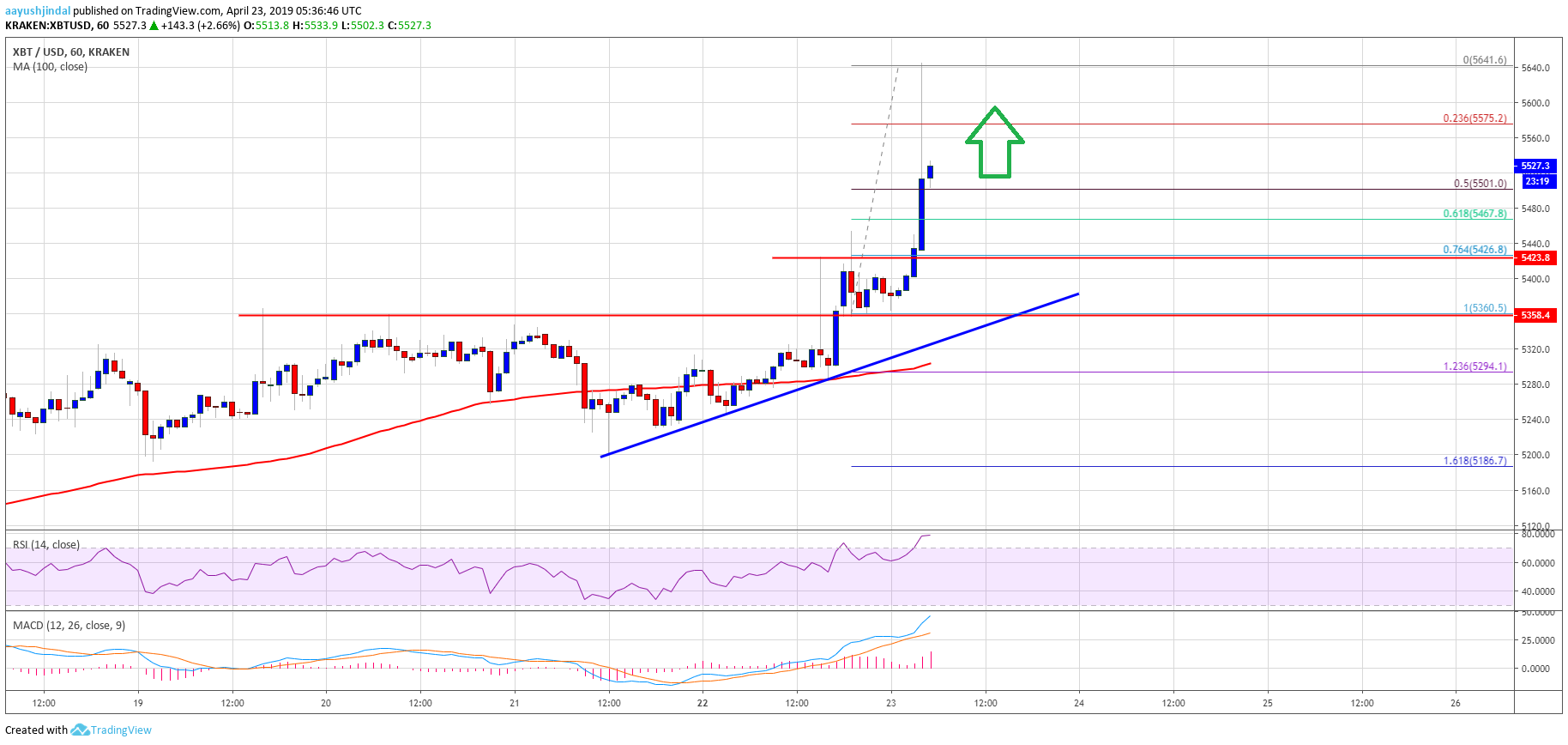
    After a short term downside correction, bitcoin price found support near the $5,200 level against the US Dollar. The BTC/USD pair formed a strong support base above $5,200 and later started a steady rise. There was a break above the $5,300 resistance and the 100 hourly simple moving average. The price traded in a range for a few hours and recently broke the key $5,350 resistance to start a strong rally. The bulls came into action and pushed the price above the $5,400 and $5,500 resistance levels (as discussed in the previous analysis).

    The price even broke the $5,600 level and traded to a new 2019 high at $5,641. Recently, it corrected gains below the $5,600 level and the 23.6% Fib retracement level of the recent rise from the $5,360 low to $5,641 high. However, the $5,500 level is currently acting as a decent support. The 50% Fib retracement level of the recent rise from the $5,360 low to $5,641 high is also near the $5,500 level.

    If there is a downside extension, the next key support is near the $5,420 level. It also coincides with the 76.4% Fib retracement level of the recent rise from the $5,360 low to $5,641 high. Moreover, there is a major bullish trend line forming with support at $5,360 on the hourly chart of the BTC/USD pair. Therefore, dips from the current levels are likely to face a strong buying interest near $5,400 and $5,360.

    Looking at the chart, bitcoin price started a strong rally above the $5,400 resistance (as per our weekly analysis post). The bulls are clearly in control and they could aim further gains above $5,600 and $5,650. The next stop could be near the $5,800 level. If there are further gains, the price is likely to test the all-important $6,000 resistance area.

    Technical indicators:

    Hourly MACD – The MACD is gaining momentum in the bullish zone.

    Hourly RSI (Relative Strength Index) – The RSI for BTC/USD climbed higher sharply above the 60 and 70 levels.

    Major Support Levels – $5,500 followed by $5,420.

    Major Resistance Levels – $5,600, $5,640 and $5,800.

    The post Bitcoin (BTC) Price Starts Much Awaited Rally To $6K appeared first on NewsBTC.

    This content was originally published here.

  • Breakthrough research to revolutionise internet communication

    Breakthrough research to revolutionise internet communication

    A team of University of Otago/ Dodd-Walls Centre scientists have created a novel device that could enable the next generation of faster more energy efficient internet. Their results have been published in the world’s premier scientific journal Nature this morning.
     
    The internet is one of the single biggest consumers of power in the world. With data capacity expected to double every year and the physical infrastructure used to encode and process data reaching its limits there is huge pressure to find new solutions to increase the speed and capacity of the internet.

    Principal investigator Harald Schwefel and Madhuri Kumari’s research has found an answer. They have created a device called a microresonator optical frequency comb made out of a tiny disc of crystal. The device transforms a single colour of laser light into a rainbow of 160 different frequencies – each beam totally in sync with each other and perfectly stable. One such device could replace hundreds of power-consuming lasers currently used to encode and send data around the world.

    The work was born out of Schwefel’s previous research at the prestigious Max Planck Institute in Germany and his collaboration with Alfredo Rueda who did some of the preliminary research.

    The internet is powered by lasers. Every email, cell phone call and website visit is encoded into data and sent around the world by laser light. In order to cram more data down a single optical fibre the information is split into different frequencies of light that can be transmitted in parallel.

    Kumari says the current infrastructure is struggling to cope with demand as internet consumption increases significantly.

    “Lasers only emit one colour at a time. What this means is that, if your application requires many different colours at once, you need many lasers. All of them cost money and consume energy. The idea of these new frequency combs is that you launch one colour into the microresonator a whole range of new colours comes out,” Kumari says.

    “It’s a really cool energy saving scheme,” says Schwefel, “It replaces a whole rack of lasers with small energy efficient device.”

    He expects the devices to be incorporated in sub-oceanic landing stations where all the information from land-based fibres is crammed into the few sub-oceanic fibres available in less than a decade, perhaps within a few years.

    “To develop the device for the telecommunications industry we will need to start working with major telecommunications companies,” Schwefel explains. “We have started the process by collaborating with a New Zealand-based optical technology company.”

    This is the first milestone in a government-funded collaboration between scientists at the University of Otago and the University of Auckland who are part of the Dodd-Walls Centre for Quantum and Photonic Technologies – a virtual organisation gathering New Zealand’s top researchers working in the fields of light and quantum science. The research project has been awarded nearly one million dollars of Marsden Fund money to develop and test the potential of microresonator frequency combs.

    The optical frequency combs are based on a very unusual optical effect that happens when the intensity of light builds up to extremely high levels. You send a single colour of visible light into the crystal disc along with a microwave signal and because the crystal disc is such high quality, the light and microwave radiation gets trapped inside. 

    The light and microwave radiation keep pouring in and bouncing around and around inside the crystal. In most situations light never changes colour but in this case, the intensity becomes so high that the light and the microwave radiation start merging and making different colours. The phenomenon is known as a non-linear effect and it has taken the team many years to optimise.

    “This is a very exciting project to be working on,” says Kumari. “Optical frequency combs have literally revolutionised every field of applications they have touched. You can use them for vibrational spectroscopy, distance measurement, telecommunications. I’m looking forward to seeing how we can use ours.”

    This content was originally published here.

  • Landslide election victory thrusts Ukrainian comedian into limelight

    Landslide election victory thrusts Ukrainian comedian into limelight

    KIEV, April 21 (Reuters) – In a popular Ukrainian TV series, comedian Volodymyr Zelenskiy played a president who is scrupulously honest and outwits crooked lawmakers and shadowy businessmen who try to stand in his way.  Zelenskiy’s character in the show “Servant of the People” was loved by Ukrainians fed up with how their country had been governed since independence in 1991.  On Sunday, they turned fantasy into reality after voters elected Zelenskiy by a landslide, according to exit polls, thrusting an actor with no prior political experience and few detailed policies into the presidency of a country at war.  Zelenskiy’s sudden rise comes at a time voters around the world have upended the status quo, propelling anti-establishment forces such as U.S. President Donald Trump and Italy’s 5-Star Movement, which was also once led by a comedian, to power.

    His victory reflected voters’ frustration with politics as usual. Just 9 percent of Ukrainians trust their national government, the lowest of any electorate in the world, a Gallup poll in March showed.  Critics question Zelenskiy’s political inexperience and he remains something of an unknown quantity for investors who want reassurances that he will accelerate reforms and keep Ukraine in an International Monetary Fund programme.  Zelenskiy’s unorthodox campaign put the incumbent President Petro Poroshenko on the backfoot right from the start.  He announced his bid for the presidency on New Year’s Eve, upstaging Poroshenko who was giving a traditional televised address to the nation.  Eschewing traditional rallies, his campaign relied heavily on quirky social media posts to his millions of online followers, jokey posters, comedy gigs and winking allusions to the fictional president he portrays on screen.

    He traded insults and accusations with Poroshenko in tit-for-tat social media videos and the two met in a raucous policy debate in a soccer stadium in Kiev last Friday in front of thousands of their followers.  Back in February, when asked in an interview with Reuters what sets him apart from other candidates, Zelenskiy pointed to his face.  “This. This is a new face. I have never been in politics,” he said.  “I have not deceived people. They identify with me because I am open, I get hurt, I get angry, I get upset. I do not hide my emotions on camera, I do not try to look different. If I’m inexperienced in something, I’m inexperienced. If I don’t know something, I honestly admit it.”  After performing in student theatre, Zelenskiy came to prominence as a team captain in the TV show KVN, where teams compete against each other with jokes and song-and-dance routines. In 2003, his team formed the basis of TV production company Kvartal 95 http://kvartal95.com/en, which makes Servant of the People.

    ‘SELLING THE DREAM’

    In the TV series, Zelenskiy starts out as a humble high school history teacher who becomes president after an expletive-laced tirade about Ukraine’s corrupt political class, secretly filmed by one of his students, goes viral.  Disaffection with how little has changed under Poroshenko has helped fuel Zelenskiy’s popularity, according to Serhiy Leshchenko, an investigative journalist and lawmaker.  “The desire of Ukrainian citizens is to have new faces, to have new politicians ready to reshuffle the whole political class,” he said, comparing the comedian to Trump.  “Both of them are TV stars, and both of them are selling people the dream, so people are ready to accept this dream because they are fed up with the old class of politicians.”  The Maidan protests in 2014 that ousted a Kremlin-friendly president brought hope of change, but Poroshenko’s critics say progress has not come fast enough in a country where corruption remains entrenched, oligarchs amass wealth and influence and poverty levels are among the worst in Europe.  Zelenskiy’s squeaky clean fictitious president is a powerful image, blurring the lines of where his character stops and the real-life politician begins. Even his party is called Servant of the People after the TV series.

    IMF DEALS

    As his campaign gathered steam, Zelenskiy brought reform-minded former ministers to his team as advisers, providing a measure of reassurance to investors who nevertheless found his answers on policy questions vague at times.  Zelenskiy told Reuters he would not allow Ukraine to default on its debt commitments to the IMF, which has propped up the economy with billions of dollars in loan.  He hopes the country will eventually stop relying on the IMF but, for now, he would not allow Ukraine “to default and spoil the image of our country”.  Asked for his position on whether he would allow household gas prices to rise to market levels, another IMF demand, Zelenskiy was short on specifics. He said Ukraine’s tariffs were the lowest in Europe but still too high for many.  Ironically, given the clean image of his fictional president, Zelenskiy has had to fend off suspicion that in real life he is a puppet of Ihor Kolomoisky, a prominent oligarch whose TV channel airs Zelenskiy’s shows.  Zelenskiy insists his relationship with Kolomoisky is strictly professional. He said he would not, as some fear, hand back ownership of PrivatBank, Ukraine’s largest lender, to Kolomoisky if he becomes president.  As part of an IMF-backed clean-up of Ukraine’s financial system, the government nationalised PrivatBank in 2016 – and later alleged the lender was used for large-scale fraud and money laundering. Kolomoisky called the allegations nonsense and has said the bank was nationalised on spurious grounds.

    source

  • Mexican soldiers detain American soldiers on U.S. soil. Government response: ?

    Mexican soldiers detain American soldiers on U.S. soil. Government response: ?

    The Mexican government is powerless to control the cartels at our border. But somehow when it comes to belligerently confronting our own soldiers on our own soil, the Mexicans seem to muster the personnel and temerity to defend their side of the border. Moreover, they apparently have the unbridled impudence to complain about armed American citizens defending our border, while they have permanently transformed our country in the worst way imaginable through their disrespect of our sovereignty. This is clearly no longer about immigration, but about a pure invasion that requires a military buildup.

    On April 13, at around 2 p.m. Central Time, a group of five or six suspected Mexican soldiers approached an unmarked vehicle of two U.S. soldiers stationed at the border in El Paso County, Texas, and ordered them out of the vehicle. According to Newsweek, which obtained the “serious incident report,” the soldiers were in fact active duty members of B Battery, 1st Battalion, 37th Field Artillery Regiment, not from a National Guard unit. The Mexican soldiers disarmed one of the U.S. soldiers and placed his sidearm in the U.S. vehicle.

    While the soldiers were parked south of the border fence near Clint, Texas, they were north of the Rio Grande riverbed, which placed them “appropriately in U.S. territory,” according to Maj. Mark Lazane, a spokesman for NORTHCOM. Customs and Border Protection (CBP) and the Department of Defense (DOD), after inquiring of the Mexican government, were informed that the Mexican soldiers thought that the Americans were south of the border. “Throughout the incident, the U.S. soldiers followed all established procedures and protocols,” according to NORTHCOM.

    NORTHCOM confirmed that there are approximately 2,800 service members assigned to the border mission. “This includes approximately 1,200 on the Mobile Surveillance Camera mission, plus about 1,000 service members hardening ports of entry in Texas and New Mexico. There are approximately 200 personnel as part of a crisis response force, with the remainder being headquarters and logistics personnel supporting the mission.”

    When I asked both NORTHCOM and the State Department if our government had conveyed our concerns to Mexico and asked for an apology, both departments declined to comment.

    Zach Taylor, a retired 26-year veteran of the Border Patrol who has formed a group of retired border agents to better educate the public on the border, told CR that he is convinced these Mexican soldiers were making a political statement. “At the reported location the Rio Grande River is distinct and easily identified in relation to the actual international boundary,” asserted Taylor, who still lives near the border in Arizona. “That one of the supposed Mexican soldiers took one sidearm from an American and put it in the American vehicle is curious, as if the Mexicans knew exactly who they encountered, where they were encountered, and were simply making a statement. What the purpose of that statement was is open to broad speculation, but on the face of it, this was probably political – as in showing that to Mexico, borders mean nothing.” Taylor confirmed that he regularly saw this behavior during his time in the Border Patrol.

    read more

  • Is LGBT status a protected class?  How about aged, unborn babies, do they really care?

    Is LGBT status a protected class? How about aged, unborn babies, do they really care?

    The Supreme Court has agreed to rule on whether or not the Civil Rights Act needs further clarification to include LGBT people specifically as a protected class.

    What’s the background?

    Title VII of the 1964 Civil Rights Act “prohibits employment discrimination based on race, color, religion, sex and national origin.” The question before the Supreme Court now is whether or not this protection for employers against sex-based discrimination already extends to sexual orientation, making it a protected class.  One of the plaintiffs in the cases being brought before the court involves a New York skydiving instructor named Donald Zarda. According to the lawsuit, Zarda told a female skydiving client that he was gay to ease her mind about being strapped to him while skydiving. He claimed he was fired in 2010 for divulging this information after the woman’s boyfriend complained to his employer.

    Zarda would later die in a BASE-jumping accident in 2014, four years before the Second Circuit Court of Appeals ruled that he had been wrongfully terminated under Title VII.  Along with Zarda’s case, the court will hear the case of a Georgia child welfare services coordinator and a transgender funeral home worker from Michigan, who both attest that they were fired because of their sexual orientation or gender identity. Lower courts have disagreed about whether or not Title VII protections apply in these cases, with the 6th Circuit Court ruling they do, and the 11th Circuit Court ruling that they do not. The Trump administration has also argued that Title VII only applies to discrimination based on birth gender and not orientation or transgender identity.

    What else?

    In addition to answering more general questions about discrimination, this ruling could also determine whether or not religious organizations or business owners have a right to refuse to employ or do business with gay or transgender people on the basis of their personal convictions.  The Supreme Court had refused to hear a similar case in 2017.

    source

  • Square Dancing Is Good Healthy Fun

    Square Dancing Is Good Healthy Fun

    Remember in high school when the gym teacher announced, “Today we are going to learn square dancing!”? You picked out a partner, usually of the same sex, and then the teacher went on to teach you the commands, also known as calls, such as “dosado” and “swing your partner”. Eventually, the teacher would put on a record of country music and test your square dancing skills by yelling out the calls in random order. Well, square dancing has changed a lot since then.

    Have you seen square dancers twirling, laughing, and having fun at the state fair or at a dance convention? Do you want to meet people that will turn into life-long friends? Are you looking for more fun in your life? Would you like to have fun while exercising? You are invited to get fit through square dancing. Find out how much fun square dancing can be. Did you know that one and one-half hours of square dancing equals 30 minutes of aerobics and a 3 mile walk? Square dancing keeps the mind active and the body fit without strenuous workouts.

    Submitted by Barbara Veres

    Square Dancing is a great activity for any kind of social event. Square Dancing provides a synergy and team-building experience that is unlike any other activity that I know of. Garland Smith specializes in providing square dance and line dance entertainment for parties and social events. Garland uses Square Dancing, line dancing, circle mixers, contras, and other specialty dances to provide a unique party experience that will leave you with a smile on your face and a song in your heart.

    The post Square Dancing Is Good Healthy Fun appeared first on Garland Smith Caller.

    This content was originally published here.

  • April showers bring home and garden projects. Helpful tips for the projects to start on first! – Living Home Ideas

    April showers bring home and garden projects. Helpful tips for the projects to start on first! – Living Home Ideas

    Whether you have a sprawling property or a small backyard, there’s always some work to be done. Spring is the perfect time to liven up your outdoor space for al fresco dining or a little gardening. No matter how you like to spend your days outside, here are a few projects you’ll want to take care of first.

    Check your air conditioner

    First things first — check to make sure your air conditioner is in full working order. This simple step often goes unchecked, but you’ll definitely wish you had checked early if your AC does ever go out. If you suspect that there’s an issue, contact a local heating and air company to come take a look. Go Green Heating & Air services or replaces air conditioners in the greater Denver Metro area.

    Get your yard ready

    It’s time to start making room for all the new growth that comes following April showers. Clean up any debris like fallen twigs and rake leaves to create a clean canvas to work with. After you’ve done that, apply weed killer, pre-emergent, and fertilizer to have your lawn looking like new in no time.

    Tune-up your lawn mower

    Throughout the spring and summer you’ll want to mow often to keep everything looking nice and trim. If you have a stubborn lawn mower that doesn’t always start when you want it to, it might be time to give it a little tune-up or fully replace it.

    Repair your fence

    A broken or worn out fence can make even the prettiest landscaping look drab. If your fence isn’t in need of major repair, rent a pressure washer to scrub weather-related wear and tear. Some fences do need to be fully replaced though, and if planks are missing or falling down, it’s time to update. Companies like Ozark Fence can build any kind of fence from traditional wood fences to more unique styles like bamboo, iron, and vinyl.

    Plant a garden

    Starting a garden can be such a rewarding activity. Spring is the perfect time to plant a fruit and vegetable garden with delicious foods like tomatoes, peppers, or even watermelons. Imagine all the dishes you’ll be able to create with ingredients right at your fingertips.

    And after all that hard work, don’t forget to sit back and enjoy your freshened up outdoor space before embarking on a summer full of activities.

    This content was originally published here.

  • Arizona city overwhelmed by migrants declares state of emergency

    Arizona city overwhelmed by migrants declares state of emergency

    Yuma, a city on the U.S.-Mexico border in Arizona, declared a state of emergency Tuesday, saying it cannot handle the crush of illegal immigrants the government is being forced to release onto its streets.  Mayor Douglas Nicholls said the migrants are being released by the Border Patrol into his community faster than they can leave, and local shelters are already at capacity.  He warned of mobs of people “roaming the streets looking to satisfy basic human needs,” clashing with citizens looking to protect their own property.  “There is an imminent threat on having too many migrant releases into our community,” he said. “It’s above our capacity as a community to sustain.”  The move was designed to draw the attention of the country to what locals said was an untenable situation and to beg for solutions from the federal government, which has been at a political stalemate over what to do.

    Mr. Nicholls said he is trying to get other Arizona communities to issue similar declarations, hoping a critical mass of voices will cut through the partisan gridlock.  The migrants are overwhelmingly families and unaccompanied children from Central America. They are fleeing rough conditions at home and are drawn north by lax enforcement policies that virtually guarantee they can be quickly released into communities, where most disappear into the shadows.  Of the children and families that came in 2017, more than 98% were still in the U.S. as of the beginning of this year.  The Trump administration has been searching for ways to change the incentives that draw the migrants to the U.S. On Tuesday, Attorney General William Barr announced that migrants who take the first step toward asylum claims will no longer have an automatic right to be released on bond while their cases are proceeding. The ruling, though, won’t generally affect the children and families, who are quickly released under other court rulings and laws. Also Tuesday, a Homeland Security Department advisory council issued an emergency report calling for the government to take new steps.

    One solution was to set up regional processing centers along the border to centralize the flow of migrants, with new and better facilities to care for the children and families.  The council also pleaded with Congress to pass emergency legislation to speed up asylum cases so a decision can be issued within a month and asked for a fix to the Flores court settlement that imposes a 20-day limit on how long illegal immigrant families can be held in detention.  In the meantime, the council said, the administration should issue an emergency regulation allowing migrant families to be held.  Yuma sits on the line between Arizona and California, surrounded by rough, vacant terrain to its east and west. That means it has become the drop-off point for thousands of illegal immigrants each week streaming into the remote parts of California and Arizona, guided by smugglers who bus them north and then leave them to walk across the border and demand attention from U.S. authorities.  Border Patrol agents arrest them en masse — a group of 360 people was apprehended near Lukeville, Arizona, earlier Tuesday.  But with no ability to hold them, agents engage in what is called “catch-and-release,” processing the migrants and then letting them go at a local bus terminal.

    Communities along the border have issued desperate pleas for help, but Yuma’s state of emergency is the most striking reaction.  Mr. Nichollls said the local shelter’s normal capacity is 150 people but it can stretch to accommodate 250. It began Tuesday with 200 people, and Border Patrol agents said they were going to deliver 120 more people during the day, putting the facility well beyond its limits.  The mayor said even if the city had a bigger building, the number of people swamps the capacity for volunteers and supplies — though he did issue a call for donations of coloring books, diapers, snacks and bottled water.  He said the issue is transportation in a town of about 100,000 people, where bus links aren’t extensive and there isn’t enough capacity to ship people out as fast as they are being dropped off by the Border Patrol.  President Trump has proposed siphoning the illegal immigrants from the border into sanctuary cities elsewhere, saying it’s only right those communities step up, given their policies and proclamations about welcoming migrants. That idea has ignited a firestorm in Washington, where Democrats called it unbecoming.  Yet some sanctuary cities have stepped forward to say they would embrace the migrants.

    Oakland Mayor Libby Schaaf over the weekend said she would be happy to do so. “Oakland welcomes all, no matter where you came from or how you got here,” she wrote in response to Mr. Trump.  Pittsburgh Mayor Bill Peduto also accepted the challenge this week, saying his city “would welcome all.”  Mr. Trump cast his proposal as political payback, but others have said it’s a necessity, at least so far as releasing the migrants away from the border, where the communities are already overwhelmed.

    source

  • How to beat your wife by a guide from the Prophet Muhammad…Really!

    How to beat your wife by a guide from the Prophet Muhammad…Really!

    In a further sick move, the sociologist used a school-age boy called Nayef to show how to deliver beatings “out of love” –  so a woman can feel a “man’s strength”.  And he disgustingly said that some women enjoyed being married to “violent and powerful husbands”.  But he warned: “Some people punch her or slap her on the face… That’s not allowed.”  Al-Ansari uploaded the sick footage to the Al-Mojtama YouTube channel.

    ‘LIGHT AND PAINLESS’

    In the guide he says: “The Prophet Muhammad… Look how merciful Islam is. The Prophet forbade striking the face. He forbade men from beating their wives on the face. Slapping the face, hitting the head, punching the nose – all of this is prohibited. The beating is for discipline.”  World cup organisers FIFA are already under-fire for allowing the 2022 tournament to be held in a country where homosexuality is illegal.  The video is a stark reminder about how women are treated in the strict Muslim nation. We must understand that the man is the leader of the house. A leader has authorities, just like a company manager  Abd Al-Aziz Al-Khazraj

    Al-Ansari begins the 3.30 tutorial by saying that the beating should be light and painless, and that it should make the wife feel her husband’s masculinity and strength, as well as her own femininity.  Al-Ansari then demonstrated how to beat a wife on Nayef by slapping him on the shoulders, grabbing him and shaking him, and saying loudly: “I told you not to leave the house! How many times do I have to tell you?”  He said: “Dear viewers, many people – especially people who are married – would like to know how to beat one’s wife. Is beating your wife necessary? Must a man beat his wife every day? No.

    “First, we must understand that the man is the leader of the house. A leader has authorities, just like a company manager.

    The leader of the house may decide to discipline the wife so life can move on.How does a husband beat his wife? He gives her a disciplinary beating out of love. He loves her

    Abd Al-Aziz Al-Khazraj

    “The leader of the house may decide to discipline the wife so life can move on.How does a husband beat his wife? He gives her a disciplinary beating out of love. He loves her.  “Now, let’s see how Islam teaches how to beat your wife. Let’s imagine that Nayef here… Nayef is obviously a boy, but let’s imagine that he is the wife. How should a husband beat his wife?  “First, he must admonish her – in other words, he should advise her. Then, he should refrain from sharing a bed with her. If all of this doesn’t help, we start the beating as a last resort.  “This is a painless beating that does not leave bruises or cause bleeding. The beating I just gave Nayef is the true gentle beating in Islam.”