Author: Truth & Hammer

  • How to get rid of moles in your yard | MNN – Mother Nature Network

    How to get rid of moles in your yard | MNN – Mother Nature Network

    As you walk onto your carefully manicured lawn, an unsightly raised pattern of grass and broken earth catches your attention. Curiosity gets the better of you. You step on the raised ground, and it suddenly gives way. Has this ever happened to you?

    Or maybe this: You’re surprised to find mounds of dirt ranging from the size of a baseball to a basketball that have appeared seemingly out of nowhere.

    If these scenes sound familiar, Alan Huot has some disheartening news for you. Sorry, you have moles in your yard.

    “Tunneling and mounds of dirt thrown onto the lawn are classic signs of mole activity,” said Huot, who lives in East Granby, Connecticut, and has more than 30 years of experience in controlling wildlife pests and nuisances ranging from moles to beavers to coyotes.

    Don’t despair, though, said Huot, a National Wildlife Control Operators Association certified wildlife control professional. “There are some practical things homeowners can do to get rid of moles.”

    Mole traps

    The most effective method, he said, is trapping. When shopping for a mole trap, Huot advises homeowners to consider several important factors. These include:

    There are three common types of traps, Huot said. They are:

    There are two primary reasons homeowners fail to catch moles with traps, Huot said. The first is that they invariably place the trap in the wrong spot. “To be effective, traps have to be placed in the traveling tunnels, which are the longest and straightest tunnels,” Huot said. The second, he said, is that homeowners typically only set out one trap, whereas professional wildlife control specialists will set out many.

    Moles’ food sources

    Believe it or not, if you’ve got moles it’s because you’ve got something good going on underground in your lawn: earthworms. “Earthworms are the No. 1 source of food for moles,” Huot said. “As long as there is an abundance of earthworms in a lawn, it is a target for moles. But, since earthworms are beneficial to a lawn, you should never try to eradicate them.”

    mole with an earthworm Moles love to eat earthworms, but their diet may include lots of grubs, too. (Photo: Cezary Korkosz/Shutterstock)

    Moles, which are insectivores, will also eat insects such as ants and certain beetle larvae, commonly known as grubs. Huot believes this has led to a misconception among homeowners that can lead do-it-yourself mole control to fail. “There is a widely held notion among consumers that a grub control treatment for their lawn will resolve or mitigate their mole problem,” Huot said. “The assumption is that if you get rid of the grubs the moles will leave. My contention is that while a grub control treatment or program will perhaps benefit the lawn, the moles will still live happy and fat because their No. 1 food source is earthworms!”

    In other words, trying to control the moles’ food source is a difficult strategy, thanks to moles’ varied diets. Aside from traps, the only other options for removing moles are unacceptable to many people — poisons and chemicals. Poisons could potentially harm children and pets, as well as predators that eat moles, and chemicals could kill or drive off beneficial wildlife such as earthworms.

    Traps are the best DIY option for getting rid of moles, Huot said — unless you live in a state that bans mole traps. Most states consider mole traps to be pest control devices, so they aren’t necessarily regulated like other traps. he said. However, he pointed out that some states such as Massachusetts do not allow any trap that grips an animal’s body. “Hence, there isn’t a mole trap on the market that is legal in Massachusetts,” he said.

    Mole repellents

    mole repellent spike A solar-powered mole-repellent spike defends a bed of onions. (Photo: Irina Borsuchenko/Shutterstock)

    Repellents may not be a good way to rid your yard of moles, but they can help prevent moles from moving in to begin with. Or, if you already have moles in part of your property, repellents might at least help you protect a prized section of your lawn or garden from becoming riddled with mole hills or mole tunnels.

    Castor oil is one common mole repellent, although there is some dispute about its efficacy. Tests have shown some benefits from castor oil with eastern moles, according to the San Francisco Chronicle’s Home Guides, although evidence is lacking for western moles. You can buy castor oil repellents in stores, typically pellets or liquids, that are designed to drive moles away with a mixture of castor oil and other offensive ingredients. You could also make your own version; Home Guides recommends mixing 6 ounces of castor oil into 2 gallons of water, along with 2 tablespoons of detergent. Use about one-sixth of this solution for every 1,000 square feet of soil, spraying before it rains or watering the soil afterward to help it soak in.

    Sonic repellents are another option for preventing moles from infiltrating an area. These often take the form of spikes that are slid into the soil, where their sonic vibrations can scare away moles. The frequency isn’t audible to humans, and should pose no danger to children, pets or non-target wildlife. As with castor oil, however, this is more about prevention than getting rid of moles that are already in your yard.

    Facts about moles in your yard

    star-nosed mole The star-nosed moles is easily recognized by the unique ‘star’ of 22 tentacles on its face. (Photo: Agnieszka Bacal/Shutterstock)

    Now that you know how to trap and repel moles, here are a few facts about moles that might help your efforts:

    Editor’s note: This story has been updated since it was first published in April 2015.

    How to get rid of moles in your yard
    Are there mole tunnels in your yard? Here are tips to help with mole control, from facts about food sources to pros and cons about mole traps and repellents.

    This content was originally published here.

  • George Washington was a great man and needs to be see as that!

    George Washington was a great man and needs to be see as that!

    Yes, a better mural would do better!

    A Northern California public school district may remove a mural of George Washington from the halls of George Washington High School due to concerns that it’s offensive and demeaning to Native Americans and African-Americans.  The controversy comes after a working group determined the mural, made up of several panels, “traumatizes students and community members.” But advocates for keeping the 83-year-old mural say that removing it ignores the intent of the artist and represents an attempt to erase history.  In 1936, Victor Arnautoff painted the 13 panels that make up the “Life of Washington” mural at the San Francisco Unified School District campus. Arnautoff was a prominent Russian-American painter who created the murals as part of a Works Progress Administration project undertaken during the New Deal.  But a working group that met in recent months determined the artwork is highly problematic and should be archived after being removed from the walls of the school.

    Read more

  • The Newest Trend in Bars: No Booze

    The Newest Trend in Bars: No Booze

    It was around 9 p.m. at a corner bar off a main drag in Greenpoint, Brooklyn. Two good friends and I raised froth-filled cocktail glasses, the loudest among us punctuating our cheers with a bellowing, “Yaas!” It was an entirely unexceptional scene that could have taken place in any one of New York’s thousands of bars. But there was one crucial difference.  We were imbibing at Getaway, a two-week-old bar where no alcohol is served. Our highball and coup cups were filled not with the usual whiskey or mezcal, but a hodgepodge of gussied-up mocktail ingredients like coconut milk and elderflower syrup.  Call us squares, suckers, or both, but we left the bar laughing, arms around each other. In that grand, drunk tradition, I told one friend how much I love her. We did not need alcohol to get to that happy place, but I’m sure our sugar high helped.  Getaway is just one of the latest sober bars to open in New York. One pop up, Listen Bar, with faux beer and kombucha on tap, is currently crowdfunding for a permanent space. Ambrosia Elixirs, which promises “the taste of sacred intention” in every zero-proof sip, has been in Bushwick for three years, but will expand to spaces in Williamsburg and Manhattan this spring.

    Across the pond in London, even famously beer-happy Brits can turn to he dramatically named Redemption Bar for beetroot martinis and “Pious Pina Coladas.” The bar’s founders, entrepreneurs Catherine Salway and Andrew Waters, were reportedly inspired to open Redemption after wondering, “Why should socializing always be at the expense of your health?”  A few weeks before the opening of Getaway, Amanda Mull wrote in The Atlanticthat there is quite a bit of anecdotal evidence to suggest that “millennials are sick of drinking.” While statistics still show that more than 60 percent of 22 to 37 year olds drink alcohol every month, they might be drinking less.  “What some have been quick to characterize as an interest in being sober might actually be more like a search for moderation in a culture that has long treated alcohol like a dichotomy: Either you drink when the opportunity presents itself, or you don’t drink at all,” Mull wrote.  In this way, a kind of sober tourism has emerged. Think of friends who have gone alc-free for the 31 days of “Dry January” as a testament to willpower or made a point to buy less beer as a way to feel healthy. Regardless of how truly popular these subtle movements truly are, booze-less buzz has garnered enough interest for the wellness industry to take note.

    read more

  • Holtzman’s Survival Kit Paracord Grenade The #1 Best 48 Tool Emergency kit

    Holtzman’s Survival Kit Paracord Grenade The #1 Best 48 Tool Emergency kit

    Your emergency survival kit is full of life saving tools which are hardest to find and improvise which include

    Around 45 ft. of 550 paracord
    -2 ft. safety orange thin paracord
    -Compass
    -LED flashlight
    -Multi tool pocket knife
    -Dog Tag Signal Mirror
    -Fling Fire Starter Rod
    -Flint Striker
    -30ft of 12 lb Test Fishing Line
    -4 Fishing hooks
    -4 Split Shot Weights
    -2 Bobby Pins
    -2 Butterfly Sutures
    -P38 Can Opener
    -Compressed Towel Tablet
    -6 Waterproof Matches
    -2 Stormproof Matches
    -Jute Twine

    -Needle and Thread
    -Razor Blade
    -Military Grade Tripwire
    -Aluminum Foil
    -Wire Saw
    -4 Water Purification Tablets
    -2 Safety Pins
    -Firestarter Whistle Buckle
    -2 Split Rings
    -3 Inches of Electrical Tape
    -Plastic Ball

    Paracord Grenade click here

  • Pocket Chainsaw with Paracord Handle

    Pocket Chainsaw with Paracord Handle

    Pocket Chainsaw with Paracord Handle

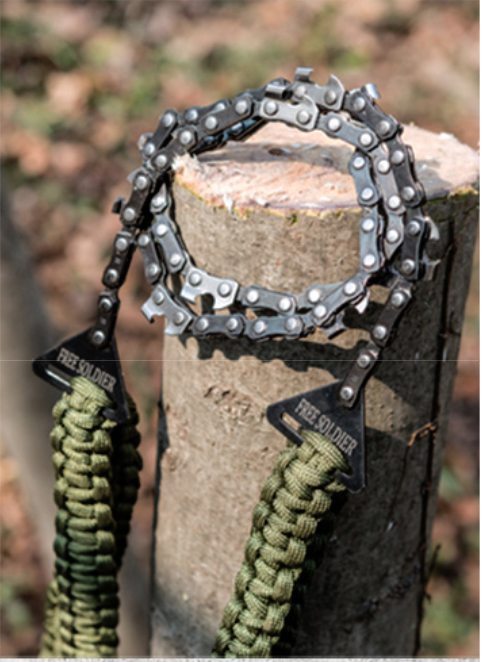
    PORTABLE CHAIN SAW WITH MULTIPURPOSE PARACORD HANDLE: The chainsaw is lightweight, versatile and flexible. 24 inches chain can be folded within 4 inches and total weight only 0.39bls, you take it just as convenient as taking a cell phone! More exciting is its cool paracord handle, it can untie and extend to maximum 275 inches to reach high branches or other emergency situations. Perfect for hiking, camping, emergencies, simple yard work and whenever you need to cut down the wood.
    FASTER CUTTING SPEED & SAVING MUCH EFFORT: With eleven sharp cutting saw blades, the portable survival saw can cut through wood from small branches to large tree trunks in seconds and cuts over-head branches with ease, the flexible chainsaw links create steady yet flexible bi-directional motion, which saves a large amount of time and effort.
    MOST DURABLE & TOUGHEST WILD SURVIVAL GEAR: Made of industrial-grade heat treated steel chain for long lasting durability, with super strong paracord handles and self cleaning style cutting teeth. You never worry about hindering you for the reason of low cutting efficiency.Comes with a convenient and compact belt loop pouch to store hand chain saw. It’s great to put into your pockets, bags or hang on the belts. Definitely be helpful to your bushcraft needs

    Pocket Chainsaw with Paracord Handle Just click here

  • When St. Joseph appeared in France he left a miraculous spring of water –Aleteia

    When St. Joseph appeared in France he left a miraculous spring of water –Aleteia

    On an extremely hot summer day, the humble shepherd Gaspard Ricard was parched with thirst. His flask of water was dry and he was no where near a stream or body of water. Ricard sat down on the grass in agony.

    At that point an older man suddenly appeared to him and said, “I am Joseph. Lift it and you will drink.”

    Joseph was pointing to a large boulder nearby, a rock that Ricard knew he couldn’t lift by himself. Yet, he tried, and somehow he was able to lift the boulder with ease. Underneath it was a fresh spring of water.

    Overjoyed, Ricard looked up to thank the mysterious stranger, but he had already vanished.

    Ricard rushed to the village to tell everyone about the miraculous spring. Soon enough the spring became associated with countless miracles, both physical and spiritual, and a shrine was built at the location.

    The spring of St. Joseph in Cotignac has been a pilgrimage site ever since, and a nearby shrine was eventually combined with a separate apparition of the Blessed Virgin Mary and St. Joseph that occurred in 1519 under the title of Our Lady of Graces.

    This content was originally published here.

  • In a trade deal with China, the US may get an empty shell – commentary

    In a trade deal with China, the US may get an empty shell – commentary

    As always, the Europeans are happy to pocket the benefits of U.S. pressure that forced Beijing to change its trade rules and practices.

    But they also do things differently. Here is the German example.

    During his speech in Beijing last Friday, German Minister for Economic Affairs and Energy Peter Altmaier said that “we shall take seriously (Xi’s) promises.” Washington, however, wants to codify the Chinese “promises” in the form of binding legal documents, drawing out the negotiating process and allowing China to keep recording surpluses on U.S. trades.

    Germans did not negotiate; they ran down China’s trade surpluses 27.1% over the last three years. But Washington wanted to talk while its trade deficit with China soared 11.6% last year.

    A much more interesting difference is the way Germany and the U.S. manage their trade with China.

    A decline of China’s trade surplus with Germany over the last three years was due to a 22.5% increase of German exports.

    By contrast, U.S. exports to China last year fell 7.5%, and in the first two months of this year they crashed 20.4% from the same period of 2018.

    Clearly, Germany relies on pragmatic and reciprocal measures to manage trade and investments with China, while the U.S. wants structural reforms of the Chinese economy, with changes in the way China manages its aggregate demand and industrial policies. And to make sure China does all that, Washington insists on an enforcement mechanism with a permanent threat of trade sanctions.

    Germany, and the EU trade commissioner, are not asking China for a similar bilateral trading regime.

    The other much more important difference is that, unlike Germany and the rest of the EU, the U.S. is locked into an adversarial strategic posture with China in a number of acute security crises in the Indo-Pacific region. The U.S. is also competing with China for technologies that will determine global military and political dominance in the years to come.

    U.S.-China trade is an essential part of that nexus.

    This content was originally published here.

  • San Francisco Bay Area home prices fall for the first time in 7 years

    San Francisco Bay Area home prices fall for the first time in 7 years

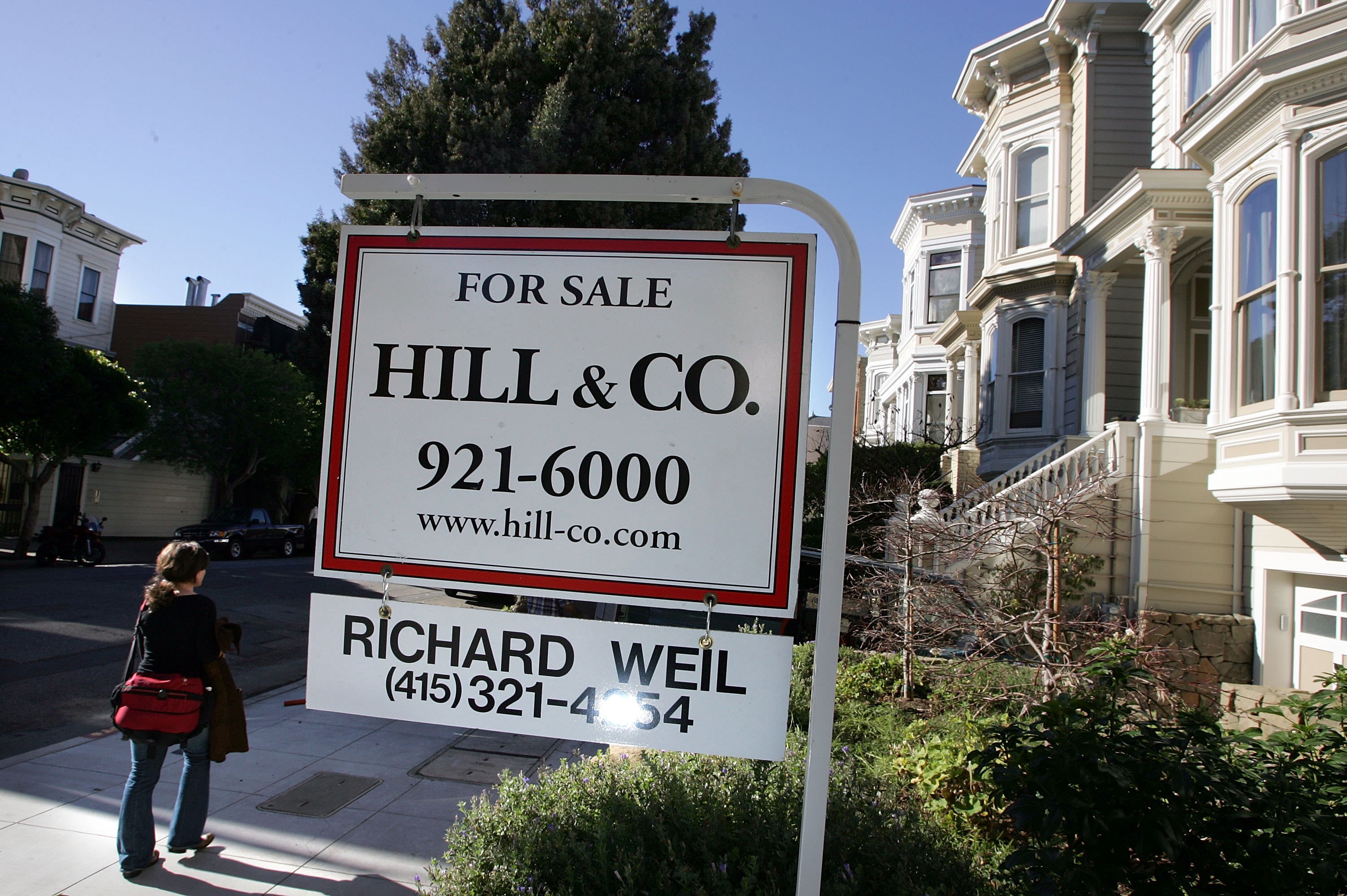
    The median price of a San Francisco Bay Area home sold last month fell slightly compared to the prior-year period, marking the first annual drop since the bottom of the last housing crash, seven years ago, according to CoreLogic.

    In March, the median price was $830,000, down 0.1% compared with March 2018. The decline came as price gains had been shrinking for several months. Before last month, the median sale price had risen annually for 83 consecutive months since April 2012. Both May and June 2018 had the highest ever median sale price: $875,000.

    Prices follow sales, and sales have been running extraordinarily low since last summer, when mortgage rates spiked.

    “It reflects a trend that began in mid-2018 when home sales slowed and inventory grew, forcing sellers to be more competitive,” Andrew LePage, a CoreLogic analyst, wrote in a release. “The year-over-year increase in the region’s median sale price was 16.2% in March last year. But after that, the gains in the median gradually decreased each month and fell to the 2 to 3% range early this year and then disappeared this March.”

    Sales of San Francisco homes – including Alameda, Contra Costa, Marin, Napa, Santa Clara, San Francisco, San Mateo, Solano and Sonoma counties – were nearly 15% lower in March compared with a year ago. That was the lowest March reading in 11 years. Sales have been at 11-year lows since December and have fallen on a year-over-year basis for the past 10 months.

    These numbers are based on closings, so they were likely deals signed in January and February. The market should have been improving, as mortgage rates were falling, the government shutdown was over, and the stock market was surging.

    “Those factors bode well for stronger sales than we’ve seen in recent months, but any impending upswing in activity wasn’t evident in the March data,” LePage said. “Beginning in late spring last year, some potential buyers got priced out and others simply stepped out of the market amid concerns prices were near a peak.”

    Buyers overall, and especially in high-priced markets like San Francisco, are extremely interest rate-sensitive. The average rate on the 30-year fixed spiked to just over 5% last November, according to Mortgage News Daily, and then fell back again in December. In March it took a deep dive to around 4%, but has since climbed back to around 4.5%.

    The next two months will be key to understanding whether all the weakness in prices and sales is due to fluctuations in interest rates, or whether the market has simply hit an affordability wall. Inventory is rising, but largely because homes are sitting on the market longer, not because there are a ton of new listings.

    This tech-heavy housing market could also be impacted to the up or downside from new IPOs including Lyft, Uber, Slack and Airbnb.

    This content was originally published here.

  • How to Read a Nutrition Label | Nerd Fitness

    How to Read a Nutrition Label | Nerd Fitness

    Reading food labels can be tricky. Today, more than ever before, the general public is health conscious and scrutinizing the food they purchase. Food manufacturers and marketers know this. So you come across a snack that says “light” or “multigrain,” and you assume the product in it is healthy. Why would they lie? There’s nothing worse than finding out your favorite protein bar is actually just a sugar filled candy bar with deceiving packaging. That’s why today we are dedicating an article to seeing through this deceptive marketing. We’ll do this by showing you how to read a nutrition information panel, as well as what packaging claims you can dismiss as bogus. We’ll also give you some tips on shifting your diet to a more healthy way of eating in general. If you are trying to watch what you eat to lose weight, make sure you grab our healthy eating guide: 10 Levels to Change Your Life. It’s a level up system, with each step shifting you towards improved nutrition strategies. We take it slow and work with your own pace, so the changes you make will be sustainable and permanent. You can download our 10-Level Nutrition Guide when you sign up in the box right here: Download our free weight loss guide THE NERD FITNESS DIET: 10 Levels to Change Your Life Follow our 10-level nutrition system at your own pace What you need to know about weight loss and healthy eating 3 Simple rules we follow every day to stay on target I identify as a: IGNORE THE FRONT OF THE PACKAGE Food manufacturers are not required to place any nutritional information on the front of the package. Because of this lack of regulation, what’s included on the front of the package is what the manufacturers want you to see. In other words, sales propaganda. Let’s take a look: “Real Fruit Bites” is the product and the company is Nothing But The Fruit. From the looks of this, I would assume these “bites” are mostly made of strawberry? Because what else would you put in them? The verdict: the number one ingredient in this is “apple puree concentrate.” I’ll devote an entire section to bogus health terms marketers use to fool us shortly. I bring up the front of the package now, to tell you it’s not where the real info is. If you want to know exactly what you are eating, you need to look at the Nutrition Label and Ingredients List. That’s where food marketers have to tell the truth (sort of). WHERE THE REAL HEALTH CLAIMS OF A FOOD LABEL CAN BE READ In the United States, the Food and Drug Administration (FDA) requires most packaged food to include a label. Many other countries around the world have a similar agency regulating food. This is key for us nerds because organizations like the FDA force companies to disclose exactly what’s in the food they’re selling. They do this with a Nutrition Label and an Ingredients List. A Nutrition Label identifies the nutrients found in a portion of food, like calories, protein, and vitamins. It’ll look like something like this: An Ingredients list tells you what they placed into the product to get those nutrients. It might look like this: Both are important to analyze. You want to know how many calories you’re getting out of your meal, which can be found in the Nutrition Label. You also want to know what foods they are using to make up those calories, which can be found in the Ingredients List. HOW DO I READ A NUTRITION LABEL Let’s look at another Nutrition Label: This is taken from a Spiced Pumpkin Pie Cliff Bar. Let’s analyze: Serving Size . This is somewhat self-explanatory: serving size is the amount of food, by volume or weight, that is considered one “serving.” New FDA regulations require this size should be typically what someone would eat in a single serving. Which matches what we see here, with “1 Bar.” However, double check this. Your serving might not match what the manufacturer has in mind. For example, a bag of Doritos has about 10 servings in it. Do you really only eat a tenth of bag of Doritos at a time? Look at the Nutrition Label. Calories . This is the energy you’ll get from food. [1] This will be one of the most critical pieces of information on the food package. Which is why it’s right under the serving size on the label. Going back to our Cliff Bar example, we can see that one bar is roughly 250 calories. I want to talk about that word “roughly.” The FDA allows a 20% leeway in either direction for food manufacturers. That means, legally, that Cliff Bar might have 200 calories…or 300 calories. %DV . Have you ever wondered what that “%DV” stands for? It means “Daily Value” and the percent will range from 0 to 100. %DV is an estimate of how much of a particular nutrient you are eating with one serving of food. For example, if you ate that Spice Pumpkin Pie protein bar, you would be getting around 8% of the potassium required for a healthy diet. However, we need to explain come caveats: it’s based on a 2,000 calorie a day diet, whereas the average person needs more than this ( calculate your calorie needs here ). Also, this is the FDA’s estimate of how many vitamins and minerals you need. Do you really trust Big Brother? Use %DV as a starting point only. Here’s some rough guidelines: – Less than 5% DV isn’t that much. – More than 20% DV is a lot. You’ll notice that some things, like Trans Fat, Protein, and Sugar don’t have %DV. The FDA doesn’t require this information, so most food sellers don’t include them. Don’t overlook the Nutrition Label. Yes, they are estimates. But an estimate of the number of calories in a meal is better than no estimate, especially if your goal is weight loss. A message I really strike home in our “ Why Can’t I Lose Weight? ” article is having a good estimate of calories in and calories out. While there is plenty of nuisance, weight loss really does come down to calories eaten and expended. That’s why reading the Nutrition Label can be so critical –  it helps you with the first part of this equation. If you have no idea how many calories you need to eat in a day to reach your goals, I have a couple of resources for you. The first is our article “ How Many Calories Should I Eat Every Day? ” It includes a calculator to give you an estimate of your individual calorie requirements, plus tips on what to do with this info. And the second is for people who are looking for more specific, guided accountability, our uber-popular 1-on-1 Coaching Program . We take all the guesswork out of a weight loss plan and help you start to make better food choices. We’ll tell you exactly what you need to do to get in shape, by changing your nutrition strategy, creating an exercise program, and offering personal accountability. Many Rebels have turned their lives around by becoming a client, and we’d be happy to talk with you to see if we could be a good fit for each other. Click on the big image below to learn more: WHAT NUTRIENTS DO I WANT MORE OF? WHAT NUTRIENTS DO I WANT LESS OF? Let’s chat quicky about some of the nutrients identified on the label. We’ll first talk about dietary fat : the good , the bad , and the ugly . The terms “saturated” or “unsaturated” refers to the bonding of hydrogen atoms to carbon atoms in a fat molecule. When every carbon molecule is bound to the maximum number of hydrogen atoms, the fat is “saturated.” If some carbon molecules are double-bonded to each other (and bonded to fewer hydrogen atoms), the fat is “unsaturated.” Let’s chat about why this matters. The good: unsaturated fat. This is the “healthy” type of fat. There are two types, monounsaturated and polyunsaturated (don’t worry too much about the difference, it has to do with the number of carbon double-bonds in the molecule). Unsaturated fat is typically liquid at room temperature, and you find it in plant-based products (like nuts, avocados, coconut, etc). When people talk about “healthy fats,” unsaturated is generally what they are referring to. What about saturated fat? There’s a lot of conflicting studies out there on saturated fat, and it’s been vilified by marketing companies for years. So what’s the truth?  Personally, I believe that saturated fat is an important nutrient that we need in our system. You can check out this article for an interesting debate on the subject. [2] The bad: trans fat. There has been a good deal of hype about trans fat in recent years.  So what’s the deal? Trans fat is technically an unsaturated fat, but the fat molecule has a different type of carbon double-bond that gets created when oil is “partially hydrogenated.” Hydrogenation is a process used in food production to increase shelf life, which is why it’s often found in processed food like frozen pizza and doughnuts.  Why does all this matter? The “trans” type double bond causes the fat to behave differently in the body, and NOT in a good way. Trans fat can contribute to atherosclerosis, which could lead to a heart attack. Keep your intake of trans fat as low as possible. [3] It should also be noted, that if food has less than 0.5g of trans fat per serving, the FDA allows food manufacturers to round down – meaning “0.” So even if the packaging says “Zero Trans Fat,” it might actually still have some. [4] We’ll end this article by talking about ways to avoid this concern, by sticking to “real food.” Cholesterol is the next big player on the list . Cholesterol is an important building block in cell membranes. We get some from food, and some is made in our liver. Cholesterol is mainly found in animal products, just like saturated fat. In my opinion, cholesterol is not the villain it’s made out to be ! Sodium , and often Potassium , are also listed in this part of the Nutrition Facts label. These are electrolytes . Should you avoid sodium, because of a possible increase in blood pressure? Eh, the findings on this are mixed. [5] A little bit of salt on your food (or in your food) should be fine. Carbohydrates include simple carbs (sugars, like glucose, fructose, dextrose) and complex carbs (fiber and polysaccharides). Dietary fiber is great stuff! There are two types: Soluble fiber is digestible and gets absorbed by your body. This type of fiber helps keep your blood sugar levels stable. Insoluble fiber is not digestible, so it stays in your GI tract and helps “keep things moving.” Trust me, this is a good thing. Prioritize fiber in the foods you eat. Sugar is a simple carbohydrate. It can be absorbed by your gut very quickly because it doesn’t need to be broken down by enzymes first. Sugar is not necessarily bad for you , but consuming large amounts of sugar can cause your blood sugar levels to become unstable. Other Carbohydrates generally refers to complex (large) carbohydrates in food, such as starch. These large molecules are broken down by enzymes into sugar, but the process takes a while. Complex carbohydrates keep your blood sugar levels more stable than do simple carbohydrates. Protein is one of the main building blocks for muscle and other body tissues. There is normally not a %DV for protein because the amount of protein that each person needs is quite variable. You can check out this article for an idea of how much protein you should be eating . At the bottom of the Nutrition Label, you’ll also see a breakdown of micronutrients. Let’s go over some of these key players: Calcium : needed to build bones. This is especially important for women, because bone mass decreases after menopause, so build your bones strong while you are young! Vitamin D : needed to aid the absorption of calcium. Some of this comes from food, and some is made by your body when you are exposed to sunlight. Iron : needed to make hemoglobin, the oxygen-carrying substance in blood cells. Women are more at-risk for being iron deficient, while men are more at-risk for being iron overloaded. You may notice that some labels list more micronutrients than others. If a micronutrient is missing from a label, that means there is not any of it in the food product. Let’s look at the Nutrition Facts for a can of soda. See any micronutrients on there? That’s why soda is referred to as “empty calories.” HOW DO I READ AN INGREDIENTS LIST? Let’s take another look at our Cliff Bar, but this time, looking at the Ingredients List: All the ingredients are listed in order of quantity by weight, so the first few ingredients make up most of the product. For example, the Spice Pumpkin Pie Cliff Bar is mostly brown rice syrup (sugar), oats, and cane syrup (more sugar), in that order. The 4th ingredient, “soy protein isolate” is where this protein bar starts to get some of its protein. I know. Perhaps “Carbohydrate Bar” would be more appropriate than “Protein Bar.” The first few ingredients will give you an idea of what you’re actually eating. So this Cliff Bar is sugar, oats, and protein from soy. Pay attention to the ingredients list. This tells you exactly what you’re eating. Because again, the front of the package can’t be trusted. BOGUS CLAIMS ON FOOD LABELS TO WATCH OUT FOR Marketers love the front of food packages. It’s where they get to use all their fun terms that sound healthy. Let’s go over some: “Light.” When you see “light” or “lite” on a package, it means it’s been processed to reduce calories or fat. However, when fat is reduced sugar is often increased to compensate. Check the ingredients list to find out for sure. “Made with whole grains.” What does “made” mean? It means it contains “some.” Check the ingredients list to see just how much. Is a whole grain in the top three? If not, it’s mostly not whole grains. “Natural.” This has to be good right? Natural, i.e nature, means good for you? Eh, it just means that at some point, the ingredients came from a natural source like apples. Going back to our example above, you could argue that the protein bar contained “natural” ingredients because brown rice syrup is derived from rice. However, a protein bar doesn’t resemble anything grown from a plant. And brown rice syrup really doesn’t have much in common with actual brown rice. For the most part, the more ingredients on a list, the less natural it is. “No added sugar.” This sounds good, until you realize that some foods like dried fruit are just naturally high in sugar. Double check the ingredients to find out. Want some other clever food labels to be on the lookout for? We have a whole article right here diving into the subject . FOOD WITHOUT LABELS Want to know how to avoid worrying about Nutrition Labels and Ingredients Lists? You’ll find a lot of the following there: Meat Eggs Fish Nuts Vegetables Fruits Do you know what most of this doesn’t have? Food labels. A banana won’t have manufacturer disclosed information, because no one manufactured it. It’s a banana. It’s what we here at Nerd Fitness call “real food.” We discuss this in great detail in our Healthy Eating Guide . Food that grew in the ground, on a tree, ran on the land, swam in the sea or flew through the air, would fall into this category.  Meat, fish, eggs, vegetables, fruits, nuts are all great examples of REAL food. Most of this food is found on the outer rim of the grocery store. And there aren’t too many food labels here, besides a barcode. If you want to start eating better, buy whole foods that don’t have food labels on them. They’ll generally have more nutrients and fewer calories, which is an ideal recipe for weight loss . Then you don’t have to worry about food manufacturers deceiving or trying to hide ingredients. The banana is a banana. However, while eating “real food” is a key component of a successful weight loss strategy, it can still be useful to have an idea on the amount of calories in foods such as bananas. Calories in and calories out is the central component of weight loss (thermodynamics for ya), so having a rough idea of calories you’re consuming is key. Even in “real food.” Maybe one day we’ll get robot vision to analyze the calories in everything we look at. For now, you can Google ‘[food] + calories” or check MyFitnessPal to educate yourself! Alright, I think that about does it for today’s article on reading a Nutrition Label. Did I miss anything? Do you have any tips or tricks on deciphering a Nutrition Label or Ingredients List? Do you have any other examples of foods that claim to be one thing, but whose ingredient list proves it’s another? Let me know in the comments! PS: If you’re reading a Nutrition Label to try and lose weight, you’re on the right track! As we state in our Rules of the Rebellion, “ You can’t outrun your fork! ” Keep at it and keep asking questions! PPS: If you want more 1-on-1 help to lose weight or shift your nutrition strategy, I’ll again remind you of our Online Coaching Program ! We work with busy people just like you to develop and execute plans to level up their lives! Click right here to learn if we are a good fit for each other . All photo sources can be read right here. [6] Footnotes    ( returns to text) For the real nerds, a calorie is the amount of energy needed to raise 1 gram of water by 1 degree Celsius, or 4.184 joules.  1000 calories equals a kilocalorie, or Calorie with a big C, which is the unit we are talking about with food. Check out Mark Sisson’s excellent article here . You can check out this article on a warning about the consumption of trans fat. NPR has a good write-up of the subject. You can check out this report from Science Daily. Light Reading , Health Food , Fine Print , Robo Detective , LEGO Collectible , Fish Soup , Lego Biohazard , Apples .

    This content was originally published here.

  • NASA Says Aluminum Fraud Caused $700 Million Satellite Failures | IndustryWeek

    NASA Says Aluminum Fraud Caused $700 Million Satellite Failures | IndustryWeek

    Faulty materials supplied by a unit of Norsk Hydro ASA, one of the world’s top aluminum producers, led to more than $700 million of losses in two failed NASA satellite launch missions, according to an investigation by the space agency.

    NASA’s Orbiting Carbon Observatory mission in 2009 and Glory mission in 2011 didn’t reach orbit and broke-up on re-entry into the Earth’s atmosphere after payloads failed to separate from Taurus XL rockets. Aluminum producer Sapa Profiles Inc. had altered test results and provided false certifications to the rocket’s manufacturer relating to extrusions used in a key component for the payload delivery system, NASA said in a statement.

    “When testing results are altered and certifications are provided falsely, missions fail,” Jim Norman, director for Launch Services at NASA Headquarters in Washington, said in the statement. “The Taurus XLs that failed for the OCO and Glory missions resulted in the loss of more than $700 million, and years of people’s scientific work.” Both missions were intended to launch monitoring instruments related to climate science.

    Oslo-based Norsk Hydro didn’t immediately respond to a phone call and text message seeking comment outside usual office hours. The producer confirmed in an annual report published in March that it had agreed to resolve Department of Justice investigations related to the unit.

    Norsk Hydro agreed to pay $46 million to NASA, the Department of Defense and others to resolve criminal charges and civil claims related to a 19-year fraud, the justice department said in an April 23 statement. Sapa, now known as Hydro Extrusion Portland Inc., is currently excluded from U.S. federal government contracting, NASA said in its statement.

    This content was originally published here.