Author: Truth & Hammer

  • Dow Jones industrials cross 27,000 points for first time

    Dow Jones industrials cross 27,000 points for first time

    A turbulent day on Wall Street ended in the record books Thursday as the Dow Jones Industrial Average climbed above 27,000 for the first time and the S&P 500 index hit another all-time high.

    The milestones came on a day when the S&P 500 briefly moved above 3,000 for the second straight day before an early rally lost some of its momentum.

    The market lost some ground after an auction of long-term U.S. government bonds failed to drum up strong demand. That pulled bond prices lower, sending yields sharply higher.

    Banks and technology stocks led the broad gains, offsetting losses in real estate and communications services companies.

    The latest gains extended a winning streak for stocks into its third day. Stocks have been trending higher for much of the week as investors have grown more confident that the Federal Reserve may cut interest rates for the first time in a decade as soon as the end of this month.

    “Sure, 27,000 is just a number and in the whole scope of things isn’t meaningful,” said Ryan Detrick, senior market strategist for LPL Financial. “What it is though is a reminder for all investors that this bull market has ignored all the scary headlines for years and the dual benefit of fiscal and monetary policy could mean it has a lot longer to go than most expect.”

    The S&P 500 rose 6.84 points, or 0.2%, to 2,999.91. The index set three straight record highs last week.

    The Dow gained 227.88 points, or 0.8%, to 27,088.08. The Nasdaq composite gave up an early gain, sliding 6.49 points, or 0.1%, to 8,196.04. The Russell 2000 index of smaller company stocks dropped 7.13 points, or 0.5%, to 1,557.92.

    Major stock indexes in Europe fell.

    Stocks rose from the get-go Thursday as investors looked ahead to Fed Chairman Jerome Powell testifying before a Congressional committee for the second straight day.

    Powell stressed that the Fed is prepared to cut interest rates to support the economy, raising hopes that the first reduction in its key policy rate in a decade could happen later this month.

    He noted that “uncertainties around trade tensions and concerns about the strength of the global economy continue to weigh on the U.S. economic outlook.”

    New government data released Thursday showed consumer prices rose in June from a year earlier. The bump in inflation wasn’t expected to give the Fed reason to reconsider whether it should lower rates, if necessary. Inflation has remained muted through much of the economy’s 10-year expansion, which Powell has said cited as a justification for potentially lowering rates.

    The early rally weakened by early afternoon after bond yields spiked following weak demand at an auction for 30-year Treasurys. That pulled bond prices lower, driving the yield on the benchmark 10-year Treasury note to 2.14% from 2.06% late Wednesday, a big move.

    “The markets were higher at the beginning of the day based on Powell’s testimony and him confirming what the futures markets have been telling us for a whole month: That we were going to get a rate cut,” said Randy Frederick, vice president of trading & derivatives at Charles Schwab. “But then we had this Treasury auction, which apparently didn’t go so hot.”

    The surge in bond yields marked a reversal from recent weeks, when many investors funneled money into bonds and other less-risky assets amid growing anxiety over the U.S. trade conflicts and signs of a slowing global economy.

    The move had a swift effect on real estate stocks, utilities and other high-dividend stocks that lose their appeal when bond yields rise. Real estate investment trusts took the heaviest losses. Iron Mountain slid 7.5%.

    Banks benefited from the surge in bond yields. When bond yields climb, they push up the interest rates that lenders charge for mortgages and other loans, making them more profitable. Bank of America rose 1.2% and Goldman Sachs gained 2.6%.

    Pharmaceutical makers dropped after the White House scrapped a plan to overhaul a system of rebates those companies pay to insurers and distributors. Merck & Co. dropped 4.5%.

    The move gave drugstore chains and health insurers a boost, however. Cigna surged 9.2%, CVS Health gained 4.7%, UnitedHealth climbed 5.5% and Anthem rose 5.5%.

    Traders also weighed a mix of corporate earnings reports, Delta Air Lines and aviation maintenance company Air notched gains after their latest quarterly results topped Wall Street’s forecasts. Bed Bath & Beyond and Fastenal slumped on disappointing results.

    Corporate earnings will keep investors busy starting next week, when S&P 500 companies begin reporting results for the April-June quarter.

    Companies have been lowering expectations for how much profit they made in the quarter. Wall Street now projects that overall S&P 500 company earnings for the quarter fell 2.6% from a year earlier, according to FactSet. As recently as the end of March, earnings were forecast to be down only 0.5%.

    This could be the first time in three years that S&P 500 companies report a back-to-back decline in overall earnings.

    “The bars for earnings have been set sufficiently low to keep expectations in check,” said Jamie Cox, managing partner for Harris Financial Group. “We will hear lots about the impact of tariffs, but not much else.”

    Benchmark crude oil fell 23 cents to settle at $60.20 a barrel. Brent crude oil, the international standard, dropped 49 cents to close at $66.52 a barrel. Wholesale gasoline fell 2 cents to $1.99 per gallon. Heating oil declined 1 cent to $1.98 per gallon. Natural gas fell 2 cents to $2.42 per 1,000 cubic feet.

    Gold fell $5.80 to $1,404.30 per ounce, silver fell 8 cents to $15.07 per ounce and copper fell 1 cent to $2.68 per pound.

    The dollar rose to 108.47 Japanese yen from 108.42 yen on Wednesday. The euro strengthened to $1.1258 from $1.1253.

    This content was originally published here.

  • Hillary Sends Tweet In Spanish Advising the Undocumented On How to Avoid ICE Agents ⋆ Is this obstruction of justice? Is it traitorous? ⋆ Flag And Cross 🇺🇸 ✟

    Hillary Sends Tweet In Spanish Advising the Undocumented On How to Avoid ICE Agents ⋆ Is this obstruction of justice? Is it traitorous? ⋆ Flag And Cross 🇺🇸 ✟

    Nancy Pelosi, AOC, and Hillary Clinton were three of the biggest names to send tweets advising illegal aliens how to avoid being captured by ICE.

    Because this is how things work in 2019.

    Because this is what the Democrat Party has become.

    take our poll – story continues below

    Which Democrat Presidential Hopeful Has The Wildest Campaign Promise So Far?

    Which Democrat Presidential Hopeful Has The Wildest Campaign Promise So Far?  

    This field is for validation purposes and should be left unchanged.
    Completing this poll grants you access to Flag And Cross updates free of charge. You may opt out at anytime. You also agree to this site’s Privacy Policy and Terms of Use.

    — Hillary Clinton (@HillaryClinton) July 11, 2019

    The @nytimes reported overnight that ICE is planning to conduct massive raids this weekend to deport families and “collateral” immigrants who may be nearby.

    Share this guidance from @UNITEDWEDREAM on what to do if ICE comes to your door. #HereToStay #CloseTheCamps pic.twitter.com/yE837Jzptj

    — Swing Left (@swingleft) July 11, 2019

    More on the raids, from Fox News:

    Starting Sunday, Immigration and Customs Enforcement (ICE) is expected to resume its previously announced plan to apprehend thousands of illegal immigrants across the country.

    The reinvigorated effort comes just weeks after President Trump tweeted that ICE was preparing to kick off days of raids in at least 10 major cities. The operation was halted, however, the day before it was set to start, to give Congress time to arrive at a legislative solution on immigration. Trump said his administration would relaunch the raids after a two-week window – after the Independence Day observance – and that time now seems to have arrived.

    Lori Lightfoot is the far-left Democrat mayor of Chicago that replaced far-left Mayor Rahm Emanuel.

    Lightfoot wants illegal aliens to know that they are welcome in the Windy City, because who needs laws?

    Check this out, per Daily Caller:

    Chicago Democratic Mayor Lori Lightfoot is refusing to cooperate with Immigration and Customs Enforcement (ICE) as it seeks to deport illegal immigrants in cities across America.

    ICE has promised to begin the task of large-scale deportation this weekend but Lightfoot tweeted Friday that “Chicago has taken concrete steps to support our immigrant communities.”

    Lori’s tweets:

    THREAD 1/ We are all aware of the threat from President Trump regarding raids by ICE, and in response, Chicago has taken concrete steps to support our immigrant communities.

    THREAD 1/ We are all aware of the threat from President Trump regarding raids by ICE, and in response, Chicago has taken concrete steps to support our immigrant communities.

    — Mayor Lori Lightfoot (@chicagosmayor) June 21, 2019

    2/ I have directed – and Superintendent Johnson has confirmed – that CPD has terminated ICE’s access to CPD’s databases related to federal immigration enforcement activities.

    2/ I have directed – and Superintendent Johnson has confirmed – that CPD has terminated ICE’s access to CPD’s databases related to federal immigration enforcement activities.

    — Mayor Lori Lightfoot (@chicagosmayor) June 21, 2019

    3/ I have also personally spoken with ICE leadership in Chicago and voiced my strong objection to any such raids. Further, I reiterated that CPD will not cooperate with or facilitate any ICE enforcement actions.

    3/ I have also personally spoken with ICE leadership in Chicago and voiced my strong objection to any such raids. Further, I reiterated that CPD will not cooperate with or facilitate any ICE enforcement actions.

    — Mayor Lori Lightfoot (@chicagosmayor) June 21, 2019

    4/ Chicago will always be a welcoming city and a champion for the rights of our immigrant and refugee communities, and I encourage any resident in need of legal aid to contact the National Immigrant Justice Center (@NIJC). More info here:

    4/ Chicago will always be a welcoming city and a champion for the rights of our immigrant and refugee communities, and I encourage any resident in need of legal aid to contact the National Immigrant Justice Center (@NIJC). More info here: https://t.co/NTMAmhmBbn

    — Mayor Lori Lightfoot (@chicagosmayor) June 21, 2019

    This content was originally published here.

  • Turkey defies US as Russian S-400 missile defence arrives – BBC News

    Turkey defies US as Russian S-400 missile defence arrives – BBC News

    Media playback is unsupported on your device
     

    Turkey has received the first parts of a Russian S-400 missile defence system despite opposition from the US.

    The shipment arrived in an airbase in the capital Ankara on Friday, the Turkish defence ministry says.

    The move will anger the US, which has warned that Turkey cannot have both the S-400 anti-aircraft defence system and US F-35 fighter jets.

    Turkey and the US are Nato allies – but Turkey has also been establishing closer links with Russia.

    What’s the argument about?

    Turkey has signed up to buying 100 US F-35 warplanes and has invested heavily in the F-35 programme. Turkish companies produce 937 of the plane’s parts.

    But Turkey has also pursued an increasingly independent defence policy amid strained ties with the US and Europe. It has purchased Russia’s advanced S-400 air defence system for $2.5bn and sent members of its armed forces to Russia for training.

    US defence officials said the S-400 is incompatible with the wider Nato air-defence system in the region.

    The officials said they did not want the F-35 jets to be near S-400 systems because they feared Russian technicians would be able to access the F-35’s vulnerabilities.

    The US warned that it would exclude Turkey from the F-35 programme if the S-400 deal went ahead, and warned that it could impose economic sanctions.

    Turkey has argued that the two systems would be located in separate locations, and that the US was slow to offer an alternative missile defence shield.

    President Recep Tayyip Erdogan said after a meeting with US President Donald Trump that he believes the US will not impose sanctions.

    This looks set to prompt a major rift between Washington and one of its key Nato allies. For an alliance member to buy this kind of equipment from Russia is almost unprecedented.

    The US has already halted deliveries of the aircraft to Turkey and suspended the training of Turkish pilots.

    Plans are also under way to remove Turkey from the programme altogether. It manufactures part of the F-35 and is due to be a regional hub for maintenance of the aircraft.

    Turkish President Recep Tayyip Erdogan seems to believe that, whatever the Pentagon may say, Donald Trump himself is less hostile to the purchase of the Russian missiles.

    A major test of ties between Ankara and Washington beckons.

    How important is Turkey?

    Turkey has the second-largest army in Nato, a 29-member military alliance.

    It is one of the US’s key allies, and is located in a strategic position, sharing borders with Syria, Iraq and Iran.

    It has also played an important role in the Syria conflict, providing arms and military support to some rebel groups.

    However, it has seen relations deteriorate with some Nato members and the EU, who have accused Mr Erdogan of adopting an increasingly authoritarian style following a failed coup in 2016.

    Media playback is unsupported on your device
     

    How does the S-400 work?


    This content was originally published here.

  • House Dem blasts ‘juvenile’ Ocasio-Cortez, chief of staff: ‘Ignorance is beyond belief’ | Fox News

    House Dem blasts ‘juvenile’ Ocasio-Cortez, chief of staff: ‘Ignorance is beyond belief’ | Fox News

    Capri Cafaro and Terry Holt weigh in on Rep. Alexandria Ocasio-Cortez’s recent comments insinuating that Speaker Nancy Pelosi doesn’t respect her as a ‘woman of color.’

    Rep. William Lacy Clay, D-Mo., added to the mounting Democratic criticism of Rep. Alexandria Ocasio-Cortez, D-N.Y., slamming her “inappropriate” suggestion that House Speaker Nancy Pelosi, D-Calif., is singling out the New Yorker and her “squad” of fellow freshman because of their race.

    Speaking to Fox News on Thursday nice, Clay hammered Ocasio-Cortez’s suggestion.

    “It was such a weak argument to say she was being picked on and that four women of color were being picked on by the Speaker,” he said.

    “It tells you the level of ignorance to American history on their part as to what we are as the Democratic Caucus.

    “It is so inappropriate. So uncalled for. It does not do anything to help with unity. It was unfair to Speaker Pelosi.”

    Clay continued his broadside, saying the comment exposed how much Ocasio-Cortez and Reps. Ilhan Omar, D-Minn., Rashida Tlaib, D-Mich., and Ayanna Pressley, D-Mass., have to learn when it comes to being “effective legislators”.

    “It’s going to take a process of maturing for those freshman members. They will have to learn to be effective legislators,” he said.

    “It shows their lack of sensitivity to racism. To fall back on that (trope) is a weak argument. It has no place in a civil discussion.”

    The lawmaker closed his remarks by suggesting the four freshmen could hurt Democratic chances in upcoming elections.

    “It shows they have no sensibility to different members from our caucus. Some come from red districts and those are the ones who gave us the majority. We need them all,” he said.

    His comments followed a feud between Pelosi and freshman congresswomen, like Ocasio-Cortez, that involved racially-charged criticism.

    Ocasio-Cortez’s chief of staff, Saikat Chakrabarti, previously compared moderate Democrats to racists — prompting Pelosi, at the request of some of her members, warn House Democrats not to attack each other on Twitter.

    “You got a complaint?  You come and talk to me about it.  But do not tweet about our members and expect us to think that that is just ok,” she reportedly said. On the same day of that caucus meeting, Ocasio-Cortez called out Pelosi for what she sees as the speaker continually targeting her and other freshmen lawmakers of color.

    “Their ignorance is beyond belief,” Clay also said while in the Speaker’s Lobby, according to The Hill.

    Clay wasn’t the only one to attack Ocasio-Cortez on Thursday. “The View” hosts Joy Behar and Whoopi Goldberg criticized her’s and others’ decision to attack Democrats like Pelosi. “I think this is more BS,” Goldberg said of Ocasio-Cortez’s comments on race.

    Pelosi, meanwhile, refused to provide further comment on the feud while discussing it during her weekly press briefing.

    “I’ve said what I’m going to say…What I said in the caucus yesterday had an overwhelming response from my members,” she said.

    “Because they know what the facts are and what we are responding to. We respect the value of every member of our caucus. The diversity of it all is a wonderful thing. Diversity is our strength. Unity is our power.”

    Fox News’ Alex Pappas contributed to this report.

    This content was originally published here.

  • 20+ Edible Weeds in Your Garden (with recipes!)

    20+ Edible Weeds in Your Garden (with recipes!)

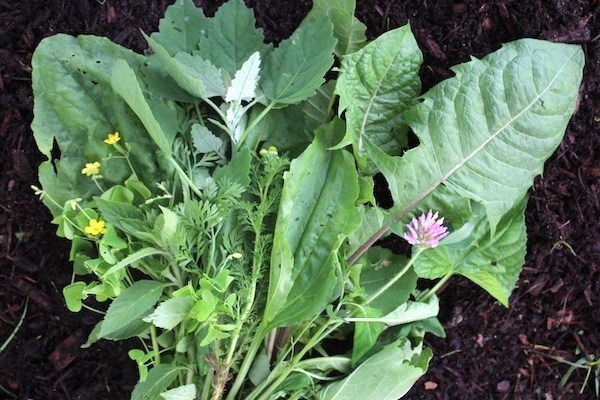
    Eating edible weeds is an easy way to increase your garden’s productivity.  While everyone loves to bring in the harvest, weeding is most people’s least favorite part of gardening.  What if weeding could be harvesting?  When you know how to identify and use edible weeds, basic garden maintenance becomes more like a scavenger hunt.

    Having children makes you think a lot about your own actions and motivations.  Not for any purposeful, metaphysical reason…but simply because they’re always asking, “Why?”

    My 3-year old is uncommonly helpful, and she’s my regular foraging companion.  She’s great at spotting chanterelles and knows all about foraging tasty edible flowers.  Outside of foraging with mama, she’s a huge help weeding the garden.  She used to ask, “Is this a weed mama?” before pulling out an unknown plant.  Now the tiny forager in her asks, “What’s this plant?”

    More often than not, I find myself explaining what it is, and how it can be used for both food and medicine.  That leads my inquisitive little one to ask the next logical question.  “If it’s food, then why are we pulling it up?”

    Good question.

    We spent the afternoon “weeding” our strawberry beds and harvested dozens of varieties of edible weeds.  Yes, we still pulled them up, because strawberries are amazing, and nothing gets between me and a homegrown strawberry, but we also ate them. 

    Knowing how to identify edible weeds turns weeding into harvesting and makes the exercise a lot more fun, not to mention tasty.

    List of Edible Weeds

    Here’s a list to get you started eating wild weeds from A to Z.  I’ll keep adding to the list as I find more fun plants in the garden to spark my memory, but if I’ve missed one of your favorites leave me a note in the comments at the end.

    Burdock (Arctium sp.)

    With a 2+ foot long taproot, burdock can be particularly difficult to remove from the garden.  The sticky burrs are perfect for sticking to clothes, and I often find it growing alongside paths waiting to stick to clothing.  The sticky seeds can be prolific, and if one goes to seed at the edge of the garden you’ll have your work cut out for you the following year.

    Good news, burdock is an edible weed and every part is tasty.  It’s actually cultivated as a vegetable in Asian cultures where it’s called gobo.  The root is often used in curries, or roasted like any other root vegetable, and we make a really effective anti-inflammatory burdock tincture with it.

    Burdock flower stalks are also edible, and creamy centers taste like freshly steamed artichokes to me.  The leaves are edible too, and are great for wrapping dishes cooked in the campfire.  I also found a recipe for burdock leaf kraut in the book Fermented Vegetables, which contains all manner of unconventional and inspiring recipes.

    Chickweed (Stellaria media)

    One of the earliest spring greens you can forage, chickweed can take over a garden fast.  It spreads quickly to form a low growing mat, but it only really thrives in the early spring with cool temperatures.  That’s enough though, to choke out young seedlings in the garden.  Harvest it young, so it doesn’t take over and enjoy it as a tasty snack right in the garden.  Or, bring it inside to make chickweed tincture,  a natural antibacterial used externally, or anti-inflammatory and antihistamine used internally.

    Chickweed pesto is mild and tasty, and a great way to save a big harvest for later.  On the medical side of things, a chickweed salve is great for doctoring gardener’s hands after a long day weeding…

    Cleavers/Bedstraw (Galium sp.)

    Also known as bedstraw, cleavers has been used for centuries in the kitchen and home.  It was once dried for bed filling, and bundles of it were used as a rudimentary strainer for frontier and backwoods cooks.  Some species are used as a form of vegetable rennet to coagulate cheese, and the seeds have been roasted and used as a herbal coffee substitute.

    The name cleavers comes from its herbal usage, since it’s noted for having the ability to “cleave out illness.”  I’ve used cleavers tincture successfully to treat urinary tract infections where it also has the added benefit of being a diuretic which helps move things along.

    Cleavers is especially invasive and difficult to eradicate once established, so I work hard to keep this one out of the garden and mostly harvest it as an edible weed along woods edges.

    Our local species Galium mollugo, also known as Common Bedstraw and false babies breath.

    Our local species Galium mollugo, also known as Common Bedstraw and false babies breath.

    Clover (Trifolium sp.)

    I have a friend who absolutely hates clover because a clover patch means bees foraging nectar and she’s terrified of bees.  The bees have the right idea though, those clover flowers are sweet and tasty….and both bees and clover run rampant in my veggie garden.

    Each flower contains a tiny drop of honeydew at its base, and rural children in New England spend summers harvesting the blossoms for a teeny tiny sweet treat.  The flowers are often made into clover tea.  The blossoms can also be ground into clover flour, which can replace flour in baked goods.  The blossoms can also be baked into things whole, like in these clover and strawberry cookies.  Clover greens are an edible wild salad green, though not one of my favorites.

    Not just an edible weed, clover is also medicinal.  Herbalists recommend a tea for colds, flu, and coughs, and it’s also used to help treat skin conditions like eczema.  Studies show that red clover can help balance hormones in menopausal women, and my midwife specifically recommended I drink red clover tea during my pregnancy.

    Curly Dock (Rumex sp.)

    There are a lot of dock species (Rumex genus), all of them are edible weeds.  The leaves are cooked into curries or baked into chips, the seeds can be ground into dock flour that’s similar in some respects to buckwheat and the roots are cooked too.

    Dock plants form long tap roots, and they’re persistent perennials, producing thousands of seeds each year.  Once one gets a foothold it’s hard to get them out of the garden unless you dig out the whole root system.  Luckily, the roots are not only edible but medicinal.  They’re used as a blood cleanser similar to burdock, but I’ll admit this is one of my least favorite medicines.  Few things taste worse than dock root to my palate, but plenty of people love them.

    Dandelion (Taraxacum officinale)

    More and more people these days know that dandelions are edible weeds, and many are willing to pay $5 for a bunch of dandelion greens on the shelf at the whole foods.  Still, there’s something deeply ingrained in our culture about our hatred for a dandelion-filled lawn.  Leave them if possible, there a great early spring nectar source for the bees.  In our garden, if left unchecked they’ll completely take over and we harvest them by the wheelbarrow full. 

    Just about every part of a dandelion is useful as food or medicine, and there’s a pretty absurd variety of ways to use them.  The blossoms make lovely dandelion wine or dandelion ice cream for the kids.  The roots can be roasted and made into dandelion coffee, or steamed whole and eaten like carrots.  They also are a key ingredient in dandelion tincture and dandelion bitters, both of which are medicinal.  Even the unopened flower buds are edible, and they make a remarkably convincing wild foraged dandelion caper when pickled.  

    Garlic Mustard (Alliaria petiolata)

    Though it’s considered one of the worst invasive weeds, garlic mustard happens to be really tasty.  The name gives you an idea of the taste, a bit garlic-y, a bit mustard-y, and basically green and mildly spicy.  Used sparingly, it makes a good salad green, or it can be cooked as it is in this garlic mustard frittata.

    Personally, I’m less excited about using it as a green and more excited about using it as a seasoning.  This garlic mustard chimichurri sounds perfect.

    Japanese Knotweed (Reynoutria japonica)

    One of the most invasive weeds out there, and very difficult to eradicate.  Luckily, it’s also delicious, with a taste a lot like rhubarb raw and a bit like asparagus cooked.

    I’m glad we don’t actually have any Japanese knotweed on our land, but I do go out of my way to forage it from a patch just up the road.  A tincture of the root is one of the few herbal treatments for Lyme disease, and the shoots can be used in all manner of recipes.

    I wrote up a long list of Japanese knotweed recipes some time ago, including strawberry knotweed pie, and even a few cocktails like a knotweed gin and tonic.

    My own homemade knotweed mini pies. The filling includes 1 cup chopped knotweed, 1/4 cup sugar and a bit of cinnamon and allspice.

    My own homemade knotweed mini pies. The filling includes 1 cup chopped knotweed, 1/4 cup sugar and a bit of cinnamon and allspice.

    Jewelweed (Impatiens capensis)

    One of the best natural remedies for bug bites and poison ivy, jewelweed is handy to have around.  I keep a few jars of jewelweed salve in the medicine cabinet just in case, and it’s come in handy a few times.

    Jewelweed is also edible, and the seed pods taste a lot like walnuts.  Harvest carefully because they’re built to pop when touched, sending the seeds flying in all directions.  If you harvest very carefully though, you can enjoy that pleasant pop on your tongue followed by the taste of fresh walnuts right from the garden.

    Lambs Quarter (Chenopodium album)

    Another edible weed that grows prolifically in our garden, I tend to leave lambs quarter anywhere I can.  I love the sweet succulent taste of the young leaves.  It’s actually a form of wild quinoa, and you can harvest lambs quarter grain if you allow them to mature and go to seed.

    The plants have a sheen on the underside of the leaves because they bio-accumulate minerals.  If dried, they can be burned to use as a wild foraged salt substitute.  Just dry the leaves, then burn them and save the ash.  

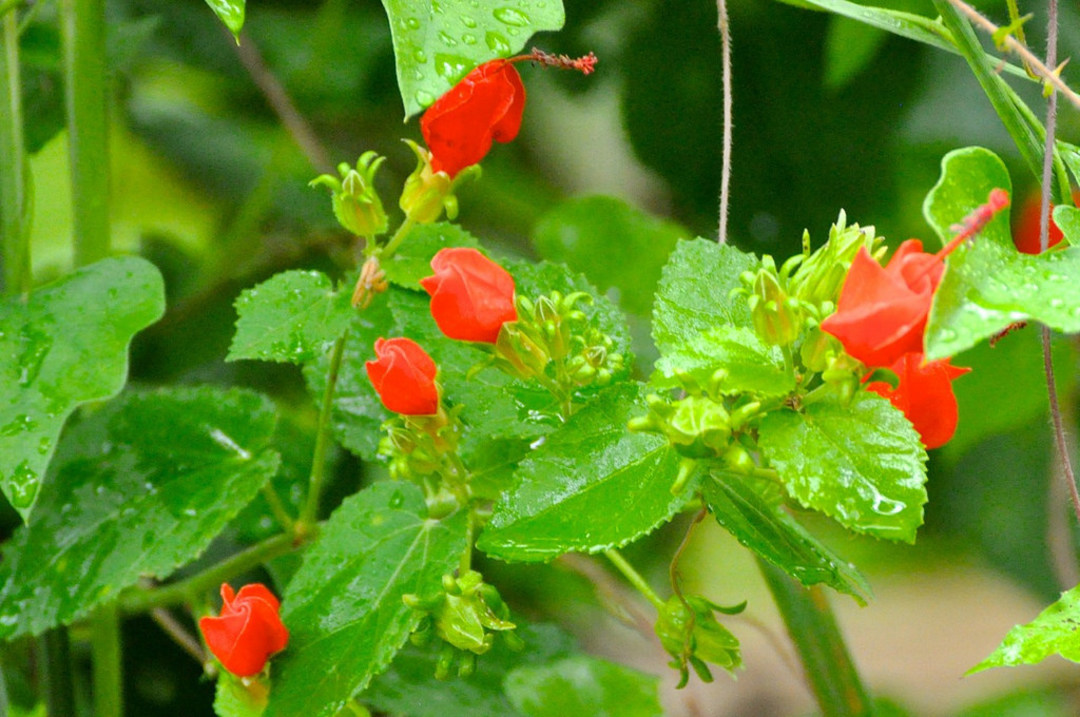
    Mallow Species (Althaea sp.)

    Mallow plants love moist rich soils, and they’re everywhere in our garden.  There’s a cultivated variety (Althaea officinalis) that’s grown in formal perennial gardens, and it was once used to make marshmallow candies.  There are also many varieties that just grow wild, readily self-seeding and taking over unweeded vegetable gardens. 

    The variety we get here grows huge, about 4 feet tall and just as wide.  If they grow in an out of the way spot, I’m likely to leave them for their beautiful flowers and edible leaves.  The leaves are tasty salad green, and work well cooked into dishes like this mallow leaf ravioli.

    Beyond their use as an edible weed, they’re one of my favorite remedies for dry coughs.  The roots contain soothing mucilage compounds that help to coat throats and protect mucous membranes.  The plant’s soothing nature makes it good for digestive and skin issues as well.

    A native bee on a wild marshmallow plant growing in my blueberry bed.

    A native bee on a wild marshmallow plant growing in my blueberry bed. We leave all these wild plants whenever possible, and they grow without any care.

    Milkweed (Asclepias syriaca)

    One of my favorite perennial edible weeds, milkweed shoots taste a lot like asparagus when sauteed in butter.  Every stage of growth is edible, from the young shoots to the flowers to the unripe seed pods.  And at every stage of growth, it tastes a little different and results in a totally new vegetable.

    I let milkweed grow in with my asparagus, particularly because I actually think milkweed shoots taste better than asparagus and also because I really love the intoxicating smell of their mid-summer blooms.

    Be careful, some species of milkweed can be toxic and I only eat common milkweed (Asclepias syriaca).  Be aware that milkweed also has some toxic look-alikes (Dogbane) and you need to be 100% certain on your identification.  I’d strongly suggest a good foraging guide, like The Forager’s Harvest, which contains detailed information on identifying and foraging milkweed.

    For milkweed recipes, I’ve got quite a few tasty ones listed in this milkweed foraging guide, and there are even more in the book Forage, Harvest, Feast including a delicious looking milkweed blossom cordial that I’m going to make this summer.

    Pineapple Weed (Matricaria discoidea)

    Also known as wild chamomile, this little edible weed grew just about everywhere around my home in California.  It loves hot sandy soil, and if you have a warm climate garden with good drainage you’ll likely have plenty of wild pineapple weed.  Even here in Vermont, it grows all over our gravel driveway and finds its way into the dryer spots in the garden.

    The blossoms look like chamomile, but without the white petals.  They have a mild sweet pineapple taste, thus the name, and they’re commonly made into tea.  I absolutely love this recipe for wildflower jam that uses pineapple weed and red clover as main ingredients.

    Around here though, my little ones just love eating the tiny golden flowers fresh in the garden.

    Plantain

    Though it grows best in compacted soils, rather than fluffy garden beds, wild plantain still makes its way into garden paths and beds.  There’s a huge spreading patch of it at the entrance to my garden, and it’s a common weed in lawns and along sidewalks.

    Herbalists know plantain as a potent medicinal, great for insect bites, stings, and minor cuts.  I keep a homemade plantain salve in my medicine cabinet, and we end up using it several times a week all summer.   

    It’s also an edible weed that can be eaten like any other salad green.  The leaves can be a bit tough, but they’re a good substitute for spinach (like on this plantain leaf pizza).  They can also be made into leafy green chips using recipes for kale chips.

    Need more inspiration?  Here are 10 things to make with plantain.

    Foraging Wild Plantain Plants

    Broadleaf plantain. Image Courtesy of Melissa Keyser.

    Purslane

    I remember weeding out the purslane from my garden in southern California.  It was so vigorous in that hot desert heat!  These days, I actually plant purslane in my Vermont garden and tend it along with my salad greens.  Most of the world considers purslane to be a cultivated green, and it’s especially popular in the Mediterranean and the middle east where it thrives in the wild.

    It has some of the highest naturally occurring levels of Omega 3’s in plants, along with a host of other nutrients that put it in the class of “superfoods.”   Try a simple purslane salad to get started, but then get creative…

    A potted purslane start about to be planted in my garden. This is one of the few edible weeds that I actually plant rather than weed out.

    A potted purslane start about to be planted in my garden. This is one of the few edible weeds that I actually plant rather than weed out.

    Queen Anne’s Lace

    Also known as wild carrots, that pretty well sums up Queen Anne’s Lace.  The root is a wild form of our domesticated carrot and tastes pretty similar.  Queen Anne’s Lace flowers and greens are also edible and can be made into dishes like this carrot top pesto or this floral soda.

    The trick is, the plants can easily be confused with very toxic water hemlock.  When in bloom, I think it’s easy to tell them apart, but this is one mistake that can be deadly.  I’d recommend avoiding Queen Anne’s Lace until you’re really confident in your identification.  For more information on positively identifying this edible weed, read up on the difference between it and poison hemlock

    Queen Anne's Lace Flowers ~ This edible weed gets its name from the tiny red flower in the middle, supposedly where queen Anne pricked her finger when making the lacy flowers.

    Queen Anne’s Lace Flowers ~ This edible weed gets its name from the tiny red flower in the middle, supposedly where Queen Anne pricked her finger when making the lacy flowers.

    Quickweed (Galinsoga parviflora)

    Originally native to South America, quickweed has been introduced just about everywhere in the world.  It often doesn’t show up in gardens until later in the summer, but then it grows at an alarming rate, quickly outpacing everything else.  One day the garden is weed free, and a week later you could fill a garbage bag in just a few minutes with this prolific edible weed.

    Forager Chef says it’s “the hardest working green I’ve met so far…It can be used raw, or cooked. Got a call from a farmer that the spinach was killed by hail? Don’t worry, just toss some Galinsoga in that pasta. While you’re at it, put it in the salad mix and on the fish entree, then throw the purchased microgreens in the compost where they belong, as fodder to grow interesting, edible weeds.”

    The scientific name, galinsoga, is often mispronounced and it eventually took on the common name “gallant soldier” as a result.  There’s nothing particularly gallant about this weed, but it does soldier on all summer, remaining tender and edible well after flowering.

    Since it’s a South American native, it’s incorporated into their traditional cuisine.  It’s a key ingredient in a dish called Ajiaco, a Columbian chicken stew.

    Stinging Nettles (Urticia dioica)

    Honestly, I really hate stinging nettles and I’m glad they’re not a problem in my garden.  My neighbors though, they have a huge stinging nettle patch taking over the corner of their garden, and I learned about it the hard when I walked through it in sandals…

    Stinging nettles sting you see, and it can be quite painful.  Once cooked, the stinging leaves are absolutely delicious and lose their sting completely.  If you harvest with care, using gloves and long sleeves, foraging stinging nettle can be a really satisfying way to turn a menace into a meal.

    Here are a few stinging nettle recipes to try:

    Still need more inspiration?  Check out these 40+ Ways to use Stinging Nettles.

    Woman cuts stinging nettle tops while wearing gloves

    Harvesting Stinging Nettles. Image Courtesy of Melissa Keyser.

    Thistle (Cirsium sp.)

    Thistles are never fun to find in the garden, especially if you find them with bare feet.  All of them are edible to the best of my knowledge, and I’ve personally eaten bull thistle and Canada thistle.  The stalks are eaten like celery, and the roots can be cooked like any other root vegetable.

    I’ve talked to some people that love them, mostly my more adventurous foraging friends, but I’d class them as a survival food that’s barely worth the bother.

    bee and bull thistle flower

    While I’m not a fan of thistles, the bees sure do love them…

    Violets (Viola sp.)

    Left unchecked, wild violets would absolutely take over my strawberry beds, and they love the shady rich soil underneath my rhubarb.  They’re common lawn weeds, sprouting up in moist shady spots, but without grass as competition, they’ll readily grow in sunny gardens too.

    Every part of this beautiful weed is edible.  The flowers make a lovely violet jelly, and they add beauty to a wild greens salad.  The leaves can be eaten fresh or made into tea.  They’re also made into a medicinal salve to support the lymphatic system.

    We have so many of them, this spring I posted to Instagram asking for creative ways to use violets…and I got a bunch of answers.  My favorite idea was a violet leaf pesto, and I’m planning on making that happen shortly.

    Wood Sorrel (Oxalis spp.)

    Though it’s not actually related to true sorrel, wood sorrel has a similar bright, lemon-y taste.  The most common edible garden weed type has three-part clover-like leaves and tiny yellow flowers make it easy to identify in the garden.  There are other wild varieties, hundreds in fact, with different blossom colors.

    I find wood sorrel to be really refreshing when weeding, and I’ll happily munch the leaves fresh right in the garden.  

    A wood sorrel plant held in my hand, this edible weed was harvested from the garden and then promptly consumed on the spot.

    A wood sorrel plant held in my hand, this edible weed was harvested from the garden and then promptly consumed on the spot.

    That’s my list, mostly harvested right from our garden.  What did I miss?  What are your favorite edible weeds to pull (I mean harvest) from the garden?

    Looking for more information on edible wild plants?  Check out any of these foraging guides:

    This content was originally published here.

  • Out-of-Ground Swimming Pools: Custom Concrete Construction

    Out-of-Ground Swimming Pools: Custom Concrete Construction

    —How raised gunite pools beautifully triumph over building challenges

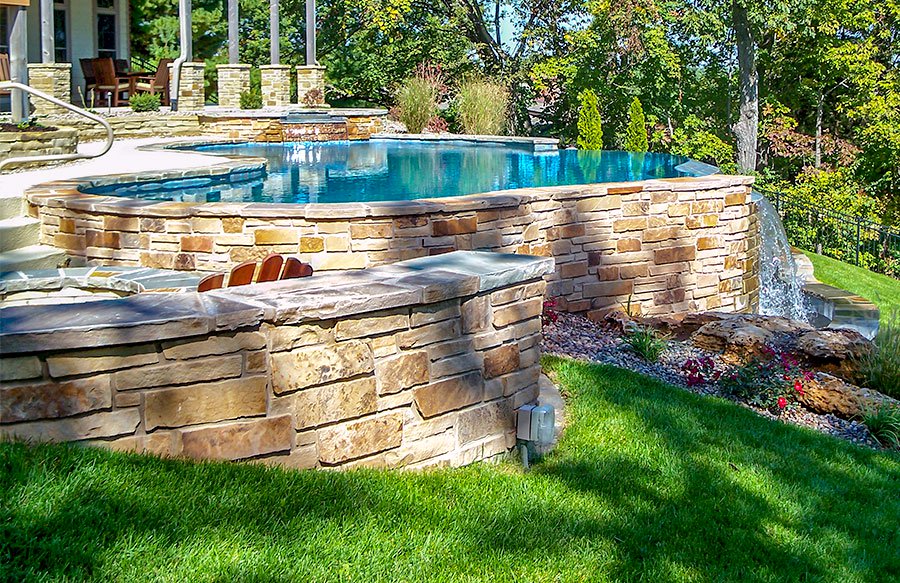
    One reason to build a raised, out-of-ground concrete swimming pool (gunite or shotcrete) is for style: The configuration achieves a distinctive, multidimensional aesthetic and delivers an original backyard design. 

    Another reason is functionality. Some homeowners opt for an elevated, “on-ground” pool design for a family member’s physical mobility needs. The design of some raised pools even yields safety and maintenance benefits.

    However, the most common purpose for using an out-of-ground pool design is to overcome a backyard condition, such as a slope or hard soil, which makes it a virtual construction necessity.

    Regardless of the reason behind the decision to build all or partially out of the ground, the outcome can be eye-pleasing and cost-effective. You can view some examples of these semi-on-ground pool designs to see how their configuration achieves results that are both beautiful and functional!

    Out-of-ground pool construction: overcoming—and capitalizing on—backyard obstacles

    Depending on factors in your outdoor property, your pool builder may suggest a plan for a concrete pool that’s positioned several inches to several feet up out of the soil.

    A number of special considerations impacting construction can make a full or partial above-the-ground pool a smart solution for a new concrete pool.

    However, the three most frequent ones come in the form of slopes, hard or rocky soil, or underground water sources.

    Sloped backyards

    The most common reason for an elevated design is a property with a slope. In most cases, the house sits at the peak or higher up, and the backyard slopes downward away from the home.

    One way to tackle a hilly plot of land is to use its uneven grade to your advantage. On the slope’s high end, it makes sense to build the pool level with the ground, and at the slope’s lower end, build that portion of the pool above or out of the ground.

    Both homeowners and contractors usually prefer this “elevated” approach to the alternative solutions for a sloped yard. These involve leveling the area for the pool using a costly, multi-phase process.

    In a nutshell, it involves building one large or two small solid retaining walls, usually in concrete or stone. Then, your contractor must haul in many yards of fill dirt to the job site and distribute it as needed to bring all areas up to the desired grade.

    Finally, crews need to heavily compact every bit of fill dirt throughout the yard. For many sloped yards, such a massive undertaking is both pricey and impractical. Worse yet, retaining walls may block all or part of a scenic view.

    By building one side of your pool out of the ground, you may not only save money and possibly preserve a scenic view, but come out ahead with a more interesting, more dramatic pool. In fact, a sloped yard often makes it easier to build an infinity pool design that so many homeowners love.

    Problem soil and “hard digs”

    Another reason for building a concrete pool above the earth is due to what lies below it. Rocks, hardpan, and caliche pose serious excavation challenges that require special equipment and tactics to overcome.

    Rock plagues a few geographic areas around the United States. When you can’t dig more than a few inches past the topsoil without hitting rock, excavation comes to a standstill without special machinery and tactics.

    Elsewhere in the country, excavation crews may encounter hardpan. It’s a kind of tough, clay-like soil that’s so tightly compacted its consistency resembles concrete.

    In desert regions, such as parts of Arizona and Nevada, the soil enemy is caliche. Sometimes called “nature’s cement,” caliche contains heavy deposits of calcium carbonate that bind tightly to other elements in the soil. The resulting rock-hard earth is notorious for making regular excavation a non-starter.

    To save time and money associated with bringing in specialty excavation equipment and hiring crews to jackhammer through a backyard that’s filled with rock or rock-hard soil, consider an elevated pool.

    Your contractor can excavate a few inches to a few feet through the soft topsoil, and then build a design that’s partially under the ground and partially above the ground.

    Along with being a practical solution to a “hard dig,” a custom elevated pool will produce a visually intriguing final design.

    Underground water sources

    Do you have a pond, lake, or river near your house? Are you by the ocean or a bay? Is your lot located above the area’s water table—as indicated by frequent patches of wet or damp ground?

    Another prime candidate for an out-of-ground concrete pool is an excavation site vulnerable to water from underground sources. To build a typical inground pool, contractors need to remove earth and create a dry, stable hole for the concrete shell. Water gets in the way.

    So, before starting regular excavation for a pool, a professional builder will create a small test hole. If a water table is already present two or three feet below the surface, full excavation may be tricky—and costly.

    Here’s why: Your contractor may have to bring in pumps and continuously run them to remove water from the pool hole while completing all of the other construction phases.

    To enhance pool-shell stability in high-water-table areas, your builder may also add a special layer of pea gravel in the bed of the excavated hole. Installation of permanent hydrostatic relief valves may be needed as well.

    These kinds of additional steps, materials, and equipment make construction more time-consuming and will increase anyone’s overall pool budget.

    But here’s the good news: You can negate the time and budget required to deal with an underground water table by opting for an elevated, up ground pool. Its configuration circumvents most issues of water infiltration, and it still gives you all of the choices of beautiful features of a concrete pool design.

    Pool design: taking style and functionality to new heights

    Some homeowners want a total out-of-ground concrete pool strictly for its unique good looks.

    Sometimes, the idea comes from a creative pool builder who presents this atypical configuration to clients who ask for something “original” or “different from all of the neighbors’ pools.”

    In other cases, homeowners latch onto this out-of-the-ordinary concept from seeing an elevated pool in a magazine or on a trip. In fact, it’s not uncommon for vacationers to return from overseas—whether Caribbean resorts or European cities—where they see unique concrete pools built out of the ground. Upon coming home, they want to replicate the look in their own backyard.

    Some people like the elevated design because they want to evoke the image of a large public fountain or pool-fountain they see at a park or in front of a museum. While they prefer the elegant fountain-inspired style, they still want a swimming pool in which the family can play and exercise.

    In addition to the great appearance of a raised concrete pool, it may offer some unexpected functionality. If your pool is even just a foot above ground level, an added benefit is that the wall becomes a convenient place to sit and socialize near the water.

    An on-ground pool also offers something of a safety benefit. While you should never leave a small child unattended near a pool, a fully elevated pool with raised walls around the full perimeter creates a barrier to wayward toddlers.

    In some cases, you may gain a leg up on pool maintenance as well. Pool walls that extend over the ground may hinder windblown debris from entering the water. In sandy beach or desert areas and landscaped areas with lots of fallen dead leaves, this vertical buffer can be especially helpful.

    Best of all, your builder can tailor a raised pool with the same range of decorative and functional features—from tanning ledges to graceful laminar water features—as a typical inground concrete pool.

    You may have your eye on a particular elevated design, or your backyard may pose conditions that call for some variation of an elevated pool. Whatever the motivation, the result can be an attractive, functional, out-of-the-ordinary aquatic playground.

    This content was originally published here.

  • Robert Foster is already showing discernment talent!

    Robert Foster is already showing discernment talent!

    Maybe it would have been better to just say “No”.  There is no need to hide behind some religious rule!  You have the right to your rules just like this woman does.  I think her inability to deal with issues comes out when she was told she could not come along.  Get her own bus, car or train and stop looking for a free ride!  Good call at any rate by Robert Foster.  The lady in questions is not someone you might want for a ride along any way.
    A Republican running for governor of Mississippi sparked a media firestorm for refusing to let a female reporter go on a 15-hour campaign “ride-along” with him unless she agreed to bring along a colleague.

    Candidate Robert Foster says he was following the “Billy Graham” rule and had made a promise to his wife never to be alone with another woman.

    The newspaper reporter, Larrison Campbell, told CNN she felt she was being treated as a sexual object first, and a reporter second.

    In a phone interview with CBN News, we asked Foster if his campaign could have accommodated Campbell by bringing along another campaign staff member.

    He told us the situation escalated before they got the chance.

    “She felt like it was a personal attack,” Foster said. “And it never really got to the point of us trying to work out those details before it went viral, almost. It was an issue of me discriminating against her, sexism, and all the feminists went nuts. And we hadn’t even had the chance to get to the point of trying to work out the finer details.”

    Foster also told CBN News he understands why Campbell might be offended, but added that in the end, it’s his truck, his rules, and his marriage comes first.

    “They acted as if that was an attack against her, and not something they were willing to compromise on,” he said. “But the thing is, they asked me for the interview, I didn’t ask them for the interview. So I just put that one stipulation on it and asked that they comply with that if they wanted to ride in my truck. Because in the end, you know, it’s my truck – my rules.”

    source

  • A smart and Brave 10-Year-Old Girl and Boy Suspended After Asking to Be Excused from LGBT Lesson

    A smart and Brave 10-Year-Old Girl and Boy Suspended After Asking to Be Excused from LGBT Lesson

    Why, why do schools need to teach the difference between people instead of teaching we are all human and get on with it.  People can make their own choice of who, what and may become.  Just like you get to choose what you do for a career when you are older.

    A 10-year-old girl in Britain is bravely speaking out on video after being suspended from class, accused of making homophobic comments during an LGBT class lesson. Not only is she denying that claim, she says she didn’t even know what that word meant.

    Kaysey and a classmate named Farrell, studying at a school in South London, both asked to be excluded from a school lesson that promoted LGBT pride month.

    The teacher, Susan Papas, told the two students that the lesson was part of the curriculum and refusing to participate was not an option, according to the Christian Legal Centre which fights for religious freedom in the UK.  But the two children courageously stood up for their beliefs, despite their young age.

    Kaysey and Farrell were told they were being homophobic and were accused of making anti-LGBT comments in class. The teacher even accused them of wanting to kill LGBT people. Both of the young children say they never said that, and they had rejected the statement when the teacher demanded, “Do you want them to die?”

    Kaysey says she did not even know what the word “homophobic” meant until her teacher explained it.

    “I was confused when she said that I was being very homophobic. I’m not homophobic I’m just against the point of putting in schools and teaching it to children. I think that they are trying to confuse children. Before all this happened, they were completely confident of who they were but now they’re not,” Kaysey said.

    Kaysey, a pentecostal Christian, defends her beliefs in a Christian Concern video and explains that kids are losing self-confidence.

    “It’s really affecting the kids. Now they are losing confidence in themselves and thinking, ‘Why am I this person, why couldn’t I be someone else?”

    “Teachers are saying that this is doing children good but it’s not. Since this came out and into schools, children are now facing the choice of what gender they are,” Kaysey added.

    Despite suspending Kaysey and Farrell for expressing their beliefs, Heavers Farm Primary School displays the value of mutual respect on their website:
    “Within our schools we have created safe and supportive environments where children are able to voice opinions and make their own choices.”

    More than 23,000 people have signed a petition to support Kaysey and other brave students who are asking to be excused from LGBT class lessons.

  • ‘Christianophobia’? Why Anti-Christian Attacks Have Quadrupled in France

    ‘Christianophobia’? Why Anti-Christian Attacks Have Quadrupled in France

    There’s a disturbing phenomenon happening in France that you may not have heard about. An alarming increase in anti-Christian attacks on churches, cemeteries and other distinctly Christian sites has gone largely unreported.  According to the French Ministry of the Interior, there were 875 anti-Christian incidents in 2018. The number of attacks has quadrupled between 2008 and 2019.  “This kind of thing causes real consternation,” Henri Lemoigne, the mayor of a town on the English Channel, told a Catholic news source after someone vandalized a local church. “People feel that their values are under attack, even their very beings.” Richard Bernstein of RealCearInvestigations went to France to find out what may be behind this largely ignored, but unsettling issue. During his investigation, he poses this question: “Why are these attacks happening and what do they mean?”

    The answer is complicated.  Many people point to an increase in Muslim migration to France as the reason for this uptick in attacks, especially after ISIS jihadists beheaded a French priest and others committed deadly terror attacks in the name of Islam. But Bernstein says the evidence shows that Muslims only “account for a small fraction of anti-Christian crimes.” “For the majority of the attacks, we have no idea of the perpetrator,” Ellen Fantini, a former federal prosecutor in New Hampshire who heads the Observatory on Discrimination and Intolerance in Vienna, told Bernstein. “It’s safe to say that there are many attacks that have nothing to do with extremist groups.” When police have found and arrested the perpetrators of these attacks, they are frustrated young people, homeless, or the mentally ill. French press reports that 60% of the attackers are minors.  Many church leaders and intellectuals say the attacks are happening because there is a moral decay in France that is being expressed in direct attacks on symbols of Christianity.

    French political philosopher Pierre Manent told Bernstein he partially blames the vandalism on the “crisis of the church”. “There’s the impression that the church is an obstacle to contemporary life,” Manent said. “And that nourishes a certain hostility. The church suffers from ill will.”Historian Jean-Francois Colosimo disagrees.  “Is it Christianophobia? No. Is it a loss of the sense of the sacred? Yes,” he said.  He believes that some people who believe nothing is sacred want to destroy what was once considered sacred — like a church. Thanks to France’s rich Catholic history, there are hundreds of churches in the country vulnerable to attack. Recently, two boys desecrated a statue of Christ and set a church ablaze in the city of Lavaur.  Lavaur priest Father Joseph Dequick says there is a move against faith in France.

    “There is a mood against the church, against faith,” he told Bernstein. It’s a fashion to say, ‘I’m an atheist.’ The media are anti-Catholic. There is a discourse against the church. In France, in particular, there’s an anti-clerical feeling that goes back a long time. It’s not so much a religious argument as a political one. It’s a reaction against the moral limitations that the church represents.” “When somebody turns a cross upside down, that’s an anti-Christian expression. That represents a society that no longer transmits respect for values. It’s a loss of the sense of the sacred,” he added.

    You can read the entire RealClear Investigations story here.