

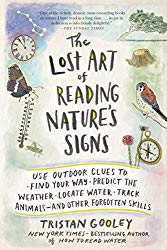
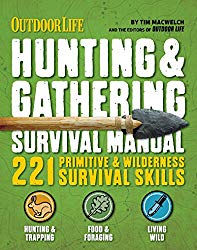

The modern hunter-gatherer’s manual for learning important wilderness skills, surviving tough situations, and getting back to the land. Harvest nature’s bounty and turn it into a gourmet meal; hunt and fish in the wild, with weapons or with your own two hands; and prepare for any outdoor adventure or emergency, whether you’re lost in the woods or in need of herbal medicine. This book identifies it all, with step-by-step instructions and skills to make you a self-sufficient survivor—in your backyard and in the wild.

As preppers, we are always looking for items that have more than one use to save space and money for our bug-out-bags. With CBD oil’s rapid rise in popularity (even among the prepper community), it’s important to highlight why it might be a good choice for medicinal use and a great addition to a bug-out-bag.
Holistic health and natural medicines, in general, have also seen a spike in popularity, as Big Pharma racks in billions by hooking people on their drugs. CBD (cannabidiol) oil is a decent solution to the drugs being pushed by the pharmaceutical industry, and it has 3 specific uses that could make it a perfect addition to any bug-out-bag.
The great news is that just a little CBD goes a long way, it is not addictive and has only trace amounts of THC in it. You will not get high using CBD oil. The three ways it can be effectively used during an emergency are:
MICRODOSING
Rodent research has found that low doses of the cannabinoid reduce pro-inflammatory compounds in the body. This is a big deal if the SHTF! Because reduced inflammation can have wide-sweeping beneficial effects on the body, especially during times of stress, limiting that could be essential. Just one drop can do the trick.
STRESS RELIEF
As a neuroprotective antioxidant, CBD oil may be particularly good to take after a night of reduced sleep and it helps eliminate the symptoms of anxiety – something that could come in handy if one needs to “bug out.”
PAIN MANAGEMENT
While it is not recommended to use CBD directly on an open wound (though it is an antibiotic and you could probably do so using your own discretion), CBD oil can be used on bruises, bug bites, and other areas of soreness. Unless the oil is infused into a transdermal patch, CBD oil placed directly on the skin does not enter the bloodstream, therefore, higher doses of the oil can be used to alleviate pain and inflammation in the skin.
Remember that CBD oil is not likely to reduce pain as effectively as opioids can, but it isn’t addictive, and it won’t have you reliant on doctors or drug dealers when things go wrong. I suggest looking for an oil that is organic, non-GMO, and pesticide free. Also, consider getting the oil in a darker bottle. These oils will last longer and will better retain their potency over time.
Look, I know CBD oil isn’t right for everyone, but we should look at all options (especially when something has more than one purpose) when choosing what we will be tossing in our bug-out-bags. I have some CBD oil in mine. I also keep some in my medicine cabinet at home. I like the stuff and it works well for myself and my family.
If you’re on the fence, you could always grab some CBD oil and check it out now, before committing it to your bug out bag. Just remember, hemp oil, and CBD oil are not the same thing. Both can be useful in holistic wellness; however, CBD has been shown to be more effective as it has the cannabinoids in it. Hemp seed oil comes from the seeds of the hemp plant, and there is no THC whatsoever in it.
In the end, what we put in our bug-out-bags all comes down to personal preference!
This content was originally published here.
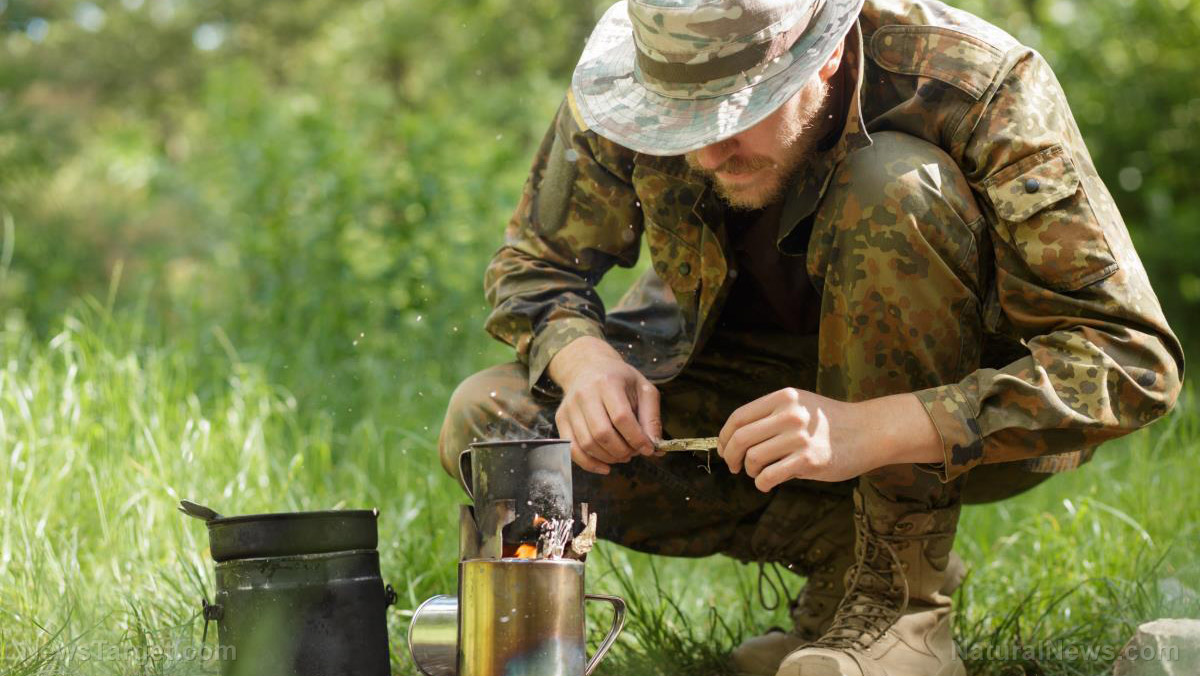
(Natural News) Depending on their needs, preppers rely on different tools for various survival applications. If you’re not sure where to start, here’s a list of 12 items that can help you survive when disaster strikes. (h/t to SurvivalistPrepper.net)
This list doesn’t just include the kind of gear you need in your survival bag. Certain tools and skills can act as force multipliers and they can make your survival supplies even more effective and useful.
Before SHTF, you should learn how to use each tool in your possession. Otherwise, you could get hurt if you start using an item you’re unfamiliar with during a survival scenario.
There are more than 12 items in the list below since some categories require more than just one type of prepping gear.
Almost all of the items in this list will be stored in your bug-out bag (BOB). Survival gear can also be stored in your bug-in bags, get-home bags, or everyday carry (EDC) kits. (Related: These important items deserve a place in every bug-out bag.)
Force multiplying survival skills:
EDC kits may vary, but most preppers rely on similar core tools. When preparing an EDC kit, you should at least include emergency cash, BIC lighter, flashlight, pocket knife, and a multi-tool.
A high-quality fixed blade knife is the second most important survival tool in your bag. With your survival skills and a good knife, you can get or make anything you need. Select a knife within your budget with features that meet your specific needs.
Sponsored solution from the Health Ranger Store: The Big Berkey water filter removes almost 100% of all contaminants using only the power of gravity (no electricity needed, works completely off-grid). Widely consider the ultimate “survival” water filter, the Big Berkey is made of stainless steel and has been laboratory verified for high-efficiency removal of heavy metals by CWC Labs, with tests personally conducted by Mike Adams. Explore more here.
Force multiplying survival skills:
A water filter is a must in your prepping gear because clean water is key to your survival when SHTF, especially outdoors. Aside from a water filter, you should also have access to alternate means of water purification such as boiling or water tablets.
Force multiplying survival skills:
Firestarting is crucial because without fire, you can’t stay warm, cook food, and signal for help. Useful firestarting items include:
Force multiplying survival skills:
You need a well-stocked first aid kit and medicine when SHTF. In case you run out of medicine, you also need to know how to find and use medicinal plants.
Keep painkillers, prescription medicine, and remedies for common complaints (e.g., diarrhea, fever, nausea, etc.) in your first aid kits.
Force multiplying survival skills:
Since people have different skills and abilities, choose a weapon that’s suited to your own skill set. Self-defense can include your physical ability to defend yourself, using a weapon, or a combination of both.
Force multiplying survival skills:
When SHTF, cordage might just save your life. You can use various types of cordage to build a shelter, fishing, trapping, and other survival uses.
Force multiplying survival skills:
Multi-tools are a great addition to any EDC kit or BOB. Multi-use survival gear will significantly reduce the number of supplies you need and the weight of your BOB, which is important if you need to evacuate immediately.
Other useful supplies include:
Footwear is an often neglected aspect of prepping and survival. If you wear cheap shoes, your feet will hurt if you need to bug out or hike to camp. If you can’t walk properly, how can you escape when SHTF?
While you can review various articles and resource materials, it’s impossible to remember everything you read. To ensure that you have access to information when the power grid goes down, set aside prepping and survival resources.
You may need books about knot-tying or first aid, along with the SAS (Special Air Service) Survival guide. Review these resources before SHTF and practice these skills so you know what to do during a survival scenario.
Alternatively, you can create your own preparedness and survival file with data that is relevant to your location.
You may have no need for cash in certain survival scenarios, but it is important to have emergency cash on hand at all times. For personal emergencies, having a bit of extra cash is a must.
Regardless of the amount you carry, you should prepare cash in smaller bills.
Your survival mindset can make all the difference during a survival scenario. Even if you have the most expensive tools and gear, they’ll be useless if you panic at the first sign of danger.
Your will to survive gives you the strength you need to protect yourself and your loved ones when disaster strikes, so keep calm, learn how to use your weapons, and stock up on survival supplies before SHTF.
Sources include:
This content was originally published here.

The term “bugging out” has made it into the public consciousness. It’s a concept often marginalized to survivalists and conspiracy theory wingnuts. Really, it’s part of a sound strategy that every person who cares about their safety and well-being should be aware of.
Bug-Out Bag List
In addition to a good evacuation plan, bugging out requires a proper bug out bag (also known as an evac bag, a 72-hour bag, or a get-out-of-dodge bag). Bug out bags are self-contained kits that include all the essentials the average person needs to survive the first 72 hours after a natural disaster, zombie apocalypse, or attack from our alien overlords.
They’re so important that whole companies are dedicated to providing would-be survivalists with ready-made bug out bags. Assembling your own is a straightforward and inexpensive alternative, however, that requires common materials found in most tool sheds and garages. Here’s a list of everything you need for a proper DIY bug out bag.
First, and most obviously, you need the pack itself. It should be an actual backpack, although the exact model you choose is a matter of personal preference. The bag should be durable, water-resistant (ideally waterproof), and as lightweight as possible. You should also be comfortable carrying it fully-loaded for several hours over uneven terrain.
It’s worth noting that you’ll want to fly as under the radar as possible. Stealth is the name of the game here. You want a backpack that looks as low-key as possible — nothing flashy or ornate. Think drab, functional, and military issue. It should be capable of carrying everything you need to without looking like you’re stocked to the gills. Sociologists and preparedness experts agree the first 72 hours after a disaster are critical. If widespread power outages and food and water shortages last beyond three days, society can start to break down very quickly. You don’t want to become a target for the roving hordes of Mad Max-style bandits looking for guns, booze, and snacks.
Plan on one liter of water per person per day. In the case of a solo 72-hour bag, that means a minimum of three liters, although a gallon is ideal when you account for bathing, potential spillage, and other unforeseen circumstances. Divide your water stock among several different containers such as a military canteen (good for boiling water), a hard plastic Nalgene bottle, and a collapsible bottle that shrinks down to save space when empty.
Of course, you can’t possibly pack all the water you’ll need to survive a more long-term situation. In that case, you’re going to need to find and purify water along the way. There are three main types of water purification: boiling, filtration, and chemical. Your best bet is to plan for access to at least two of these. Boiling can be time-consuming (every batch of questionable water should be boiled for at least 10 minutes) and won’t filter out heavy metals, dirt, and chemicals. It is great, however, at eliminating bacteria, virii, and many pathogens. The best portable mechanical filtration systems are ideal for filtering out just about everything. Chemical purification tablets like those from Potable Aqua are a solid backup, and they take up little room in your pack.
Fire is among the most essential requirements in any survival situation which is why should plan for at least three different ways to make it. Fortunately, with some advanced planning, you’re all but guaranteed to always have fire-making kit on hand when you need it.
Pack a fire steel (capable of sparking in all weather conditions), several lighters, waterproof matches, and a bit of tinder. For the latter, a handful of cotton balls doused in vaseline work great, as does dryer lint. Both pack down small and allow you to start a fire almost instantly.
Most importantly, however, an emergency scenario is not the place to learn how to build a fire. Practice with your own kit at home — in your backyard if you have to — until you feel comfortable starting a fire, even in the rain.
Strictly speaking, you’re perfectly capable of surviving 72 hours without food. Sure, you’ll be hungry, but you won’t die. That said, anything you do eat should feel like a luxury. Here, it pays to think like a polar explorer: nutrient-dense foods that are portable and packable. Nuts, canned beans, and dehydrated camp meals (whether self-prepared or mil-spec MREs) are all solid options. Candy and energy bars are great supplements as well.
Companies like Huel sell nutrient-rich meal replacement powders that mix into cold water, eliminating the need for cooking. One cup of Huel powder, for example, provides an entire day’s calories, protein, fat, and carbohydrates, plus more vitamins and minerals than you’d typically find in over-the-counter multivitamins.
If you’re cool with forgoing taste in favor of an ultra-light pack, you can skip food prep tools altogether. If, however, you opt to bring anything that needs preparing, you’ll need to plan for cooking it. At a minimum, your mess kit should include a small metal pot, a lightweight spork, and a metal cup with collapsible handles. Ideally, all the pieces of your kit should nest inside one another to maximize packability. Lastly, you’ll want a lightweight stove — the ultra-portable MSR PocketRocket 2 is a great choice — plus a couple of fuel canisters. Plan on relying on making and cooking over a fire whenever necessary, but having a camp stove is a wise backup.
Like your survival backpack, clothing is a matter of personal preference. No matter what, you’ll want to think like a backcountry hiker, and that means dressing in layers. At a bare minimum, pack:
Everything in the list above can be mixed and matched to keep you cool and comfortable in warmer climates, and warm in all but the most frigid regions. Remember the old adage that “cotton kills.” All the clothing in your bug out bag should consist of quick-drying fibers designed to keep you warm even when wet. Merino wool is a great all-around choice.
In terms of survival essentials, having a reliable shelter is on par with fire-making capabilities. At a minimum, you’ll want to keep dry even if you can’t keep warm. Ideally, you’ll be able to shelter in place at home, a friend’s house, or a backcountry shelter. However, it’s wise to pack a backup option in case things really go sideways.
The previously mentioned military-grade survival poncho should be designed with built-in grommets so it can double as a make-shift emergency tent in a survival situation. While you’re at it, throw a cheap, reflective emergency survival blanket into your bug out bag as well. They’re available at most dollar stores.
In a true survival scenario, the tools you carry will be just as important as your survival skills. A multi-tool is essential. Leatherman offers an extensive line of well-built products that, at a minimum, usually include pliers, screwdrivers, a folding knife blade, and wire cutters. This limited toolset should provide everything you need to tackle even complex mechanical tasks no matter where you are.
Another great tool is a fixed-blade survival knife. The exact model comes down to personal preference, but an overall length of 8-10 inches is versatile enough for splitting wood, chopping, cooking, and a host of other tasks. As a bonus, it comes in handy as a weapon if you need it.
In a relatively short disaster scenario, odds are good that society will keep it together. After that, once food and water supplies start to run dry, civility can quickly turn to desperation. If things get really bad, you’re going to want some way to defend you and yours.
Again, a fixed-blade knife is a good starting point — it serves several purposes, but you must be confident (and hopefully trained) to wield it as a weapon, especially in self-defense. Beyond that, your preferred method of self-defense is up to you. Many survivalists prefer something compact and stealth like a .357 revolver or another lightweight handgun. For something more robust, shotguns and machetes guarantee a certain intimidation factor, even if you never actually need to use them. Again, please make sure that you are properly trained to handle any of these options.
A proper fire will provide most of the light you’ll need in a survival situation. However, it’s wise to pack several backup lighting sources. In addition to lighters and waterproof matches, a handful of small, nine-hour candles is a smart choice. Glow sticks, a proper headlamp, and tiny LED flashlights or keychain lights are also ultra-portable and guarantee focused task lighting when you need it.
It might seem obvious, but remember to pack your cell phone. Cell towers are likely to work — at least for sending text messages, if not for making calls — in all but the worst disaster situations. Be sure to pack two ways to charge it, plus a backup battery and solar/hand-cranked charger. Even better, pack a hand-crank emergency radio as most of these include a flashlight and built-in battery for charging your gadgets.
If you’re keen to spend a bit more, a satellite phone like those from Iridium can be an invaluable tool. Even in the case of regional cell network outages, a satphone will allow you to stay connected anywhere on earth.
It’s cheap and easy to prepare your own portable first aid kit, and most folks already have the supplies to do so in their home medicine cabinet. However, prepackaged first aid kits often include better quality — sometimes hospital-grade — equipment.
Adventure Medical Kits offers several great options for around $10-20. At the very least, be sure to pack adhesive bandages in a variety of sizes, butterfly closure bandages, gauze dressing, and rubbing alcohol. Standard household painkillers, anti-inflammatory medications, and any personal prescriptions are essential as well.
Properly packing your bug out bag with the all of the gear above will prepare you for almost any situation. Some additional useful items include:
If you’re keen on staying comfortable as well, consider packing additional “luxuries” such as:
If you are preparing to shelter in place during an emergency situation, here’s everything you should have stocked inside your home. Or you can upgrade to a luxury doomsday bunker.
Article originally published on January 3, 2019.
This content was originally published here.
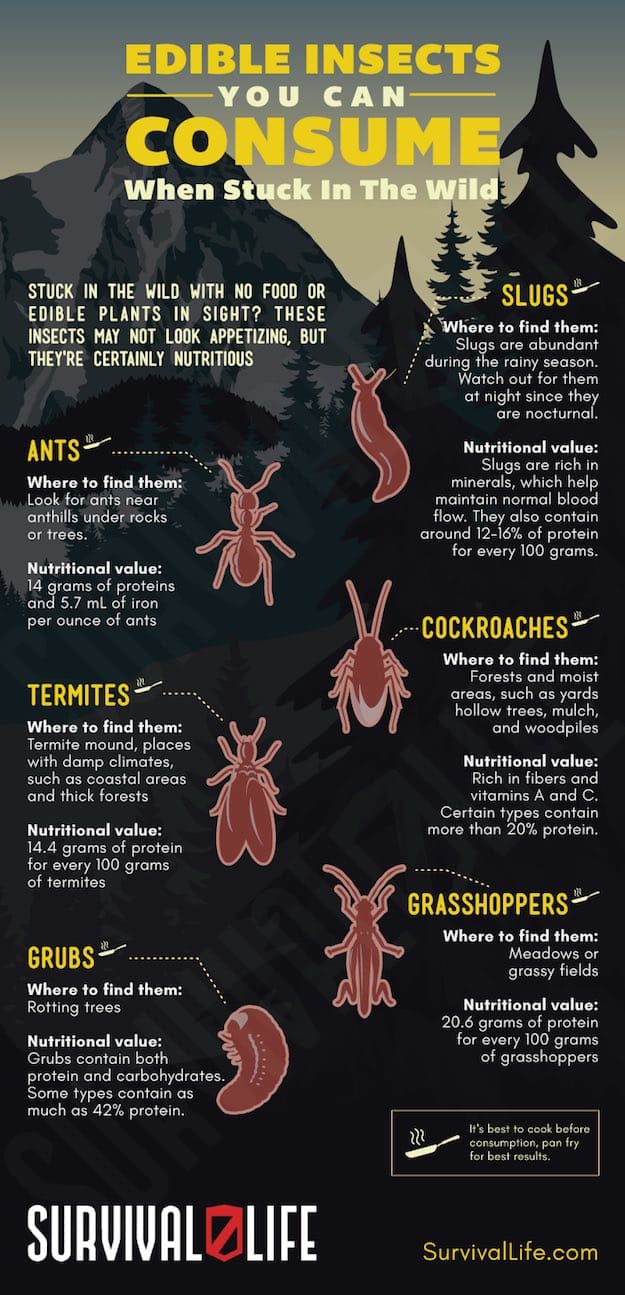
In the wild, you can survive by making a meal out of edible insects. You’ll be glad to know they are actually nutritious and could fill your protein needs.
Being stuck in the wild can make you think of crazy things like having insects for lunch. Disgusting as it may sound, this could actually save your life.
If you’re in no luck finding some edible wild plants outdoors, you might as well start looking for edible insects to get through your hunger problem. You’d be surprised to know of this edible insects list is, in fact, abundant with nutrients that can provide your cellular needs.
It’s better to be prepared and know what can help you survive in the wild, so go on and read along!
|
One great thing about ants is that you can find them in a lot of places. Dig among anthills and scoop up the ants into a container.
It is recommended for you to boil them first before eating to remove the bitter and vinegary taste it has. An ounce contains about 14 grams of proteins and 5.7ml of iron.
Termites can be found in hordes and fill your protein needs easily. 100 grams of termites is equivalent to 14.4 grams of protein.
A termite mound can feed a couple of people in one go. These edible bugs for humans are in damp climates like coastal areas and thick forests.
|
If you ever find a corpse of an animal laying there and being fed on by maggots, never think of these maggots as a waste.
While the maggots are feeding upon the corpse of an animal, you may feed on those maggots in exchange and have the meat they’ve eaten for yourself. Maggots contain both protein and carbohydrates you would need for energy.
These slimy creatures are rich in minerals which help maintain normal blood flow. Slugs are carriers of harmful parasites that can kill you so it would be wise to cook them first before eating it.
These edible insects can be found abundantly during the rainy season.
|
These are the ones you can find in the wild and not those pesky little buggers that fly around your house. The ones found in the wild feed on fruits and vegetation which are rich in fibers and vitamins A and C.
Have them fried or boiled to kill any bacteria they might have.
|
Locusts can actually save your life from hunger plus it is rich in both protein and calcium. They travel in swarms and are much bigger than the grasshoppers.
Locusts go to places that have fertile soil, thus, it would be best to look for these edible insects in those places.
|
Grasshoppers are very rich in protein — for every 100 grams of grasshoppers, there are around 20.6 grams of protein. They can be eaten raw or cooked. But, to add some palate of crunchiness, consider having them cooked.
You can find them on meadows and grassy fields.
Here’s what you need to know about eating edible insects by STORYHIVE:
When SHTF and you run out of food to eat or there are no edible plants in sight, hunt for these edible insects and you’ll get by. However, while these insects are quite nutritious, there are also some that can be poisonous.
Be aware of what you can eat or it could lead to having an upset stomach or something even worse. Make sure to know how these edible insects look like and not mistake them for a poisonous kind.
With that said, it’s also imperative to know how to identify edible insects for your safety.
Have you tried eating any of these edible insects? How was the experience? Share your survival stories in the comments section below!
Follow us on Facebook, Instagram, Twitter, Pinterest, and Tumblr!
Editor’s Note: This post was originally published on July 17, 2017, and has been updated for quality and relevancy.
This Article Was First Found at survivallife.com Read The Original Article Here
The post Edible Insects You Can Consume When Stuck In The Wild appeared first on Total Survival.
This content was originally published here.
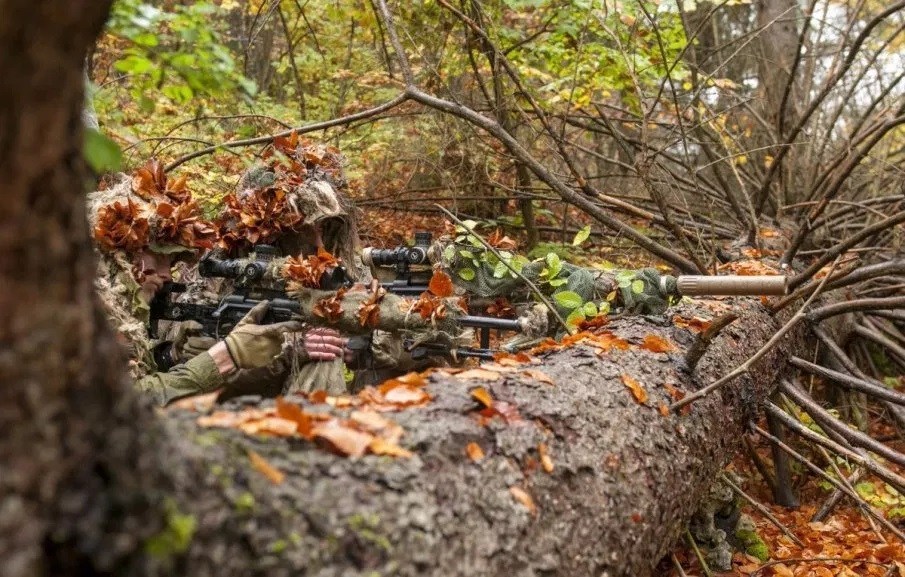
“U.S. and Allied #SOF conduct joint sniper training at the International Special Training Centre (ISTC) Basic Sniper Course held in Hohenfels, Germany.”
This image of U.S. and allied Special Operations war fighters conducting sniper training was provided by the official U.S. Spec Ops Europe Twitter account. Follow U.S. Spec Ops Europe to learn more about the unique missions America’s Special Operations forces are tasked with, and the incredible ways they accomplish their objectives.
To learn more about U.S. Special Forces sniper training, watch the video below:
This content was originally published here.

Company Drinks founder Kathrin Bohm says being less wasteful comes naturally if you understand the energy that goes into making something in the first place.
“We’ve become so used to buying a drink, to make your own drink is quite empowering and to understand the politics of drinks-making is really important.
“Food is not just something you consume, you can use your own city to make food, there’s a lot of learning involved. By making drinks you learn what grows in your space, you meet other people. Food is a strong social glue.”
Major ecological changes and an abundance of processed goods is causing many people to pay greater attention to the provenance of our food.
Based in Barking and Dagenham, the drinks-maker runs foraging workshops to teach people how to take things like elderflower, dandelions and even Japanese knotweed, and turn them into cordials or fizzy drinks.
Through the project, Sean Tuck has become an expert at brewing up locally-sourced soft drinks using long-forgotten recipes.
“We get together as a community to go out into the local parks to collect and forage for flowers for stalks and leaves and we create drinks from that,” he said.
“We don’t want the knowledge to get lost, we want to share and grow that knowledge so everybody knows that something so simple that could be growing in their lawn can be used as a food or a drink.”
When it comes to understanding food production, the links between east London and the Kent countryside go way back.
Before machinery was introduced onto farms, from the 1850s through to the 1950s, successive generations of working class families would spend their summers hop-picking.
The community group also organises special day trips so that today’s families can get a taste of what it was like back then.
For 89-year-old Violet Charlton, the trips are a chance to share her stories.
“I do remember those days really fondly because it gave me an occasion to meet all my family, my cousins, my aunts.
“I grew up in Wapping, which was dark, damp and dirty, and going into Kent… it was this fresh, beautiful smell. That’s what I remember more than anything.”
Violet believes people today could learn a lot from the approach to food back then.
“Then, you could pick raspberries, blackberries – all sorts of things locally that were grown. We used to do pea picking as well.
“Food buying and food producing was so different. We grew a lot more vegetables in our back gardens and it was much better than what you taste in the supermarkets today.”
Our relationship to what we eat is central to a new exhibition at the V&A that’s examining what artists, scientists and food producers are doing to plan for a sustainable food future.
Curator Catherine Flood says the idea was to explore “how food connects us as a society – to culture, to our own bodies and ultimately, to the planet”.
“Because of major ecological challenges – fast changing societies – now’s a really key moment to be asking not just what we’re going to be eating tomorrow, but what kind of food future do we want.
“What does that look like? What could it taste like? It’s at the forefront of so many global challenges that we’re facing today.”
Company Drinks’ June Hopping Afternoon takes place on 15 June and FOOD: Bigger Than The Plate runs at the V&A until 20 October.
This content was originally published here.
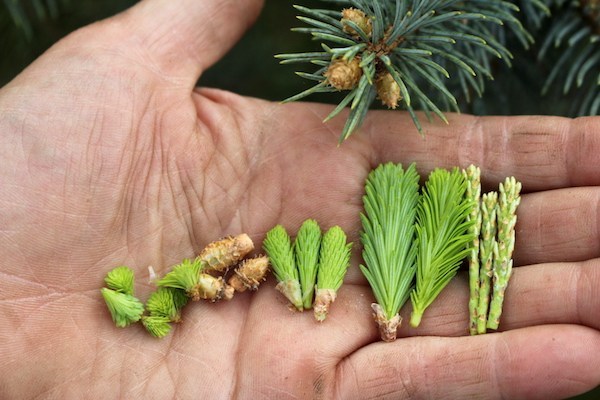
Spruce tips have a bright, citrus flavor that works well in both savory and sweet dishes. Almost all conifer tips are edible, and the only exception is yew trees. Pine and fir tips have their own unique taste, and as an added bonus, all conifer tips have medicinal properties.

Conifer Tips ~ From left to right: Hemlock tips, Spruce Tips, Young Fir Tips, Older Fir tips and Pine Shoots
A spruce tip is the new spring growth at the end of a branch. The tree hunkers down for winter, but then in the spring they send out tender (and flavorful) new growth. The flavors can vary from tree to tree, ranging from bright and citrus-y to warm and resinous.
While spruce are the most famous, other conifer tips are also edible.
We don’t have many spruces on our land, but we have a plethora of hemlock, pine and fir trees. I’d had my eye on making spruce beer for years, but without a source of spruce tips, it seemed out of reach. A few months ago, when I was doing research for an article on how to eat a pine tree, I learned that all conifer tips are edible with the exception of yew trees which are questionably toxic. That’s a pretty big selection of conifer tips, and a lot more options than spruce tips alone.
I found a really excellent guide to identifying different conifer species here, and it takes you through all the ins and outs of different varieties. I’ll give you a quick rundown of each species as I know it.
As it turns out, we do have spruce or two in a few landscape plantings around our house. Spruce tips tend to stay inside a papery covering when they’re young, which helps you identify them at a distance.
Beyond that, spruce trees:
Spruce tips are the canonical “tip” that’s used by fancy chefs to create real world class foraged food. This spruce tip ice cream is served in classy restaurants, and they’re also used as an exotic veggie mixed with pasta or in stir-fries.
Still though, my favorite are fir tips…

Handful of fir tips…mostly indistinguishable from spruce tips at this stage.
My favorite thus far, all the fir tips around these parts are lightly sweet with a hint of citrus. Grapefruit maybe, with an ever so slight bitter note. They’re also a lot more pleasant to harvest than spruce tips, since the needles are soft and you won’t get spiked if you trip into the tree.
Fir trees have:
Thus far, I’ve been eating fir tips raw out of hand because they’re so good. I have a boatload of them squirreled away in the fridge, and I’m hoping to get creative over the next month or so. Tips keep really well if they’re refrigerated promptly, so these will be coming out for fun projects all the way into mid-summer.
I did make a lovely fir tip posset, which is a simple eggless custard that simmers cream until it thickens and then adds a bit of lemon juice to help it set up. If you summer the spruce tips in the cream, they infuse beautifully.
Probably the easiest to identify of all the conifers, pine trees have many long needles coming out of a single point of origin. Beyond that, pine trees have:
Pine shoots are a bit different than all the other “tips” in that they’re more of a tight shoot and they don’t really look like conifer needles. It’s the shoot of a new branch coming out, and there are no needles visible yet. They’re pretty plain looking, but they’re packed with incredible flavor.
Warm, spicy and resinous, pine tips taste like sweet pine candy to my palate. Imagine the smell of pine, but without the “green” taste of the needles (if you’ve ever recreationally eaten pine needles). Slightly bitter, but still warm, comforting and mildly sweet.
I made a pine shoot syrup that’s totally out of this world, and just uses sugar to draw out the natural liquid from the pine shoots. Add in 2 parts pine shoots and 1 part sugar to a jar, then give it a good shake. Allow it to sit for about a week, shaking it any time you think about it, and then spoon out a taste of heaven.
I dipped a spoon in for a taste, and I’m glad I was alone because I actually let out a soft moan…so good! Next year I’m making a huge batch of this stuff.
This pine shoot syrup can be used to flavor meats, and I’m thinking it’d make a really unique baklava-like treat. It’s also a natural cough syrup, in the same way as this pine needle cough syrup.
Thus far I’m not a huge fan of hemlock tips. They’re wicked tiny, and they taste distinctly sour to my palate. Hemlock trees have needles that are flat, and come out in one plane from the stem like a fan.
They can look a bit like yew species, but the underside of hemlock needles are white, while yew are a uniform green.
While I’m passing on hemlock tips, I am loving baby hemlock cones. The underside of mature trees produce tiny hemlock cones that you can harvest at the same time as tips. They’re sweet and flavorful, and much better tasting than the tips.
A little later on they produce a lot of pollen from those little proto-cones, and I’m trying to come up with some way to gather it. Give the branch a whack and you’ll see what I mean, as a huge cloud puffs off the branch if your timing is right.
Your best bet in avoiding a potentially toxic yew tree is to positively ID the conifer as something else edible. Pretty simple.
In the northeast, we do have some yew species, namely Taxus canadensis, which looks quite a bit like young hemlock trees. The main difference is hemlock trees have a white underside, and this species of yew is evenly green on both sides.
I’ve never seen a yew tree to my knowledge out here, and I think they’re maybe more common in the Pacific Northwest. You can see I’m no expert on these, so do a bit of research to see if there are any in your local area to avoid.
Regardless of the type of tips your harvesting, search for “spruce tip recipes” because that’s the one that everyone knows. Each conifer tip has a slightly different flavor, but so does each individual tree. They all produce slightly different flavors, so if you find one you don’t like, that doesn’t mean the next tree might not be better.
What’s your favorite way to use spruce tips? I’m always looking for new ideas! Leave me a note in the comments.
This content was originally published here.

There are six venomous species to fear in the state, but it’s one of the nonvenomous categories that is unpredictable enough to count as a “zombie snake,” according to a June 6 post by the N.C. Department of Parks and Recreation.
The eastern hognose snake, which grows up to 4 feet, is “famous” for playing dead when the mood strikes it, the parks department said. They are nonvenomous and rarely bite, but could be brutal for the faint of heart when miraculously springing back to life.
