Author: Truth & Hammer

  • Would you let Amazon 3D-scan your body for a $25 gift card?

    Would you let Amazon 3D-scan your body for a $25 gift card?

    Amazon has already amassed a staggering amount of data about its customers. But this is a tech giant, so it should be no surprise the company wants to know even more about you. As Mashable notes, Amazon is now running a study that is looking for volunteers who will allow their bodies to be 3D-scanned. Amazon says the study is “to learn about diversity among body shapes.”

    Volunteers will go to Amazon’s Union Square office in New York City where they will be weighed and have their height measured. 3D scans, photos, and videos will then be taken of them in their everyday clothing. Next, Amazon will give them form-fitting clothing to wear (women, you’ll get a bikini or form-fitting shorts and sports bra to wear), and another set of 3D scans, photos, and videos will be taken.

    For all this, one of the richest companies in the history of the world will give participants a $25 Amazon.com gift card. The study is run by Amazon Body Labs, which creates detailed 3D models for gaming and shopping. Amazon doesn’t say what the data it collects from volunteers will be used for specifically, only that it will be “exclusively for internal product research and not for marketing purposes.” It is possible, the data will be used to improve the capabilities of Amazon’s “style assistant” camera, the Echo Look. People interested in volunteering for Amazon’s study have until June 30 to take part. Full details can be found on the study’s website.

    source

  • Private Companies Are Building an Exoskeleton Around Earth

    Private Companies Are Building an Exoskeleton Around Earth

    In 1957, a beach-ball-shaped satellite hurtled into the sky and pierced the invisible line between Earth and space. As it rounded the planet, Sputnik drew an unseen line of its own, splitting history into distinct parts—before humankind became a spacefaring species, and after. “Listen now for the sound that will forevermore separate the old from the new,” one NBC broadcaster said in awe, and insistent that others join him. He played the staccato call from the satellite, a gentle beep beep beep.  Decades later, we are not as impressed with satellites. There have been thousands of other Sputniks. Instead of earning front-page stories, satellites stitch together the hidden linings of our daily lives, providing and powering too many basic functions to list. They form a kind of exoskeleton around Earth, which is growing thicker every year with each new launch.

    The newest additions come from SpaceX. The company launched 60 satellites into orbit Thursday night, the first batch of thousands of satellites that will someday beam internet down to Earth. The satellites traveled to space in a big, cozy stack. Once in orbit, they will fan out—“like spreading a deck of cards on a table,” according to Elon Musk—and unfurl solar arrays to soak up the sunlight they’ll use to power themselves. As of early Friday morning, all 60 satellites had come online.  That’s a lot of satellites. Right now, about 5,000 are in orbit around Earth—in total. Only about 2,000 are still functioning. Nearly half belong to the United States, with China and Russia leading the pack with the rest. “I think within a year and a half, maybe two years, if things go well, SpaceX will probably have more satellites in orbit than all other satellites combined,” Musk said. “If things go according to plan—a big if, of course, but it is quite remarkable to think of that being the case.”

    The launch puts Musk ahead of other entrepreneurs with their own internet-satellite ambitions. Jeff Bezos wants to launch thousands through a program under Amazon, and Greg Wyler, the head of OneWeb, which was established for this express purpose, deployed the company’s first six satellites in February.  SpaceX’s initial delivery of satellites is also a bit of a headache for a niche group of conservationists, the people who worry about the growing number of satellites and pieces of debris accumulating over Earth. They warn that a crowded orbit increases the risk of collisions, fast-moving impacts that would generate even more floating junk. A historian once told me that if an avalanche of crashes were to knock out the entire satellite infrastructure, “tentacles of disruption” would unfurl across the globe. Some experts even say that a packed orbit would make it more difficult for space missions to squeeze through and leave Earth altogether.

    source

  • China unveils 600km/h maglev train prototype

    China unveils 600km/h maglev train prototype

    Those involved with the project are optimistic it will completely transform China’s travel landscape, filling the gap between high-speed rail and air transportation.
    “Take Beijing to Shanghai as an example — counting preparation time for the journey, it takes about 4.5 hours by plane, about 5.5 hours by high-speed rail, and [would only take] about 3.5 hours with [the new] high-speed maglev,” said CRRC deputy chief engineer Ding Sansan, head of the train’s research and development team, in a statement.
    While the cruising speed of an aircraft is 800-900 km/h, at present trains on the Beijing-Shanghai line have a maximum operating speed of 350 km/h.
    Maglev trains use magnetic repulsion both to levitate the train up from the ground, which reduces friction, and to propel it forward.
    After nearly three years of technical research, Ding said the team had developed a lightweight and high-strength train body that lays the technical foundation for the development of five sets of maglev engineering prototypes.
    So what comes next? CRRC Qingdao Sifang — a subsidiary of the CRRC — is currently constructing an experimental center and a high-speed maglev trial production center, which are expected to begin operating the second half of this year.
  • At $2.1 million, newly approved Novartis gene therapy will be world’s most expensive drug

    At $2.1 million, newly approved Novartis gene therapy will be world’s most expensive drug

    he Food and Drug Administration on Friday approved the first gene therapy for a type of spinal muscular atrophy, a lifesaving treatment for infants that will also be the most expensive drug in the world.  Known as Zolgensma, the gene therapy treats children under 2 years of age with spinal muscular atrophy, an inherited neuromuscular disease that causes progressive loss of muscle function. The most severe form of SMA causes infants to die or rely on permanent breathing support by the age of 2. The disease is caused by a defect in a gene that makes SMN, a protein necessary for the survival of motor neurons. Zolgensma uses a re-engineered virus to deliver a functional copy of the defective gene so that SMN protein can be produced.

    Novartis is pricing Zolgensma at $2.125 million, or an annualized cost of $425,000 per year for five years, the company said.  Launching Zolgensma will be a big test for Novartis and CEO Vas Narasimhan, now two years on the job. Shareholders expect the gene therapy to deliver blockbuster sales to justify the $8.7 billion that Novartis spent to acquire it last year.  To achieve commercial success, Novartis must persuade doctors who treat SMA patients that the muscle-preserving benefits from a one-time injection of Zolgensma will be durable. Complex payment and insurance reimbursement arrangements required for expensive gene therapies need to be handled deftly.

    source

  • Asian and Asian American heroes to power new Marvel comics series

    Asian and Asian American heroes to power new Marvel comics series

    Marvel Comics is giving ink to an unprecedented team-up of its mightiest Asian and Asian American heroes, also known as the new Agents of Atlas. Established icons like martial arts master Shang-Chi and newbies like Wave, the newest Filipino superhero, will team up in a stand-alone, five-part comic book series starting this summer, the publishing giant told The Associated Press Thursday.

    The roster of 10 super-powered pan-Asian champions made their debut as a team earlier this month in “The War of the Realms: New Agents of Atlas.” That comic book is one piece of an ongoing saga involving several different groups across the Marvel universe, including the Avengers, doing battle with a fire goddess. But the exclusively Asian limited series is set to roll out in August.

    The man leading the heroic charge is veteran comic book writer Greg Pak. Pak is credited with ushering in a new era of Asian characters in co-creating Amadeus Cho, a Korean American genius teen. The character first appeared in 2005. A decade later, he absorbed the Hulk‘s powers and started going by Brawn.

    “It’s always been my dream to do a team book using a bunch of Asian and Asian American heroes,” said Pak, who thinks there’s more appetite for representation with the success of the movie “Crazy Rich Asians.” ”There’s literally never been a better time in my memory with more opportunities for doing work that specifically includes Asian and Asian American characters.”

    source

  • Four more deaths on traffic-jammed Everest

    Four more deaths on traffic-jammed Everest

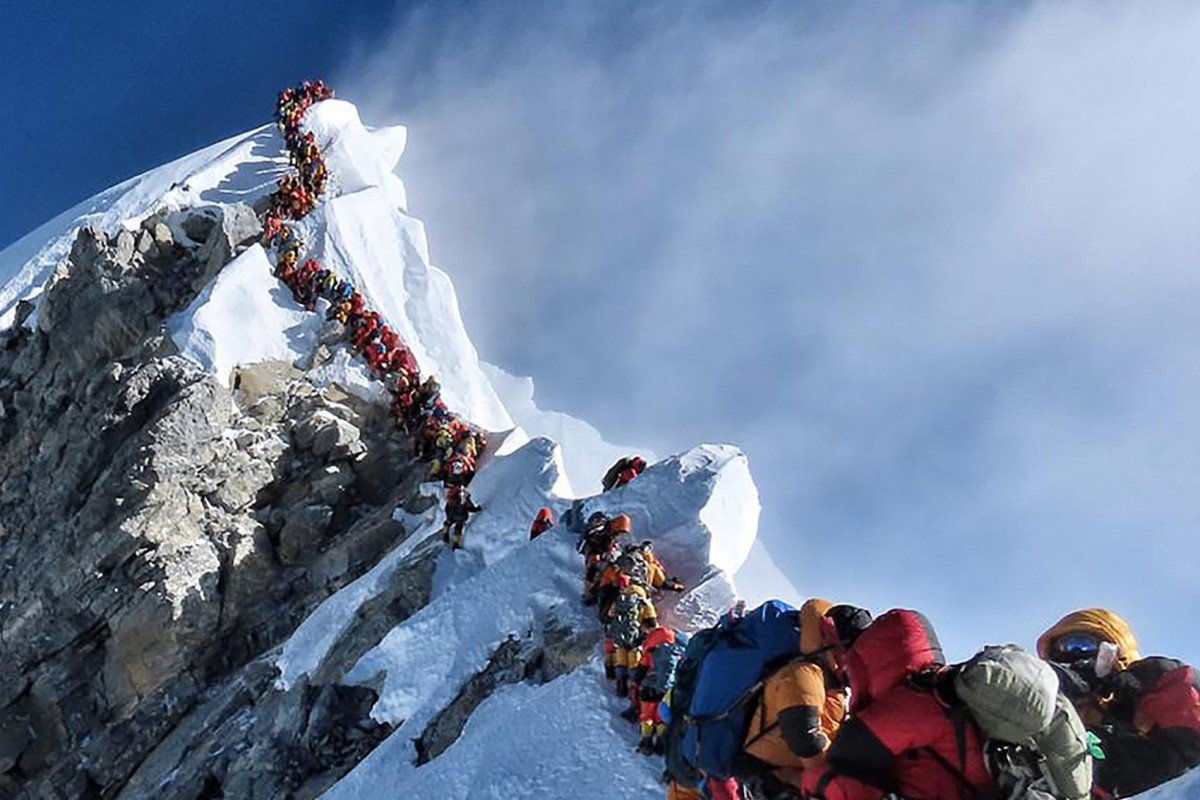
    A traffic jam of climbers in the Everest “death zone” was blamed for two of four new deaths reported Friday, heightening concerns that the drive for profits is trumping safety on the world’s highest peak.  Nepal has issued a record 381 permits costing $11,000 each for the current spring climbing season, bringing in much-needed money for the impoverished Himalayan country.  But a small window of suitable weather before the short season ends has in recent days triggered bottlenecks of hundreds of climbers wanting to achieve for many — although perhaps not for purists — the ultimate in mountaineering.  The four latest deaths reported on Friday, taking the toll from a deadly week on the overcrowded peak to eight, include two Indians and a Nepali on the Nepal side and an Austrian on the way down on the northern Tibetan side, officials and expedition organisers said.  Ang Tsering Sherpa, former president of the Nepal Mountaineering Association, said that the weather window to summit this season was narrow, meaning that many teams had to wait to go up.

    “Spending a long time above the death zone increases the risk of frostbite, altitude sickness and even death,” he said.  Kalpana Das, 52, reached the summit but died on Thursday afternoon while descending, as a huge number of climbers queued near the top. The other Indian, Nihal Bagwan, 27, also died on his way back from the summit.  “He was stuck in the traffic for more than 12 hours and was exhausted. Sherpa guides carried him down to Camp 4 but he breathed his last there,” said Keshav Paudel of Peak Promotion.  A 33-year-old Nepali guide died at the base camp on Friday after he was rescued from Camp 3 for falling sick.  Wednesday claimed the lives of an American and another Indian.  Donald Lynn Cash, 55, collapsed at the summit as he was taking photographs, while Anjali Kulkarni, also 55, died while descending after reaching the top.  Kulkarni’s expedition organiser, Arun Treks, said heavy traffic at the summit had delayed her descent and caused the tragedy.

    “She had to wait for a long time to reach the summit and descend,” said Thupden Sherpa. “She couldn’t move down on her own and died as Sherpa guides brought her down.”  Pasang Tenje Sherpa, of Pioneer Adventure, told AFP that Cash collapsed on the summit and died close to Hillary Step as guides were bringing him back.  Last week, an Indian climber died and an Irish mountaineer went missing after he slipped and fell close to the summit and is presumed dead.  The Irish professor was in the same team as Saray Khumalo, 47, who this week became the first black African woman to climb Everest and who is hoping to conquer the highest summits on each of the seven continents.

    Mountaineering in Nepal has become a lucrative business since Edmund Hillary and Tenzing Norgay made the first ascent of Everest in 1953.  Most Everest hopefuls are escorted by a Nepali guide, meaning more than 750 climbers were expected to tread the same path to the top in the current season.  At least 140 others have been granted permits to scale Everest from the northern flank in Tibet, according to expedition operators. This could take the total past last year’s record of 807 people reaching the summit. “About 550 climbers have summited the world tallest mountain by Thursday according to the data provided by expedition organizers to us,” said Mira Acharya, spokeswoman for Nepal’s Tourism Department

    source

  • Facebook plans to launch ‘GlobalCoin’ cryptocurrency in 2020

    Facebook plans to launch ‘GlobalCoin’ cryptocurrency in 2020

    Facebook is planning to launch its own cryptocurrency in early 2020, allowing users to make digital payments in a dozen countries.  The currency, dubbed GlobalCoin, would enable Facebook’s 2.4 billion monthly users to change dollars and other international currencies into its digital coins. The coins could then be used to buy things on the internet and in shops and other outlets, or to transfer money without needing a bank account.  Mark Zuckerberg, the founder and chief executive of Facebook, last month met the governor of the Bank of England, Mark Carney, to discuss the plans, according to the BBC.  Zuckerberg has also discussed the proposal, known as Project Libra, with US Treasury officials and is in talks with money transfer firms, including Western Union, to develop cheap, safe ways for people to send and receive money. A report last year said Facebook is working on a cryptocurrency that would let users transfer money using WhatsApp, its encrypted mobile-messaging app.

    “Payments is one of the areas where we have an opportunity to make it a lot easier,” Zuckerberg told the company’s developer conference last month. “I believe it should be as easy to send money to someone as it is to send a photo.”  In order to try to stabilise the digital currency the company is looking to peg its value to a basket of established currencies, including the US dollar, the euro and the Japanese yen.  Facebook is also looking at paying users fractions of a coin for activities such as viewing ads and interacting with content related to online shopping, similar to loyalty schemes run by retailers.  However, experts believe that regulatory issues and Facebook’s poor track record on data privacy and protection are likely to prove to be the biggest hurdles to making the currency a success.

    “Facebook is not regulated in the same way as banks are, and the cryptocurrency industry is, by definition almost, unregulated,” said Rebecca Harding, chief executive of banking trade data analytics firm Coriolis Technologies.  “In the UK, for example, there are no formal laws that govern this market because cryptocurrencies are not legal tender. Facebook has also had issues with protecting user data in the past few years and this may well be an issue for it as it tries to provide guarantees to users that their financial information is safe.”

    source

  • Home of Brave Land of the Free?  Who can tell you No Go!….Los Angeles Bans Travel to Alabama, Calls Pro-Life Law ‘an Act of Aggression’

    Home of Brave Land of the Free? Who can tell you No Go!….Los Angeles Bans Travel to Alabama, Calls Pro-Life Law ‘an Act of Aggression’

    Los Angeles can deal with killing kids is OK, no ban on New York.  But heaven forbid, saving one, no go to Alabama!!  Really, maybe a better example for the United States and take care of your own.  Get Real!

    The Los Angeles County Board of Supervisors has voted to institute a one-year travel ban to Alabama in response to the state’s recently passed pro-life law.  The ban, which was authored by Los Angeles County Supervisor Hilda L. Solis “imposes a one year travel restriction to the State of Alabama for official LA County business, except for emergencies and other limited situations.” “This challenge by Alabama and other states would overturn decades of precedent. It is an attack not only confined to the residents of those states, but an act of aggression upon all of us,” Supervisor Solis said  The board also voted to send a letter to Alabama Gov. Kay Ivey and Alabama leaders urging them to repeal their abortion ban immediately.  The county will send a similar letter to political leaders in other states that have passed or advanced pro-life bills in recent months, including Arkansas, Georgia, Kentucky, Mississippi, Missouri, Ohio and Utah. The Los Angeles County isn’t the first to institute a travel ban to Alabama.  Last week, Colorado Secretary of State Jena Griswold banned her staff from traveling to the state. Maryland has threatened to do the same.

    source

  • Nurse ‘Rightly Fired’ For Offering to Give Bible to Cancer Patient, Court Rules

    Nurse ‘Rightly Fired’ For Offering to Give Bible to Cancer Patient, Court Rules

    A medical professional who attempted to offer a Bible to a cancer patient was “rightly sacked” from her job, a court has heard . British nurse Sarah Kuteh was fired from Darent Valley Hospital in Dartford, Kent back in 2016 for talking to several patients about her faith in Jesus and even choosing to hand out Bibles.  According to the original complaint, after a patient stated that they were “open-minded” about religion, Kuteh quickly explained that “the only way he could get to the Lord was through Jesus.”“(She) told him she would give him her Bible if he did not have one; gripped his hand tightly and said a prayer that was very intense and went ‘on and on’; and asked him to sing Psalm 23 [The Lord is My Shepherd] after which he was so astounded that he had sung the first verse with her,” the ruling added, as reported by the Telegraph.  According to court documents, the nurse also told a bowel cancer patient “that if he prayed to God he would have a better chance of survival.” As a result of these encounters, Kuteh, a mother-of-three, was fired from her job for “gross misconduct.”

    APPEAL TURNED DOWN

    After a failed appeal, Kuteh launched another bid to have the ruling overturned, arguing that the employment tribunal “failed to consider the correct interpretation of the Nursing and Midwifery Council (NMC) Code and the distinction between appropriate and inappropriate expressions of religious beliefs.”  She also argued that the tribunal had failed to uphold her rights to religious freedom endowed by European Convention on Human Rights, Article 9.  “What was considered to be inappropriate was for the Claimant [Ms Kuteh] to initiate discussions about religion and for her to disobey a lawful instruction given to her by management,” the ruling added.  Lord Singh concluded that the “employment Appeal Tribunal was plainly correct, in my view, to regard the appeal as having no reasonable prospect of success and therefore in dismissing it.”  Many praised Kuteh for her passionate presentation of the gospel in the workplace. “Many Ghanaian Christians have a habit of talking about Jesus all the time, even though in the UK it is seen to be culturally inappropriate,” tweeted the CEO of London City Mission, Graham Miller. “Praise the Lord for Sarah’s compassionate heart and courage!”  Kuteh is being represented by the Christian Legal Centre and is currently considering her legal options moving forward. In a tweet, CLC’s sister organization, “Christian Concern” urged British Foreign Secretary Jeremy Hunt to take into account instances of Christian persecution that are going on inside British borders on a terrifyingly regular basis.  In a newly released report commissioned by Hunt, it was determined that global Christian persecution is reaching the UN-defined threshold for “genocide.”

    source

  • 10 Common Kitchen-Layout Mistakes and How to Avoid Them

    10 Common Kitchen-Layout Mistakes and How to Avoid Them

    1. Inadequate Circulation Space

    Failing to allow enough circulation space can make a kitchen feel cramped and restrict the number of people who can comfortably use the space at the same time, says Jenefer Gordon, principal at interior design firm Eat Bathe Live. “It causes even more issues when your kitchen doubles as a thoroughfare. A lack of space can also make it difficult to open appliances such as the fridge and dishwasher,” she says.

    Solution: To provide adequate circulation, try to have about 4 feet of space between kitchen countertops, Gordon says. Allow a little more room if there is a thoroughfare leading through the kitchen. “In a small kitchen, [39 inches] would be the minimum amount of space between countertops, but aim for more if you can,” she says.

    2. Not Planning Around the Workflow

    “A good kitchen workflow is essential. If you don’t have one, your kitchen will be inefficient, and you can end up running backwards and forwards between the different parts of your kitchen every time you cook, wash or prep,” Gordon says.

    Solution: In the planning stages, carefully consider how you use your kitchen, she says. She suggests increasing functionality by including storage for spices and oils near the cooking zone and storing cutlery and dishes near the dishwasher. “You’ll find many smart solutions on the market, including wide drawers and tailored inserts that facilitate high-functioning storage,” Gordon says.

    3. Not Measuring Appliances

    Lack of planning when it comes to appliances can lead to excessive protrusion from oversize refrigerators. “This can affect the ability to open cabinets and other appliances in your kitchen, and reduce circulation space,” Gordon says.

    Not measuring small appliances like microwaves, blenders and food processors can be an issue too. Without a proper home, they can end up sitting out on the counter and creating clutter, she says.

    Solution: Select appliances well in advance, checking the dimensions and the way appliances open to ensure that your kitchen layout can accommodate them in concealed, tailored storage, Gordon says. This also applies to pots and pans.

    4. Poor Lighting Placement

    If you don’t put the right light fixtures over your countertops, you will end up prepping, cooking and cleaning up in the shadows, says home stager Naomi Findlay.

    “Another common lighting mistake is prioritizing aesthetics over functionality. Pretty pendants are beautiful, but if they don’t shine enough light over your work surfaces, they will not be practical,” she says.

    Solution: Findlay recommends positioning lighting slightly in front of you rather than directly overhead or behind you. Installing downlights, pendant lights and sconces on separate circuits makes it easier to control your lighting levels and atmosphere, she says. And don’t forget to choose bulbs that emit sufficient light, so you can see what you’re doing when you’re chopping and cooking.

    5. Forgetting About Function

    When planning your remodel, make sure you put your kitchen’s busiest areas — the sink, stove and fridge — in practical locations that are relevant to one another while allowing enough space for people to use and access them comfortably, Findlay says.

    When choosing cabinetry, make sure the doors won’t block your workflow when they’re open, she says. “The last thing you want is your fridge and cupboard doors banging into each other every time you open them!”

    Solution: Plan your kitchen layout as far in advance as possible, and choose your appliances before you start looking at cabinetry, Findlay says. “This will allow you to fit your units around your appliances, rather than the other way around, giving you a seamless look that’s both smart and space-efficient.”

    Tip: Think about how many people live in your home and will be using the kitchen at one time, she says. If it’s going to get crowded, you may have crammed too many elements into the kitchen layout and may want to consider scaling back

    6. Wasted Space on a Kitchen Island

    Kitchen islands are great for increasing your prep and storage space but will work only if you have the room, Findlay says. If your kitchen is small, an island can be a waste of space.

    “Placing an island in the wrong spot is another recipe for disaster,” she says. “A poorly positioned island can obstruct the flow of traffic to and from the sink, refrigerator, stove and primary workstations, creating a bottleneck in your kitchen.”

    Solution: Choose an island only if your kitchen can accommodate it or specify a narrow one. Findlay suggests having about 40 inches on both sides of the island for good traffic flow. “Deciding how big or small your island unit should be will depend on what it needs to house and the proportions of your kitchen,” she says. “I would recommend a minimum width of [about 47 inches] for a kitchen island. But if you don’t plan on installing a sink or a stovetop in it, you could go as narrow as [about 24 inches] in width.”

    7. Inadequate Space Between the Sink and the Stove

    The area between the sink and the stove is the main food preparation area, so although there are no set guidelines, you’ll want a decent expanse of countertop space there, says Cherie Barber, owner of Renovating for Profit, which offers online instruction in remodeling.

    Solution: When planning your kitchen, make sure the layout meets the practical day-to-day needs of the kitchen user, she says.

    8. Poorly Positioned Cabinet Doors and Drawers

    Cabinet doors and drawers can end up blocking doorways and walkways when they’re opened, Barber warns.

    Solution: “Planning is key,” she says. “Before you commit to a layout, think about how and where all the elements in your kitchen will open, including cupboards, drawers, the fridge and dishwasher, and how people will move through the space.”

    9. Not Maximizing Vertical Wall Space

    In a small kitchen, every bit of space counts, and your walls offer valuable storage real estate, Barber says.

    Solution: “Taking your cupboards right up to the ceiling will maximize your storage potential in a compact kitchen,” she says. “If you don’t like the idea of rows of closed-door cupboards, you can always mix it up with open shelving.”

    Tip: If your wall cabinets are positioned over a cooktop, minimum clearance rules apply, Barber says. The minimum requirements can vary for electric and gas cooktops, and range from 2 to 3 feet, she says.

    10. Assuming You Need a New Layout

    “I’d never automatically dismiss the existing layout of a kitchen,” Barber says. “It’s often planned that way for very practical reasons, such as placement of doors and windows and the most logical traffic flow.”

    Solution: A tweak to the layout, such as making it open plan or adding a breakfast bar or an island, may be all that’s needed, she says. This can save money because you won’t have to move electrical and plumbing systems.

    “If you’re designing a kitchen layout from scratch, address the practical considerations first: How many people will be using the kitchen on a regular basis? Do you do a lot of entertaining?” she says. “This will help you work out the kitchen’s size and function.”

    Then consider how the work triangle — cooktop, sink and fridge — will best fit your layout, she says. Allow enough space between the three points of the triangle, so you’re not walking yards between them every time you use your kitchen.

    This content was originally published here.