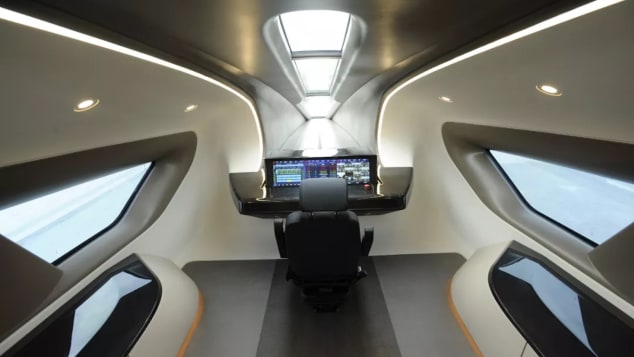
Those involved with the project are optimistic it will completely transform China’s travel landscape, filling the gap between high-speed rail and air transportation.
“Take Beijing to Shanghai as an example — counting preparation time for the journey, it takes about 4.5 hours by plane, about 5.5 hours by high-speed rail, and [would only take] about 3.5 hours with [the new] high-speed maglev,” said CRRC deputy chief engineer Ding Sansan, head of the train’s research and development team, in a statement.
While the cruising speed of an aircraft is 800-900 km/h, at present trains on the Beijing-Shanghai line have a maximum operating speed of 350 km/h.
Maglev trains use magnetic repulsion both to levitate the train up from the ground, which reduces friction, and to propel it forward.
After nearly three years of technical research, Ding said the team had developed a lightweight and high-strength train body that lays the technical foundation for the development of five sets of maglev engineering prototypes.
So what comes next? CRRC Qingdao Sifang — a subsidiary of the CRRC — is currently constructing an experimental center and a high-speed maglev trial production center, which are expected to begin operating the second half of this year.