Author: Truth & Hammer

  • Companies planning to go off the grid – Moneyweb

    Companies planning to go off the grid – Moneyweb

    Forward-thinking businesses in SA are now starting to confront life without Eskom by putting plans in place to generate their own energy.

    Anglo Platinum and Sibanye-Stillwater are two high profile companies at an advanced stage of planning for solar plants to generate their own electricity. The City of Joburg wants to cement a deal with Harith-owned Kelvin Power Station to purchase power as a way to prevent load shedding, which has done incalculable harm to businesses in the city.

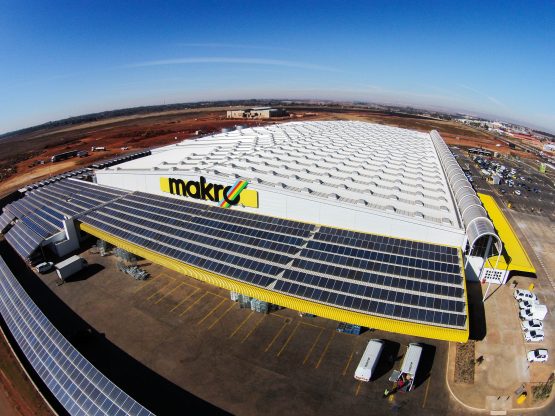
    Other companies are further advanced in their plans to reduce their dependence on Eskom power. In 2016 Makro erected solar panels on the roof of its Makro Carnival store on the East Rand to generate 60-80% of its energy needs during the day, equivalent to 30% of the store’s annual energy needs. Many smaller businesses have invested hundreds of thousands of rands in generators to serve as back-up power sources in the event of outages.

    ‘No plan’ from government

    In his state of the city address last month, Joburg mayor Herman Mashaba said load shedding would be a reality in the coming years, and the national government had not come up with a plan to solve it. Though Eskom has attempted to block the city from sourcing electricity directly from Kelvin Power Station, Mashaba said he was looking at legal options as well as a direct approach to Kelvin over the prospect of securing a supply contract.

    Kelvin has a 600 megawatt (MW) capacity, but is currently producing just 200MW, and even that will be shut down within the next two to three years. One of the options being explored is the installation of gas turbines from about 2023 onwards to ramp up output to the original design capacity of 600MW, pending the availability of a reliable gas supply. This is still just a fraction of Joburg’s total electricity consumption, but sufficient to prevent most of the outages experienced by businesses over the last six months.

    The City of Joburg’s 2018 financial results show a 6% drop in electricity sales. Though some of this was due to outages, there is also evidence of businesses switching to alternative energy sources, according to Ratings Afrika’s latest Municipal Financial Sustainability Index (MFSI) for 2018.

    Des Muller, MD of energy advisory group NuEnergy Developments, says there is a direct correlation between SA’s declining economic growth and the commencement of electricity blackouts starting in 2007.

    “Stable and sufficient electricity supply is a precondition for any growing economy, and there is plenty evidence from around the world that those countries that can guarantee reliable power at a good price are those countries that grow the fastest,” he says. He warns that South Africa’s electricity challenges will remain in the foreseeable future and companies need to be prepared, but urges taking sound independent advice before plunging into self-generation solutions.

    Aluminium businesses have already left SA

    In 2012 Eskom paid energy-guzzling aluminium smelters to shut down furnaces so it could redirect power for use elsewhere in the economy. This has driven energy-intensive businesses to other countries in the Far East where power supply is stable and affordable.

    As part of its medium- to long-term energy management strategy, Sibanye-Stillwater is pursuing the first 50MW phase of its solar photovoltaic (PV) project to be built on a site strategically placed between the Driefontein and Kloof mining complexes on the West Rand. “The project, originally envisioned in 2014, represents a partial solution to securing an alternative electricity supply, representing approximately 3% of our total electrical energy requirements in SA, and enables the power generated to be fed directly into the mine’s electrical reticulation while reducing our overall electricity expenditure and carbon footprint,” says the group’s head of investor relations, James Wellsted.

    “We cannot disclose costs of the plant or the cost of the electricity through the PPA [power purchase agreement], however, we can state that solar PV power offers a cost-effective alternative to Eskom already.”

    Sibanye-Stillwater ran a competitive tender process to appoint a developer to build, own and operate the project, and sell power back to the mining group through a PPA. This approach has a minimal upfront capital requirement for Sibanye-Stillwater and allows capital to be prioritised for core mining projects. The tender was successfully concluded in 2017, suggesting a significant forecasted return to Sibanye-Stillwater over the course of the agreement. Although several regulatory delays (including policy uncertainty and contracting issues relating to Eskom) were experienced in 2018, resolutions are expected to be reached in 2019. A decision to proceed with the PPA will then be made.

    AngloPlat still to make final decision

    Though Anglo Platinum has yet to make a final investment decision, it is exploring a 167 gigawatt hour (GWh) per annum solar PV plant at Mogalakwena, representing roughly 21% of its annual 777 GWh consumption.

    Anglo Platinum says it wants to optimise the value of its overall portfolio, including improved energy management and planning for future energy sustainability in response to rising cost pressures in the mining sector. Efficiency measures have been implemented since 2013; however, this is not enough to counter the projected cost increases and the requirement for sustainable energy.

    In 2017 the mining group started formalising its alternative energy strategy by transitioning to sustainable energy sources that reduce carbon emissions and provide predictable cost and energy efficiency.

    Anglo Platinum is considering one of two options for the project development: the IPP option, or to self-build, own and operate.

    These projects require a generation licence from the National Energy Regulator of South Africa (Nersa) and exemption from the minister of energy.

    The mining group says it is currently negotiating land sites, host-community participation and Mining Charter 2018 compliance.

    Based on current progress, the solar generation plant should be operational by mid-2021.

    This content was originally published here.

  • Meteor filmed soaring in the sky was size of a ‘small car’ when it hit the atmosphere, NASA says – ABC News (Australian Broadcasting Corporation)

    Meteor filmed soaring in the sky was size of a ‘small car’ when it hit the atmosphere, NASA says – ABC News (Australian Broadcasting Corporation)

    A meteor that soared across the Australian sky on Tuesday night was the size of a “small car” when it hit the Earth’s atmosphere, according to an expert from NASA.

    Key points:

    Footage of the “fireball” crashing towards the ground flooded social media on Wednesday with sightings of the phenomenon coming in from across both South Australia and Victoria.

    It followed another meteor sighting that lit up the sky and shook windows near Alice Springs in the Northern Territory earlier this week.

    Astronomer David Finlay, who administrates the Australia Meteor Report Facebook page, said data estimates had shown the meteor landed in the ocean, about 400 kilometres south of Adelaide.

    He estimated it would have weighed between 20 to 40 tonnes and would have been about the size of a four-wheel drive.

    He said it was also travelling at about 40,000 kilometres per hour and had an explosive yield of about 1.6 kilotons.

    “When you think of the Hiroshima nuclear bomb, that was 15 kilotons, so the South Australian fireball was 10 per cent the explosive yield of Hiroshima,” he told the ABC.

    “Imagine a Toyota Prado that’s just all rock entering the atmosphere, that’s essentially what’s happened here.

    “In the four years that I’ve been running the Australian Meteor Report site, this is the biggest event we’ve seen.”

    A spokesperson from Geoscience Australia said data had shown the estimated landing site was close to the border of South Australia and Victoria.

    “The meteor on Tuesday night was observed travelling through the atmosphere quite close to the SA/Victoria border by our infrasound array near Hobart, as well as at a second infrasound array in New Caledonia,” a Geoscience Australia spokesperson said.

    “The meteor location is about 400km south of Adelaide [offshore].”

    Mr Finlay said while the meteor would have broken up into fragments, he believed it would have been dangerous if its fragments had landed in a populated area.

    “We’re estimating that around 3 to 4 tonnes would have survived atmospheric entry,” he said.

    “If this was over Adelaide, you would be looking at fatalities … I’m not trying to be alarmist here, that’s just the reality of it.

    “If it was over a populated area we would essentially be looking for holes in roofs and cars.”

    Meteor recorded by NASA experts

    Despite the claims of its estimated size, Dr Steve Chesley from NASA’s jet propulsion laboratory, based in California, said this particular meteor was pretty small by NASA’s standards.

    He said he believed it would have been the size of a small car and objects of this size would hit the atmosphere about three to six times a year around the world.

    “When these things hit the atmosphere going so fast, the pressure from these hypersonic entries basically causes them to shatter and fragment,” Dr Chesley told ABC Radio Adelaide.

    “There are likely [to be] some small pieces — maybe the size of a fist or perhaps larger — you wouldn’t want it to land on your head.”

    Dr Chesley said while the meteor would have created a spectacular light show, it was actually travelling on the slower end of the scale.

    “This object almost certainly, tens of millions of years ago, started out in the main asteroid belt out beyond Mars, between Mars and Jupiter,” he said.

    “The slowest velocity you can get is about 11 kilometres per second and we have cases of upwards of 35 [kps] and higher.

    “This one was [travelling] at about 11.5 kps, which suggests it was probably on an orbit very similar to that of the Earth.”

    This content was originally published here.

  • A Bizarre Form of Water May Exist All Over the Universe | WIRED

    A Bizarre Form of Water May Exist All Over the Universe | WIRED

    Recently at the Laboratory for Laser Energetics in Brighton, New York, one of the world’s most powerful lasers blasted a droplet of water, creating a shock wave that raised the water’s pressure to millions of atmospheres and its temperature to thousands of degrees. X-rays that beamed through the droplet in the same fraction of a second offered humanity’s first glimpse of water under those extreme conditions.

    Quanta Magazine

    Original story reprinted with permission from Quanta Magazine, an editorially independent publication of the Simons Foundation whose mission is to enhance public understanding of science by covering research developments and trends in mathematics and the physical and life sciences.

    The X-rays revealed that the water inside the shock wave didn’t become a superheated liquid or gas. Paradoxically—but just as physicists squinting at screens in an adjacent room had expected—the atoms froze solid, forming crystalline ice.

    “You hear the shot,” said Marius Millot of Lawrence Livermore National Laboratory in California, and “right away you see that something interesting was happening.” Millot co-led the experiment with Federica Coppari, also of Lawrence Livermore.

    The findings, published this week in Nature, confirm the existence of “superionic ice,” a new phase of water with bizarre properties. Unlike the familiar ice found in your freezer or at the north pole, superionic ice is black and hot. A cube of it would weigh four times as much as a normal one. It was first theoretically predicted more than 30 years ago, and although it has never been seen until now, scientists think it might be among the most abundant forms of water in the universe.

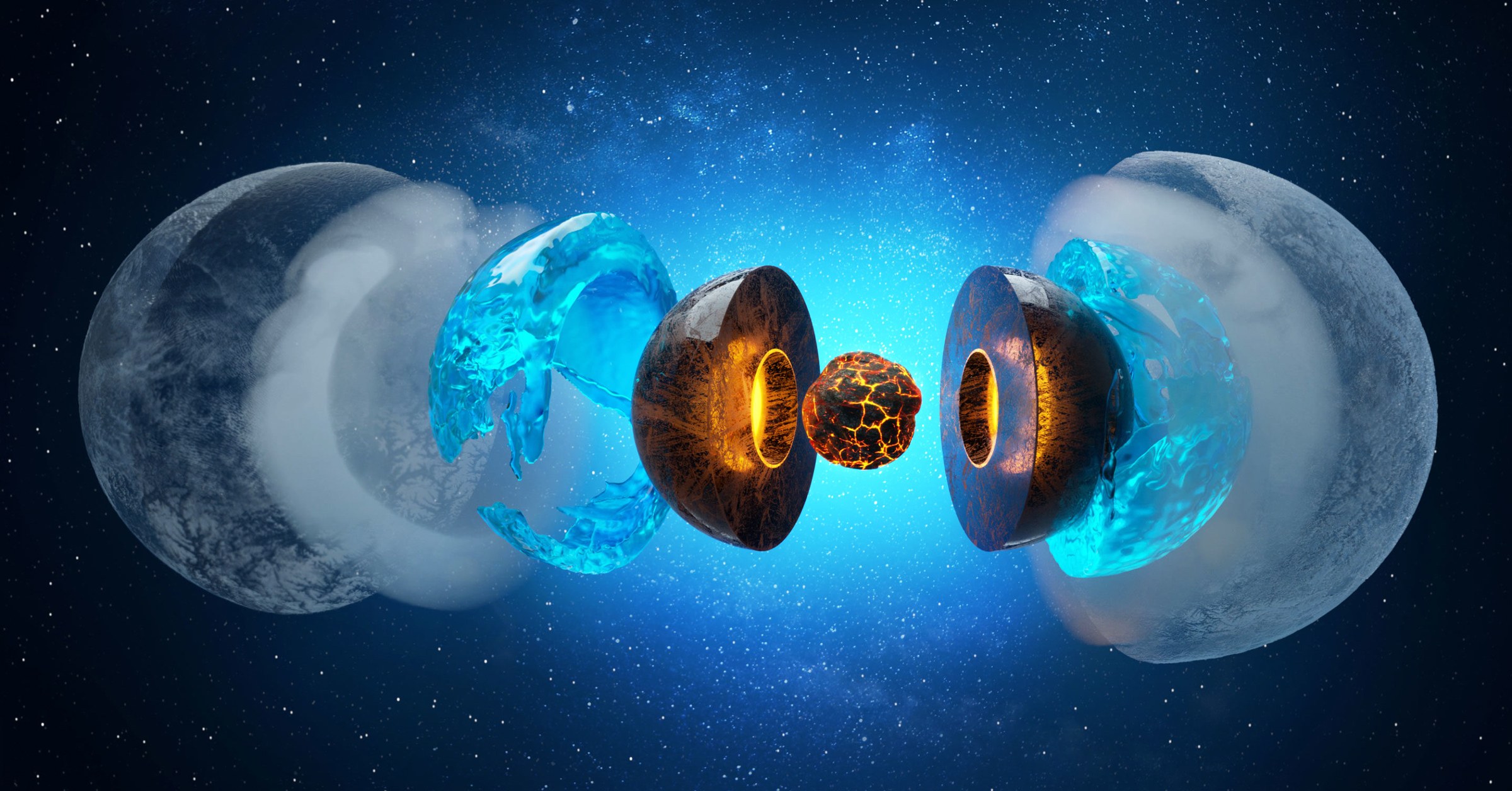
    Across the solar system, at least, more water probably exists as superionic ice—filling the interiors of Uranus and Neptune—than in any other phase, including the liquid form sloshing in oceans on Earth, Europa and Enceladus. The discovery of superionic ice potentially solves decades-old puzzles about the composition of these “ice giant” worlds.

    Including the hexagonal arrangement of water molecules found in common ice, known as “ice Ih,” scientists had already discovered a bewildering 18 architectures of ice crystal. After ice I, which comes in two forms, Ih and Ic, the rest are numbered II through XVII in order of their discovery. (Yes, there is an Ice IX, but it exists only under contrived conditions, unlike the fictional doomsday substance in Kurt Vonnegut’s novel Cat’s Cradle.)

    Superionic ice can now claim the mantle of Ice XVIII. It’s a new crystal, but with a twist. All the previously known water ices are made of intact water molecules, each with one oxygen atom linked to two hydrogens. But superionic ice, the new measurements confirm, isn’t like that. It exists in a sort of surrealist limbo, part solid, part liquid. Individual water molecules break apart. The oxygen atoms form a cubic lattice, but the hydrogen atoms spill free, flowing like a liquid through the rigid cage of oxygens.

    A time-integrated photograph of the X-ray diffraction experiment at the University of Rochester’s Laboratory for Laser Energetics. Giant lasers focus on a water sample to compress it into the superionic phase. Additional laser beams generate an X-ray flash off an iron foil, allowing the researchers to take a snapshot of the compressed water layer.
    Millot, Coppari, Kowaluk (LLNL)

    Experts say the discovery of superionic ice vindicates computer predictions, which could help material physicists craft future substances with bespoke properties. And finding the ice required ultrafast measurements and fine control of temperature and pressure, advancing experimental techniques. “All of this would not have been possible, say, five years ago,” said Christoph Salzmann at University College London, who discovered ices XIII, XIV and XV. “It will have a huge impact, for sure.”

    Depending on whom you ask, superionic ice is either another addition to water’s already cluttered array of avatars or something even stranger. Because its water molecules break apart, said the physicist Livia Bove of France’s National Center for Scientific Research and Pierre and Marie Curie University, it’s not quite a new phase of water. “It’s really a new state of matter,” she said, “which is rather spectacular.”

    Puzzles Put on Ice

    Physicists have been after superionic ice for years—ever since a primitive computer simulation led by Pierfranco Demontis in 1988 predicted water would take on this strange, almost metal-like form if you pushed it beyond the map of known ice phases.

    Under extreme pressure and heat, the simulations suggested, water molecules break. With the oxygen atoms locked in a cubic lattice, “the hydrogens now start to jump from one position in the crystal to another, and jump again, and jump again,” said Millot. The jumps between lattice sites are so fast that the hydrogen atoms—which are ionized, making them essentially positively charged protons—appear to move like a liquid.

    This suggested superionic ice would conduct electricity, like a metal, with the hydrogens playing the usual role of electrons. Having these loose hydrogen atoms gushing around would also boost the ice’s disorder, or entropy. In turn, that increase in entropy would make this ice much more stable than other kinds of ice crystals, causing its melting point to soar upward.

    But all this was easy to imagine and hard to trust. The first models used simplified physics, hand-waving their way through the quantum nature of real molecules. Later simulations folded in more quantum effects but still sidestepped the actual equations required to describe multiple quantum bodies interacting, which are too computationally difficult to solve. Instead, they relied on approximations, raising the possibility that the whole scenario could be just a mirage in a simulation. Experiments, meanwhile, couldn’t make the requisite pressures without also generating enough heat to melt even this hardy substance.

    As the problem simmered, though, planetary scientists developed their own sneaking suspicions that water might have a superionic ice phase. Right around the time when the phase was first predicted, the probe Voyager 2 had sailed into the outer solar system, uncovering something strange about the magnetic fields of the ice giants Uranus and Neptune.

    The fields around the solar system’s other planets seem to be made up of strongly defined north and south poles, without much other structure. It’s almost as if they have just bar magnets in their centers, aligned with their rotation axes. Planetary scientists chalk this up to “dynamos”: interior regions where conductive fluids rise and swirl as the planet rotates, sprouting massive magnetic fields.

    By contrast, the magnetic fields emanating from Uranus and Neptune looked lumpier and more complex, with more than two poles. They also don’t align as closely to their planets’ rotation. One way to produce this would be to somehow confine the conducting fluid responsible for the dynamo into just a thin outer shell of the planet, instead of letting it reach down into the core.

    But the idea that these planets might have solid cores, which are incapable of generating dynamos, didn’t seem realistic. If you drilled into these ice giants, you would expect to first encounter a layer of ionic water, which would flow, conduct currents and participate in a dynamo. Naively, it seems like even deeper material, at even hotter temperatures, would also be a fluid. “I used to always make jokes that there’s no way the interiors of Uranus and Neptune are actually solid,” said Sabine Stanley at Johns Hopkins University. “But now it turns out they might actually be.”

    Ice on Blast

    Now, finally, Coppari, Millot and their team have brought the puzzle pieces together.

    In an earlier experiment, published last February, the physicists built indirect evidence for superionic ice. They squeezed a droplet of room-temperature water between the pointy ends of two cut diamonds. By the time the pressure raised to about a gigapascal, roughly 10 times that at the bottom of the Marianas Trench, the water had transformed into a tetragonal crystal called ice VI. By about 2 gigapascals, it had switched into ice VII, a denser, cubic form transparent to the naked eye that scientists recently discovered also exists in tiny pockets inside natural diamonds.

    Then, using the OMEGA laser at the Laboratory for Laser Energetics, Millot and colleagues targeted the ice VII, still between diamond anvils. As the laser hit the surface of the diamond, it vaporized material upward, effectively rocketing the diamond away in the opposite direction and sending a shock wave through the ice. Millot’s team found their super-pressurized ice melted at around 4,700 degrees Celsius, about as expected for superionic ice, and that it did conduct electricity thanks to the movement of charged protons.

    Federica Coppari, a physicist at Lawrence Livermore National Laboratory, with an x-ray diffraction image plate that she and her colleagues used to discover ice XVIII, also known as superionic ice.
    Eugene Kowaluk/Laboratory for Laser Energetics

    With those predictions about superionic ice’s bulk properties settled, the new study led by Coppari and Millot took the next step of confirming its structure. “If you really want to prove that something is crystalline, then you need X-ray diffraction,” Salzmann said.

    Their new experiment skipped ices VI and VII altogether. Instead, the team simply smashed water with laser blasts between diamond anvils. Billionths of a second later, as shock waves rippled through and the water began crystallizing into nanometer-size ice cubes, the scientists used 16 more laser beams to vaporize a thin sliver of iron next to the sample. The resulting hot plasma flooded the crystallizing water with X-rays, which then diffracted from the ice crystals, allowing the team to discern their structure.

    Atoms in the water had rearranged into the long-predicted but never-before-seen architecture, Ice XVIII: a cubic lattice with oxygen atoms at every corner and the center of each face. “It’s quite a breakthrough,” Coppari said.

    “The fact that the existence of this phase is not an artifact of quantum molecular dynamic simulations, but is real—­that’s very comforting,” Bove said.

    And this kind of successful cross-check behind simulations and real superionic ice suggests the ultimate “dream” of material physics researchers might be soon within reach. “You tell me what properties you want in a material, and we’ll go to the computer and figure out theoretically what material and what kind of crystal structure you would need,” said Raymond Jeanloz, a member of the discovery team based at University of California, Berkeley. “The community at large is getting close.”

    The new analyses also hint that although superionic ice does conduct some electricity, it’s a mushy solid. It would flow over time, but not truly churn. Inside Uranus and Neptune, then, fluid layers might stop about 8,000 kilometers down into the planet, where an enormous mantle of sluggish, superionic ice like Millot’s team produced begins. That would limit most dynamo action to shallower depths, accounting for the planets’ unusual fields.

    Other planets and moons in the solar system likely don’t host the right interior sweet spots of temperature and pressure to allow for superionic ice. But many ice giant-sized exoplanets might, suggesting the substance could be common inside icy worlds throughout the galaxy.

    Of course, though, no real planet contains just water. The ice giants in our solar system also mix in chemical species like methane and ammonia. The extent to which superionic behavior actually occurs in nature is “going to depend on whether these phases still exist when we mix water with other materials,” Stanley said. So far, that isn’t clear, although other researchers have argued superionic ammonia should also exist.

    Aside from extending their research to other materials, the team also hopes to keep zeroing in on the strange, almost paradoxical duality of their superionic crystals. Just capturing the lattice of oxygen atoms “is clearly the most challenging experiment I have ever done,” said Millot. They haven’t yet seen the ghostly, interstitial flow of protons through the lattice. “Technologically, we are not there yet,” Coppari said, “but the field is growing very fast.”

    Original story reprinted with permission from Quanta Magazine, an editorially independent publication of the Simons Foundation whose mission is to enhance public understanding of science by covering research developments and trends in mathematics and the physical and life sciences.

    More Great WIRED Stories

    This content was originally published here.
  • Cambridge scientists create world’s first living organism with fully redesigned DNA | Science | The Guardian

    Cambridge scientists create world’s first living organism with fully redesigned DNA | Science | The Guardian

    Scientists have created the world’s first living organism that has a fully synthetic and radically altered DNA code.

    The lab-made microbe, a strain of bacteria that is normally found in soil and the human gut, is similar to its natural cousins but survives on a smaller set of genetic instructions.

    The bug’s existence proves life can exist with a restricted genetic code and paves the way for organisms whose biological machinery is commandeered to make drugs and useful materials, or to add new features such as virus resistance.

    In a two-year effort, researchers at the laboratory of molecular biology, at Cambridge University, read and redesigned the DNA of the bacterium Escherichia coli (E coli), before creating cells with a synthetic version of the altered genome.

    The artificial genome holds 4m base pairs, the units of the genetic code spelled out by the letters G, A, T and C. Printed in full on A4 sheets, it runs to 970 pages, making the genome the largest by far that scientists have ever built.

    “It was completely unclear whether it was possible to make a genome this large and whether it was possible to change it so much,” said Jason Chin, an expert in synthetic biology who led the project.

    The DNA coiled up inside a cell holds the instructions it needs to function. When the cell needs more protein to grow, for example, it reads the DNA that encodes the right protein. The DNA letters are read in trios called codons, such as TCG and TCA.

    Nearly all life, from jellyfish to humans, uses 64 codons. But many of them do the same job. In total, 61 codons make 20 natural amino acids, which can be strung together like beads on a string to build any protein in nature. Three more codons are in effect stop signs: they tell the cell when the protein is done, like the full stop marking the end of this sentence.

    Pinterest

    The Cambridge team set out to redesign the E coli genome by removing some of its superfluous codons. Working on a computer, the scientists went through the bug’s DNA. Whenever they came across TCG, a codon that makes an amino acid called serine, they rewrote it as AGC, which does the same job. They replaced two more codons in a similar way.

    More than 18,000 edits later, the scientists had removed every occurrence of the three codons from the bug’s genome. The redesigned genetic code was then chemically synthesised and, piece by piece, added to E coli where it replaced the organism’s natural genome. The result, reported in Nature, is a microbe with a completely synthetic and radically altered DNA code. Known as Syn61, the bug is a little longer than normal, and grows more slowly, but survives nonetheless.

    “It’s pretty amazing,” said Chin. When the bug was created, shortly before Christmas, the research team had a photo taken in the lab with a plate of the microbes as the central figure in a recreation of the nativity.

    Such designer lifeforms could come in handy, Chin believes. Because their DNA is different, invading viruses will struggle to spread inside them, making them in effect virus-resistant. That could bring benefits. E coli is already used by the biopharmaceutical industry to make insulin for diabetes and other medical compounds for cancer, multiple sclerosis, heart attacks and eye disease, but entire production runs can be spoiled when bacterial cultures are contaminated with viruses or other microbes. But that is not all: in future work, the freed-up genetic code could be repurposed to make cells churn out designer enzymes, proteins and drugs.

    Play Video
    4:22

    In 2010, US scientists announced the creation of the world’s first organism with a synthetic genome. The bug, Mycoplasma mycoides, has a smaller genome than E coli – about 1m base pairs – and was not radically redesigned. Commenting on the latest work, Clyde Hutchison, from the US research group, said: “This scale of genome replacement is larger than any complete genome replacement reported so far.”

    “They have taken the field of synthetic genomics to a new level, not only successfully building the largest ever synthetic genome to date, but also making the most coding changes to a genome so far,” said Tom Ellis, a synthetic biology researcher at Imperial College London.

    But the records may not stand for long. Ellis and others are building a synthetic genome for baker’s yeast, while Harvard scientists are making bacterial genomes with more coding changes. That the redesigned E coli does not grow as well as natural strains is not surprising, Ellis added. “If anything it’s surprising it grows at all after so many changes,” he said.

    This content was originally published here.

  • Why every desk at your office should have a plant

    Why every desk at your office should have a plant

    Call it green energy — by giving every employee a plant, engineer Mike Robinson created an environment where both humans and their leafy friends thrive. Plus, 9 recommendations for hardy, hard-to-kill plants to call your own.

    This post is part of TED’s “How to Be a Better Human” series, each of which contains a piece of helpful advice from someone in the TED community; browse through all the posts here.

    Besides a paycheck and reasonable hours, what else does a person need to thrive at work? Decent space, adequate supplies and tools? Yes. Lunch breaks, sick days, time off to recharge? Sure. A plant? Well …

    Such an idea had never occurred to engineer Mike Robinson. He owns a small company based in British Columbia, Canada, that designs and builds windbreaks and other control structures. One day, his wife, Suzanne, who runs the company with him, said: “I think we should give every person in the office a plant for their desk.”

    Robinson was skeptical. He thought that plants would be distracting and a drain on people’s time. “The average staff member would probably spend about five minutes a day either looking after the plant or admiring it,” as he puts it in a TEDxWhiteRock talk. Upon his wife’s insistence, however, he agreed to give it a try.

    He and Suzanne bought 20 plants for their 20 employees. Then, they did something a bit different. Instead of handing them out, they asked each employee to approach the tableful of plants and choose their own — but from the perspective of the plant.

    Think of it like a human-plant speed-date. Robinson explains, “So you have to put yourself in the spot of the plant, as it were, and say, ‘Which person do I want to be my new friend?’” Employees then received a small sign on which they wrote ‘My friend is …’ and their own name, stuck it in the soil, and brought it into their personal workspace.

    Over time, Robinson realized that the plants were having a positive impact. He says, “I did my own mathematics, and I reckoned that we might be doing about 30 percent more business per staff [member].” Of course, this is far from a scientific study. There’s no control group or double-blind — just a company filled with happy plant lovers excelling at their jobs. And maybe that’s enough.

    Another sign that something is going right: After 5 years, not a single plant has died. Robinson guesses that since each was hand-selected and bears the employee’s name on the label, they’re well-tended because “this is your friend and you care about your friend.” As he explains, “Our office is a more contented place, a relaxed place, and a place that I’m proud to be to be a part of, and a big part of that is the personal plant.”

    But what plant is right for your desk? Perhaps you’ve gotten one and felt the warm glow of human-plant friendship — only to see it wither before your eyes. We asked Rebecca Bullene, New York City horticulturist, cofounder of Greenery Unlimited and the person who designed and tends the greenery at the TED NYC offices, to recommend hardy plants for different light conditions. Note: Almost all of these plants are available in desktop sizes, but if you want them to stay that way, you will need to prune them.

    Plants for low light

    Sansevieria plant, or snake plant: “They’re an architectural plant; I usually use them in spaces that have a more modern aesthetic,” says Bullene.

    ZZ plant, or emerald palm: “This plant has very deep glossy leaves and a kind of two-tone coloring. It’s a softer plant.”

    Aglaonema, or Chinese evergreen: “It has very beautiful patterning on the leaves, and it’s a larger-leafed plant. It is a welcoming plant.”

    Plants for medium light

    Monstera deliciosa, or Swiss cheese plant: “It’s a fabulous name for a fabulous plant. The leaves have a really interesting texture, and this plant is a fast grower.”

    Schefflera arboricola: “it’s very cute. It’s one of my favorites, and it’s easy to take care of.”

    Anthurium, or laceleaf plant: “This is one of my favorite flowering plants. I prefer them to orchids because orchids can be difficult to care for and their blooms only last for about six weeks, whereas the anthurium puts up new flowers year-round.”

    Plants for high light

    Ficus audrey, or banyan fig: “While the fiddle-leaf fig is the most popular ficus, the ficus audrey is gaining. I think it’s just as beautiful, if not more so. It has very velvety leaves, and its growth habit is more restrained.”

    Philodendron selloum, or philodendron hope selloum: “This was popular in the 1970s and the 1980s and fell out of favor, but it’s having a resurgence now. These plants have large tropical leaves with really deep cuts in them and a lovely, ruffle-like texture. This is not one that you’d have on your desk — it’s large — but next to it.”

    Succulent plants, such as aloe vera, pincushion or zebra plant: “These are very popular right now. They’re best on a sunny windowsill rather than away from natural light. Most need water every 7 to 10 days, but touch the soil first — if it’s damp, don’t water it. They really like to dry out between waterings.”

    : “This is a flowering succulent that’s good in high light. They put out these long stems with bell-shaped flowers.”

    But what if you’re in a space that has no windows or a window facing a stairwell? “The sansevieria and aglaonema can survive in a room with no windows, although they won’t flourish. But people without natural light should known that grow lights have come far in the past three years,” says Bullene. “They screw into any fixture and they provide the same kind of light to work by, but they’re actually introducing a full spectrum of light for plants. I’ve seen plants respond really well to them.”

    What about air plants? “These generally require more care and attention than people are willing to give. When I’ve gone into a store and the sales people are like, ‘Oh, you don’t need to do anything with them,’ it breaks my heart,” says Bullene. “One of the fundamentals of plant care is to think about a plant’s native habitat and how to recreate it so the plant will be happy. Air plants grow in extremely high humidity environments that are full of life; they get their nutrients from the air.” She recommends either putting them near a humidifier (and misting them regularly) or soaking them for 20 minutes at a time in a bowl of water. Air plants like bright, indirect light.

    Last but not least: Don’t overwater. “There’s a direct proportional relationship between light and water. The less light a plant gets, the less water it should receive; the more light, the more water,” explains Bullene. “Often, people think they should water every day, and that’s the kiss of death. In a low light environment, you should water plants every 10 days or so.“

    What’s confusing is the signs of overwatering and underwatering are largely the same — yellow leaves, wilting — and most of us respond by adding water. Says Bullene, “I’d say 80 percent of the time plants are receiving too much water, and the correct response would be to withhold it for a little bit longer.”

    Watch Mike Robinson’s TEDxWhiteRock talk now:

    This content was originally published here.
  • Keep Lavender Plant in Your Bedroom: It Dramatically Improves Sleep, and Reduces Anxiety

    Keep Lavender Plant in Your Bedroom: It Dramatically Improves Sleep, and Reduces Anxiety

    Your insomnia isn’t something you should ignore, and the Center for Disease Control and Prevention confirms that sleep deprivation is a common issue these days.

    Meditation and relaxation techniques are some of the solutions people try to improve their sleep. They buy expensive mattresses, drink banana tea or take sleep medication. None of this works and actually makes the situation even worse.

    We suggest that you go all natural, and keep a few plants in your home. Yes, most plants release carbon dioxide at night, but there are a few plants that release oxygen.

    Indoor plants provide the following benefits:

    • Better air quality
    • Reduced stress
    • Less anxiety
    • Better smell
    • Headache relief
    • Boosted mood
    • Cold/illness prevention
    • Improved brain function
    • Improved sleep

    The best plants for your bedroom

    According to NASA, you can improve the quality of the air you breathe and your sleep by placing a few plants in your bedroom. We give you the top 5:

    1. Aloe Vera

    It’s low-maintenance and provides a lot of benefits. NASA listed it as one of the greatest air-purifying plants. Aloe Vera releases oxygen at night, and helps those dealing with insomnia.

    The ‘plant of immortality’ reproduces easily, and you can also use it to treat numerous health problems.

    2. Lavender

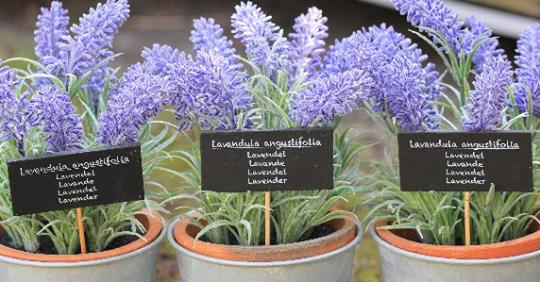
    Lavender reduces anxiety and stress, slows your heart rate, helps you sleep better and even calms crying babies.

    3. Jasmine

    This exotic plant has an excellent smell. It improves the quality of your sleep, your alertness and productivity. Smell it to “kill” your anxiety.

    4. English Ivy

    It’s the best air-purifying plant as confirmed by NASA. English Ivy has great effect in those dealing with asthma and breathing problems at night. It reduces airborne mold by 94%. Contaminants trigger asthma, allergies and other respiratory issues. keep this in your house to improve the quality of your sleep.

    5. Snake plant

    Snake plants are easy to grow and make your home look pretty. This plant improves the quality of the air you breathe and filter oxygen. Studies show that snake plant prevents eye irritation, respiratory issues, headaches and improves your productivity.

    If this list is too short, do your own research and bring some great plants in your home. Look for Chinese evergreen, Peace Lily, Chrysanthemum, Valerian, Chamomile, and California Poppy.

    Chamomile is a powerful medicinal herb. Dried chamomile flowers contain terpenoids and flavonoids which give this plant its great healing effect. You can use it to relieve numerous conditions and sleep well at night. Chamomile helps those with nerve issues, anxiety and nightmares. Make yourself a nice cup of chamomile tea or use it as aromatherapy.

    Final words

    The quality of your air is of great importance for your overall health. Mold and airborne contaminants trigger diseases and you end up dealing with severe symptoms.

    Keep a few plants in your home to optimize your health and sleep better.

    Sources:
     

    The post Keep Lavender Plant in Your Bedroom: It Dramatically Improves Sleep, and Reduces Anxiety appeared first on Healthy Food House.

    This content was originally published here.

  • Spicy style: The best influencer looks from The Spice Girls

    Spicy style: The best influencer looks from The Spice Girls

    Last night, The Spice Girls took to Croke Park to an audience of 80,000 screaming fans.

    Among the fervent crowd were some of Ireland’s top influencers, who headed out to the concert with their friends and families.

    As always, the fashion and beauty bloggers kept their looks chic but 90s inspired, and served major summer style inspiration.

    Louise Cooney

    instagram

    Louise Cooney donned a very appropriate top for last night’s gig.

    Her t-shirt, featuring the Prada logo and The Spice Girls, is from Missy Empire, you can shop it HERE, and looked stunning paired with a chic blue co-ord and Fila runners.

    Aideen Kate

    instagram

    Queen of Instagram beauty Aideen Kate paid homage to Ginger Spice in a dramatic makeup look ahead of the comeback tour.

    Featuring a ginger wig and glitter eyeshadow, the YouTuber looked every inch the 90s pop sensation.

    For the actual concert, the blogger kept it casual in a pink oversized shirt, black lace up platform shoes and paired back makeup.

    Niamh Cullen

    instagram

    Niamh Cullen slayed the game with her rendition of a modern Baby Spice look.

    Donning a pink slip dress and platform runners, the fitness influencer opted for Baby Spice’s signature pigtails and a fluffy backpack to complete the look.

    Emma Kehoe

    instagram
    instagram

    Emma Kehoe kept things cute and comfy in a denim dress from In The Style.

    Teaming her look with a classic Louise Vuitton monogram print and white boots, the influencer looked ready for a night in Croker.

    Rosie Connolly

    instagram

    Despite managing a hectic family and work life, top Irish blogger Rosie Connolly made the time to enjoy a girls night out to see The Spice Girls.

    Rocking a floral dress from ASOS, Rosie emulated the foursome on stage by adding an electric blur fur coat to her ditzy-print dress.

    The post Spicy style: The best influencer looks from The Spice Girls appeared first on Goss.ie.

    This content was originally published here.

  • Selena Gomez Wore Baby Blue Sweats While Out at Lunch in L.A.

    Selena Gomez Wore Baby Blue Sweats While Out at Lunch in L.A.

    Selena Gomez is back from the red carpet in Cannes and into a pair of casual baby blue sweats in L.A. The singer/actress was photographed lunching with friends wearing a matching sweat set by Essentials while she smiled and chatted with her lunch companions.

    Gomez is currently reigning as the queen of comfy clothes. While arriving in the south of France last week, Gomez looked extra snug in a tan cardigan with white flowing trousers. A few days later she prepared to leave the country via helicopter in a simple white tank top and jeans.

    gotpap/Bauer-GriffinGetty Images

    Of course, Gomez knows how to hit peak glam. For the Cannes Film Festival red carpet, she wore a white corset top and long skirt by Louis Vuitton while dripping in Bulgari diamonds. It was Gomez’s debut at the luxurious festival, as she was there to promote her new film The Dead Don’t Die.

    The soft spoken star recently opened up for the first time this year on the Dream It Real podcast, where she discussed how she’s managed to stay authentic despite the glamorous red carpets and her 151 million Instagram followers.

    “I think there came a point in my life where I just started not to care….Obviously my situation is different and very weird but when I was younger, I was exposed to all of this [fame]. It was just all these pictures and all the things and all I would do is look at the flaws,” she said. “And I think that you kind of create this other persona of yourself and then when I started going through real, really difficult things, it [not caring and ultimately being authentic] just allowed me to have worth, to know that I’m worthy and that I am who I am. And who is that? And do I like that person? I think that it’s important for me. I don’t want to be anything that’s a show or a persona. I just don’t.”

    Shop Selena’s Sweats and Pairs Just Like It

    SSENSE Exclusive Green Fleece Lounge Pants
    Essentials ssense.com

    $100.00
    needle supply company needsupply.com

    $124.99

    This content was originally published here.
  • Taylor Swift Shuts Down Interviewer Who Asks If She Wants Children | toofab.com

    Taylor Swift Shuts Down Interviewer Who Asks If She Wants Children | toofab.com

    Taylor Swift doesn’t have time for sexist questions, and the 29-year-old superstar didn’t hesitate to shut down an interviewer who went there.

    It’s the single-woman equivalent of asking a mother if it’s difficult juggling her career with having children, and Swift called it out immediately. The question came during a German interview posted to RTL when the “ME” singer was asked about turning 30 this year.

    “Is this kind of a turning point in your life,” she was asked. “Would you like to be a mother someday, have children?”

    Swift rightfully shut the question down, recognizing it for what it is. “I really don’t think men are asked that question when they turn 30,” she shot back. “So I’m not going to answer that now.”

    The pop star remained courteous, though. Even though she did not answer that question, she did talk about her feelings in general about moving into the third decade of her life.

    “I hear others say when you’re in your thirties there isn’t as much stress and anxiety in life as in your twenties,” she continued. “And I can relate to the observation that we are in our twenties looking to gain experience, try things out, fail, make mistakes.”

    Swift promised that she definitely plans to continue trying and failing at things into her thirties, but is looking forward to being a little more confident in who she is. “The closer I get to it, the more I feel it happen,” she said. “Hopefully that will be the case!”

    Taylor Swift turns 30 on December 13. She is currently dating Joe Alwyn, but is remarkably private about her personal life — inasmuch as she can be. It’s unclear when the couple first started dating, and obviously there is no word on if or when the couple might consider having children.

    If she does reach that point, though, he fans can likely expect a lot of cryptic clues about it through her social media channels. She’d also probably talk about it there first, over an interview, anyway (though she would drop more clues). Swift is very connected with her fans, who are currently far more interested in details about her forthcoming studio album.

    The singer blew away her fans by dropping the lead single from the album, “ME,” complete with a candy-colored music video featuring collaborator and Panic! at the Disco frontman Brendon Urie.

    No word on a title or release date for #TS7 just yet, though Swifities are looking to an interview with The Independent where Swift said the title was seen once and heard twice, leading them to believe it will be called “Lover.”

    Got a story or a tip for us? Email TooFab editors at tips@toofab.com.

    This content was originally published here.

  • CrossFit quits Facebook, Instagram, accuses social media giant of censorship, being ‘utopian socialists’

    CrossFit quits Facebook, Instagram, accuses social media giant of censorship, being ‘utopian socialists’

    CrossFit, the branded workout regimen, accused Facebook of being “utopian socialists” and left the platform after the social network deleted a group dedicated to a diet.

    The move to quit both Facebook and Instagram came in the wake of the decision to delete “without warning or explanation the Banting7DayMealPlan,” a group that advocated a diet aimed at eating “food that is as close to its natural state as possible — free from processing, additives, preservatives and sugar.”

    he group suspension was later overturned, but CrossFit issued a lengthy statement announcing the end of their presence on the platform.

    “All activity on CrossFit, Inc.’s Facebook and Instagram accounts was suspended as of May 22, 2019, as CrossFit investigates the circumstances pertaining to Facebook’s deletion of the Banting7DayMealPlan and other well-known public complaints about the social-media company that may adversely impact the security and privacy of our global CrossFit community,” the statement read.

    source