Author: Truth & Hammer

  • An Astounding Amount of Water Has Been Discovered Beneath the Martian North Pole

    An Astounding Amount of Water Has Been Discovered Beneath the Martian North Pole

    Using ground-penetrating radar, scientists detected a massive reservoir of frozen water sandwiched by layers of sand beneath the northern polar ice cap on Mars. This reservoir contains so much ice that, if melted and brought to the surface, it would submerge the entire planet.

    “This was a surprise even for us,” Stefano Nerozzi, the lead author of the new paper and a PhD student at the University of Texas at Austin, told Gizmodo in an email.

    The massive reservoir was detected within Mars’ northern cavi unit, a deposit of multiple layers of water ice mixed in with sand that formed over the course of hundreds of millions of years. The cavi unit rests about 2 kilometers (1.2 miles) beneath the Martian north pole, and prior to the new study, scientists figured it was primarily composed of sand dunes and contained less than 50 percent water ice by volume. These estimates were based on observations of visible outcrops, which revealed significant amounts of dark sands intermixed with small amounts of frozen water.

    But now, radar scans from orbit suggests the cavi unit is packed with more water ice than sand, making it possibly the third-largest water reservoir on the Red Planet, followed only by the two polar ice caps. The new paper was published this week in Geophysical Research Letters.

    These new observations were made by the Shallow Radar, or SHARAD, instrument aboard NASA’s Mars Reconnaissance Orbiter. SHARAD emits surface-penetrating radar waves that allowed Nerozzi’s team to discern the internal structures and composition of the cavi unit.

    Observations revealed horizontal slabs rich in ice that were sandwiched by alternating layers of sand. The distribution of water ice ranged from 61 to 88 percent by volume, which means the cavi unit is primarily composed of frozen water. As noted in the press release, if melted and brought to the surface, “the newly discovered polar ice would be equivalent to a global layer of water around Mars at least 1.5 meters (5 feet) deep.” That’s a lot of water.

    SHARAD data showed that the frequency and volume of the ice slabs increased with proximity to the north pole. In one region, for example, the researchers detected two sand sheets over 40 kilometers (25 miles) wide on top of a layer of ice ranging in depth from 50 to 100 meters (165 to 330 feet).

    Advertisement

    These buried structures are the remnants of former ice caps which shrunk and were buried during warm periods, according to the paper. Consequently, this cavi unit contains a historical record of the Martian climate. The layers of ice are like the rings on a tree, showing the growth and retreat of ancient polar caps over the years. Like Earth, Mars has experienced multiple ice ages. During the warm periods, sand enveloped the shrunken ice caps, protecting them from the Sun and in turn preventing the ice from evaporating into the atmosphere.

    “The only hypothesis that can reconcile our results and all the previous studies is that the cavi unit is made of alternating ice sheets, remnants of former polar caps, and sand layers, which acted as protective blanket and prevented the complete retreat of the old polar ice,” Nerozzi told Gizmodo. “This is another big surprise in itself, because it means that we have a new and unexpected record of past polar ice cap growth and retreat that dates back hundreds of millions of years.”

    Prior to the new study, scientists figured the ancient ice caps were lost, but SHARAD data suggests otherwise.

    “These results are significant because it attests to past climate cycles in the north polar region,” Matthew Chojnacki, a planetary scientist at the University of Arizona who was not involved in the new research, said in an email to Gizmodo. “For tens of millions of years, maybe longer, wind built up massive sand deposits which were repeatedly buried with various levels of ice. These intra-dune ice deposits happen on Earth but I’m not aware of such a large example as this north polar cavi unit on Mars.”

    The new finding could also tell us a bit more about water ice located elsewhere on Mars, particularly in the lower latitudes. Jack Holt, co-author of the study and a researcher at the University of Arizona, previously used SHARAD to confirm the presence of massive glaciers in the Martian mid-latitudes—one of which is three times the size of Los Angeles. These glaciers are almost completely comprised of water ice, but they’re obscured by surface materials.

    “Surprisingly, the total volume of water locked up in these buried polar deposits is roughly the same as all the water ice known to exist in glaciers and buried ice layers at lower latitudes on Mars, and they are approximately the same age,” said Holt in the University of Texas press release.

    Mars, as we’re learning, holds a tremendous amount of water. This theoretically bodes well for future colonists in need of the precious liquid.

    “The ice sheets might be very pure, with only a few percent dust impurities. However, this unit is buried underneath a polar ice cap up to 2 kilometers thick, so it is not easy to reach,” said Nerozzi. “It would be much easier to extract nearly pure water from the ice at the surface of the polar cap. To make it drinkable, or process it into fuel for rockets, one would need to filter out the dust impurities and perhaps some salts.”

    Nerozzi is continuing to study this cavi unit and using SHARAD to read the record of past polar cap evolution. Given the geological and climate data how available, he might even be able to reconstruct the entire formation history of the cavi.

    “This would give us precious insights into the past distribution of water on the planet, and thus if any amount of liquid water existed near the equator that could have supported life,” said Nerozzi.

    This content was originally published here.
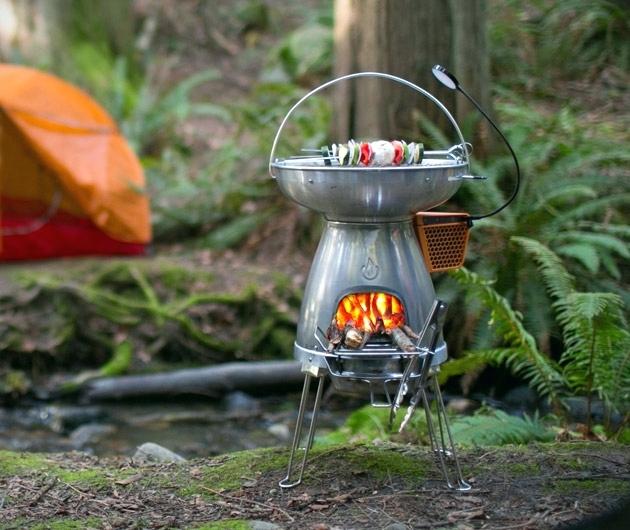
  • BioLite Basecamp Wood Burning Stove System

    BioLite Basecamp Wood Burning Stove System

    • excess heat is converted into electricity and stores it in the integrated 2200mAh Lithium ion battery. Stored energy can be used later, even without a fire. Battery recharges automatically every time you build a fire. Powerbank provides 5 watt (5 volt) USB output to charge your devices including cell phones and smartphones. Smart LED Dashboard monitors your power generation and battery level.
    • Large Group Cooking: 138 square inch grill surface fits 8 burgers using energy efficient outdoor and off-grid cooking. Uses solid biomass (twigs, firewood, wood chunks, etc.)
    • Flexible arm light with USB pass-through. Light your meal and keep a device charging at the same time.
    • Grill-to-Boil Lever: Transform flame from dissipated heat for grilling to direct heat for pot boiling, at the flip of a switch.
    • Set includes: BioLite BaseCamp, Fire starters, Fuel Rack, Ash Tray, Gooseneck USB light, and Instructions, all weighing under 18 pounds.
    Click here for more information

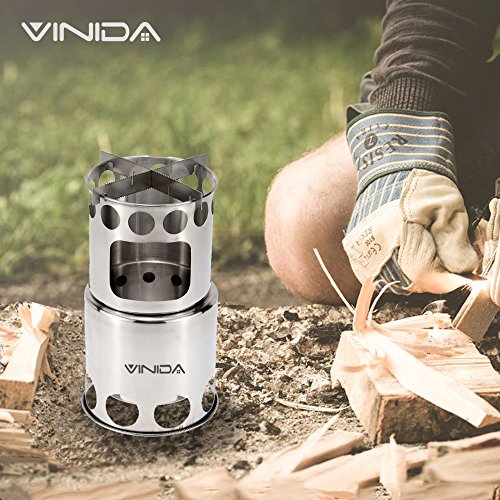
  • VINIDA Camping Stove Backpacking Stove Survival Stove – Portable Lightweight Wood Burning Stove with Nylon Carry Bag for Hiking Climbing Fishing Picnic BBQ

    VINIDA Camping Stove Backpacking Stove Survival Stove – Portable Lightweight Wood Burning Stove with Nylon Carry Bag for Hiking Climbing Fishing Picnic BBQ

    • 🔥【FREE FUEL & NATURE FRIENDLY】Wood Burning Camp stove uses twigs, leaves, pinecones and wood as fuel. Free up more space in your backpack and no more spending money on heavy, polluting and expensive white gas or liquid canister fuel
    • 🔥【EFFICIENT DESIGN & FAST BOIL TIME】Backpacking Wood Stove boils water(34 fl oz) in 7-10 mins. It creates clean gasification that causes a third combustion. It allows fuel to burn more completely with less smoke
    • 🔥【COMPACT & LIGHTWEIGHT 】Backpacking Stove weighs only 9.17 oz and 4.5″ Diameter, 3.9″/7.45″ Tall (Packed/Assembled). It nests inside a Nylon Stuff Sack leaving you with more room in your backpack. It is suitable for 1-2 people use
    • 🔥【STURDY & EASY TO INSTALL】Made of premium stainless steel. The collapsible 4 parts are very easy to install and disassemble . The portable stove is even STABLE enough in windy conditions
    • 🔥【WHAT YOU GET】1 x Wood Camping Stove,1x Nylon Stuff Sack, 2 YEAR PROTECTION FOR FREE from the date of its original purchase
    Click here for more information

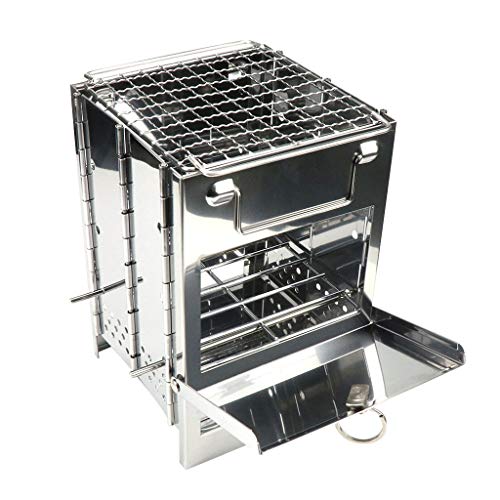
  • Outdoor Square Camping Stove, Wood Stove/Backpacking Stove,Portable Stainless Steel Wood Burning Stove – Nylon Carry Bag Backpacking Hiking Traveling Picnic BBQ Grill

    Outdoor Square Camping Stove, Wood Stove/Backpacking Stove,Portable Stainless Steel Wood Burning Stove – Nylon Carry Bag Backpacking Hiking Traveling Picnic BBQ Grill

    • ★ Durable stainless steel stove: the stove is made of superior stainless steel with a portable backpack
    • ★ Unique assembly system: the construction of the stove creates a stable cooking platform and distributes the heat evenly
    • ★ Portable camping stove: the stove with a carrying bag can be folded like a book, which you can store in your backpack
    • ★ Different fuel: You can make full use of different fuels to make a meal, such as branches, leaves, wood, charcoal and solidified alcohol, etc
    • ★ Easy installation: with some simple steps, it can be mounted correctly. Suitable for barbecue, boiling and cooking, etc–camping Outdoor Hiking Bags Sport Travel Backpacks Sports & Outdoors led lights Fashion Waterproof Flashlight Lighting Lamp Survival Interior Design Men’s Fashion Military Hunting Canvas Tent Fishing Mini Picnic water Tool Men
    click here for more information

  • Migrants dropped at US bus stations as Border Patrol shelters overflow

    Migrants dropped at US bus stations as Border Patrol shelters overflow

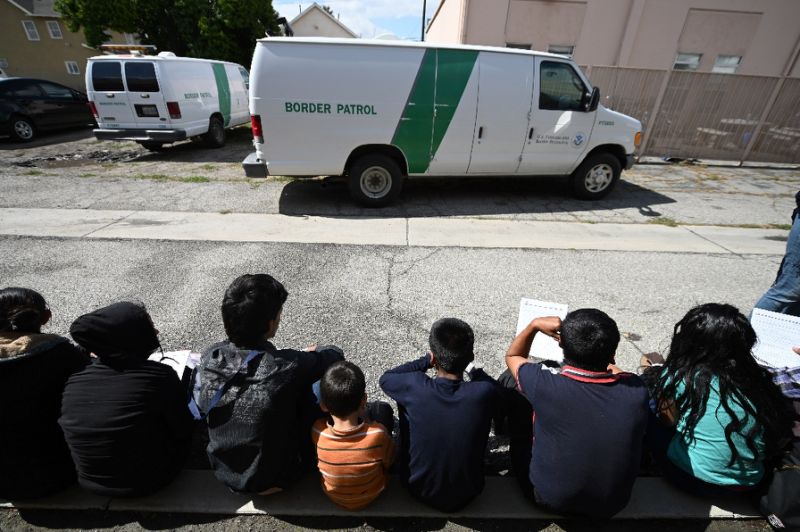
    The three white vans bearing the Border Patrol logo slowly make their way into a back alley next to the Greyhound bus station in the city of San Bernardino, east of Los Angeles.  As the agents slide open the doors, a group of 36 haggard-looking men, women and children — most of them from Guatemala — exit the vehicles carrying plastic bags filled with their meager belongings.  They line up on a sidewalk as their names are checked by a representative from a local NGO who also enquires about their health.  A man asks where he can rent a phone and one of the agents sternly answers back in Spanish.  “You decided to come this way into the US, you figure out what to do,” the agent says. “What do you expect? You want me to give you my house?”  Though clearly anxious about this next phase in their long journey to the US, the faces of the migrants show their relief at having made it so far.  The group is part of thousands being dropped off at bus stations in California and other states by US Border Patrol as the agency deals with an influx of migrants crossing the border with Mexico and filling detention facilities to capacity.

    – System at breaking point –

    After staying at a local shelter or church in San Bernardino, the migrants typically head to other states to join relatives or friends pending the outcome of their asylum application.  According to immigration authorities, more than 40,000 immigrant families apprehended at the border since March 19 and with no known criminal record have been released into the United States due to Border Patrol facilities being swamped.  “Whenever possible, the releases have been coordinated with local non-governmental organizations (NGOs),” US Border Patrol said in a statement to AFP. “As NGOs have reached their capacities, CBP has released family units at transportation hubs during daylight hours when the weather does not endanger those released.”  Nearly 250,000 unaccompanied children or people traveling with family members were apprehended at the border in April alone, officials said, as opposed to some 59,000 in April of last year — a 400 percent increase.

    US President Donald Trump has reacted with fury at the crisis, threatening to shut down the border and accusing asylum seekers of trying to gain entry into the US under false pretenses.  The asylum seekers are mainly from Honduras, Guatemala and El Salvador, countries beset by crushing poverty and gang violence.  The current surge in asylum seekers mainly concerns people from Guatemala.  “Despite everything, they feel absolute freedom, they feel they were born again,” said Homero Lobato, of the Immigrant Immediate Response Network, an NGO assisting the migrants. Jennaya Dunlap, of the Immigration Justice Coalition, another NGO, said nearly all of the asylum seekers don’t speak English, are poor and have no clue on arrival as to where they are or the next step to take.  “The first thing they ask us is, ‘Where are we? What region is this?’ And they try to figure out the state they are in by looking at license plates,” said Dunlap, who greeted the group of 36 migrants at the San Bernardino bus station this week. “Welcome,” she tells the group as they exit the Border Patrol vans as volunteers hand them water and granola bars. “Don’t worry, we are going to help you.”  Lurking nearby, however, is an example of what await some of the migrants in a country deeply divided on the immigration crisis.

    “Send them back to Tijuana (Mexico),” shouts a white bearded man in a red pick-up truck as he drives by the group of migrants at the bus station in San Bernardino.

    “Or better yet, send them to (liberal) San Francisco,” he adds.

    source

  • Young homebuyers scramble as prices rise faster than incomes

    Young homebuyers scramble as prices rise faster than incomes

    For millennials looking to buy their first home, the hunt feels like a race against the clock.  In the seven years since the housing crash ended, home values in more than three-quarters of U.S. metro areas have climbed faster than incomes, according to an Associated Press analysis of real estate industry data provided by CoreLogic.  That gap is driving some first-timers out of the most expensive cities as well as pressuring them to buy something before they are completely priced out of the market.  The high cost of home ownership is also putting extreme pressure on 20- and 30-somethings as they try to balance mortgage payments, student loans, child care and their careers.  “They do want all the same things that previous generations want,” said Daryl Fairweather, chief economist for the brokerage Redfin. “They just have more roadblocks, and they’re going to have to come up with more creative solutions to get the homes that they want.”  A Redfin analysis found these buyers are leaving too-hot-to-touch big-city markets — among them, San Francisco and Seattle, where the tech boom has sent housing prices into the stratosphere. The brokerage found that many millennials are instead buying in more reasonably priced neighborhoods around places like Salt Lake City, Oklahoma City and Raleigh, North Carolina. That, in turn, is driving up housing prices in those communities.

    Jake and Heather Rice, both 35, moved to Utah last year from Mountain View, California, where the biggest employers are tech giants such as Google, Symantec and Intuit and the median home price is a dizzying $1.4 million or so. The couple and their three children settled into a 4,500-square-foot house in fast-growing Farmington, just far enough away from Salt Lake City to feel rural but minutes from a major shopping center and Heather’s sister. They did not disclose the purchase price for the sake of privacy, but they said their monthly mortgage payments will be $3,000, roughly the same as the rent for their former two-bedroom, 1,000 square-foot apartment in Mountain View. “We didn’t expect to stay in California because of how ludicrous the prices had become,” said Jake, a mechanical engineer who works in the medical device sector.  Nationally, home prices since 2000 have climbed at an annual average rate of 3.8%, according to the data firm CoreLogic, while average incomes have grown at an annual rate of 2.7%. And in the metro areas with the strongest income growth — for example, parts of Silicon Valley — home prices have risen even faster.

  • ‘Revolution’ in Poland as nation confronts priestly abuse

    ‘Revolution’ in Poland as nation confronts priestly abuse

    One victim spoke out, and then another, and another. A statue of a pedophile priest was toppled in Gdansk, put back by his supporters, and finally dismantled for good. A feature film about clerical abuse was a box office hit.

    Poland thought it had started confronting the problem of clerical abuse and its cover-up by church authorities. Then a bombshell came: A documentary with victim testimony so harrowing it has forced an unprecedented reckoning with pedophile priests in one of Europe’s most deeply Catholic societies.

    Poland’s bishops acknowledged this week they face a crisis and made a rare admission that they have failed to protect the young. It’s also a crisis for the country’s conservative government, which is closely aligned with the Catholic Church, putting the ruling Law and Justice party on the defensive before Sunday’s European Parliament vote in Poland.

    The documentary ”Tell No One ” was directed by journalist Tomasz Sekielski. Before its release on May 11, ruling party leader Jaroslaw Kaczynski had described discussion about clerical abuse as a “brutal attack” on the church and portrayed the LGBT rights movement as the key threat to children in the country. But the revelations in the documentary have pushed the party to face up to the cleric abuse crisis. It has vowed stiffer penalties for pedophilia, although its leaders have avoided pointing a finger at the church specifically.

    Across the country, the film has triggered soul searching and raised questions, including whether the same bishops who moved perpetrators from parish to parish for years will be capable of cleansing the church. Some wonder if Poland, which is already being reshaped by economic growth and secularization, could eventually follow Ireland, where the abuse crisis broke the Catholic Church’s hold on society.

    Crowdfunded and free on YouTube, “Tell No One” has gotten more than 21 million views so far and has prompted a new wave of survivors to come forward. About 150 people have contacted a foundation helping victims of clerical abuse, “Have No Fear.” One was an 86-year-old man who was molested when he was 6 and had never told anyone until now.

    “He finally understood that he is not alone,” said Anna Frankowska, a lawyer for the organization who took his call.

    “A huge tsunami has come, and there is no way this issue can be swept under the rug now,” she said. “It has to be addressed.”

    more

  • 30 Quotes By Famous People That Might Inspire You To Change The Way You Think

    30 Quotes By Famous People That Might Inspire You To Change The Way You Think

    Have you ever noticed that when someone quotes famous people in a conversation, they instantly gain more credibility and his or her words just seem so much more on point and serious? Also, if you are a famous person, do your publicly spoken words automatically gain a status of wisdom, or do those words make the person even more famous for being wise words? Well, we are not sure about the second question, but memorizing a famous quote or two is a sure shot to appearing smarter and well-educated and also might save you some serious life lessons. Now, you could browse the Internet all day until you find the citation of your liking, or you could just check this list by Bored Panda full of famous quotes from beloved entrepreneurs, actors, artists and historical figures.

    We made sure to add citations that are not only sharp but also quotes you could actually live by – such as choosing to be extraordinary instead of being a cog in the machine or setting your own path in life rather than following someone else’s dreams and aspirations. Memorizing these inspiring quotes might not only make you look smart in a conversation but also change your own views on this thing called life. So, scroll down below for some verified wisdom and don’t forget to vote for truly eye-opening quotes about life!

    More

  • 30 Incredibly Detailed Balloon Sculptures By Japanese Artist Masayoshi Matsumoto

    30 Incredibly Detailed Balloon Sculptures By Japanese Artist Masayoshi Matsumoto

    They say practice makes perfect so Masayoshi Matsumoto, an artist who has been perfecting his craft for 10 years, should be pretty good, right? No. He’s amazing. The guy creates balloon sculptures so intricate, every single one of his pieces seem to breathe with life.

    What makes Matsumoto stand out from the crowd is how insanely familiar he is with the material. “My creations are one hundred percent balloon-only,” the 29-year-old told Bored Panda. “I don’t use any adhesive, marker pens, or anything else.”

    Once you know that, the limbs, spikes, and other little details elevate his pieces to another level. Majestic mammals, graceful birds, and pesky insects with their incredibly textural exoskeletons are only part of the artist’s body of work. Fauna aside, Matsumoto also portrays plants and fungi, including cacti and morel mushrooms.

    See and Read more

  • 40 Times People Realized They’re Living With A ‘Monster’ And Just Had To Share The Evidence

    40 Times People Realized They’re Living With A ‘Monster’ And Just Had To Share The Evidence

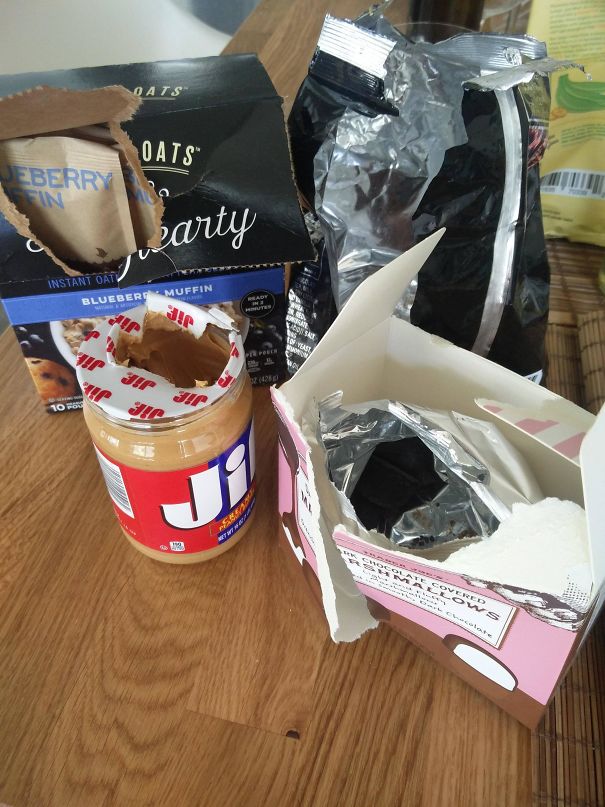
    If you like things tidy, living with other people is hard. You have to maneuver through their dirty clothes, go on a scavenger hunt every time you need a clean plate, and work part-time as a garbage collector. But if you’re unlucky enough, you might move in with an individual that’s impossible to live with. No matter if you’re high-maintenance or chill as a goldfish. The Internet calls these creatures ‘monsters’. And rightfully so. Who else could keep a potato in their cupboard so long that it starts sprouting? Or leave so much hair on the wall of a shower that you could make a wig out of it? Bored Panda has compiled a list of pictures that show what it’s like to live with a monster so scroll down, check out their insane living habits, and upvote your (least) favorite ones!

    more