Look, there’s no getting around the fact that purchasing an espresso machine for your kitchen is a luxury. While it’s far from an essential kitchen appliance, if you’re addicted to espresso drinks, it sure is nice to be equipped with the gear to make a cappuccino, latte, or velvety smooth shot at home.
If you’re ready to pull the trigger on buying an espresso machine, be prepared to shell out a little cash. Espresso machines can be wildly expensive. Rightfully so. Pulling a perfect shot requires precision: The machine must maintain both precise temperature and stable pressure throughout the brewing process. Achieving this stability is difficult and requires complex machinery, which is why you can find machines for upwards of $5,000.
We wanted to find the best espresso machine available to home brewers for less than $1,000. At this comparatively low price point, we hoped to find a machine that could pull a shot that—if not as high-quality as one served at a prized Italian cafe or as high-dollar as a Brooklyn coffee shop’s—would have nuanced flavor, the right amount of brightness and acidity, and very little bitterness.
It turns out, this is possible. In 2018, we tested 12 countertop models and found an espresso machine worth paying for. To see if our 2018 winner held up, we added a few more models in 2019 and retested. Keep reading for the best espresso machines of 2019; to see the contenders and find out how we tested, scroll to the bottom of the page.
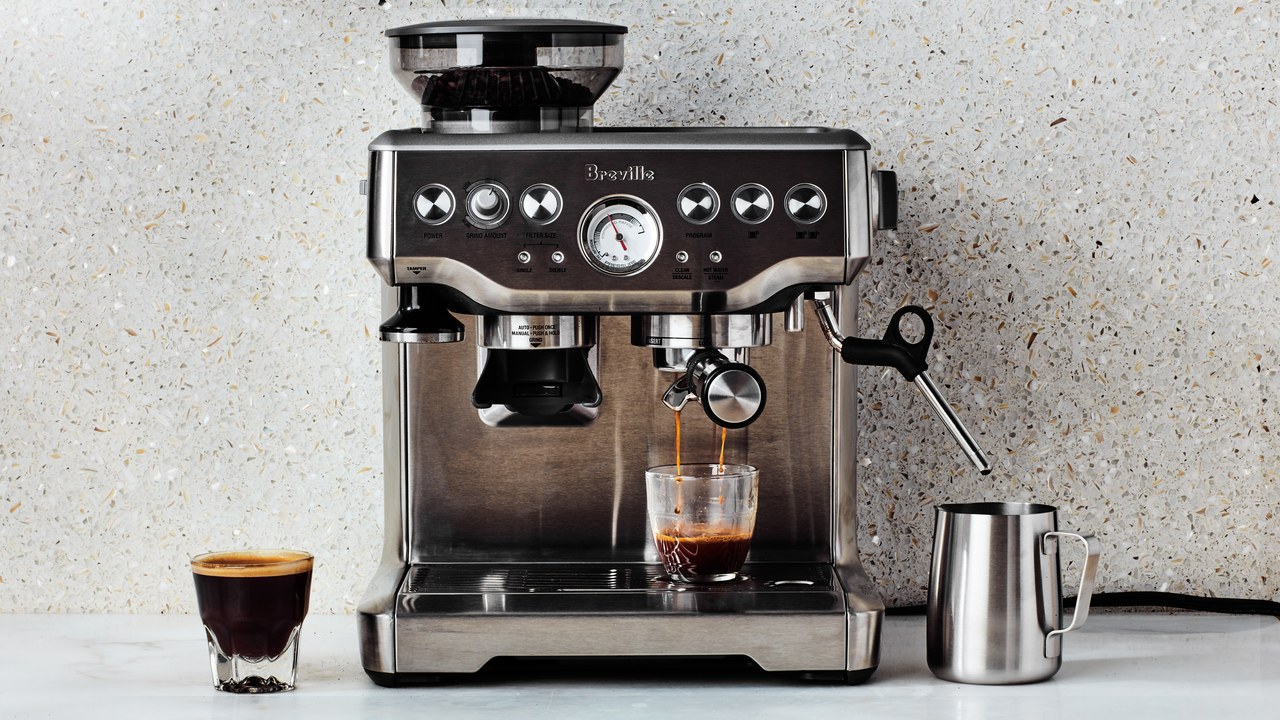
The Best Semi-Automatic Espresso Machine: Breville Barista Express
This was the number one choice in 2018’s test and it remains the winner. From the construction to ease of use, it’s clear that the Breville Barista Express was thoughtfully made, and there was no competition when it came to the final quality of the espresso shot.
The highlight of the Breville Barista Express is a pressure meter that allows you to accurately assess the quality of the coffee as you make it, just like on a professional espresso machine. This is extremely valuable because it helps you figure out what other variables need to be tweaked to make a better cup. For example, if the pressure is too low while you’re pulling a shot, you can tamp with more pressure or use a finer grind the next time. None of the other machines we tested had a feature like this, meaning that if you pull a shot that doesn’t taste great, you have no way of knowing if it’s the machine or you.
As long as you’re pulling shots within the right range of pressure, the Breville espresso maker produces full-flavored, densely textured shots that were the closest to what you might get in a cafe. The concentration compared to other machines was unrivaled, and the crema was dark and varied—or tiger striped, as coffee connoisseurs would call it. Other machines produced shots with a uniformly white or tan crema that could be dense but was rarely flavorful.
The Breville was also the only semi-automatic machine to produce a velvety, well-incorporated milk foam. The consistency with which it incorporated air made for a beautifully textured latte—and our coffee expert was even able to make some latte art with it (something that was impossible with the air bubbles from other models, including the Gaggia and all of the less expensive machines).
Finally, the design and extra tools are impeccable. The machine includes a large drip tray to catch spilled coffee and milk and has a sensor that lets you know when the tray is too full. It also has a compartment underneath for storing extra filters (which are included). It includes hefty, stainless steel milk steaming jug and a tamper for pressing the espresso grounds down.
The Best Automatic Espresso Machine: Espressione Concierge
The Espressione Concierge replaces last year’s winner in the automatic category, the Jura Ena Micro 1, which is just as fast and easy to use. The Espressione has a handily removable water tank, light-up buttons, and built-in burr grinder. Most importantly, it had a clear advantage when it came to taste.
None of the automatic machines we tested could produce a shot that came close texturally or flavor-wise to a semi-automatic, but the coffee from the Jura machine was downright watery. Even when selecting the Jura’s stronger brew option, compared side-by-side, the Espressione Concierge pulled better tasting shots that were closer to the full flavor and body of real espresso.
The Jura Ena Micro 1 is a slightly more attractive machine with its seamless black finish, but it also measures about an inch wider and longer than the Espressione, if space is a concern. Additionally, the Espressione comes with a milk frother while the Jura does not, which can be a deal-breaker for some shoppers.
The Espressione produces a seemingly effortless single, double, or lungo coffee within a few minutes of powering up, exactly what you want in an automatic machine.
How We Tested & Other Models We Tried
We tested several machines by making shots of espresso and lattes on each. For our 2018 test, we enlisted the help of an expert from Students of Coffee, a group of coffee educators and roasters at New York University, to judge for quality. For the 2019 update, we had Tammie Teclemariam, a former barista who’s interned at Annapolis’ Ceremony Coffee, cross-test last year’s winners against the new contenders.
The majority of the models we tested were semi-automatic, meaning brewers still have to grind the coffee and pack it in the portafilter (the little filter cup with a wand that you place in the front of the machine). Semi-automatic espresso machines heat the water for you, and then pump it through the grounds at varying levels of pressure, depending on the machine. The semi-automatic models we tested were:
We also tested three fully automatic varieties of espresso maker. For these, you insert the beans into a grinder, then press a button for the machine to grind and make your shot.
Since semi-automatic espresso makers require you to dose the coffee yourself, grind and pack it, they give you more control. You can tinker and master the art of making espresso. Fully automatic machines are a good option for someone who wants quality espresso at home but wants to put in less effort (and skill). That said, a semi-automatic machine will yield a better cup.
Factors We Evaluated
1. How well do the machine control temperature and pressure?
For semi-automatic machines, water pressure and temperature must be stable and consistent, and the pressure shouldn’t be too high. Typically, coffee is brewed at a pressure of about 10 bars, and the ideal water temperature is around 195°F. Generally, the more expensive the machine, the better the equipment inside that regulates these two factors. High-quality machines tend to have a mechanism called a PID, or proportional-integral-derivative, controller. The PID’s function is to maintain constant water temperature with extreme accuracy, down to the degree. A central problem plaguing inexpensive espresso machines is that they lack a PID, meaning the temperature of the brewing water can fluctuate up and down and yield inconsistent results. Inexpensive machines often advertise that they have 15 or 20 bars of pressure as a selling point, but higher pressure is not the priority, and too much pressure can actually lead to over-extraction and bitterness in your espresso shot. Therefore, we looked for a machine with good temperature and pressure control.
2. How well did the steamer wand incorporate air?
Most of the espresso machines we tested only included a single boiler for heating. This means that there’s only one mechanism for heating both the water for brewing and the steamer wand. Because of this, it’ll take the steamer wand a while to heat up after pulling the espresso shot, since the steamer wand operates at a much higher temperature than the brewing temperature of around 195°F. It is possible to buy a home machine with a double boiler (Breville makes one) but this raises the price significantly (we didn’t test that Breville because it’s over $1,000), and the minor wait time wasn’t a major concern for us. We figured it wouldn’t be for home brewers either.



 The organizer will hold all of your serving essentials, including sugar, cups, stirrers, napkins, creamers and even K-Cups