Author: Truth & Hammer

  • Geologist Accuses Apple of Political Bias in Removing App Countering Climate Alarmism

    Geologist Accuses Apple of Political Bias in Removing App Countering Climate Alarmism

    Political figures who support the so-called Green New Deal and other proposals to restrict carbon dioxide emissions are up against some “inconvenient facts” that Americans may access immediately through a smartphone application, a geologist and author say.

    But there’s one big problem.

    The app, called Inconvenient Facts, is available only to Android users through the Google Play Store. Since March 4, users of Apple’s iPhone no longer can access the app through the tech giant’s App Store.

    Why is that?

    The liberal Left continue to push their radical agenda against American values. The good news is there is a solution. Find out more >>

    Gregory Wrightstone, a geologist with more than three decades of experience, told The Daily Signal in an interview that he has his own opinion about what may have transpired inside Apple.

    Wrightstone is the author of the book “Inconvenient Facts: The Science That Al Gore Doesn’t Want You to Know,” which served as the basis for the information available from the app.

    He notes that former Vice President Al Gore, a leading proponent of the view that mankind’s activities propel dangerous climate change, is a board member of Apple.

    “It’s very rare for an app to be approved and then taken down unless there is offensive material or some other extreme issue,” Wrightstone said of Apple’s action in a phone interview with The Daily Signal, adding:

    We thought at first it may have been our fault. But I did a search on climate change and global warming in the Apple App Store and pulled up a whole bevy of pro-man-made global warming apps that are really bad. They are not formatted, they have incorrect spellings and no links.

    But I suppose they have the political narrative right. Compared to these, our app is the gold standard. I made sure we had charts and links and references to the source for our data. This is all right in the palm of your hand.

    A total of 60 facts in Wrightstone’s book are available through the Inconvenient Facts app to Android users. Complete with data, charts, and videos, they challenge the premise of alarmist theories about climate change that link man-made emissions to dangerous levels of global warming.

    Gore’s ongoing campaign to convince the public that rising levels of carbon dioxide emissions could trigger catastrophic global warming was the subject of the 2006 documentary “An Inconvenient Truth” and the 2017 follow-up, “An Inconvenient Sequel: Truth to Power.”

    Before reversing itself March 4, Apple initially approved the Inconvenient Facts app for sale Feb. 3. Since that time, the app has been downloaded 13,000 times, according to figures Wrightstone provided.

    He also points out that the app has earned positive reviews.

    “A key takeaway here is that Apple has a monopoly over iPhone apps and the Apple App Store is the only place to get them,” Wrightstone said. “It appears that Apple has chosen to weaponize its control over purchasing apps to stifle science that doesn’t conform to its politically correct notions.”

    The Daily Signal sought comment from Apple’s media relations office by phone and email, asking whether the company would address Wrightstone’s allegations of political bias. Apple had not responded by publication time.

    The Daily Signal also sent inquiries to Delaware-based Carthage Group LLC, with which Gore is associated, and to the Climate Reality Project, which Gore founded, seeking his comment for this article. Neither organization had responded by publication time.

    Users who tap on the Inconvenient Facts app have access to images and data that run counter to much of what was presented in Gore’s documentary films. Some examples:

    Inconvenient Fact No. 53: “There are more polar bears now than we’ve had for 50 years.”

    Inconvenient Fact No. 10 cites a “Recent Inconvenient Pause of 18 years in warming, despite rising in CO2.”

    Inconvenient Fact No. 12: “Modern warming began long before SUVs or coal-fired plants.”

    — Inconvenient Fact No. 21: “The current warming trend is neither unusual nor unprecedented.”

    The Cornwall Alliance for the Stewardship of Creation, a Christian public policy group that favors free-market approaches to environmental policy, published a commentary Friday that is critical of Apple. It concludes that the company’s decision to reject the Inconvenient Facts app “smacks of censorship.”

    The study of geology provides important insights into the study of climate change because it considers short-term trends within the larger context of Earth’s history, Wrightstone told The Daily Signal.

    “Geologists are probably the most skeptical of all the sciences concerning a man-made link to temperature changes,” the geologist said, adding of carbon dioxide:

    Just to be clear, I don’t, and my colleagues don’t, dispute that CO2 is increasing, and I agree that it has to have some slight warming effect on the atmosphere. But I argue that it’s modest and overwhelmed by the same natural forces that have been driving temperatures since the dawn of time. …

    Looking out across Earth’s history, CO2 levels are extremely low. I always argue we are actually CO2 impoverished.

    Information about Wrightstone’s book and the Inconvenient Facts app may be found here as well as on YouTube and Facebook.

  • The Amazing Health Benefits of Nettle

    The Amazing Health Benefits of Nettle

    health benefits nettle teaWe have March – we drink nettle! As Paul Pitchford wrote, “Wild vegetables give us a lot of strength and vitality, especially when we collect them ourselves.”

    There is a lot of truth in this, because the movement in the open air is the basis of health. That’s why we take gloves and run to forests, parks and gardens for fresh nettle.

    March is the best time to harvest. We can remove it and then drink it in the form of infusions, use as a hair rinse. But later, in spring, I encourage you to drink freshly squeezed nettle juice.

    Nettle has a protective effect on the mucous membranes of the body due to the high content of beta-carotene (provitamin A). The chlorophyll contained in the cut inhibits the development of viruses and allows the lungs to expel the remains of chemical vapors, coal dust, tobacco smoke – something that is in effect after the heating season.

    If you’re looking to improve your health, nettle is a fantastic herb to incorporate into your overall nutritional plan. Let’s take a closer look at the health benefits of nettle.

    Nettle Health Benefits: Nature’s Powerhouse Herb

    Nettle is packed with nutrients and offers many beneficial health properties including:

    Nettle is also…

    Chock-full of Minerals

    Nettle is packed with minerals, especially magnesium and calcium. Studies have shown that nettle has more calcium, magnesium, potassium, boron, phosphorus, and strontium than other popular herbs including peppermint, sage, and even chamomile.

    Packed With Beta Carotene

    Also due to the content of beta-carotene, the nettle has a protective effect on the lungs and large intestine. And as we know, the large intestine is our body management center (to pair with the brain).

    A Gentle Diuretic

    It works as a gentle diuretic and improves the functioning of the kidneys, so it is good to get rid of excess water from the body. It has beneficial effects on the kidneys, urinary bladder and urinary tract, and thanks to chlorophyll for hair growth and blood reconstruction, which is important for people with anemia or, for example, those with celiac disease.

    Vitamin B9 Rich

    Nettle juice is a very good way to deliver folic acid to the body, which we often lose while cooking green vegetables. And folic acid, together with iron, copper and vitamin K – nettle ingredients – are involved in the formation of red blood cells and hemoglobin, that is, improves the quality of blood.

    Full of Antioxidants

    Nettle contains a lot of antioxidants in the form of vitamins C, E, folic acid or beta-carotene, which deal with these free radicals, responsible for the aging of the body and the formation of diseases.Therefore, it helps to keep our body young.

    The Bottom Line

    The health benefits of nettle are many. Nettle is packed with minerals, folic acid, antioxidants, and other key nutrients. There’s a reason nettle has been a stable among herbalists for centuries.

    Stinging nettle grows wild in temperate regions globally so the usage of nettle as a nutritive herb is widespread too. This means getting a hold of some is as simple as buying nettle tea at your local grocery store or visiting your local herbalist.

    If you’re looking to improve your health, try some nettle tea today for some easy and refreshing nourishment!

  • Early Spring Garden Tips – Get Your Garden Ready for Spring

    Early Spring Garden Tips – Get Your Garden Ready for Spring

    The warm weather is right around the corner. That means it is time to start thinking about ways to get your garden ready with these spring garden tips. Whether you are interested in vegetable gardening or just love to grow flowers, these tips will be helpful

    Many areas of the country are still under a blanket of snow, but it won’t be long before most of us will be doing things to get our garden ready for spring.  Here in NC, depending on how late our winter lasts, that time is almost here!  

    Even though most areas of the country are slowly warming, it’s also true that most plants are still dormant.  (I am delighted to see my early bulbs peeking through though.  It won’t be long before my daffodils, hyacinths and tulips will be blooming.)Spring gardening

    Even though most plants are still dormant, there are a lot of ways that you can plan ahead and prepare your garden for spring.  

    The Gardening Cook is a participant in the Amazon Affiliate Program. This post may contain affiliate links. I earn a small commission, at no extra cost to you if you purchase through an affiliate link.

    These spring garden tips will help you get ready for the warm weather.

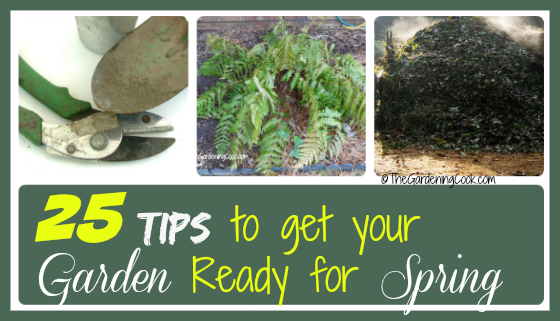
    I have included a list of my top list of 25 things that you can do to ensure that your garden will be ready when the plants start to grow. Lets start with a good look around the garden!

    Give the Garden a General Inspection

    Most garden beds suffer from the heavy rains of winter and need some TLC.  Check my tips for preparing spring flower beds here.

    Inspecting the garden is probably the most important step and you should not skip it.  Most of us are eager to get out and actually do something in the garden after a long winter, but taking stock of what has happened over the winter is so important.

    It also gives us a to do list and makes sure that the garden gets started on the right foot.

    Check your Fences and trellises.  Have they started to break or splinter from the moisture? Now is the time to mend them.

    Look over your Raised Beds.  If you use raised garden beds, it is important to check the sides. Are they bowing?  Are the joints coming apart? If so, fix them now. Raised garden beds are easy on the back

    There is no point in planting in something that will start coming apart mid season. Raised garden beds don’t have to just be wood, either.  See how I recycled recently to make a cement blocks raised garden bed.

    Do you have Winter weeds?  No matter how well you weeded before the winter set in, there will still likely be weeds out there.  Take stock.

    Will you need a tiller to get them up, or will a hoe do?  That means you may need to borrow or rent a machine.  Some beds can do with just a light till and for others you may will need to borrow or rent a rototiller. 

    This patch of irises is full of a weed that propagates with under ground runners. I’ll need to dig up the whole patch and till this area of the garden bed or the whole bed will be full of these weeds this summer!weedy garden beds

    Check over your Garden Furniture.  Now is the time to inspect your outdoor furniture too.  Will anything need replacing? 

    If you notice it now, you can be on the lookout for upcoming sales, rather than waiting till mid season when prices are the highest.

    Check out your Potting Shed

    Look over your potting area.  Do you have a potting table? If not, drag out a sturdy table from the attic and put it to use.  Check over your pots.

    Sterilize those pots that need it. Clean your clay pots if you did not do it in the fall.  Get potting soil, fertilizers (if you use them) and other soil additives now so that they will be on hand when you need them.dirty flower pots

    Inspect your lawn edging. 

    Now is a good time to get the edges of your garden beds ready.  It will make sure that the weeds won’t start growing into the beds once the lawn starts growing and will save you one job later in the spring, when all you will really want to do is to get into the bed and dig.

    Last summer, I cut back one of my large garden beds and just laid a row of bricks around the outside of it to keep the weeds out. This spring, I’ll dig the trench and lay the bricks properly to give this bed a nice edge. 

    Working on this project now will be easier than waiting until the hot days of summer hit!bricks for a garden bed edge

    Check Bird Feeders and Bird baths 

    Give your bird bath a good cleaning.   Clean out bird houses and put in fresh feed and bedding for your feathered friends. 

    Give your hummingbird feeder a good cleaning.  Make a stock of hummingbird nectar to use when the weather warms up and the hummers arrive.clean your birdbath in early spring

    Give planters and pots a good inspection in spring

    Not all gardening in done in soil in the ground.  An important tip to get your garden ready for spring is to check over your containers.

    Take stock of your patio planters. Dig out the weeds, inspect them for cracks, and refresh the soil for new plantings.

    It’s a good idea to replenish the soil in planters each spring. Plants will deplete the soil of nutrients, so adding fresh soil will give your potted plants a good start.

    Spring Garden Tips for Plants

    We have just started on these spring garden tips. Now on to the meat of the garden – plants, trees, shrubs and more.  It’s not enough to just inspect the plants to see what is what. It’s important to give them some TLC as well.

    Plant inspection in early spring

    Winter is hard on a garden. The soil is wet and compacted and the harsh weather takes its toll on the plants.  Time to see what needs some work.

    Inspect all the plants, shrubs and trees to see what has been damaged and make notes of jobs to do to repair this.

    Clean up Perennials

    Once the soil is sufficiently dry, it’s time to start the clean up of your perennial plants.    These plants come back year after year but often need to be tended to in the spring. What you will need to do depends on the type of perennial in question.

    Prune the crowns For most perennials, if you did not prune your perennials in the fall, do so now. Cut back the old and dead foliage close to the top of the crown and mulch around it but not too close to the crown.foxglove perennial

    This foxglove plant was grown from seed last year and has made a nice mound.  It was evergreen all winter but the cold has damages a lot of the outer leaves.  A good clean up is all it needs.

    Discard dead perennials. Remove any dead plants and add them to the compost pile.  If they really are dead, they won’t grow back.  Signs of a dead perennial is a rotten root ball or crown. There should be some sign of life in the center of the crown.

    Pruning woody perennials. Some perennials with woody stems actually prefer pruning in the spring.  Examples of perennials that like to be pruned in the spring are:

    Evergreen perennial care. Evergreen perennials don’t really go dormant in some areas of the country.  But they may still need trimming now.

    Examples of evergreen perennials are hellebore and coral bells and also some of my  ferns. For me, these are green right through the winter but still look scraggly in the spring, so they need a touch up in early spring.

    All of my hellebores are flowering right now and are gorgeous but the foliage really needs trimming. See my tips for pruning hellebores here.

    Check your roses. Early spring is a good time for pruning roses. Do this before the leaf buds open. This will allow the plant to send it’s energy into the new growth.

    Cut back grassy plants. Grasses often are left for winter interest.  My Japanese silver grass has interest all winter long, but in early spring, I give it a good hair cut to encourage it to grow again and to tidy it up.

    This means cutting all of the dead leaves and grassy tops right back to just above the crown.  The grasses will love this and will send out new growth soon.

    Last year we divided some Japanese Silver grass plants and added the divisions along a fence line to hide the fence. The birds loved the seed heads in the winter.Japanese silver grass needs to be cut back in early spring.

    They have grown beautifully but will need to be cut right back this year to allow the new growth to flourish.

    You can also divide overgrown grass plants at the same time. They can easily take over a spot of you don’t divide them every few years. Spring is a good time to do this.

    Prune trees and shrubs

    Look over your small trees and shrubs to see what needs early pruning.  Doing so will help to maintain good form for them, and will result in vigorous growth when the growing season really gets going.

    Be sure to get information of which shrubs and trees like pruning later in the year.  Some benefit from early pruning and others like to be pruned after flowering. The best time to prune depends on when they set flower buds.

    Some shrubs that enjoy early spring pruning are:

    Be sure to check out my pruning tips here.

    Divide plants in spring

    Check to see if perennials have outgrown their spots. Early spring is the time to divide over grown perennials.  Give some to your gardening friends or plant the divisions in other areas of your garden. 

    Transplant plants that are just too big for the garden bed they are in now.  Last year, I had to transplant almost everything in one garden bed because I miscalculated how closely to put the plants when I first planted the bed.

    Crowded perennials just don’t grow well and really benefit from division.  If you divide and transplant early in the spring, they won’t be set back as much as if you do it later in the summer.

    Photo credit Wikimedia commons

    Spring garden tips for tools

    Spring is a good time to check over your tools.  Some may have seen there better days and need replacing. Hopefully, you gave them some care before you put them away in the fall. Put these spring garden tips for tools in place to give you a good foundation for your work.

    Examine your Tools. 

    Did you winterize your tools last fall?  If you did, then lucky you!  All you need is to check them over and maybe do a light oiling and gather them so they are ready.  If not, you have a few things to do to get them ready!

    Check garden tools in spring

    Treat yourself to a new tool

    Each year, I treat myself to one new piece of garden equipment or a new tool. 

    There is no way that I can buy afford to buy everything I need all at once.  I purchased the most necessary ones first, and then gradually, each year, I have added something new.

    A few years ago, it was a nice, good quality, pitch fork for my compost bin. Last year, I was lucky enough that one of my sponsors sent me an expandable gorilla hose with brass fittings to try out and review. 

    I have wanted one for years but just never managed to put the money aside for it.  I hate the sight of hoses all over my yard, and having to move them each time my husband mows the lawn. With the new expandable hose, that will be a thing of the past. 

    The hose is a full 150 feet in length and expands in use and contracts when not.  It has really well made brass fittings, as well as a shut off valve on one end.  I am delighted to have this baby.

    Photo credit Gorilla Hose on Amazon

    General garden tips for early spring

    Once you have inspected everything and tidied up in the garden, get ready for the new growth by putting these tips into practice.

    Don’t forget the mulch.

    Once the winter weeds are gone and the perennials are tidied up, lay down some mulch.  There are so many reasons to mulch:

    Mulched garden bedStake plants

    Figure out which perennials will need staking and get the stakes inserted.  It is so much easier to put a plant stake in before you need it, than to have to deal with all the massive growth, when staking is overdue. 

    Sure, it’ll look a bit like your garden has big toothpicks in it for a while, but you will be glad you did it when they start growing.

    Soil and Composting Tips for Spring Gardens

    The soil is the medium that gives your plants their nourishment. It pays to make sure that it is in good shape.

    Start with the soil

    Inspect your soil.  To really get your garden ready for spring, start with the soil. One of the biggest mistakes that inexperienced gardeners make is to start planting and working the soil too early. 

    Months of snow and rain make for a very wet and compacted soil.  If you work it now, it can get more compacted from treading on it, and from heavy machinery.  Pick up a ball of soil.  If it stays compacted in a ball, it is too early to work it. 

    The soil should break apart easily, not stay in a firm ball.  If you have not done so, test your soil with a soil testing kit to make sure you get off to a good start.

    Test your soil. 

    Knowing the balance of nutrients in your soil and the PH balance is important.  It helps later if you need to diagnose plant problems and gives you an idea of the type of fertilizing that you’ll need to take care of yourself.soil testing

    It is a good idea to take a PH test of your soil each year, so you will know if you need to add anything to it.  If you do, get those supplies ready. For already healthy soil, just adding compost may be all that you will need.  

    The Compost Pile. 

    A compost pile is a collection of garden waste and organic kitchen refuse that will decompose slowing to produce compost or humus. This can be used as a great source of soil enhancement and fertilizer. You would be surprised at how many common items that you can add to a compost pile.

    It is important to Inspect not just your garden beds, but your compost pile too. Turn the compost pile regularly. Check for things that are diseased and remove those and also any seed heads that you may find. 

    You won’t want to be adding compost with weed seeds in it to freshly weeded soil! Be sure to also check out my list of things to never compost.

    Photo credit Wikimedia commons

    Starting a compost pile

    If you do not already compost, what are you waiting for?  The rich earthy compost is black gold to experienced gardeners.  Find a level area of your garden and start your compost pile there. 

    You don’t even need a fancy compost bin.  If you have about 10 feet free, you can use a rolling compost pile.   I have had more success from this method than from any compost bin that I have used.

    Spring is the time to fertilize

    Once you have tested your soil to know what condition it is, get out the fertilizer or compost.  Most plants like to be fertilized early in the spring when they are having their initial growth spurt. 

    I use a handful of compost in every hole that I dig for a new plant. It’s a great habit to get into. If you don’t have a compost pile, your soil test will give you an idea of the fertilizer to buy.

    A garden planner is a big help to get your garden ready for spring.

    Do you intend to make changes to your garden this year? Did some things work well where they are and some languish? Get out that garden planner and sketch your garden the way you would like it to be.

    Check the times that your plants took to flower last year. See when your last frost will be so that you know when you can start. A garden planner is invaluable. 

    I planned my combination perennial/vegetable garden bed last year before I ever dug one hole and I am so glad I did. I had a concrete idea of how it would turn out before I ever started digging.Plan your garden

    Plan for new flowers

    I try to add several new plants each year.  Last year, it was a Hellebore

    I was determined to have something that would flower in the winter time and I am so glad I planned ahead for it.  We had snow during the last few weeks and this beauty was still blooming. What a delight!  What will you add to your garden this year?Hellebore in flower

    Go Native

    Spend some time learning about the plants that are native to your area and consider planting these.  Your water bill will thank you and you will be planting things that will have a good likelihood of success.

    Native plants are well adapted to local conditions. They require far less water and this saves both time and money.  Also, native plants will encourage local wildlife to visit your yard

    Add a new garden bed.

    The soil in early spring is easy to dig since it has had plenty of moisture.  Weeds will come out easily and you can add a pre-emergent weed deterrent at the same time.

    If you have the room, and the ambition, dig up a new garden bed, or get together a lasagna bed for planting later in the year. You can add garden refuse to it as the season progresses. If you start it early enough, you’ll be able to plant in it in summer.

    Tips for starting seeds in spring

    One of the best ways to save money on your garden is to start as much as you can from seed.  You’ll get dozens of plants for less than the price of one perennial!

    Time to order seeds.

    Order your seeds now.  One of every gardener’s favorite things to do each year is to look through the gardening magazines that are starting to arrive.

    Place your order for seeds

    now so that you will have the seeds when it is time to actually plant them.seed catalogs


    Seed Planting Tips

    Containers for Seed Planting. Don’t wait until it is time to plant seeds before you think about containers.  If you don’t have a supply of pots for them, start saving household items to use for planting seeds indoors to give them a head start.

    In addition to retail plant starters, some inexpensive and good containers are items that you have around the home.  Some ideas are:

    egg shells and egg cartons make great seed starting pots

    If you do have pots on hand, be sure to disinfect them so that they will be ready when it is time for you to plant the seeds.

    Order seed labels

    If you plan to have a lot of plants that start from seeds, gather some plant labels so that you’ll know what you have planted. 

    You can purchase plant labels online or make use of house hold items like popsicle sticks and firm plastic cut into strips.

    Spring Garden Tips for lawns

    When you are working to get your garden ready for spring, don’t forget the lawns. Raking your lawns will get rid of winter debris. 

    It will also help to aerate the soil to insure that air gets to the root zone and will get your lawn off to a good start.  Inspect the lawn while you are doing this to see if you need to reseed some areas, or aerate more fully.

    If you have dead patches, now is a good time to reseed or add more sod to fill them in.

    Spring Garden Tips for Vegetables

    A vegetable garden is one of the true pleasures of a spring garden.  Here in NC, the summers are so warm that I need to make sure my vegetables are planted and ready to grow in spring to get the best harvests.

    Cold Weather Vegetables  

    If you plan to plant vegetables, be sure to consider how much cold they can take. These cold hardy vegetables are a good choice for early spring planting, since they can really take the cold.

    Get early spring vegetables in the ground as soon as the soil can be worked.  

    Plan for crop rotation

    Planting the same vegetables in the same spot each year encourages diseases to flourish.  Take the time to plan for some crop rotation.

    Crop rotation allows you to decide where to plant each vegetable from one year to the next.  This will help manage soil fertility and reduce problems from air borne diseases and soil dwelling insects.

    Add Supports for Vegetables

    Tall vegetables, such as climbing beans and peas also need supports. Get the supports in early and when you plant the seeds, you will know that the supports will be there for them when they start growing. 

    This handy teepee supported my climbing beans the last few years.  I left it in place and just need to move it when I rotate my crops this year.   See how to make this bean teepee here.bean teepee

    What other things do you do to get your garden ready for spring?  I’d love to hear your thoughts.  Please leave them in the comment section below.

    Pin it for later

    Would you like a reminder of these early spring garden tips?  Just pin this image to one of your gardening Boards on Pinterest so that you can easily find it later.These early spring garden tips will make sure that your garden gets off to a good start this year.

    You can also print out the Spring Gardening Check List in the project card below.

    Admin note: This post first appeared on the blog in March of 2015. I have update the post with new information, all new photos, a spring garden check list for you to print out and a video for you to enjoy.

    Yield: Use this check list to get your garden ready for spring.

    Spring Gardening Check List

    Spring Gardening Check List

    Spring is right around the corner. Winter can play havoc with a garden. This check list will get your garden off to a good start.
    Active Time 2 hours

    Tools

    GENERAL INSPECTION. LOOK OVER THESE ITEMS FOR DAMAGE

    SOIL TIPS:

    LAWN CARE:


    VEGETABLE TIPS

    As an Amazon Associate and member of other affiliate programs, I earn from qualifying purchases.

    Project Type: How To / Category: Gardening Tips

    Disclosure of Material Connection: Some of the links in the post above are “affiliate links.” This means if you click on the link and purchase the item, I will receive a small commission from the sale, but the price is the same for you. I am disclosing this in accordance with the Federal Trade Commission’s 16 CFR, Part 255: “Guides Concerning the Use of Endorsements and Testimonials in Advertising.”


  • What is a genetically-engineered CRISPR baby?

    What is a genetically-engineered CRISPR baby?

    Following is a transcript of the video.

    In 2011, scientists created glow-in-the-dark cats. The researchers took a gene from a glowing jellyfish and inserted it into the unfertilized eggs of house cats. It was a neat trick, but they had a bigger goal in mind. They also made the cats more likely to be resistant to a feline form of AIDS by, again, manipulating their DNA. And cats aren’t that different than humans. In fact, we share around 90 percent of our DNA with them.

    So why can’t we engineer humans in the same way? Well, we can — engineer ourselves to be resistant to life-threatening illnesses, that is. In fact, one scientist claims that he’s genetically engineered two babies using a revolutionary tool called CRISPR. But what exactly is a CRISPR baby, anyway?

    Would you like to be six feet tall? Or never bald? The secret to traits like these lies in the six billion letters of your genetic code. But there can be something else in there as well. Mutations. Genetic mutations are linked to at least 6,000 medical conditions, from sickle cell anemia to Huntington’s disease. But what if you could make those mutations simply disappear? That’s where the gene-editing tool CRISPR comes in.

    CRISPR is made from specialized proteins and other compounds found in certain bacteria. Normally, these proteins protect the bacteria by destroying enemy invaders like viruses, but the inventors of CRISPR figured out how to turn those proteins against genetic mutations and other genes linked to disease.

    First, they give the proteins coordinates of the wanted gene. Then, CRISPR runs a seek-and-destroy function. After that, other molecules are dispatched to repair the gene with new, healthy DNA. And just like that, you can edit the human genome.

    But while edits may be quick, their changes can last for centuries. Especially if you’re editing the DNA in an embryo. Embryos start out with a single cell that eventually replicates into millions and then trillions more. So, if you alter that initial cell first, you’re manipulating the ingredients for every cell that follows later in life, and those same altered cells can be passed on from generation to generation. That’s one reason why most experiments on human embryos haven’t left the lab.

    That is, except for the work of Dr. He Jiankui. He claims to have used CRISPR to target and knock out the CCR5 gene in human embryos, which is linked to HIV infection. And then he did something that shocked the scientific community. He implanted the embryos into several women, one of whom gave birth to genetically modified twins. Resistance to HIV aside, most scientists say that the procedure was too risky. At least two studies suggest that edited cells might actually trigger cancer. And another found that CRISPR can accidentally take aim at healthy DNA.

    So, while CRISPR could make us immune to disease, who knows what else we might get on the side?

    Source

    https://www.businessinsider.com/genetically-engineered-crispr-baby-dna-chinese-scientist-2019-2

  • Pro-Lifers Win Legal Battle Over ‘ME,’ ‘ME, AGAIN,’ ‘STILL ME’ Bus Ad

    Pro-Lifers Win Legal Battle Over ‘ME,’ ‘ME, AGAIN,’ ‘STILL ME’ Bus Ad

    A government-run public transportation company in Lafayette, Indiana is reversing course, allowing pro-life ads to be displayed on the side of buses.

    After facing litigation from the Alliance Defending Freedom, CityBus has agreed to allow Tippecanoe County Right to Life to run its classy ad showing the humanity of unborn children.

    The ad in question featured two ultrasound images of an unborn child, and a third showing a newborn wrapped in a blanket. Superimposed over the photos are the words “ME,” “ME, AGAIN,” and “STILL ME.”

    Tippecanoe County Right to Life is a non-profit organization with a mission “to protect the right to life through positive education and compassionate advocacy.”

    ADF says CityBus has now revised its advertising policy and will no longer reject the ad. As part of a legal settlement, CityBus has also agreed to pay attorneys’ fees and damages.

    CityBus denied Tippecanoe County Right to Life’s ad in the past because it determined the ad publicized a “political viewpoint” that was not in compliance with its advertising policy.

    The 2017 lawsuit against CityBus contended “it is critical to educate the public about the humanity of unborn children and the harms of abortion.” It also claimed the nonprofit believes “one reason abortion is permitted in America is that many people do not understand the scientific truth about the humanity of unborn children.”

    “It’s a scientific fact that unborn babies are just as human as the newborn babies we cherish, and Tippecanoe County Right to Life’s ad shares that truth in a compelling way,” said Alliance Defending Freedom Legal Counsel Samuel Green.

    “We are thankful that CityBus is now allowing this educational message to reach people as they study, shop, and commute. The First Amendment protects freedom of speech for all people, regardless of their beliefs or their viewpoint,” Green continued.

    After attorneys filed Tippecanoe County Right to Life v. Greater Lafayette Public Transportation Corporation in the US District Court for the Northern District of Indiana, CityBus agreed to a contract for Tippecanoe County Right to Life to run its advertisement for up to 16 months and amended its advertising policy, ADF reported.

    source


  • Tax Credit For The Elderly Or Disabled: Are You Eligible for This Tax Credit?

    Tax Credit For The Elderly Or Disabled: Are You Eligible for This Tax Credit?

    If you are over age 65 or are retired due to a disability, you may be eligible for a separate tax credit designed to help the nation’s seniors and disabled. Even better than a deduction, the Senior Tax Credit for the Elderly and Disabled could take up to $7,500 directly off of your tax bill. (Deductions can only reduce your tax bill in proportion to your tax rate.)

    To qualify for the credit this year, you must meet two sets of criteria:

    Age/Disability Criteria – You are at least age 65 or meet these three conditions: you are retired due to a disability, accepted taxable disability income for the 2018 tax year, and had not reached the mandatory retirement age for your employer by January 1 of 2018.

    To be qualified under the disability criteria, you must have a signed statement from a physician certifying that you can’t “engage in gainful activity” because of a physical or mental condition. The same goes if the condition has either lasted for at least twelve months or is likely to do so, or that death is expected to result from the condition.

    Income Criteria – Your adjusted gross income (AGI) or your combination of non-taxable disability income, pension annuity income, and Social Security income falls below threshold limits listed in IRS Publication 524, “Credit for the Elderly or the Disabled“. Limits on AGI range from $12,500 to $25,000, while limits on the non-taxable income path range from $3,750 to $7,500.

    To calculate the credit, you must fill out Schedule R. IRS Publication 524 contains the instructions to help you fill out Schedule R and determine if you qualify for this tax credit.

    Schedule R contains three separate sections. In Part I, you select the box that corresponds to your filing status, age, and disability status. This box determines the starting amount of your credit – $3,750, $5,000, or $7,500. Part II is for those qualifying by disability instead of age, requiring a statement of permanent and total disability by a physician. Part III walks you through the series of adjustments to your credit based on your status and other income sources.

    Once the credit is calculated, enter the credit value in line 54 of Schedule 3, which should be attached to your Form 1040, and also attach your Schedule R to the tax form. Select box “c” on line 54 and write “Schedule R” in the adjacent blank. Note that the Senior Tax Credit for the Elderly and Disabled is a non-refundable credit, meaning that you can’t receive a credit larger than the remaining taxes that you owe even if you qualify for a larger credit.

    If you find the instructions overwhelming, the IRS can calculate your credit for you. Check the box in part I of Schedule R that applies to you. Next, fill out Part II (if applicable). Then include any relevant income in lines 11, 13a, and 13b of Part III. Finally, enter “CFE” in line 54 of Schedule 3.

    As an alternative, you can file your taxes electronically using tax software that will automatically calculate the tax credit for you. If you can’t afford tax software, consider using the IRS Free Filesystem for those with incomes below $66,000.

    If you think there’s a chance that you may qualify for the Senior Tax Credit for the Elderly and Disabled, take a few moments to review Publication 524 and see if you can save money on your taxes. Never overlook any opportunity to lower your tax bill.

    Failing to pay your taxes or a penalty you owe could negatively impact your credit score. You can check your credit score and read your credit report for free within minutes by joining MoneyTips.

    source

  • Pastors Knocked Out, Christians Killed as Persecution Spikes Dramatically in India

    Pastors Knocked Out, Christians Killed as Persecution Spikes Dramatically in India

    India is seeing a dramatic rise in persecution as more and more churches and Christians are coming under attack in 2019.

    The newest figures show cases of hate and violence against India’s minority Christians have jumped 57 percent in the first two months of this year.

    According to the Evangelical Fellowship of India, a total of 77 incidents were documented against Christians between January and February.

    Referring to two murder cases in two different Indian states in February,  EFI General Secretary Rev. Vijayesh Lal said, “We have reasons to believe that both men, who were in their 40s, were killed because of their faith.”

    “We have recorded cases where Christians have been facing a social boycott and have been excommunicated from their villages, and in a few instances have had to flee to save their lives,” Lal said.

    Morning Star News describes another incident that took place this year on Jan. 13 in Uttar Pradesh: “Police officers disrupted a Sunday worship service and arrested four women and two men, including the female pastor leading worship. At the police station, a female police officer physically assaulted the woman pastor, Sindhu Bharti, who fell unconscious.”

    “Boiling tea was forcibly thrust in her mouth because the police thought that she was feigning her unconsciousness,” an eyewitness, Madhu Bharati, told Morning Star News. “When that did not work, they poured two jugs of cold water on her face, not caring that it was already severely cold due to winter.”

    Christians were arrested and charged with intent to hurt religious feelings, defilement of a place of worship and rioting, among other charges. The intervention of Christian leaders resulted in police freeing the arrested female Christians, but the men were kept in custody.

    Violent attacks against Christians have steadily increased since a radical Hindu party took control of India’s government in 2014.

    Since then, Open Doors has ranked India as the tenth-worst country in the world for Christian persecution.

    source


  • Inside the Incredible Story Behind This Lifesize Replica of Noah’s Ark

    Inside the Incredible Story Behind This Lifesize Replica of Noah’s Ark

    The Ark Encounter, a life-sized Noah’s ark replica located in Williamstown, Kentucky, has made international headlines ever since it opened in 2016. A stunning architectural achievement, the ark brings a key biblical account to life in a truly unprecedented way.

    But while the structure is certainly intriguing, so is the personal history of its founder, Answers in Genesis CEO Ken Ham.

    Ham — who is set to host the PureFlix.com sponsored Answering Atheist conference this Easter at the Ark Encounter attraction — recently revealed his journey from his native Australia to the U.S., and how his innate passion for helping people understand the gospel led him with many others who came alongside to create the Ark Encounter as well as the popular Creation Museum located in Petersburg, Kentucky.

    “I had parents who believed God’s word — who stood on God’s word,” Ham recently told “The Pure Flix Insider,” noting that his father was “always looking at what the liberal critics were saying,” because he wanted to make sure he had well-thought-out answers.

    Despite growing up in Australia — a country Ham described as “very secular” — the apologist had an upbringing that was firmly rooted in the Christian gospel.

    “My father and mother would Teach us God’s word,” he said. “But not just teach us what it said, but also give us answers to what the skeptics, what the critics were saying that would undermine God’s word.”

    Ham said he felt a calling to Christian ministry at a very young age. In fact, it all started when he was 10 years old and a missionary arrived with a challenge for him and fellow children.

    That missionary asked if the kids would want to commit to going wherever God wanted them — a prospect Ham willingly accepted, knowing from that point on that he would devote his life to spreading biblical truth.

    As time went on and Ham grew up, he became a science teacher and started to work in Australian schools. But a key moment in his journey came after two students made some comments about the Bible — critiques that left Ham truly feeling compelled to write some educational wrongs.

    “One of the students said, ‘How can you be a Christian when you know the Bible’s not true?’” Ham recounted. “I said, ‘How do you know the Bible isn’t true?’”

    The student responded by noting that their textbooks make it clear that evolution is the truth and, thus, the Bible cannot be valid. Then, another student said the Bible couldn’t possibly be true, as it seemed implausible that Noah could have fit all the animals on the ark.

    This all deeply disturbed Ham.

    “I had a real burden that I believe came from the Lord, a fire in my bones,” he said, noting that he began to wonder, “Why can’t we have a creation museum, one that teaches about creation, not evolution?”

    Ham soon began to teach all over Australia and then throughout the U.S. in the 1980s. It was in 1987 that he and his wife came to America as missionaries, assuming they’d eventually return to Australia within a few years.

    Flashforward more than 30 years and Ham is still in America and has become one of the most prominent creationist voices in the nation. His Ark Encounter and Creation Museum are two of the biggest Christian-themed attractions in the world; he has strategically placed them in a key location aimed at maximizing visitor attendance.

    “We looked for a destination location,” Ham said of the decision to place these attractions in Kentucky. “We didn’t want to compete with the Disneys or others.”

    Ham said one of the most frequently asked questions he has contended with is: “How can Noah fit the animals on the ark?” Through the Ark Encounter, he’s responding to that curiosity, showing audiences why he believes the biblical account is entirely accurate.

    “It is the biggest timber frame structure in the world,” he said. “[And it was built] according to the dimensions of the Bible.”

    Ham said he often finds himself in awe when he is at either the Creation Museum or Ark Encounter, as he is overwhelmed by gratitude when he hears stories of how these attractions have spiritually impacted visitors.

    “It’s very humbling because you sit back and say to yourself, ‘It’s amazing to think that God would even allow us that privilege and opportunity of sharing the gospel in this way and hearing this feedback,’” he said. “We just thank Him.”

    Ham is set to host a powerful event from April 17-21 at the Ark Encounter. The Answering Atheists conference, sponsored by PureFlix.com, will center around Easter and will include well-known speakers like Ham and apologist Ray Comfort.

    “Not only do we need to reach atheists, but we need to equip people to know how to reach atheists,” Ham said. “They need to know how to talk to people. They need to have answers.”

    source

  • Justin Bieber asks for fans’ prayers after revealing he’s been ‘struggling a lot’

    Justin Bieber asks for fans’ prayers after revealing he’s been ‘struggling a lot’

    In an emotional Instagram post, the 25-year-old pop star shared that he’s in midst of the “most human season I’ve ever been in,” adding that he plans to face his challenges “head on.”

    “Just wanted to keep you guys updated a little bit hopefully what I’m going through will resonate with you guys,” Bieber captioned a picture of himself praying with manager Scooter Braun and Kanye West. “Been struggling a lot. Just feeling super disconnected and weird.”

    The “Love Yourself” singer didn’t exactly detail what challenges he’s facing, but did ask his 105 million followers to “pray for me.”

    “God is faithful and our prayers really work,” he wrote, adding that he “always bounce(s) back so I’m not worried.”.

    During an interview with Vogue last month, Bieber revealed a darker time in his life, sharing that he got “really depressed” on the tour for his album “Purpose” in 2017. “I haven’t talked about this, and I’m still processing so much stuff that I haven’t talked about,” he shared. “I was lonely. I needed some time.”

    Bieber said he relied heavily on Xanax during that period of his life to distance himself from his reality.

    “I found myself doing things that I was so ashamed of, being super-promiscuous and stuff, and I think I used Xanax because I was so ashamed,” he shared. “My mom always said to treat women with respect. For me, that was always in my head while I was doing it, so I could never enjoy it. Drugs put a screen between me and what I was doing.”

    source


  • Lady Luck: Richmond woman wins Virginia Lottery 30 times in one day

    Lady Luck: Richmond woman wins Virginia Lottery 30 times in one day

    RICHMOND, Va. — Some people have all the luck. On February 11, 2019, that person was Deborah Brown.

    Brown won the Virginia Lottery 30 times that day.

    She initially bought 20 Pick 4 tickets with the numbers: 1-0-3-1

    She said she just had a feeling.

    “A couple of times during the day, I saw those numbers,” she explained.

    Later that day, she bought 10 more tickets with the same numbers.

    Sure enough, that night the winning numbers were: 1-0-3-1

    “I nearly had a heart attack!” she said.

    Each of her 30 plays won the $5,000 top prize.

    She recently picked her check for $150,000.

    “She bought all her tickets at Irongate Shell located at 6437 Iron Bridge Road in Chesterfield County,” a Virginia Lottery spokesperson said. “Ms. Brown said she has no immediate plans for her winnings, but she’s considering some home renovation.”

    SHARE on social media if you LOVE GOOD NEWS!

    source