Category: US News

  • First-ever private border wall built in New Mexico

    First-ever private border wall built in New Mexico

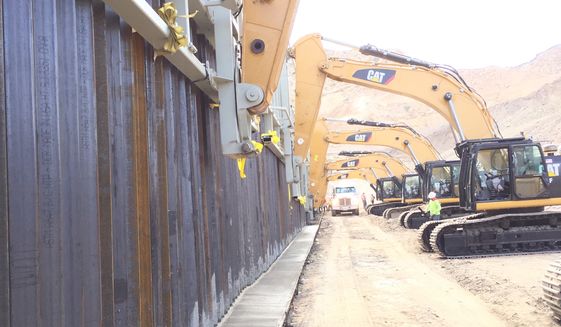
    A private group announced Monday that it has constructed a half-mile wall along a section of the U.S.-Mexico border in New Mexico, in what it said was a first in the border debate. The 18-foot steel bollard wall is similar to the designs used by the Border Patrol, sealing off a part of the border that had been a striking gap in existing fencing, according to We Build the Wall, the group behind the new section. The section was also built faster and, organizers say, likely more cheaply than the government has been able to manage in recent years. Kris Kobach, a former secretary of state in Kansas and an informal immigration adviser to President Trump, says the New Mexico project has the president’s blessing and says local Border Patrol agents are eager to have the assistance. “We’re closing a gap that’s been a big headache for them,” said Mr. Kobach, who is general counsel for We Build the Wall. The announcement comes at a critical time for the border. Mr. Trump’s plans to build hundreds of miles of new and replacement wall took a hit late last week when a federal judge ordered a halt to part of his emergency declaration and shifting of money within the Pentagon to make up for Congress’s refusal to grant him the money he wanted. Judge Haywood Gilliam says the president can’t spend money when Congress has debated it and refused to approve it.

    Enter We Build the Wall, which says, now that it’s proved it can build border wall, that it has eyes on other areas where private parties hold border lands and want to build barriers there to cut down on the illegal traffic across their property.The new wall begins at the Rio Grande and runs up to the lower elevations of Mount Cristo Rey. The wall on the Texas side ends at the river, and there used to be a gap on the New Mexico side running from the river over to Mount Cristo Rey. Two parking lots, one on the Mexican side and one on the U.S. side, with nothing but a ditch to separate them, offered a convenient staging point for would-be migrants.  Mr. Kobach says agents have told him perhaps 100 migrants a night cross — but the bigger problem is that they would cross, gaining agents’ attention, then drug smugglers would use the distraction to run drugs through elsewhere in the gap. A typical night could exceed $100,000 worth of drugs through the gap, Mr. Kobach said.

    We Build the Wall made waves over the last six months as it used crowdfunding to raise money. Its campaign set a $1 billion goal and has raised more than $22 million from more than 265,000 pledges through GoFundMe. The group posted photos of the New Mexico section to the pledge page on Monday. “We did it,” the group said on Facebook.  Construction began Friday and will be completed Tuesday, Mr. Kobach said. Tommy Fisher’s Fisher Sand & Gravel did the construction. Mr. Fisher has been in the news recently with Mr. Trump suggesting repeatedly and publicly that the government should consider his outfit for future border wall construction. He was one of the contractors selected in 2017 to build wall prototypes in San Diego. None of those prototypes was deemed contract-worthy, and Congress has forbidden the Border Patrol from using any of those designs anyway. More recently Mr. Fisher announced he could build 234 miles of fencing at $1.4 billion — or about $6 million per mile. That’s about a quarter of the cost of Mr. Trump’s current fencing, which goes off at about $25 million per mile.

    source

  • Who Owns The American Land?

    Who Owns The American Land?

    Those are two words that are commonly used to stir up patriotic feelings. They are also words that can’t be taken for granted, because today nearly 30 million acres of U.S. farmland are held by foreign investors. That number has doubled in the past two decades, which is raising alarm bells in farming communities. When the stock market tanked during the past recession, foreign investors began buying up big swaths of U.S. farmland. And because there are no federal restrictions on the amount of land that can be foreign owned, it’s been left up to individual states to decide on any limitations. It’s likely that even more American land will end up in foreign hands, especially in states with no restrictions on ownership. With the median age of U.S. farmers at 55, many face retirement with no prospect of family members willing to take over. The National Young Farmers Coalition anticipates that two-thirds of the nation’s farmland will change hands in the next few decades. “Texas is kind of a free-for-all, so they don’t have a limit on how much land can be owned,” say’s Ohio Farm Bureau’s Ty Higgins. “You look at Iowa and they restrict it — no land in Iowa is owned by a foreign entity.” Ohio, like Texas, also has no restrictions, and nearly half a million acres of prime farmland are held by foreign-owned entities. In the northwestern corner of the state, below Toledo, companies from the Netherlands alone have purchased 64,000 acres for wind farms.

    There are two counties in this region with the highest concentration of foreign-owned farmland — more than 41,000 acres each. One of those is Paulding County, where three wind farms straddle the Ohio-Indiana line. His other concern is that every acre of productive farmland that is converted over to something other than agriculture is an acre of land that no longer produces food. That loss is felt from the state level all the way down to rural communities, where one in six Ohioans has ties to agriculture. Angela Huffman is a sixth-generation farmer in Wyandot County, which, along with Paulding County, has more than 41,000 acres of foreign-owned farmland. Her modest, two-story white farmhouse has been in her family for almost 200 years. Her grandfather was the last person to actively farm the land here. When he got out of farming due to declining markets, none of his five children wanted to take over, and the cropland is now leased. But Huffman, a young millennial who lives here with her mother, wants to try to keep the farm going and revive her family heritage. Walking out to the barn, a huge white Great Pyrenees dog watches over a small flock of sheep. Huffman says she’s worried about the effects of foreign land ownership on her rural community — which she describes as similar to Walmart pushing local businesses out of the market.

    “Right out my back door here, Chinese-owned Smithfield Foods, the largest pork producer in the world, has recently bought out a couple grain elevators,” Huffman says, pointing across the field behind her house, “basically extracting the wealth out of the community.” To be fair, U.S. farmers and corporations also invest in overseas agriculture, owning billions of dollars of farmland from Australia to Brazil, but the Smithfield Food buyout has really raised concerns with American farmers. As part of that 2013 sale, a Chinese company now owns 146,000 acres of prime U.S. farmland. Back in the Huffman farmhouse, Joe Maxwell is typing on a laptop at the kitchen table. Maxwell is a fourth-generation farmer from Missouri. He and Huffman are part of the Organization for Competitive Markets, an advocacy group of farmers and ranchers across the nation. Maxwell points to the Smithfield Foods elevators across the field: “The money that those elevators used to make stayed within the community. Today the money those elevators make will go into the pocket of someone thousands of thousands of miles away. This is going on across America.” Maxwell is concerned that, as other states put restrictions on foreign purchases in place, Ohio in particular is being targeted. “So when they’re looking for investments in the U.S. and agriculture,” he says, “Ohio’s a great ag state, and you don’t have any restrictions like other states.” Nationwide, Canadian investors own the most farmland. In Ohio, it’s Germany, with 71,000 acres.

    On the southern central part of the state, John Trimmer manages 30,000 acres of corn and soybeans for German investors. He’s been working with German families that have wanted to get into U.S. agriculture since the 1980s. “They started to buy land in Iowa and Minnesota,” Trimmer explains, “but right when they started, [Iowa and Minnesota] passed state laws which restricted foreign ownership.” Instead, the Germans turned to Ohio. But, Trimmer says, there is a misconception about foreign owners — that they aren’t good neighbors or good stewards of the land. What he sees is a growing divide between older family members who still live on the farm, and their children who have no interest in the family business and want to cash out the land. “The last two farms we bought here, through an owner, her and her brothers and sisters inherited it from their mother, and none of them wanted to farm. None of them have an interest in the farm.” Trimmer explains that his German clients have established a reputation in the community for letting the tenants — often aging parents or grown children — continue to live in the houses on the farms they buy. Sellers work directly with his German clients — instead of putting the property up on the market, the sale ensures that family members can live out their lives in the family homestead, while still getting cash value for the farmland.

    source

  • A Bizarre Form of Water May Exist All Over the Universe | WIRED

    A Bizarre Form of Water May Exist All Over the Universe | WIRED

    Recently at the Laboratory for Laser Energetics in Brighton, New York, one of the world’s most powerful lasers blasted a droplet of water, creating a shock wave that raised the water’s pressure to millions of atmospheres and its temperature to thousands of degrees. X-rays that beamed through the droplet in the same fraction of a second offered humanity’s first glimpse of water under those extreme conditions.

    Quanta Magazine

    Original story reprinted with permission from Quanta Magazine, an editorially independent publication of the Simons Foundation whose mission is to enhance public understanding of science by covering research developments and trends in mathematics and the physical and life sciences.

    The X-rays revealed that the water inside the shock wave didn’t become a superheated liquid or gas. Paradoxically—but just as physicists squinting at screens in an adjacent room had expected—the atoms froze solid, forming crystalline ice.

    “You hear the shot,” said Marius Millot of Lawrence Livermore National Laboratory in California, and “right away you see that something interesting was happening.” Millot co-led the experiment with Federica Coppari, also of Lawrence Livermore.

    The findings, published this week in Nature, confirm the existence of “superionic ice,” a new phase of water with bizarre properties. Unlike the familiar ice found in your freezer or at the north pole, superionic ice is black and hot. A cube of it would weigh four times as much as a normal one. It was first theoretically predicted more than 30 years ago, and although it has never been seen until now, scientists think it might be among the most abundant forms of water in the universe.

    Across the solar system, at least, more water probably exists as superionic ice—filling the interiors of Uranus and Neptune—than in any other phase, including the liquid form sloshing in oceans on Earth, Europa and Enceladus. The discovery of superionic ice potentially solves decades-old puzzles about the composition of these “ice giant” worlds.

    Including the hexagonal arrangement of water molecules found in common ice, known as “ice Ih,” scientists had already discovered a bewildering 18 architectures of ice crystal. After ice I, which comes in two forms, Ih and Ic, the rest are numbered II through XVII in order of their discovery. (Yes, there is an Ice IX, but it exists only under contrived conditions, unlike the fictional doomsday substance in Kurt Vonnegut’s novel Cat’s Cradle.)

    Superionic ice can now claim the mantle of Ice XVIII. It’s a new crystal, but with a twist. All the previously known water ices are made of intact water molecules, each with one oxygen atom linked to two hydrogens. But superionic ice, the new measurements confirm, isn’t like that. It exists in a sort of surrealist limbo, part solid, part liquid. Individual water molecules break apart. The oxygen atoms form a cubic lattice, but the hydrogen atoms spill free, flowing like a liquid through the rigid cage of oxygens.

    A time-integrated photograph of the X-ray diffraction experiment at the University of Rochester’s Laboratory for Laser Energetics. Giant lasers focus on a water sample to compress it into the superionic phase. Additional laser beams generate an X-ray flash off an iron foil, allowing the researchers to take a snapshot of the compressed water layer.
    Millot, Coppari, Kowaluk (LLNL)

    Experts say the discovery of superionic ice vindicates computer predictions, which could help material physicists craft future substances with bespoke properties. And finding the ice required ultrafast measurements and fine control of temperature and pressure, advancing experimental techniques. “All of this would not have been possible, say, five years ago,” said Christoph Salzmann at University College London, who discovered ices XIII, XIV and XV. “It will have a huge impact, for sure.”

    Depending on whom you ask, superionic ice is either another addition to water’s already cluttered array of avatars or something even stranger. Because its water molecules break apart, said the physicist Livia Bove of France’s National Center for Scientific Research and Pierre and Marie Curie University, it’s not quite a new phase of water. “It’s really a new state of matter,” she said, “which is rather spectacular.”

    Puzzles Put on Ice

    Physicists have been after superionic ice for years—ever since a primitive computer simulation led by Pierfranco Demontis in 1988 predicted water would take on this strange, almost metal-like form if you pushed it beyond the map of known ice phases.

    Under extreme pressure and heat, the simulations suggested, water molecules break. With the oxygen atoms locked in a cubic lattice, “the hydrogens now start to jump from one position in the crystal to another, and jump again, and jump again,” said Millot. The jumps between lattice sites are so fast that the hydrogen atoms—which are ionized, making them essentially positively charged protons—appear to move like a liquid.

    This suggested superionic ice would conduct electricity, like a metal, with the hydrogens playing the usual role of electrons. Having these loose hydrogen atoms gushing around would also boost the ice’s disorder, or entropy. In turn, that increase in entropy would make this ice much more stable than other kinds of ice crystals, causing its melting point to soar upward.

    But all this was easy to imagine and hard to trust. The first models used simplified physics, hand-waving their way through the quantum nature of real molecules. Later simulations folded in more quantum effects but still sidestepped the actual equations required to describe multiple quantum bodies interacting, which are too computationally difficult to solve. Instead, they relied on approximations, raising the possibility that the whole scenario could be just a mirage in a simulation. Experiments, meanwhile, couldn’t make the requisite pressures without also generating enough heat to melt even this hardy substance.

    As the problem simmered, though, planetary scientists developed their own sneaking suspicions that water might have a superionic ice phase. Right around the time when the phase was first predicted, the probe Voyager 2 had sailed into the outer solar system, uncovering something strange about the magnetic fields of the ice giants Uranus and Neptune.

    The fields around the solar system’s other planets seem to be made up of strongly defined north and south poles, without much other structure. It’s almost as if they have just bar magnets in their centers, aligned with their rotation axes. Planetary scientists chalk this up to “dynamos”: interior regions where conductive fluids rise and swirl as the planet rotates, sprouting massive magnetic fields.

    By contrast, the magnetic fields emanating from Uranus and Neptune looked lumpier and more complex, with more than two poles. They also don’t align as closely to their planets’ rotation. One way to produce this would be to somehow confine the conducting fluid responsible for the dynamo into just a thin outer shell of the planet, instead of letting it reach down into the core.

    But the idea that these planets might have solid cores, which are incapable of generating dynamos, didn’t seem realistic. If you drilled into these ice giants, you would expect to first encounter a layer of ionic water, which would flow, conduct currents and participate in a dynamo. Naively, it seems like even deeper material, at even hotter temperatures, would also be a fluid. “I used to always make jokes that there’s no way the interiors of Uranus and Neptune are actually solid,” said Sabine Stanley at Johns Hopkins University. “But now it turns out they might actually be.”

    Ice on Blast

    Now, finally, Coppari, Millot and their team have brought the puzzle pieces together.

    In an earlier experiment, published last February, the physicists built indirect evidence for superionic ice. They squeezed a droplet of room-temperature water between the pointy ends of two cut diamonds. By the time the pressure raised to about a gigapascal, roughly 10 times that at the bottom of the Marianas Trench, the water had transformed into a tetragonal crystal called ice VI. By about 2 gigapascals, it had switched into ice VII, a denser, cubic form transparent to the naked eye that scientists recently discovered also exists in tiny pockets inside natural diamonds.

    Then, using the OMEGA laser at the Laboratory for Laser Energetics, Millot and colleagues targeted the ice VII, still between diamond anvils. As the laser hit the surface of the diamond, it vaporized material upward, effectively rocketing the diamond away in the opposite direction and sending a shock wave through the ice. Millot’s team found their super-pressurized ice melted at around 4,700 degrees Celsius, about as expected for superionic ice, and that it did conduct electricity thanks to the movement of charged protons.

    Federica Coppari, a physicist at Lawrence Livermore National Laboratory, with an x-ray diffraction image plate that she and her colleagues used to discover ice XVIII, also known as superionic ice.
    Eugene Kowaluk/Laboratory for Laser Energetics

    With those predictions about superionic ice’s bulk properties settled, the new study led by Coppari and Millot took the next step of confirming its structure. “If you really want to prove that something is crystalline, then you need X-ray diffraction,” Salzmann said.

    Their new experiment skipped ices VI and VII altogether. Instead, the team simply smashed water with laser blasts between diamond anvils. Billionths of a second later, as shock waves rippled through and the water began crystallizing into nanometer-size ice cubes, the scientists used 16 more laser beams to vaporize a thin sliver of iron next to the sample. The resulting hot plasma flooded the crystallizing water with X-rays, which then diffracted from the ice crystals, allowing the team to discern their structure.

    Atoms in the water had rearranged into the long-predicted but never-before-seen architecture, Ice XVIII: a cubic lattice with oxygen atoms at every corner and the center of each face. “It’s quite a breakthrough,” Coppari said.

    “The fact that the existence of this phase is not an artifact of quantum molecular dynamic simulations, but is real—­that’s very comforting,” Bove said.

    And this kind of successful cross-check behind simulations and real superionic ice suggests the ultimate “dream” of material physics researchers might be soon within reach. “You tell me what properties you want in a material, and we’ll go to the computer and figure out theoretically what material and what kind of crystal structure you would need,” said Raymond Jeanloz, a member of the discovery team based at University of California, Berkeley. “The community at large is getting close.”

    The new analyses also hint that although superionic ice does conduct some electricity, it’s a mushy solid. It would flow over time, but not truly churn. Inside Uranus and Neptune, then, fluid layers might stop about 8,000 kilometers down into the planet, where an enormous mantle of sluggish, superionic ice like Millot’s team produced begins. That would limit most dynamo action to shallower depths, accounting for the planets’ unusual fields.

    Other planets and moons in the solar system likely don’t host the right interior sweet spots of temperature and pressure to allow for superionic ice. But many ice giant-sized exoplanets might, suggesting the substance could be common inside icy worlds throughout the galaxy.

    Of course, though, no real planet contains just water. The ice giants in our solar system also mix in chemical species like methane and ammonia. The extent to which superionic behavior actually occurs in nature is “going to depend on whether these phases still exist when we mix water with other materials,” Stanley said. So far, that isn’t clear, although other researchers have argued superionic ammonia should also exist.

    Aside from extending their research to other materials, the team also hopes to keep zeroing in on the strange, almost paradoxical duality of their superionic crystals. Just capturing the lattice of oxygen atoms “is clearly the most challenging experiment I have ever done,” said Millot. They haven’t yet seen the ghostly, interstitial flow of protons through the lattice. “Technologically, we are not there yet,” Coppari said, “but the field is growing very fast.”

    Original story reprinted with permission from Quanta Magazine, an editorially independent publication of the Simons Foundation whose mission is to enhance public understanding of science by covering research developments and trends in mathematics and the physical and life sciences.

    More Great WIRED Stories

    This content was originally published here.
  • Cops using ‘Minority Report’ predictive policing could see INNOCENT citizens framed

    Cops using ‘Minority Report’ predictive policing could see INNOCENT citizens framed

    The Sci-Fi movie Minority Report was set in a world in which police arrested people for crimes that were only predicted and not committed.  But now real life is emulating fiction, according to campaign group Liberty.  A report by Liberty called “Policing by Machine” reveals the widespread use of biased “predictive policing” that they claim threatens everyone’s rights and freedoms.  The report collates 90 Freedom of Information requests sent to every force in the UK.  These programmes also “learn” over time and become more autonomous when making predictions, without having to be programmed. There are two types of predictive policing, predictive mapping programmes, and individual risk assessment programmes. Predictive mapping programmes use police data about past arrests to identify “hot spots” of high risk and police are then directed to patrol the areas. But Liberty says these tend to be areas that already experience “over-policing”. Liberty says it simply presents a biased picture of how police have been responding to crime and people from black, Asian and minority ethnic communities are disproportionately more likely to be arrested.

    This leads the program to assume that the areas where they live or spend have more crime. Ms Couchman added: “When police strategy is influenced by historic bias, this will lead to more people from minority communities being subject to excessive surveillance where they are over-policed and over-criminalised. This leads to unfair and inefficient policing for us all. “There is a case for using data to address issues in policing and criminal justice, including bias, but rights issues surrounding privacy, free expression and discrimination are not being properly addressed in a way that make this tech part of a legitimate policing strategy.” Liberty says the biggest problem with the program is the lack of transparency. Police claim that a human will be overseeing the computer programs, but even officers deploying the technology will be unable to explain fully how it arrives at its conclusion. This means people can’t hold the programs to account or properly challenge the predictions they make.

    The campaign group says the way to tackle the root causes of crime in the UK is to invest properly in housing, education and deprivation that leads to people becoming criminals.

    source

  • Operation Restored Warrior: Reaching out to Veterans Before It’s Too Late

    Operation Restored Warrior: Reaching out to Veterans Before It’s Too Late

    It’s estimated a military veteran commits suicide each hour of every day. One organization hopes to change that by helping vets fight their way back to restoration.

    Healing for Hidden Battle Scars

    Veterans fighting overseas not only suffer physically but emotionally as well –- hidden battle scars that make life difficult back home.  That’s where “Operation Restored Warrior” comes in. To find it, CBN News traveled to the heart of Colorado.  With its wide open spaces and large horse corral, the 4 Eagle Ranch resembles something out of the Old West. But take a closer look and you’ll see much more. Organizers of Operation Restored Warrior say it’s a location where healing takes place.  While the program welcomes all faiths, its core Christian ministry is the five-day program called the “Drop Zone.”  “A ‘drop zone’ is a place in enemy territory where you go take that ground,” Keith Poole, Army veteran and ORW facilitator, told CBN News. “And very often in kind of Christian environments we refer to things as retreats. ‘I’m going to go to a retreat,’ and that just didn’t sit well with us as professional military men.”  “It’s like why are we retreating? How about if we go gain ground?” Poole continued. “So we specifically call coming to a Drop Zone, a counter-attack, and that appeals to warriors.”

    Rescue, Rebuild and Restore

    That counter attack is three-fold: rescue, rebuild and restore.  “Warriors come to this place because they’re looking for hope, and often the enemy has just beat them down,” Poole explained. “But this is the place where they know there’s some hope, and when they get here what they find out is that this is where healing is.”  “And that hope and healing is here because Jesus is here,” he continued.  The intensive program involves targeting areas of the heart that need healing. ORW leaders hold to the belief, “Psychology reveals; Jesus heals,” and say it’s been proven hundreds of times.

    Literal Life-Saver

    For participants like Navy veteran Paul Williams, the program can be a literal life-saver.   “July 2nd of this year I had written a note, and I was ready to go,” he shared with CBN News. “And it just didn’t happen. I went back to my truck to go get the gun, and it wasn’t there.”  “So I just started praising Jesus with my praise and worship music and said, ‘You know what, I need to give this ORW, Operation Restored Warrior, a really good shot,’” Williams continued.  And that decision led to victory.  “I was able to open up to Paul, the founder of ORW, about all the trash that I’ve been carrying, and it felt so good to finally just let it out,” Williams explained. “I can’t thank this organization enough.”  “I came here fighting’ for my life, and I’m going to walk away a champion,” he said, trying to fight back tears. “So I love them a lot, and I’m super thankful for it.”

    A Unique Gift 

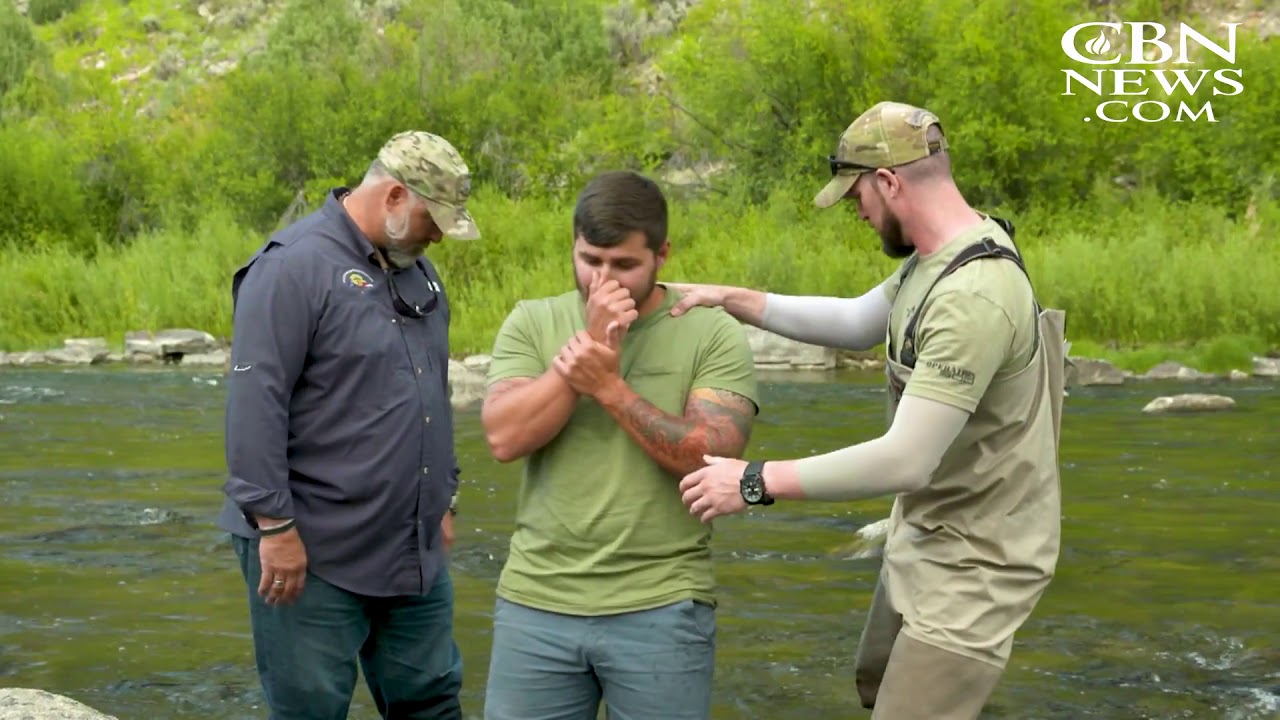
    Former atheist Paul Lavelle started ORW nine years ago.  “Around 2008, I felt like Jesus just put in my heart that he had gifted me my whole life to rescue people, and I felt like I had a unique gift of healing as well,” the Air Force veteran told CBN News. “But I had no idea it had to do with anything spiritual.”  “And about 2008, I just felt this nudge that I had to do something,” Lavelle continued. “ORW – our focus is to heal, and we bring Jesus into that healing process.”  Army veteran Braxton Dunbar dealt with many things, including suicidal thoughts, before coming to ORW.  “I was definitely a broken, a broken man, had a lot of depression and anxiety, a lot of anger, a whole lot of anger and just felt lost, really just didn’t… didn’t know where my place was, didn’t know how to find my place either,” he shared with CBN News. Dunbar accepted Christ during the Drop Zone and decided to get baptized. “The same individual that prayed with me, Jordan, kind of came to me and said, ‘You accepted him yesterday, and you verbally accepted him into your life. Would you want to show the action of it?’” Dunbar recalled. “And there was no question at all. I said, ‘Absolutely. I’d love to.’” Retired Air Force Chaplain Steve Frick also received healing through the program. “ORW doesn’t just help; they heal,” he told CBN News. “And that’s a little hard to hear when you first get here. But I’m telling you it’s true.”

    Healing Adventure 

    In addition to powerful sessions building up the faith of the men, the Drop Zone also allows time for recreational activities like fly fishing. What can they learn from this? Lavelle says it nourishes the soul among other things. “The reason we do the activities is because it’s part of a spiritual longing for a man to have adventure in his life,” he said. “It’s one of the core desires of a man.” “And so as part of this restoration process, we want to remind them that there is adventure out there,” Lavelle continued.

    Before It’s Too Late

    Army veteran Chris Fields is the Drop Zone lead facilitator. He, too, once contemplated taking his life and also lost fellow service members to suicide. Fields understands the urgency of going through this program before it’s too late. “Don’t wait another moment to reach out and to ask for help,” he said. “I used to think that I was ten feet tall and bulletproof. I ate barbed wire in the morning, and you can surmise what I did in the afternoon.””But when I reached out for help I’m stronger than I ever was… and it just takes one moment, one moment to say, ‘Okay, let me see what this is all about.’ And then let Jesus take it from there,” he continued.

    This article was originally published in 2017. It’s being reprinted in honor of America’s troops on Memorial Day.


  • Migrants dropped at US bus stations as Border Patrol shelters overflow

    Migrants dropped at US bus stations as Border Patrol shelters overflow

    The three white vans bearing the Border Patrol logo slowly make their way into a back alley next to the Greyhound bus station in the city of San Bernardino, east of Los Angeles.  As the agents slide open the doors, a group of 36 haggard-looking men, women and children — most of them from Guatemala — exit the vehicles carrying plastic bags filled with their meager belongings.  They line up on a sidewalk as their names are checked by a representative from a local NGO who also enquires about their health.  A man asks where he can rent a phone and one of the agents sternly answers back in Spanish.  “You decided to come this way into the US, you figure out what to do,” the agent says. “What do you expect? You want me to give you my house?”  Though clearly anxious about this next phase in their long journey to the US, the faces of the migrants show their relief at having made it so far.  The group is part of thousands being dropped off at bus stations in California and other states by US Border Patrol as the agency deals with an influx of migrants crossing the border with Mexico and filling detention facilities to capacity.

    – System at breaking point –

    After staying at a local shelter or church in San Bernardino, the migrants typically head to other states to join relatives or friends pending the outcome of their asylum application.  According to immigration authorities, more than 40,000 immigrant families apprehended at the border since March 19 and with no known criminal record have been released into the United States due to Border Patrol facilities being swamped.  “Whenever possible, the releases have been coordinated with local non-governmental organizations (NGOs),” US Border Patrol said in a statement to AFP. “As NGOs have reached their capacities, CBP has released family units at transportation hubs during daylight hours when the weather does not endanger those released.”  Nearly 250,000 unaccompanied children or people traveling with family members were apprehended at the border in April alone, officials said, as opposed to some 59,000 in April of last year — a 400 percent increase.

    US President Donald Trump has reacted with fury at the crisis, threatening to shut down the border and accusing asylum seekers of trying to gain entry into the US under false pretenses.  The asylum seekers are mainly from Honduras, Guatemala and El Salvador, countries beset by crushing poverty and gang violence.  The current surge in asylum seekers mainly concerns people from Guatemala.  “Despite everything, they feel absolute freedom, they feel they were born again,” said Homero Lobato, of the Immigrant Immediate Response Network, an NGO assisting the migrants. Jennaya Dunlap, of the Immigration Justice Coalition, another NGO, said nearly all of the asylum seekers don’t speak English, are poor and have no clue on arrival as to where they are or the next step to take.  “The first thing they ask us is, ‘Where are we? What region is this?’ And they try to figure out the state they are in by looking at license plates,” said Dunlap, who greeted the group of 36 migrants at the San Bernardino bus station this week. “Welcome,” she tells the group as they exit the Border Patrol vans as volunteers hand them water and granola bars. “Don’t worry, we are going to help you.”  Lurking nearby, however, is an example of what await some of the migrants in a country deeply divided on the immigration crisis.

    “Send them back to Tijuana (Mexico),” shouts a white bearded man in a red pick-up truck as he drives by the group of migrants at the bus station in San Bernardino.

    “Or better yet, send them to (liberal) San Francisco,” he adds.

    source

  • Nurse ‘Rightly Fired’ For Offering to Give Bible to Cancer Patient, Court Rules

    Nurse ‘Rightly Fired’ For Offering to Give Bible to Cancer Patient, Court Rules

    A medical professional who attempted to offer a Bible to a cancer patient was “rightly sacked” from her job, a court has heard . British nurse Sarah Kuteh was fired from Darent Valley Hospital in Dartford, Kent back in 2016 for talking to several patients about her faith in Jesus and even choosing to hand out Bibles.  According to the original complaint, after a patient stated that they were “open-minded” about religion, Kuteh quickly explained that “the only way he could get to the Lord was through Jesus.”“(She) told him she would give him her Bible if he did not have one; gripped his hand tightly and said a prayer that was very intense and went ‘on and on’; and asked him to sing Psalm 23 [The Lord is My Shepherd] after which he was so astounded that he had sung the first verse with her,” the ruling added, as reported by the Telegraph.  According to court documents, the nurse also told a bowel cancer patient “that if he prayed to God he would have a better chance of survival.” As a result of these encounters, Kuteh, a mother-of-three, was fired from her job for “gross misconduct.”

    APPEAL TURNED DOWN

    After a failed appeal, Kuteh launched another bid to have the ruling overturned, arguing that the employment tribunal “failed to consider the correct interpretation of the Nursing and Midwifery Council (NMC) Code and the distinction between appropriate and inappropriate expressions of religious beliefs.”  She also argued that the tribunal had failed to uphold her rights to religious freedom endowed by European Convention on Human Rights, Article 9.  “What was considered to be inappropriate was for the Claimant [Ms Kuteh] to initiate discussions about religion and for her to disobey a lawful instruction given to her by management,” the ruling added.  Lord Singh concluded that the “employment Appeal Tribunal was plainly correct, in my view, to regard the appeal as having no reasonable prospect of success and therefore in dismissing it.”  Many praised Kuteh for her passionate presentation of the gospel in the workplace. “Many Ghanaian Christians have a habit of talking about Jesus all the time, even though in the UK it is seen to be culturally inappropriate,” tweeted the CEO of London City Mission, Graham Miller. “Praise the Lord for Sarah’s compassionate heart and courage!”  Kuteh is being represented by the Christian Legal Centre and is currently considering her legal options moving forward. In a tweet, CLC’s sister organization, “Christian Concern” urged British Foreign Secretary Jeremy Hunt to take into account instances of Christian persecution that are going on inside British borders on a terrifyingly regular basis.  In a newly released report commissioned by Hunt, it was determined that global Christian persecution is reaching the UN-defined threshold for “genocide.”

    source

  • Hold on to your Bible– Christian Students are Forced to Cite Islamic Conversion Prayer in School!

    Hold on to your Bible– Christian Students are Forced to Cite Islamic Conversion Prayer in School!

    Wow!  Get ready to cite your Islamic hola, or whatever.  I am all for a good education, well rounded is nice too.  However, prayer?  Yes I know you need them but when the school, (government) says this is how you pray.  We are in trouble!!!!

    Four years ago, a Christian high school junior was compelled by her teacher at La Plata High School in La Plata, Md., to recall the Islamic conversion creed – the Shahada – as part of a written assignment. She was required to write the Islamic creed, “There is no god but Allah, and Muhammad is the messenger of Allah.”  The World History course also taught that “Most Muslims’ faith is stronger than the average Christian’s.”  Caleigh Wood refused to complete the assignment, believing that is it is a sin to profess by word or in writing, that there is any other god except the Christian God.   School officials refused to let her opt out of the course, and as a result she received a lower percentage grade for the course, but that did not affect her letter grade.

    The Thomas More Law Center (TMLC) on behalf of the Wood family filed a lawsuit, claiming the school had violated the First Amendment Establishment Clause and the girl’s right not to be forced to profess faith in another religion. Both the Federal District Court and the Fourth Circuit Court of Appeals ruled in favor of the high school’s Islamic curriculum.   Now, the TMLC has appealed the case to the Supreme Court asking the high court to decide whether any legal basis exists to allow public schools to discriminate against Christianity while at the same time promoting Islam.

    “Under the guise of teaching history or social studies, public schools across America are promoting the religion of Islam in ways that would never be tolerated for Christianity or any other religion,” TMLC President and Chief Counsel Richard Thompson said in a statement. “I’m not aware of any school which has forced a Muslim student to write the Lord’s Prayer or John 3:16: ‘For God so loved the world, that He gave His only begotten Son, that whosoever believeth in Him should not perish, but have everlasting life.’”

    Using a Powerpoint presentation in the class, the students at the school were also taught:

    • Islam is a peaceful religion
    • Jihad is a “personal struggle in devotion to Islam, especially involving spiritual discipline.”
    • “To Muslims, Allah is the same God that is worshiped in Christianity and Judaism.”
    • “Men are the managers of the affairs of women” and “Righteous women are therefore obedient.”

    “Many public schools have become a hotbed of Islamic propaganda,” Thompson continued. “Teaching Islam in schools has gone far beyond a basic history lesson. Prompted by zealous Islamic activism and emboldened by confusing court decisions, schools are now bending over backward to promote Islam while at the same time denigrate Christianity.”

    “We are asking the Supreme Court to provide the necessary legal guidance to resolve the insidious discrimination against Christians in our public schools,” he concluded.

    source

  • ‘I’m Pretty Sure Every Single Employee at Twitter Hates Trump’: Social Media’s War on Conservatives

    ‘I’m Pretty Sure Every Single Employee at Twitter Hates Trump’: Social Media’s War on Conservatives

    What is the point of news, any news?  Is it to give you the best, latest, and more accurate report of real events?  Today, not so much.  You kinda subscribe to what suits your mood.  I think that is just great.  You will not learn anything new, but you will be happier.

    Many conservatives rightfully feel like second class citizens on social media, where now simply posting conservative ideas can get you in trouble.   Facebook suspended conservative Candace Owens last week after she posted that liberal policies were harmful to the black family. Facing an outcry, Facebook claimed the suspension was a mistake.   Twitter suspended Heritage Foundation Media Director Greg Scott for so-called ‘hateful conduct’ after simply tweeting about the physical differences between men and women.  Conservative actor James Woods – with two million Twitter followers – left the platform altogether after Twitter suspended him for a tweet quoting Ralph Waldo Emerson. (“‘If you try to kill the King, you better not miss.’ #HangThemAll.”)

    “We just have to say ‘This is wrong,’” says author and radio host Eric Metaxas, “This is fundamentally un-American and it must be addressed. It will undermine our voting process, it will undermine self-government, it’s already doing that. ”  He added, “When you control information you control everything.”  A new study published by the left-wing Columbia Journalism Review confirmed that search giant Google skews heavily liberal in its search results. Only one conservative news source popped up in Google’s top 20 – Fox News. Dan Gainor of the media research center says no one should be surprised. After all, Google is liberal. “They set up rules that are liberal,” Gainor says, “They hire staff who are liberal. The staff give politically to liberal candidates and then when you appeal it you have to talk to the liberal staff. We’re boxed in on all sides.”

    A Project Veritas undercover investigation found the same anti-conservative attitudes at Twitter, where one employee was recorded saying, “I’m pretty sure every single employee at Twitter hates Trump.” And when companies like Facebook start deciding who is allowed to have free speech, first amendment lawyer Alex Abdo at the Knight First Amendment Institute at Columbia University says we should all be concerned. “Over the last few years we’ve certainly seen indications that Facebook gets content moderation wrong all the time,” Abdo says. “They take down speech that most reasonable people think shouldn’t be taken down and they leave up other speech that a lot of people think should be taken down. ” President Trump has taken notice, setting up an online tool for reporting censorship on social media. The White House has also refused to sign on to a new global compact to monitor online speech, in what some call a worldwide attempt to censor conservatives.

    source


  • Children in Social Services System Most at Risk of Being Sex Trafficked

    Children in Social Services System Most at Risk of Being Sex Trafficked

    Among children reported as likely victims of child sex trafficking upon running away from home, most have one thing in common—they were supposed to be looked after by the government.

    In 2014, some 10,000 endangered runaway children were reported to the National Center for Missing and Exploited Children (NCMEC), a nonprofit that serves as a clearinghouse for reports on missing children. Nearly 1,700 of them were likely victims of sex trafficking and of those, 68 percent were in the care of social services when they went missing, be it a group home, a government facility, or foster care.

    While these sobering statistics have been reported for years by the NCMEC, more recent data suggests that the problem is even more acute.

    In 2017, nearly 25,000 runaways reported to NCMEC and nearly 3,600 were likely victims of sex trafficking. Of those, 88 percent came from the social services system.

    In fact, children in the social services system are the group with the highest prevalence of child sex trafficking, said Robert Lowery, NCMEC’s vice president who heads its missing children division.

    source