Category: Business

  • In Paris, cars forced to make way for the two-wheel revolution

    In Paris, cars forced to make way for the two-wheel revolution

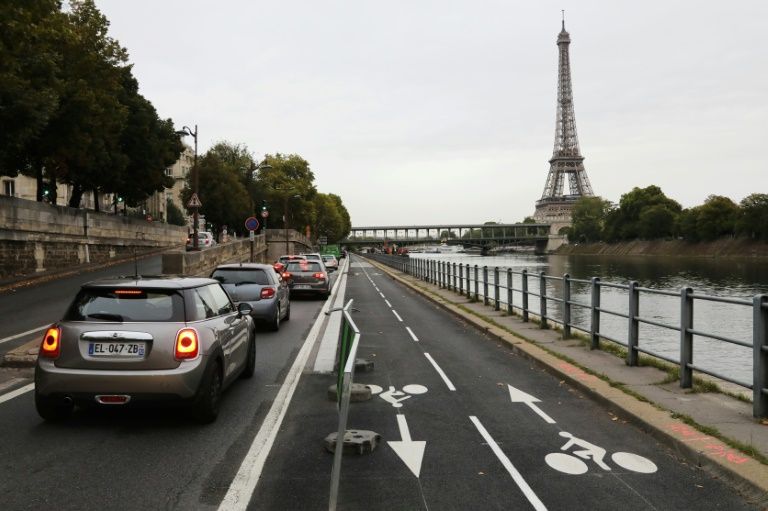
    Paris (AFP) – With the wind rushing through their hair, they zip past on bikes, electric scooters and mono-wheels, effortlessly passing lines of hot-and-bothered drivers stuck in the endless Paris traffic.

    In the French capital, the new mobility revolution has caught on fast, with locals and tourists embracing the growing array of app-based ways to get around.

    And with climate change bringing frequent heatwaves and more peak pollution alerts, Paris is beginning to push back against the dominance of the car.

    Not only is the city upgrading its public transport system offering of interurban trains, buses and the metro, it is also enjoying an unparalleled explosion of alternatives.

    “Our cities have been colonised by cars. They get into the smallest gaps, today we need to put them back into their proper place,” says Christophe Najdovski, the city’s deputy mayor who has responsibility for transport.

    “In Paris, they are only used for 10 percent of daily trips but they take up 50 percent of the public space.”

    – Car crush –

    But the city has been at the forefront of innovation, setting up a pioneering bike-share service back in 2007.

    Known as Velib’, it has since been copied across the globe, from London to Chicago.

    Then came the Autolib’ electric car-sharing scheme which was followed by a flood of dockless bikes, and then the overnight appearance of e-scooters that exploded onto the streets in the summer of 2018.

    And that’s without mentioning other private mobility devices such as two-wheeled e-hoverboards or electric unicycles.

    But is there enough space?

    Not according to the taxi drivers, who are already infuriated with the growing demands on their space and the planned 1,000-kilometres (600 miles) of bike lanes that are due to be completed by 2020.

    And the estimated 15,000 e-scooters on the streets have also triggered a backlash, with riders initially dumping them randomly on pavements, cluttering the curb and creating a nuisance for pedestrians.

    “I’d like to slap them,” fumes Nordine, a woman in her 40s walking through the Marais district, muttering furiously about “the lack of public spirit”.

    “Paris is a great playing field but the space is saturated. They need to bring it back down to two or three operators, like San Francisco, which has just two,” says Najdovski from the mayor’s office.

    At its height, Paris had 13 companies running scooter fleets, but that number dropped to around seven earlier this month after the city brought in a raft of demands for operators.

    – 37% of Parisians own a car –

    Every day, there are some 41 million trips made in the Paris region, of which 15 million are by car and 10 million by public transport.

    Since July 1, all diesel vehicles registered before 2006 have been banned from entering the city, but should the authorities go further and shut the entire city centre to cars?

    Today, just over a third — 37 percent — of Parisian homes have a car, and that drops to one in five in the city centre, according to the mayor’s office.

    “The priority is to enable city dwellers to get around,” says Jean-Pierre Orfeuil, an engineer who specialises in urban mobility.

    “Generally speaking, those who are using these new means of transport are people who used to use the metro,” he said.

    “So they haven’t played a role in easing the traffic.”

    – Dumping diesel, passing on petrol –

    To get away from fuel-powered vehicles, the focus should be on electric bikes, which could potentially help those living in the suburbs, he says.

    But even there, the infrastructure is lacking.

    “In France, we are two or three times worse off than Germany or the Netherlands” in terms of the number of electric bikes, he said.

    Although car-sharing has been slow to take off in France compared with its neighbours, one way to encourage this could be shared lanes, notably on the city’s choked peripherique, its 34-kilometre ring road.

    “At rush hour, you have an average of 1.1 people in every car. If you increased that to 1.7 it would get rid of the congestion,” Nadjovski said.

    But these new forms of transport don’t work for everyone, notably raising questions for those with families.

    And for many city dwellers, the car is a private space akin to their living room which offers a certain form of intimacy, says Orfeuil.

    “You can make private calls, you can listen to music.”

    For Mireille Apel-Muller, a sociologist who heads the City on the Move Institute, mobility is about more than just transport.

    “It’s a way of life,” she said.

    “All these new forms of transport require a smartphone and applications which you have to master. Otherwise, it becomes exclusive.”
  • Dow Jones industrials cross 27,000 points for first time

    Dow Jones industrials cross 27,000 points for first time

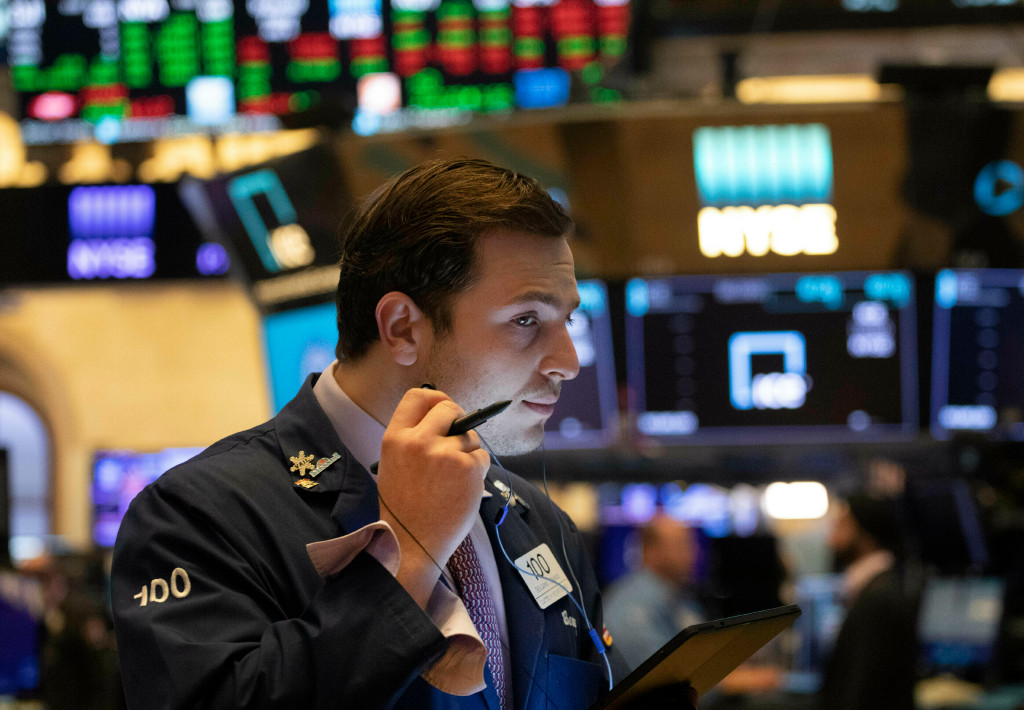
    A turbulent day on Wall Street ended in the record books Thursday as the Dow Jones Industrial Average climbed above 27,000 for the first time and the S&P 500 index hit another all-time high.

    The milestones came on a day when the S&P 500 briefly moved above 3,000 for the second straight day before an early rally lost some of its momentum.

    The market lost some ground after an auction of long-term U.S. government bonds failed to drum up strong demand. That pulled bond prices lower, sending yields sharply higher.

    Banks and technology stocks led the broad gains, offsetting losses in real estate and communications services companies.

    The latest gains extended a winning streak for stocks into its third day. Stocks have been trending higher for much of the week as investors have grown more confident that the Federal Reserve may cut interest rates for the first time in a decade as soon as the end of this month.

    “Sure, 27,000 is just a number and in the whole scope of things isn’t meaningful,” said Ryan Detrick, senior market strategist for LPL Financial. “What it is though is a reminder for all investors that this bull market has ignored all the scary headlines for years and the dual benefit of fiscal and monetary policy could mean it has a lot longer to go than most expect.”

    The S&P 500 rose 6.84 points, or 0.2%, to 2,999.91. The index set three straight record highs last week.

    The Dow gained 227.88 points, or 0.8%, to 27,088.08. The Nasdaq composite gave up an early gain, sliding 6.49 points, or 0.1%, to 8,196.04. The Russell 2000 index of smaller company stocks dropped 7.13 points, or 0.5%, to 1,557.92.

    Major stock indexes in Europe fell.

    Stocks rose from the get-go Thursday as investors looked ahead to Fed Chairman Jerome Powell testifying before a Congressional committee for the second straight day.

    Powell stressed that the Fed is prepared to cut interest rates to support the economy, raising hopes that the first reduction in its key policy rate in a decade could happen later this month.

    He noted that “uncertainties around trade tensions and concerns about the strength of the global economy continue to weigh on the U.S. economic outlook.”

    New government data released Thursday showed consumer prices rose in June from a year earlier. The bump in inflation wasn’t expected to give the Fed reason to reconsider whether it should lower rates, if necessary. Inflation has remained muted through much of the economy’s 10-year expansion, which Powell has said cited as a justification for potentially lowering rates.

    The early rally weakened by early afternoon after bond yields spiked following weak demand at an auction for 30-year Treasurys. That pulled bond prices lower, driving the yield on the benchmark 10-year Treasury note to 2.14% from 2.06% late Wednesday, a big move.

    “The markets were higher at the beginning of the day based on Powell’s testimony and him confirming what the futures markets have been telling us for a whole month: That we were going to get a rate cut,” said Randy Frederick, vice president of trading & derivatives at Charles Schwab. “But then we had this Treasury auction, which apparently didn’t go so hot.”

    The surge in bond yields marked a reversal from recent weeks, when many investors funneled money into bonds and other less-risky assets amid growing anxiety over the U.S. trade conflicts and signs of a slowing global economy.

    The move had a swift effect on real estate stocks, utilities and other high-dividend stocks that lose their appeal when bond yields rise. Real estate investment trusts took the heaviest losses. Iron Mountain slid 7.5%.

    Banks benefited from the surge in bond yields. When bond yields climb, they push up the interest rates that lenders charge for mortgages and other loans, making them more profitable. Bank of America rose 1.2% and Goldman Sachs gained 2.6%.

    Pharmaceutical makers dropped after the White House scrapped a plan to overhaul a system of rebates those companies pay to insurers and distributors. Merck & Co. dropped 4.5%.

    The move gave drugstore chains and health insurers a boost, however. Cigna surged 9.2%, CVS Health gained 4.7%, UnitedHealth climbed 5.5% and Anthem rose 5.5%.

    Traders also weighed a mix of corporate earnings reports, Delta Air Lines and aviation maintenance company Air notched gains after their latest quarterly results topped Wall Street’s forecasts. Bed Bath & Beyond and Fastenal slumped on disappointing results.

    Corporate earnings will keep investors busy starting next week, when S&P 500 companies begin reporting results for the April-June quarter.

    Companies have been lowering expectations for how much profit they made in the quarter. Wall Street now projects that overall S&P 500 company earnings for the quarter fell 2.6% from a year earlier, according to FactSet. As recently as the end of March, earnings were forecast to be down only 0.5%.

    This could be the first time in three years that S&P 500 companies report a back-to-back decline in overall earnings.

    “The bars for earnings have been set sufficiently low to keep expectations in check,” said Jamie Cox, managing partner for Harris Financial Group. “We will hear lots about the impact of tariffs, but not much else.”

    Benchmark crude oil fell 23 cents to settle at $60.20 a barrel. Brent crude oil, the international standard, dropped 49 cents to close at $66.52 a barrel. Wholesale gasoline fell 2 cents to $1.99 per gallon. Heating oil declined 1 cent to $1.98 per gallon. Natural gas fell 2 cents to $2.42 per 1,000 cubic feet.

    Gold fell $5.80 to $1,404.30 per ounce, silver fell 8 cents to $15.07 per ounce and copper fell 1 cent to $2.68 per pound.

    The dollar rose to 108.47 Japanese yen from 108.42 yen on Wednesday. The euro strengthened to $1.1258 from $1.1253.

    This content was originally published here.

  • Amazon Will Pay a Whopping $0 in Federal Taxes on $11.2 Billion Profits

    Amazon Will Pay a Whopping $0 in Federal Taxes on $11.2 Billion Profits

    Those wondering how many zeros Amazon, which is valued at nearly $800 billion, has to pay in federal taxes might be surprised to learn that its check to the IRS will read exactly $0.00. According to a report published by the Institute on Taxation and Economic (ITEP) policy Wednesday, the e-tail/retail/tech/entertainment/everything giant won’t have to pay a cent in federal taxes for the second year in a row. This tax-free break comes even though Amazon almost doubled its U.S. profits from $5.6 billion to $11.2 billion between 2017 and 2018. To top it off, Amazon actually reported a $129 million 2018 federal income tax rebate—making its tax rate -1%. Amazon’s low (to non-existent) tax rate has been chided by politicians ranging from Senator Bernie Sanders to President Donald Trump.

    But even though Trump previously blasted Amazon for its limited state taxes—a single presidential tweet caused the company’s shares to fall by 9%—ITEP notes that its non-existent federal tax payment is a result of the Trump Administration’s corporation-friendly tax cuts. The think tank writes that the 2017 Tax Cuts and Jobs Act not only decreased corporate tax rates from 35% to 21%, but it also didn’t close “a slew of tax loopholes that allow profitable companies to routinely avoid paying federal and state income taxes on almost half of their profits.” According to The Week, Amazon ended up paying an 11.4% federal income tax rate between 2011 and 2016, which is a contrast to the -1% rate this year. Amazon has a history of avoiding various sales taxes and made headlines last summer after successfully convincing Seattle Mayor Jenny Durkan to repeal a taxthat would have helped the city’s homeless population.

    Furthermore, New Yorkers made waves after learning about the significant tax cuts Amazon would receive if it built a headquarters in Long Island City.

    source

  • Big Pharma Fail: No Evidence Of Added Benefit In Most New Drugs, Study Finds

    Big Pharma Fail: No Evidence Of Added Benefit In Most New Drugs, Study Finds

    There seems to be a new drug to treat anything and everything these days, but are these medications as effective as they claim to be? A new study has concluded that the answer to that question is no. Furthermore, researchers say that international drug development processes, standards, and policies are fundamentally broken and must be reformed.

    According to the study performed at the German Institute for Quality and Efficiency in Health Care, more than half of the new drugs entering the German healthcare system show absolutely no added benefit.

    Between 2011 and 2017, researchers examined 216 drugs that passed regulatory approval and entered the German market. Most of these assessed drugs were also approved by the European Medicines Agency for widespread use throughout greater Europe.

    Alarmingly, only a quarter of those drugs showed any significant medical added benefit based on the available evidence. What’s more, 16% showed even a minor added benefit, and a whopping 58% of studied drugs did not show any added benefit over standard patient care.

    When the drugs were separated by speciality, the results were just as unsettling: just 6% of psychiatric drugs showed added benefit, along with 17% of diabetes drugs..

    Even in the investigated drugs that did show significant benefit, most of the research could only apply to sub-groups. “For the overall patient population, the current output of drug development may thus be resulting in even less progress than our assessments suggest,” the study reads.

    The study’s authors say that some within the healthcare industry argue that limited information on a drug at the time of its approval is how things have always been done, and is simply the “price to be paid” in order to provide patients with early access to unprecedented new drugs.

    To refute this argument, researchers revisited a study on cancer drugs conducted between 2009 and 2013 that found most of the drugs had been approved with little evidence of any benefits to cancer patients quality of life or survival chances. After following up on the cancer drugs’ success rates, researchers found minimal additional evidence of the drugs’ effectiveness.

    The research team says drugs are almost never studied after being initially approved, and even when a drug is found to be ineffective, global regulators do little to punish offending drug manufacturers.

    “As a consequence, patients’ ability to make informed treatment decisions consonant with their preferences might be compromised, and any healthcare system hoping to call itself ‘patient centred’ is falling short of its ethical obligations,” the study states.

    The authors recommend a much more strict drug approval process that demands stronger evidence from long-term studies conducted on large, randomized control groups. Even after a drug is approved, research should continue in order to fill in any and all information gaps that may remain.

    The entire way these drugs are priced and incentivized needs to be overhauled as well; right now vague and unclear results are being rewarded with monetary gain, whereas real tangible results should be the only final outcome that produces profit.

  • How Regulation Killed the Station Wagon and Created the Minivan

    How Regulation Killed the Station Wagon and Created the Minivan

    From a New York Times account of the career of auto executive Lee Iacocca — different from the Times obituary of him — comes this account of the role that government regulations played in changing the family car to a minivan from a station wagon:

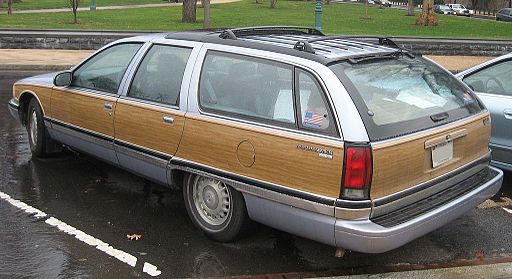
    Stringent fuel economy regulations imposed on cars in the 1970s had made it practically impossible for automakers to keep selling big station wagons. Yet many Americans still wanted roomy vehicles.

    The answer, Mr. Sperlich and Mr. Iacocca realized, was to make family vehicles that were regulated as light trucks, a category of vehicles that includes pickups. The government had placed far more lenient fuel economy rules on light trucks, as well as more lenient safety and air pollution standards.

    Cargo vans, a tiny niche marketed to carpenters, plumbers and other workers, were regulated as light trucks. When Chrysler introduced the minivan in 1983, fewer than 3 percent of them were configured as cargo vehicles, with just a couple of seats in the front and a long, flat bed in the back. But that was enough for Mr. Iacocca to persuade federal regulators to label all minivans as light trucks….

    Four years after the introduction of the minivan, Mr. Iacocca led the acquisition of American Motors. He then oversaw the development of the roomy Jeep Grand Cherokee, a sport utility vehicle that became a runaway best seller in the 1990s.

    Best of all for Detroit, the federal government limited foreign competition: Japanese automakers were initially kept out of the minivan and S.U.V. markets by an obscure 25 percent tariff on imported light trucks that was imposed by President Lyndon B. Johnson.

    It’s ironic, because there might have been less fuel consumed had the government just left station wagons alone rather than instead effectively pushing consumers into even bigger minivans. The unintended consequences of regulations can be hard to predict, but it’s not hard to predict that there will be some, because there almost invariably are.

    source

  • $1200 a month for a bunk bed in a shared space

    $1200 a month for a bunk bed in a shared space

    With the cost of rent continuing to rise, some Americans are taking unusual measures to find a place to sleep.

    In Los Angeles and San Francisco, where prices are particularly exorbitant, people have taken to renting bunk beds in communal homes.

    PodShare, which provides 10 to 15 co-ed bunkbeds in six locations across California, is hoping to help solve the affordable housing crisis.

    The beds can be rented from $35 to $50 a night, which amounts to between $1,050 and $1500 for one month.

    It’s no secret that housing prices have rapidly spiked over the last decade and incomes have not kept up

    One 2018 study published found that only about one-third of millennials currently own homes.

    This is fewer than the number of Generation Xers and baby boomers who owned homes when they were the same age.

    And a study conducted by Harvard University this year found that one-in-three Americans can’t afford to pay rent.

    It’s unsurprising considering that, in cities such as San Francisco, the average rent for an apartment is about $3,900.

    But for $1,200, if you rent with PodShare everyone gets a bed that turns into a desk, individual power outlets, a locker, a shelf and a personal TV.

    Each location also provides a communal living room, food such as cereal, toiletries such as toilet paper, laundry machines and WiFi access, reported CNN.

    Tenants are known as ‘pod-estrians’.

    source

  • Wolf of Wall Street producer charged with embezzling millions

    Wolf of Wall Street producer charged with embezzling millions

    The Wolf of Wall Street producer Riza Aziz, who is the stepson of former Malaysian prime minister Najib Razak, has been charged with embezzling millions of dollars from the Malaysian government.

    Riza, who ran a Hollywood production company Red Granite Pictures, appeared in a Kuala Lumpur court on Friday morning charged with five counts of money laundering, accused of receiving $248 million into Swiss bank accounts from the Malaysian state fund 1MDB, which was controlled by Najib. Each charge carries a five-year jail sentence.

    Riza is now the third member of the former first family of Malaysia to face multiple charges linked to misappropriated 1MDB funds. Najib, who was toppled from power in May 2018, is facing 42 corruption charges and his first trial of at least three is ongoing. Najib’s wife and Riza’s mother, Rosmah Mansour, has also been charged with 17 counts of money laundering.

    The 1MDB scandal, described as the biggest corruption scandal in Malaysian history, involved billions of dollars being embezzled from a government fund and fraudulently spent around the world. Some $681m (£516m) of 1MDB money went into Najib’s personal bank account, where it is alleged it was used to fund the lavish spending habits of Najib and Rosmah. The US justice department believes more than $4.5bn was stolen overall. The couple deny all wrongdoing.

    Riza has been accused of receiving the 1MDB money into a bank account in Switzerland and then transferring the funds in smaller amounts, between $1.2m and $133m, into a Red Granite bank account in the US. He has pleaded not guilty to all charges and was granted bail of 1 million Malaysian ringgit ($240,000).

    Pinterest

    It was a US justice department investigation that first accused Red Granite productions of using stolen 1MDB money to fund Hollywood productions, from Wolf of Wall Street to Dumb and Dumber 2 and Daddy’s Home. In March last year the company agreed to pay a $60m fine, though it stated that the payment was not “an admission of wrongdoing”.

    Red Granite was a relative unknown on the Hollywood scene before it stumped up $100m to help director Martin Scorsese make The Wolf of Wall Street. Three months after shooting began, Red Granite also presented the film’s star, Leonardo DiCaprio, with the Oscar given to Marlon Brando for On the Waterfront, worth around $600,000, as a lavish birthday present. DiCaprio has since surrendered the statue as part of the 1MDB investigation.

    This content was originally published here.

  • Airports Open Up to Terminal Tourists Who Just Want to Hang Out

    Airports Open Up to Terminal Tourists Who Just Want to Hang Out

    Chuck Hughey braves security lines at Pittsburgh International Airport at least once a week. Not to catch a flight, but to get an ice cream cone or cruise a few of the concourses. Is he nuts? Not at all, he will tell you, just a doting grandfather. He and 3-year-old Cleo spend quality time there, riding the trams between terminals and gliding along the moving walkways. “It’s so convenient, so sa

    Read more at: https://www.bloombergquint.com/business/airports-open-up-to-terminal-tourists-who-just-want-to-hang-out
    Copyright © BloombergQuint

  • The economic expansion is now the longest on record

    The economic expansion is now the longest on record

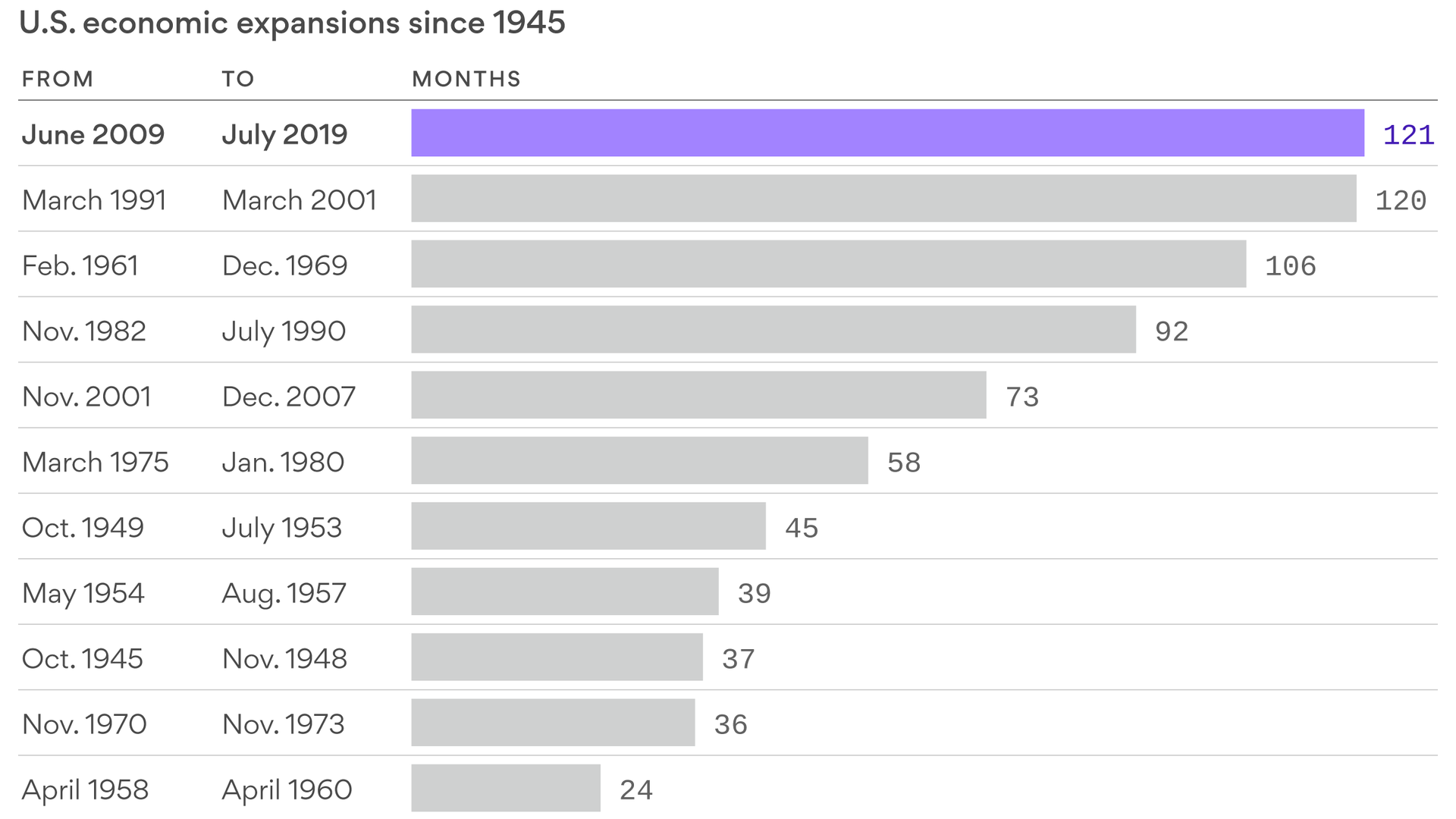
    Data: The National Bureau of Economic Research; Chart: Harry Stevens/Axios. Note: Current expansion is ongoing.

    This month marks the longest period of time the U.S. economy has gone without a recession, just edging past the economic cycle that ended when the dot com bubble burst.

    Why it matters: This milestone comes at one of the more pessimistic moments in the last decade as economists are warning that a significant slowdown in growth, and maybe a recession,is coming thanks to the impact of trade tensions and slumping growth in other economies across the globe.


    Behind the numbers: The pace of growth has been significantly slower than its predecessors, making the length of the cycle the defining factor of this period.

    • “Signs of over-exuberance” have ended the past 3 economic cycles, Michael Pearce, an economist at Capital Economics, tells Axios. “The interesting thing about this expansion is that it’s been very slow and we’ve really not seen a big buildup of excesses.”
    • Inflation has also been notably muted in the face of a near 50-year low unemployment rate and strong job creation. And low interest rates that’s helped prop up the economy in the past decade may be even lower in coming months.

    The bottom line: Economic cycles don’t die of old age (cliché, but true). Still, as people worry that a recession is around the corner simply because there hasn’t been a recession in a while, that could weigh on consumer and business confidence — and the fear of a recession could become a self-fulfilling prophecy.

    Go deeper: The yield curve and what it says about the economy

    This content was originally published here.