
Author: Truth & Hammer

  • Self Reliance & Preparedness | Precious Metals and The ‘End of The World’

    Self Reliance & Preparedness | Precious Metals and The ‘End of The World’

    Having an interest in history, I’ve been doing a good bit of reading on financial systems dating back to the Old Testament times (7th century BC) as well as more modern societies prior to fiat currencies (fiats are currencies declared by a Government to be valued at a certain amount but are not backed by any physical commodity). These include the Vikings (first known coins 995 A.D), ancient Romans (500 B.C), and ancient Chinese empire (770 B.C). The vast majority of currency in history has been based on the use of precious metals (PM) as an intermediate currency. The reasons are fairly simple:

    So I’d like to take a look at PM’s regarding “the end of the world as we know it” (TEOTWAWKI) from a few different angles. I am not advocating PM’s as a sole method of storing value. Prepping is about insurance: the more things you’re prepared for, the more likely when one of them befalls, you will be equipped to handle it. I’ll tackle such arguments as “you can’t eat gold” later.

    Before The Fall

    You run into two major theories here, both with historical precedent. Either you have a slow decline leading to spiraling hyperinflation before the whole mess crashes, or you have a major event that sends a massive number of people into the bronze age. (Note: I’m intentionally disregarding regional disasters such as major earthquakes or hurricanes. Those don’t directly cause currencies to fail, nor do they change PM’s value as a barter item.)

    With a slow decline, your currency becomes less valuable by the month, day or hour (in extreme historical circumstance). PM’s purchased before the decline gain value in direct opposition to the failing currency. When we say the value of PM’s are up or down, we’re really saying the inverse: the dollar is down or up. The value of PM’s relative to the American dollar isn’t the same as the value of PM’s relative to the Yen or Euro. Notice when a country has financial troubles “we buy gold” signs pop up everywhere?

    With a cataclysmic and rapid departure from the world we know, the likelihood of using your old currency to buy what you need is low. How much cash do you have in your pocket right now? Don’t count on using your ATM card when there is no internet. Silver and Gold have been treated as valuable since before the Roman empire was an itch in southern Europe’s skinny jeans.

    During The Dark Times

    Bad times are here. Maybe one country has fallen to accident, war or disaster. If it’s a superpower, the rest of the world will be feeling the crunch financially. In this scenario, the rough days could number in the years before a semblance of civility is restored nationwide and a new government is implemented. Humanitarian aid and multinational involvement would be likely if war is not a factor. PM’s are valuable in other countries right now, that wouldn’t change if they’re still up and running. A fistful of benjamins would be worth a fistful of nose blows. Food is something you will (shockingly) need to survive. Probably don’t want to trade much of that away… Ammo has uses defensive, offensive and for sustainability. That’s good for trading IF you really don’t need it. Ostensibly, nearly every item with barter value is directly related to survival.

    A Brave New World

    Take a look around the world today. Do you see any nations or regions that were thriving recently and now resemble a terrible Mad Max reality? Nope. Even with a full global meltdown, anything short of an extinction event will leave behind a significant number of people. Wherever there have been humans, there is a tendency towards grouping, commerce and mutual reliance. Don’t expect some long-running Book of Eli business. Even if that were to be a reality, there are a mass number of variables, too many to account for. A sharp brain and strong body are always valuable assets. If you’re looking past the big slump in the middle, what’s the plan for securing wealth now that will stay valuable until then?

    I’m no definitive expert on this matter. This article is not the be-all-end-all conversation that will zip up every internet thread regarding PM’s. I am someone who has been in a country where the local fiat currency was nearly worthless. I have also been to a few countries where I exchanged for some of the local currency and now that currency no longer exists as legal tender. Frame it as a memento or give it to the kids to play with. It has no intrinsic value.

    You Can’t Eat Gold

    Now I’d like to give my take on some of the common arguments against having PM’s as one part of the prepping plan. I’m emphasizing that PM’s should be considered only one part of the solution because number one on the most heard arguments against PM’s is

    In closing, I agree with the naysayers that “PM’s are only valuable only when we all agree they are. 9000 years of recorded human history says that someone will invariably think that they are, or will be, valuable still. PM’s do not replace beans, bullets or survival equipment. They sure don’t replace knowledge and skills. Precious metals give you a way to store wealth and a way to barter a nonessential item that can be easily transported and hidden.

    This content was originally published here.

  • Family Preparedness: What Are Your Survival Principles?

    Family Preparedness: What Are Your Survival Principles?

    Love ’em or hate ’em, without family, we break down, so consider family preparedness now and learn how-to, here!

    A Survivalists Insight Into Family Preparedness

    Introduction to Family Preparedness

    Last week, James “Dr. Prepper” Stevens shared with us his thoughts on creating a spiritual foundation for family preparedness. (Check out that article here.)

    This week, he’s back to give us some tips on forming the founding principles of your family preparedness plan. Read on to learn more.

    You may also wish to consider creating a family paradigm – a written belief statement that unites your family in your effort.

    Let me share my family’s model as an example. This helps our family to share a common perspective and thus know our objectives in terms of our preparedness efforts:

    We hope for the best;
    We fear for the worst; and
    We prepare to deal with what happens!

    Building a Family Preparedness Lifestyle

    There are three important reasons to start working toward an immersive family preparedness lifestyle:

    1. We have been advised to be prepared… (Remember the story of Noah, Joseph in Egypt, and the parable of the Ten Virgins?)
    2. You would be prudent and wise to be prepared – providential things happen as a result of being prepared.
    3. As the head of your family (patriarchal or matriarchal) responsibility, all reason demands you protect your family.

    It’s unfortunate that food storage gets such a bad rap in this Nation. When I lived out of the U.S., I was able to see that whoever controlled the food supply controlled the people

    We’ve been advised to save for the future––so many times for so long…

    What if you shift your thinking to another level, away from the mentally and physically tiring activity of food storage?

    What you achieve bit-by-bit is to comprehend the concept of accumulating a supply of food, clothing, and shelter as a way of everyday life––a preparedness lifestyle––and suddenly it’s neither so daunting nor so burdensome.

    You’ll actually get the attitude it doesn’t matter what others say or do!

    What is a preparedness lifestyle? To become self-reliant––to be able to live providently regardless of external conditions!

    May I suggest serious consideration that you make some Paradigm Shifts about your family preparedness responsibilities?

    My Three Family Preparedness Principles

    We spent many years in the activity of trying to stay prepared as we raised our six children. Here are the guiding principles that ultimately govern our family preparedness activities:

    1. We’ll Bloom Where We’re Planted

    We made a conscious decision to live on a rocky hilltop. When those below us may need to evacuate due to flooding, we plan to stay in our home.

    We have reduced and continue to reduce our belongings so as not to be owned by allegiance to our material things. If moving in the future seems important, fewer possessions will make it easier for us to move on.

    • Planning Action Item: We chose to build our house on the rock!

    2. Our Home Will Be Our Personal Convenience Store

    We’ve created and continue to maintain a very selective mini-grocery store––an in-home convenience store––stocked with the things we like to eat and know we can enjoy during a crisis situation––no matter how long it lasts!

    We set it up where we have unique access to it and can utilize it as our family needs it!

    • Faith Action Item: As others may do without, we can continue to eat––and be able to give help to others in their afflictions!

    3. Our Family Will Be Able to Camp Out Within the Walls of Our Home

    In case of a disaster or emergency situation, our family will be able to maintain an acceptable level of comfort within our house and on our property. We’re prepared now to be able to live within our comfort zone in the future when others can’t live in theirs. We have equipment that will allow us to continue to function regardless of the status of the normal utilities that we depend on normally.

    • Works Action Item: We got the gear and lost the fear!

    4. Get Out of Debt

    The only allowable debts are for purposes of education, our home, or a sound business venture to produce income for the family. My father was very wise about most things––he often told me: “Jimmy, there are only two kinds of people, those who earn interest, and those who pay it!” Grow your savings, not your stuff!

    • Paradigm Action Item: We can sustain our lifestyle without too much further reduction of “creature comforts.”

    There’s a popular national talk radio show host, Dave Ramsey, who proclaims with vigor:

    “Live now like no one else, and in the future, you can live like no one else!”

    Spot on, Dave!

    If you fail to prepare adequately now for the unknown future, you will eventually pay the price for your disobedience! Benjamin Franklin (and a lot of others, also) said, “If you fail to prepare, you prepare to fail.”

    5. Go on a Survival Shopping Now

    Remember: you can’t buy insurance on a wrecked car, a burning barn, or a sinking ship.

    We are so fortunate to have the capability to buy any products we want in this great country! There is no excuse for not being or becoming a self-reliant family.

    There is no shortage of products and services to aid us in becoming self-reliant. Truly, in this country, “…there is plenty, and to spare…”

    • There are no emergencies for those who are truly self-reliant!
    • If you are truly self-reliant, you have no need to fear!

    This video from City Prepping will show you how to build Bug out Bags for the family:

    Disaster preparedness kit for the family? Check! Emergency communication plan for families? Check! Disaster recovery plan? Check!

    These are your checklist to family preparedness. From the material, physical, emotional, and spiritual preparedness, all these factors will all play into yours and your family’s survival.

    This content was originally published here.

  • Moral emotions, a diagnostic tool for frontotemporal dementia?

    Moral emotions, a diagnostic tool for frontotemporal dementia?


    Frontotemporal dementia is a cognitive and behavioral disease caused by degenerative alteration of anterior regions of the brain. The disease is characterized by behavioral disorders such as a progressive apathy, loss of interest, social withdrawal, loss of inhibition and the processing of emotions.

    “We have known for a long time that these patients demonstrate impairment of emotion recognition and of the theory of mind i.e. the ability to figure out the mental states of others: what they think, what they feel, what they like… But does this emotional blunting also affect a specific kind of emotions called moral emotions, which are crucial for human interactions?” asks Marc Teichmann, coordinator of the study.

    Moral emotions can be defined as “affective experiences promoting cooperation and group cohesion” including emotions such as admiration, shame or pity. They are distinct from other emotions in that they are strongly linked to the cultural context, moral rules and innate moral representations. In the context of FTD, which are primarily characterized by an impairment of behavior and social interactions, studying these particular set of emotions is a major issue to better understand the disease and to refine diagnostic accuracy.

    In the present study, researchers and clinicians from the ICM – Brain and Spine Institute and the Pitié-Salpêtrière Hospital developed a test to assess moral emotions. It is composed of 42 scenarios for which the subject has to select, out of 4 response possibilities, the feeling s/he has in the scenario situation. La performance des patients FTD (N=22) are compared to the performance of 45 healthy subjects and to 15 patients with Alzheimer’s disease. To evaluate the specificity of the impairment of moral emotions in FTD the researchers contrasted the 42 moral scenarios involving an inter-human context and eliciting moral emotions with scenarios eliciting similar emotions without any moral valence. For example, it is possible to feel admiration for both an altruistic act and the architecture of a building. In both cases, the emotion is identified as admiration but the context is entirely different (moral versus extra-moral).

    The results show that moral emotions are much more impaired than emotions without moral valence. The image is in the public domain.

    The results show that moral emotions are much more impaired than emotions without moral valence. In contrast, patients with Alzheimer’s disease had no impairment as compared to healthy subjects and they had similar performance with moral and extra-moral emotions.

    “Our findings confirm that emotions, in general, are impaired in FTD and they reveal a particularly profound alteration of moral emotions. Our novel test tool appears to provide an early, sensitive and specific marker for FTD diagnosis while reliably distinguishing FTD from Alzheimer’s disease patients. It could also be a marker for other diseases involving the breakdown of moral emotions as for example in the case of psychopathic individuals.” concludes Marc Teichmann.

    Moral Emotions in Frontotemporal Dementia

    Background: Emotions, with or without moral valence, appear to be altered in the behavioral variant of frontotemporal dementia (bvFTD) but the relative degree of moral emotion breakdown, which could be a marker of bvFTD diagnosis, remains unexplored. Objective:To assess moral emotions in bvFTD, to differentiate bvFTD from typical Alzheimer’s disease (AD) based on moral emotion processing, and to provide a sensitive and specific assessment tool contributing to bvFTD diagnosis.

    Methods: We investigated moral emotions in 22 bvFTD patients, 15 patients with typical AD having positive CSF AD biomarkers, and 45 healthy controls. The ‘Moral Emotions Assessment’ task consisted in 42 scenarios exploring positive and negative moral emotions. To control for moral-specificity, we contrasted the 42 moral scenarios with 18 extra-moral scenarios eliciting the emotions without involving any inter-human moral context.

    Results: bvFTD patients were more impaired in emotion processing than AD patients and healthy controls and had significantly poorer performance in the processing of moral emotions than of emotions without moral valence. ROC analyses of data on moral scenarios showed a high area under the curve (83%), and indicated a cut-off score (

    Conclusion: Our findings demonstrate that bvFTD patients have disorders in emotion processing which is mainly related to failure regarding moral emotions. They also show that this deficit is reliably detected by the ‘Moral Emotions Assessment’ which represents a sensitive and specific diagnostic tool detecting bvFTD and differentiating it from AD.

    This content was originally published here.

  • Spice Girls bring the house down during second sold out Wembley Stadium show 

    Spice Girls bring the house down during second sold out Wembley Stadium show 

    Their reunion tour Spice World has proved a huge success.

    And the Spice Girls brought the house down once again, as they took to the stage during another sold out performance at Wembley Stadium on Friday evening.

    Mel B, Emma Bunton, Mel C and Geri Horner didn’t disappointed as they put on a energetic show for the crowd of thousands that turned out to see them.

    Star power: The Spice Girls brought the house down once again, as they took to the stage during another sold out performance at Wembley Stadium on Friday evening

    The Spice Girls – who have reunited as a four piece for a special tour – kicked off the London leg of their hotly-anticipated tour on Thursday evening at Wembley.

    The group have been touring England, Scotland, Wales and Ireland with their 2019 Spice World tour and reunited at the UK’s biggest arena for the first time in 21 years.

    The girl band have been touring without their fifth member Victoria Beckham, and they appeared to make a cheeky dig at her absence during one of their tracks. 

    Girl gang: Mel B, Emma Bunton, Mel C and Geri Horner didn’t disappointed as they put on a energetic show for the crowd of thousands that turned out to see them

    As they belted out the words to their hit track Wannabe, the girls changed the original lyrics from ‘Easy v doesn’t come for free, she’s a real lady…

    ‘And as for me, haha you’ll see’ to ‘as for V – where is she?’ as they made light of their former band member’s decision not to join them on tour. 

    Addressing the audience during Thursday’s show, Geri admitted she was glad to finally be on stage on Wembley after quitting the band shortly before their first Wembley gig in 1998.

    They’re back! The group have been touring England, Scotland, Wales and Ireland with their 2019 Spice World tour and reunited at the UK’s biggest arena for the first time in 21 years.

    ‘Amazing night’: The girl band have been touring without their fifth member Victoria Beckham, and they appeared to make a cheeky dig at her absence during one of their tracks

    ‘I was gutted they were doing it without me,’ she announced. ‘Yet 21-years later we came back and are doing it together with you lot.’ 

    Emma also admitted she was overwhelmed to be performing at the iconic venue as broke down in tears in front of a crowd of thousands, prompting supportive hugs from her band-mates.  

    Mel described the Spice Girls’ concert at Wembley Stadium as one of the most

    Jokers: ‘And as for me, haha you’ll see’ to ‘as for V – where is she?’ as they made light of their former band member’s decision not to join them on tour’

    High energy! Addressing the audience during Thursday’s show, Geri admitted she was glad to finally be on stage on Wembley after quitting the band shortly before their first Wembley gig in 1998

    Mel, known as Scary Spice, posted a picture of herself alongside two of her three daughters asleep in the car on the way to the venue on Instagram.

    She wrote: “Typical. haha yep my kids are fast fast asleep!!!

    “But I don’t care haha as long as they are right beside me, I’m in my car on the way to Wembley stadium eekkkkk wtf it’s actually happening, I’ve been praying and saying this ‘will happen’ for years and now it is friggin Nora, I’m over whelmed that is actually is, it actually is!!

    “This is one of the most important days of my whole entire life (apart from birthing my 3 beautiful babies of course) my heart is bursting open with so much love and joy, we did it or were about to it girls.

    Geri said: ‘I was gutted they were doing it without me,’ she announced. ‘Yet 21-years later we came back and are doing it together with you lot’

    Emotional: Emma also admitted she was overwhelmed to be performing at the iconic venue as broke down in tears

    “I have so much respect and loyalty to you @melaniecmusic you @emmaleebunton and YOU @therealgerihalliwell I’m humbled and greatfull to get up there with my 3 best friends at Wembley stadium tonight in front of 90,000 of MY family MY friends and YOU the fans!!!!

    “Wow wow we wa, this ‘is ALL’ for you spice fans,it’s because of YOU we get to do what we do, omg I think I’m gonna cry sporty help!!!!” 

    Earlier on Friday as she made her way to the gig, Mel proved she was just like the rest of us, as she touched up her make-up on a Jubilee line tube with a compact mirror.

    The Spice Girl was passing through St John’s Wood tube station on the way to Wembley for the group’s concert, when her tour photographer snapped her applying her lip gloss and checking her phone.

    Getting ready: Mel B proved she was just like the rest of us, as she touched up her make-up on a Jubilee line tube with a compact mirror

    Mel revealed on her Instagram story that the reason she hopped on the underground with some of her team was so that she wasn’t late to the show. 

    She told her 1.5 million followers on social media: ‘We are on the tube … We are on the tube on the way to Wembley so we are not late.’ 

    Bands typically arrive at their sold out concerts in chauffeur driven cars and tour buses, however Mel instead opted to make a very low-key arrival at the show.

    Mel appeared to be almost stage ready, as she donned a full face of make-up including a glitzy eye look with sweeping eyeliner and lashings of mascara.  

    Low-key: The Spice Girl, 44, was passing through St John’s Wood tube station when her tour photographer snapped her applying her lip gloss and checking her phone

    Down-to-earth: Bands typically arrive at their sold out concerts in chauffeur driven cars and tour buses, however Mel instead opted to make a very low-key arrival at the show

    The songstress sported a double denim look, including a cropped jacket and a pair of blue jeans which she teamed with a pair of black heeled boots. 

    Mel teamed her ensemble with a white T-shirt, while completing her look with a black baker boy cap and wore her curly locks in a loose, bouncy style.  

    Mel was no doubt on her way to the second night of the show after a successful return to the stadium, 21 years since they last performed there as a group.

    Glam: Mel appeared to be almost stage ready as she donned a full face of make-up including a glitzy eye look with sweeping eyeliner and lashings of mascara

    Stylish: The songstress sported a double denim look, including a cropped jacket and a pair of cropped jeans which she teamed with a pair of black heeled boots

    Mel B, Emma Button, Mel C and Geri Horner have been touring England, Scotland, Wales and Ireland with their 2019 Spice World tour.  

    Addressing the audience during Thursday’s show, Geri admitted she was glad to finally be on stage on Wembley after quitting the band shortly before their first Wembley gig in 1998.

    ‘I was gutted they were doing it without me,’ she announced. ‘Yet 21-years later we came back and are doing it together with you lot.’ 

    Emma also admitted she was overwhelmed to be performing at the iconic venue as broke down in tears in front of a crowd of thousands, prompting supportive hugs from her band-mates. 

    Breaking down: There were emotional scenes later that night as Emma admitted she was overwhelmed to be performing at the iconic venue, 21-years after their last Wembley show

     They’re back! Mel B, Emma Button, Mel C and Geri Horner have been touring England, Scotland, Wales and Ireland with their 2019 Spice World tour

    This content was originally published here.
  • Starting a Python blog

    Starting a Python blog

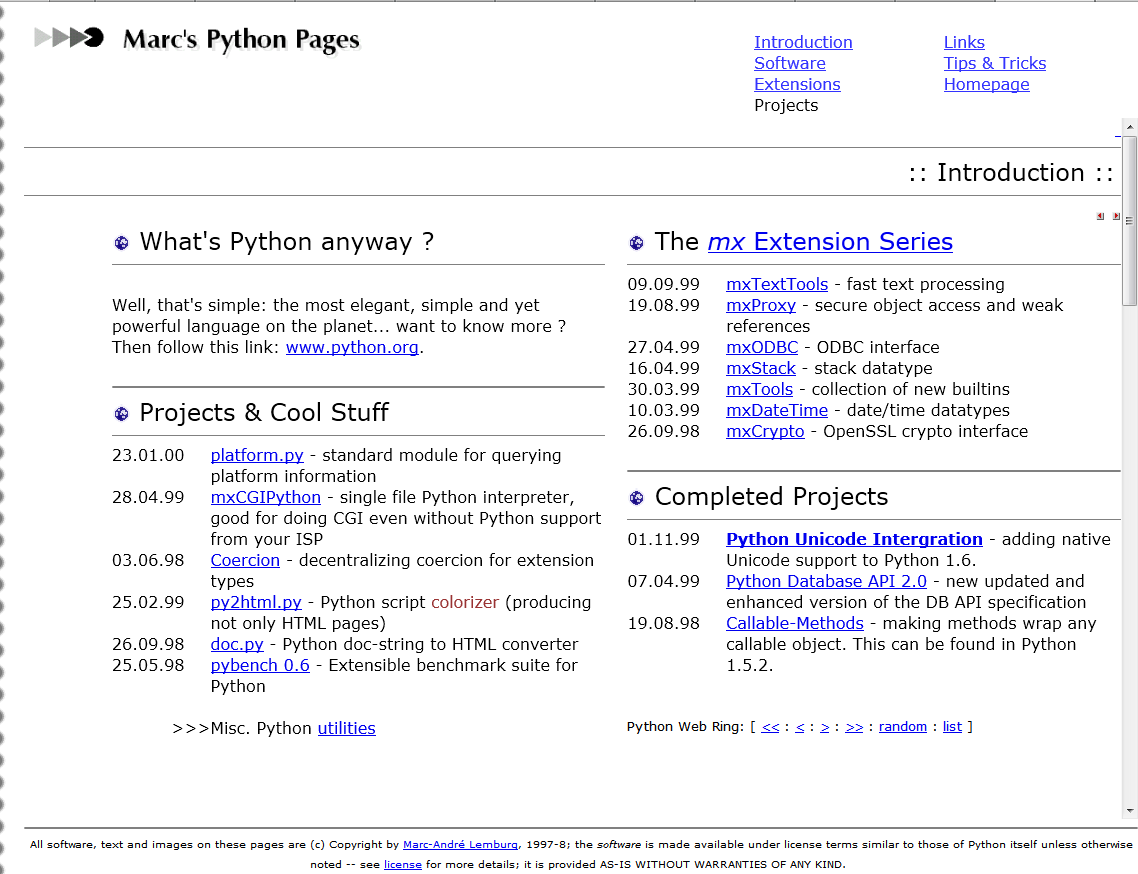
    Long ago, in the late 1990s, I had a website on Christian Tismer’s Starship Python to show my Python projects to the community and report on new developments, provide tips, hints and small utilities. The site was called “Marc’s Python Pages”:

    image

    Turning a hobby into business

    I then launched my company eGenix.com Software, Skills and Services GmbH in 2000 to market a web application server I had been working on for a couple of years. As it turned out, I was too early with the product. The market was still thriving using CGI scripts, Perl and a couple of static pages to run websites. At the same time, the Internet bubble burst, so it wasn’t exactly perfect timing for starting a DotCom company.

    I eventually sold a single license of the application server to Steilmann in Bochum and then turned to consulting work, using the eGenix mx Extensions I had written for the application server as a way to market the company and myself to companies using Python.

    This worked reasonably well and I have since run several projects, in-house at clients or outsourced to eGenix, and continued to add new useful commercial products to our portfolio – mostly around the commercial ODBC database Python interface mxODBC I had originally written for the application server.

    Commercial and Open Source Software

    Incidentally, the development in 1997 also triggered the development of a date/time library at the time, since Python had no way of storing date/time values as objects apart from using Unix ticks values. Since it was a basic building block, I open-sourced it, in the same spirit as Python itself was open source (even though the term wasn’t known at the time). mxDateTime became the de facto standard for date/time storage, until Python itself received a datetime module.

    I also open sourced several other C extensions for Python, which were all used in the application server, such as , , , etc. – what was then to become the eGenix mx Extensions.

    Still enjoying Python and it’s community

    Over 15 years later, I still haven’t lost interest in Python, which I think means something. I continue to enjoy working with it, for it and enjoy the community that has developed around Python every single day.

    I usually write lots of emails on mailing lists to discuss and stay in touch with people. Lately, I found I was missing a more persistent way of writing down ideas and snippets, something along the lines of what once were the Starship pages, so here you go… hope you’ll enjoy the ride.

    If you want to follow the blog, please see the contact page. It’s currently possible to use RSS, Twitter and Tumblr for this.

    Enjoy,

    Marc-André

    PS: The website is not yet complete, e.g. the project pages don’t work yet. I’ll add more content over the next few weeks.

    This content was originally published here.

  • US concerned about NKorean activities

    US concerned about NKorean activities

    Kathmandu, June 14

    Amidst reports of growing activities of North Koreans in Nepal, Mark Lambert, special US envoy for North Korea, has asked the Nepal government and politicians not to entertain North Koreans in the country, stating that Nepal as a member of the United Nations should respect the decision taken by the global body to impose sanctions on the country.

    Lambert, who is on a three-day visit to Nepal, made this appeal to lawmakers, senior government officials and ruling Nepal Communist Party (NCP) Co-chair Pushpa Kamal Dahal.

    He expressed concerns about growing business activities of North Koreans in Nepal. “He also expressed fear that North Koreans might have been using Nepal as a base to commit cyber crimes,” a lawmaker, who met Lambert, said.

    Lambert met four lawmakers Pabitra Niraula Kharel, Deepak Prakash Bhatta, Dibya Mani Rajbhandari and Sarala Kumari Yadav, during his visit. Kharel is the chairperson of the parliamentary International Relations Committee, while the other three are members of the same panel. Lambert also met NCP Co-chair Dahal.

    Lambert’s message during these meetings was clear — the United Nations Security Council has placed sanctions on North Korea, and Nepal, as a member country, should respect this decision.

    Nepal became a member country of the UN in 1955. The UN has imposed a number of sanctions on North Korea after the country started developing nuclear weapons, in violation of the UN charter. These sanctions, among others, bar UN member countries from hosting citizens of North Korea.

    “Nepal is a member of the UN and it has the obligation to follow resolutions passed by the UN Security Council,” said US Embassy Spokesperson Andie De Arment, who confirmed that Lambert was in Nepal to discuss growing activities of North Koreans in the country.

    Earlier, US Secretary of State Mike Pampeo had also raised the North Korean issue during Foreign Minister Pradeep Kumar Gyawali’s visit to the US in December.

    The issue was also raised by David J Ranz, acting deputy assistant secretary for US State Department’s Bureau of South and Central Asian Affairs, during his visit to Nepal in May.

    The post US concerned about NKorean activities appeared first on The Himalayan Times.

    This content was originally published here.

  • Golden Tips to Learn Any Programming Language Faster

    Golden Tips to Learn Any Programming Language Faster

    Learning a new programming language is never an easy task for anyone. You have to go through a lot of new concepts, resources, and tools and work on them for the first time. In this article, I will be giving some important tips that every programmer should keep in mind while learning any programming language.

    Tips to Learn Any Programming Language Faster

    1. Organize Your Goal

    Computer programming languages include Javascript, SQL, Python, C++, Java, PHP, Ruby and many more. Each of these languages has its specific applications. Therefore, you will take a great step forward by trying to know your goal so that you will be able to learn the right programming language. Conversely, if you fail in setting your direction right, you will be beating the air.

    2. Become a self-taught programmer

    This is important, first and foremost motivate yourself to become a self-taught coder. Most of the successful programs are self-taught, i.e., they choose a programming language like Python or Java (Python is mostly recommended because it is extremely high-level language) and start learning about its syntax with reference to documentation or ebook. According to 2018’s stack Overflow Survey, more than 86% of programmers taught themselves coding.

    3. Focus on the fundamentals

    One of the most common mistakes people do — is they try to finish the fundamentals as quickly as possible and start the coding part. In this process, they skip a few chapters at the beginning and spend less time with the fundamentals of the subject.

    First, you’ll have to understand that this doesn’t work in learning computer programming. You might finish the tutorial or reach the actual coding section fast but it will create a lot of troubles for you in the future. People who learn this way usually stuck at higher levels, easily lost and ultimately have to go back to learn basics.

    4. Use the right tools

    The primary tool is a computer with the required configuration to run programming software. The software includes bug databases, debuggers, build tools, disassemblers, interface generators, Notepad++ and much more. However, the tools you need depends on the type of programming language you want to learn.

    5. Dry Run Your Code

    Dry run means iterating through each line of your code on the paper before running it on the machine. This habit is known to improve logical thinking and makes the next levels of learning easier and faster. Dry running code is the best way to learn how to program. If you are planning to make a career in programming, try to adopt this habit in the early stage of learning.

    6. Code as you learn

    Make your learning process active rather than passive. Start juggling with the lines of code as you learn. Do not just sit back and watch tutorials or read notes hoping to implement what you are learning later. You will encounter many roadblocks that will be forcing you to go back and start learning again.

    The earlier you start trying out what you are learning, the faster you will learn. In fact, your coding environment should be running concurrently as you learn. The most recommended way of learning is to build a project as you read through the learning material. This way you will be able to learn faster and in a systematic way.

    7. Practice with Patience

    Practicing is the best way you can improve your coding skill. However, if you skip the basics, the advanced stages will be alerting you that you have missed some parts, in the long run, you may quit. Hence, begin by learning the basics before you forge ahead to a more advanced stage.

    8. Stay Motivated

    Programming is no doubt an exciting task but it’s also known to be exhaustive. Many times people spend hours on a single bug with no solution. It has the ability to affect your complete schedule of meals and speed, which is definitely not a healthy situation especially if you are young.

    You’ll have to remain calm in those days. Our brain also needs some refreshment from time to time. It could be meeting with friends, going on a trip, some sort of exercise or just playing games on your smartphone. Always focus on maintaining a balance between everything and never forget your cool. This will ultimately help you improve focus and learn things fast.

    9. Make use of Online Resources

    There are many free online sites that provide free resources, including video tutorials, that will teach you computer programming. Therefore, you can start learning the basics of programming from free coding sites, such as Codecademy, FreeCodeCamp, Coursera, edX, Codewars and much more.

    Start using StackOverflow, the community which helps you in any of the coding-related issues. You can find many solutions for code and errors. Here is the list of 5 Best Online Communities for Programmers.

    This content was originally published here.

  • The Best Tech Jobs – Top Salaries, Satisfaction & Openings (June 2019)

    The Best Tech Jobs – Top Salaries, Satisfaction & Openings (June 2019)

    June is here already, and with almost half the year gone, it may be time to re-evaluate your career situation. Techies are in high demand, and companies are offering some great incentives to lure talent (that’s you!).

    Before you determine whether last year’s swimsuit still fits, make sure your job still does. If your old job is feeling a little tight and uncomfortable, tighten up your résumé and go shopping for a new one.

    Here are the 15 hottest tech jobs being hired for right now by the top companies:

    The 15 hottest tech jobs right now

    1) Data scientist

    What data scientists do: While data science is a diverse field with a wide range of responsibilities depending on the company, all data scientists evaluate data to provide creative insight. Duties typically include creating machine-based learning tools for use by the tech company, such as recommendation engines or expanded artificial intelligence (A.I.) functions. Data scientists also typically collect, clean, and organize data, and perform statistical and predictive analysis.

    Skills and experience:

    Companies hiring data scientists now:

    2) Software engineer

    What software engineers do: Software engineers use knowledge of engineering principles and programming languages to design, develop, and install software and systems. This role can start as an entry-level position, with the opportunity to be promoted to senior software engineer roles. 

    Skills and experience:

    Companies hiring software engineers now:

    3) DevOps engineer

    What devops engineers do: DevOps engineers automate and streamline existing systems and processes, as well as build and maintain tools for deployment, operations, and monitoring systems. They also diagnose and resolve issues in development, testing, and production environments.

    Skills and experience:

    Companies hiring devops engineers now:

    4) Security engineer

    What security engineers do: Security Engineers protect computer networks and systems. They devise and carry out strategies to monitor and protect sensitive data and systems from infiltration and cyberattacks.

    Skills and experience:

    Companies hiring security engineers now:

    5) Data analyst

    What data analysts do: Data analyst duties include developing frameworks for data, analytics, and strategy development, as well as implementing data-analysis tools and providing user training. Other duties include collecting and analyzing data sets from diverse sources to inform business decisions and make accurate predictions. Tracking and monitoring internal and external data are other duties.

    Skills and experience:

    Companies hiring data analysts now:

    6) Solutions architect

    What solutions architects do: Solution architects manage complex processes to solve business problems using technology. Duties include defining features, phases, and solution requirements to address issues and weaknesses and determining the best tech solution to solve problems while also explaining the solution to project stakeholders to achieve buy-in.

    Skills and experience:

    Companies hiring solutions architects now:

    7) Systems engineer

    What systems engineers do: System engineers combine knowledge of engineering and coding to implement computer systems for businesses and organizations. Most job descriptions require system design and analysis, as well as communication, mathematical, and business skills. They implement new systems, evaluate performance, and correct software errors in existing systems. Responsibilities may include preparing progress and specifications reports, maintaining inventory, and overseeing payroll.

    Skills and experience:

    Companies hiring systems engineers now:

    8) Software developer

    What software developers do: Software developer responsibilities include designing, testing, implementing, and managing software programs. They are also charged with modifying existing programs to meet company needs, developing quality-assurance testing methods, training users, and evaluating the software for its efficiency and usability. They may also implement programs, integrate systems, train users, and monitor systems.

    Skills and experience:

    Companies hiring software developers now:

    9) UX designer

    What UX designers do: UX designers are responsible for the look and feel of websites. Using product specifications, user psychology, and research data, they work with web developers to create website concepts and conduct usability tests to evaluate design success. They find creative ways to address usability and findability issues, and use the knowledge gained to develop wireframes and prototypes to meet customer needs.

    Skills and experience:

    Companies hiring UX designers now:

    10) Systems administrator

    What systems administrators do: System administrators are responsible for providing technical support for both hardware and software issues. They manage the configuration and operation of client-based computer operating systems, monitor systems, and respond to security issues. Job duties also include maintaining secure data backups, and monitoring and upgrading systems, processes, and security measures. They will also be expected to install and test new system hardware.

    Skills and experience:

    Companies hiring systems administrators now:

    11) Applications engineer

    What applications engineers do: Application Engineers gather customer input and sales information and use it to design or redesign, develop, test, and implement complex software programs and applications based on user needs. Job duties include designing, developing, implementing, and testing new applications, upgrading existing software, and providing technical support.

    Skills and experience:

    Companies hiring applications engineers now:

    12) Data engineer

    What data engineers do: Data engineers build systems to handle big data. They design, develop, build, test, and maintain architectures, including databases and large-scale data-processing systems. They are responsible for finding ways to acquire and filter data, and developing high-performance algorithms for data use, such as predictive modeling and proof of concepts. Responsibilities also include creating and implementing a disaster-recovery plan.

    Skills and experience:

    Companies hiring data engineers now:

    13) Product manager

    What product managers do: Product managers are responsible for developing products from start to finish. They conduct market research to identify potential products, devise product requirements, write specifications, set production timelines and benchmarks, assign responsibilities, and monitor the project from end-to-end. They may also set pricing, as well as develop marketing strategies and rollout schedule.  

    Skills and experience:

    Companies hiring product managers now:

    14) Java developer

    What Java developers do: Java developers create user information system solutions by designing and developing high-volume, low-latency applications. Responsibilities include determining and defining user needs, writing specifications, and developing, testing, and implementing solutions.

    Skills and experience:

    Companies hiring Java developers now:

    15) Sales engineer

    What sales engineers do: Technical sales engineers provide clients with technical advice and introduce new products. Responsibilities include identifying new markets and clients, conducting sales meetings, negotiating contracts, and providing information, training, and technical support to clients.

    Skills and experience:

    Companies hiring sales engineers now:

    This content was originally published here.

  • Study uncovered new potential genetic causes of male infertility

    Study uncovered new potential genetic causes of male infertility

    Sperm of infertile men is healthy before it begins journey out of body, study

    Male infertility is due to low sperm production, abnormal sperm function, or blockages that prevent the delivery of sperm. Illnesses, injuries, chronic health problems, lifestyle choices, and other factors can play a role in causing male infertility.

    Not being able to conceive a child can be stressful and frustrating, but several male infertility treatments are available.

    Despite the known importance of genetic factors in the event of the man producing no , only about 25% of these cases are explained currently.

    According to a new study- to be presented today at- European Society of Human Genetics- disclosed new potential genetic causes of male infertility.

    Ms Manon Oud, from the Radboud University Medical Centre, Nijmegen, The Netherlands conducted the first exome sequencing study, where they examined the vital role of de novo mutations (genetic changes that are not present in the DNA of the parents of an individual) in male infertility.

    The human genome consists of 3 billion nucleotides or “letters” of DNA. But only a small percentage — 1.5 percent — of those letters are translated into proteins, the functional players in the body. The ‘exome’ consists of all the genome’s exons, which are the coding portions of genes.

    Ms. Oud said, “These de novo mutations are found in every individual and are part of the natural evolution of the genome. Mostly they do not affect our health. But in some cases, they have a strong effect on gene function and can lead to disease. Until now, their role in male infertility had not been studied.”

    Scientists volunteered 108 infertile men for the study. They then studied their DNA and also of their parents.

    Ms Oud said, “Comparison of the parental DNA with that of the offspring enabled the identification of the de novo mutations. ” We found 22 in genes involved in spermatogenesis, none of them previously known to cause infertility in human.”

    However, scientists think that it’s too early to give these patients a definitive diagnosis as further studies are ongoing. They want to screen more patients to learn more about the function of the genes that are affected by them.

    Ms Oud says, “We are studying the role of these genes in material from testis biopsies of our patients and performing experiments in fruit flies to see whether disruption of these genes causes infertility in them.”

    “The results will help establish new diagnostic tests, which will be able to provide a patient with a detailed analysis of the reason for his infertility and allow for personalized care. By establishing the molecular cause of infertility, the risk of transmitting infertility to another generation can be predicted.”

    The post Study uncovered new potential genetic causes of male infertility appeared first on Tech Explorist

    This content was originally published here.

  • Delightful claymation describes how a fungus is used to control an insect pest / Boing Boing

    Delightful claymation describes how a fungus is used to control an insect pest / Boing Boing

    https://www.youtube.com/watch?time_continue=4&v=BXsv-H4UX_c I’ve praised Max Helmberger’s excellent claymation videos about insects in the past. He has produced another, this time for the New York State Integrated Pest Management Program. From the YouTube description: The Hajek Lab group at Cornell University has been researching methods for biological control of Asian longhorned beetles using entomopathogenic fungi. This video…

    This content was originally published here.