Author: Truth & Hammer

  • What’s Cooking Outdoors: Trends in Outdoor Kitchen Design for 2019

    What’s Cooking Outdoors: Trends in Outdoor Kitchen Design for 2019

    Whether grilling by the pool at a bustling family barbecue or savoring a quick meal on the patio on a quiet evening, the simple joy of eating outside is a pleasure in and of itself. However, cooking outdoors with all the amenities of a fully-furnished kitchen can transform outdoor dining into an experience that will delight recreational cooks and professional chefs alike.

    From granite countertops to natural stone veneer, your local Swenson Granite Works’ store can provide you with a range of products to create a timeless outdoor kitchen that makes a bold statement of unmatched durability.

    This year’s outdoor kitchen trends offer exciting ways to create an inspiring culinary space in your own backyard.

    Year-Round Livability

    The backyard has always been a popular hangout spot for warmer days, but today’s homeowners are looking for ways to make their outdoor kitchens a more livable extension of the indoor living area.

    Mike Corsie, Founder of Terrapin Landscapes in Kennebunkport, Maine, names livability as a major trend in recent years.

    “Homeowners are using their outdoor spaces more often, and they want them to be more comfortable,” says Corsie. “Most of these larger outdoor living spaces include a kitchen and dining area.”

    Lighting and heating features can make outdoor kitchens usable on cooler and darker nights as well, meaning backyard enjoyment is no longer limited to weekends and summers. Investing in high-quality, long-lasting furniture and materials is another great way to make your backyard space more livable year-round.

    Colorful softscape creates a seamless transition from the natural surroundings to the stone design of this home in Kennebunkport, Maine. Landscaping by Terrapin Landscapes. Kitchen designed by homeowner and builder, Jon Trudo of Creative Coast Construction. Kitchen features Woodbury Gray granite inlays, countertop and pillar caps.

    According to Corsie, functionality is a growing trend as outdoor kitchens become more popular. “People are more interested in cooking outside, and it can’t just look pretty, it has to be a good blend of fashion and function.”

    As most experienced outdoor entertainers would agree, one of the biggest hassles of dining al fresco is transporting food and dinnerware back and forth from the indoor kitchen to the outdoor dining area. However, a fully functional outdoor kitchen—complete with everything from a refrigerator and storage to a recycling and trash area—can transform outdoor meals from impractical occasions to regular weeknight routines.

    A fully functional outdoor kitchen with a sandblasted Woodbury Gray granite countertop and Connecticut Blend Ledge thin veneer add warmth and a natural aesthetic to this spacious Rhode Island backyard patio. The patio pavers are Woodbury Gray granite. Project by Magma Design Group.

    Natural Stone Features

    Durability is always an important factor in hardscape design, but it is especially critical in outdoor kitchens due to the heavy wear and tear they endure.

    “I advise homeowners to always use the highest quality materials possible to ensure that (their outdoor kitchen) is going to withstand the elements,” says Corsie. “I prefer to work with natural stone, especially locally-found materials (in order to) design something that fits with the natural landscape.”

    He recommends natural stone as one of the best materials to use in an outdoor kitchen. Not only is natural stone an excellent way to complement the native landscape, it is also virtually maintenance-free. These hardwearing properties make it ideal for countertops, veneer, patio pavers and walkways in and around a backyard cooking space.

    For countertops, granite and bluestone—which naturally prevent bacteria growth—are outstanding options and will provide unbeatable utility in an outdoor kitchen. “Granite is always the most popular because everyone knows of granite as being strong and durable, especially in Maine where it’s locally available,” says Corsie.

    Natural stone veneer is an excellent way to visually frame your outdoor appliances, and it will withstand the elements much better than wood or tile. Swenson’s natural stone veneer comes in granite, limestone, fieldstone and quartzite, and can be installed in a variety of shapes from modular square and rectangular patterns to more organic round or mosaic arrangements.

    A compilation of natural stone and granite were used to create this outdoor kitchen. The countertop and facing are polished Woodbury Gray granite.

    This New Hampshire poolside outdoor kitchen features Swenson Weathered Quarry veneer and a bluestone countertop. The patio pavers are full color bluestone. Project by Steve Desmarais Contracting.

    Built-in Seating

    Homeowners with scenic backyards often prefer materials that preserve the natural aesthetic of their space. However, when it comes to functional elements like furniture and seating areas, it can be difficult to find pieces that feel natural in a backyard landscape. For these reasons, built-in seating has become a popular option.

    Built-in seating has been trending for years in outdoor living rooms, and now it’s making its way into outdoor kitchens. A seat wall will save space and complement natural stone veneer or patio pavers, all while accommodating more guests.

    Built-in seating is also an excellent option around a fire feature, like an outdoor fireplace or fire pit. Corsie often incorporates a built-in seating wall on one side of a fire pit with chairs placed across.

    An outdoor kitchen area in Hollis, New Hampshire features Woodbury Gray granite wall caps that can be used as seating around the fire pit. Also featured are Woodbury Gray granite rock face steps, a full color natural cleft bluestone patio, honed Woodbury Gray granite grill countertops and Boston blend mosaic thin veneer. Project by Northern Lights Landscape Contractors.

    Stainless Steel Cabinets

    A fully functional outdoor kitchen will need storage space for dinnerware, utensils, and other accessories. Since wood cabinets can be problematic for outdoor storage, stainless steel cabinets are growing in popularity due to their weather and insect-resistant properties. They are also easy to clean, visually appealing, and easily customizable.

    “You can choose multiple door-and-drawer combinations, sink units, pullout trash bins, and lockable storage (as part of the cabinets)”, explains DIY Network.

    Many homeowners like the way stainless steel cabinets complement both outdoor grills and natural stone elements simultaneously. However, if you prefer the appearance of natural wood, stainless steel cabinets can be coated with a realistic wood finish.

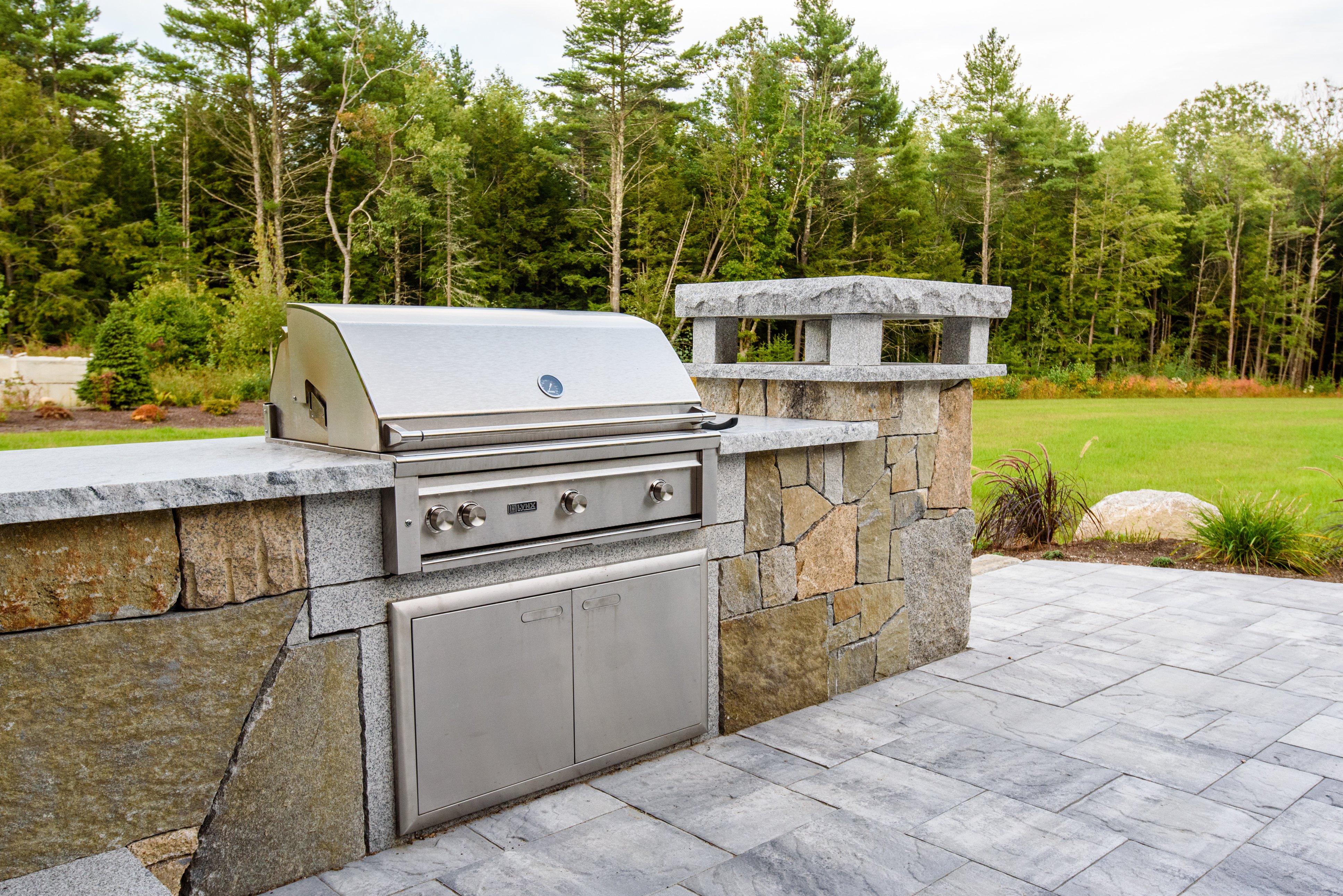
    Woodbury Gray granite countertops and inlays complement the 42” Lynx Pro Series Grill and around stainless steel storage doors. A pillar with double Woodbury Gray granite caps conceals a light fixture to create a glowing focal point at night.

    Versatile Grills

    Grills aren’t just for making burgers and hotdogs anymore. Homeowners are now looking for flexibility in their outdoor grill stations, seeking out grills that are designed to prepare a larger variety of foods. Hybrid and Kamado-style grills are two great options for outdoor cooks looking to expand their culinary capabilities.

    In terms of popularity, built-in models have significantly surpassed stand-alone barbecues in luxury outdoor kitchens within the past several years. “These days at least 75% of sales of high-end grill companies are generated by built-in models, versus cart versions,” says Kalamazoo Gourmet. With hundreds of premium built-in models available, the possibilities for customization are nearly endless.

    Hybrid grills, which easily switch between charcoal and gas, are a popular option for year-round grilling. They combine the convenience of a gas grill with the delicious smoky flavor that only a charcoal grill can provide.

    This Kalamazoo Hybrid Fire Grill even offers wood grilling in addition to charcoal and gas. A drawer below the barbecue can either be filled with wood or charcoal, or left completely empty for gas-only grilling.

    Another popular option for outdoor grilling is the highly versatile Kamado-style grill, perfect for cooking everything from a slow-roasted chicken to baked bread in the comfort of your backyard. Its wide temperature range of 225° to 750°F makes it a convenient, all-in-one option for grilling, baking, roasting, and slow smoking.

    Not only does a Kamado grill require less charcoal than a conventional grill, but it also provides even heat distribution to cook meats thoroughly without removing moisture. The Spruce Eats recommends the Kamado Joe Classic II as the best overall grill in its category.

    Grill features are also trending this year. Side burners are great for making sauces or boiling water, and some grills even come equipped with a motorized rotisserie.

    Backyard Pizza Oven

    A custom pizza oven is a perfect addition for those who want to bring a taste of Italy to their backyard kitchens. Although it comes at a higher price point and requires more installation time than a standard grill, this exciting backyard feature is well worth the investment.

    For those who want to create an artisan pizza kitchen in their own backyard, DIY Network recommends several stainless steel and wood fired options.

    Overhead Structure

    Overhead structures provide shelter from the sun and heat during the hot summer months. They can be made of natural or manmade elements, or a combination of the two, and are easily customizable to suit any backyard.

    Patio covers, which provide ample shade in any weather, are often designed as an extension of the house with a solid roof. They are particularly beneficial in areas with long, scorching summers because they offer complete full-shade coverage.

    Pergolas, on the other hand, are a great partial-shade alternative to patio covers. “Pergolas provide a little bit of shelter and shade without completely obstructing the view and experience of being outside,” says Corsie. They can either be decorated with vines or other plants or installed with retractable canopies for particularly hot days.

    This cozy patio with a pergola at this Hollis, New Hampshire home features full color natural cleft bluestone. Boston Blend ledgestone thin veneer, along with 2” thermal top Woodbury Gray granite wall caps and countertop, accentuates the space. Project by Northern Lights Landscape Contractors.

    Planting is another great option for providing shade that can double as protection from the sun and a screen for additional privacy. Homeowners can choose from a wide range of trees and shrubs that suit their local climate and surrounding scenery.

    Clever Accessories

    An outdoor kitchen wouldn’t be complete without handy and versatile accessories to provide a finishing touch. This year’s top trending favorites are clever gadgets that simplify cookouts of all kinds.

    Illuminate your grilling station with the Portable Bullet Barbecue Light, a durable, stainless steel instrument for lighting your grill station at night.

    Then start your barbecue with the Looftlighter, an electric fire starter that lights charcoal or kindling in less than 60 seconds, making it perfect for lighting any charcoal grill or wood fireplace.

    Prepare mouthwatering shish kabobs with this set of four stainless steel sliding skewers from Williams Sonoma, specially designed with a sliding disc for easily removing cooked meat or vegetables.

    After grilling, use the Grand Grill Daddy, a heavy-duty brush, to steam-clean your barbecue. This tool makes cleaning easy and is safe to use on stainless steel and iron grill grates.

    Our thin veneer spec sheet will help you choose the right material for your outdoor kitchen. Download it here.

    This content was originally published here.

  • New York ends religious exemption to vaccine mandates

    New York ends religious exemption to vaccine mandates

    Too bad the Senate did not do their homework!  Anywhere you look you will see that most children that come down with measles are new to the country.  Why not make it mandatory to have a vaccine before they even get to the country.  Also, with proper diet and good food most people will not get any viruses. However, the pharmaceuticals will not make any money if they can not force you to buy their product. So, buy up stocks in all those chemicals that create the vaccines, because soon the superbug vaccine will be hitting the market too!

    New York eliminated the religious exemption to vaccine requirements for schoolchildren Thursday, as the nation’s worst measles outbreak in decades prompts states to reconsider giving parents ways to opt out of immunization rules. The Democrat-led Senate and Assembly voted Thursday to repeal the exemption, which allows parents to cite religious beliefs to forego getting their child the vaccines required for school enrollment. Gov. Andrew Cuomo, a Democrat, signed the measure minutes after the final vote. The law takes effect immediately but will give unvaccinated students up to 30 days after they enter a school to show they’ve had the first dose of each required immunization. With New York’s move, similar exemptions are still allowed in 45 states, though lawmakers in several of them have introduced their own legislation to eliminate the waiver. The issue is hotly contested and debate around it has often been emotional, pitting cries that religious freedom is being curtailed against warnings that public health is being endangered. After the vote in the Assembly, many of those watching from the gallery erupted in cries of “shame!” One woman yelled obscenities down to the lawmakers below.

    The debate has only intensified with this year’s measles outbreak , which federal officials recently said has surpassed 1,000 illnesses, the highest in 27 years. “I’m not aware of anything in the Torah, the Bible, the Koran or anything else that suggests you should not get vaccinated,” said Bronx Democrat Jeffrey Dinowitz, the bill’s Assembly sponsor. “If you choose to not vaccinate your child, therefore potentially endangering other children … then you’re the one choosing not to send your children to school.” Hundreds of parents of unvaccinated children gathered at New York’s Capitol for the vote to protest. Stan Yung, a Long Island attorney and father, said his Russian Orthodox religious views and health concerns about vaccines will prevent him from vaccinating his three young children. His family, he said, may consider leaving the state. “People came to this country to get away from exactly this kind of stuff,” Yung said ahead of Thursday’s votes.

    Supporters of the bill say religious beliefs about vaccines shouldn’t eclipse scientific evidence that they work, noting the U.S. Supreme Court ruled in 1905 that states have the right to enforce compulsory vaccination laws. During the Assembly’s floor debate, supporters brought up scourges of the past that were defeated in the U.S. through vaccines. “I’m old enough to have been around when polio was a real threat,” said Assemblywoman Deborah Glick, D-Manhattan. “I believe in science…. Your personal opinions, which may be based on junk science, do not trump the greater good.” Supporters also suggest some parents may be claiming the religious exemption for their children even though their opposition is actually based on scientifically discredited claims about the dangers of vaccines. The bill would not change an existing state exemption given to children who cannot have vaccines for medical reasons, such as a weakened immune system. Cuomo told reporters on Wednesday that he believes public health — and the need to protect those who cannot get vaccinated because for medical reasons — outweighs the concerns about religious freedom.

    “I understand freedom of religion,” he said. “I have heard the anti-vaxxers’ theory, but I believe both are overwhelmed by the public health risk.” The current measles outbreak has renewed concern about the exemptions in many states. The nation last saw as many cases in 1992, when more than 2,200 were reported. The majority of cases are from outbreaks in New York in Orthodox Jewish communities. California removed personal belief vaccine exemptions for children in both public and private schools in 2015, after a measles outbreak at Disneyland sickened 147 people and spread across the U.S. and into Canada. Maine ended its religious exemption earlier this year. Mississippi and West Virginia also do not allow religious exemptions. Once common in the U.S., measles became rare after vaccination campaigns that started in the 1960s. A decade ago, there were fewer than 100 cases a year.

    source

  • Chinese Christians are Memorizing Scripture Because Communist Gov ‘Can’t Take What’s Hidden in Your Heart’

    Chinese Christians are Memorizing Scripture Because Communist Gov ‘Can’t Take What’s Hidden in Your Heart’

    Do you think China would have become this way if it were not for a radical religious middle eastern group that created problems for everyone in China?  All the killing this group did, and terrorising  the government like they did made it very difficult for the government to accept them.  So, rather than try to control them, all religions get the shake down.  If people are not careful this will happen everywhere.  Trying to be tolerant for so called religious groups that are violent will force governments to close everyone down.

    Wayne Cordeiro, pastor of New Hope Christian Fellowship in Honolulu, Hawaii, is praying that American Christians become more like Chinese Christians. In a sermon, the pastor of the Hawaiian megachurch shared an experience he had on a trip to China, where the church went to train leaders. On that particular trip, he brought up twenty-two Christians from the Hunan Province, who road thirteen hours on a train to attend the leadership training. They sat in a 700 square foot hotel room, with no air conditioning, or couches to sit on, with Cordeiro leading the gathering. “If we get caught what will happen to me?” Cordeiro began by asking. “Well you will get deported in 24 hours, and we will go to prison for three years,” the Chinese Christians responded. He followed up by asking how many had spent time in prison, and out of the twenty-two, eighteen shared that they had been imprisoned for their faith. The 22 that had gathered came from the mountainous province in southern China, yet amongst themselves oversaw 22 million people in China. “We forget that there are 1.3 billion people in China,” Cordeiro added. He shared that shortly after they began their lesson, in 2 Peter. He only had fifteen Bibles so seven people went without. “I said turn to 2 Peter 1, we are going to read it. Just then one lady handed hers to the person next to her, and I thought ‘hmm interesting,’” he shared.

    Once they began reading, he quickly realized why she had given her Bible away, she had memorized the whole book. “When it was done, I went over to her at a break and said ‘you recited the whole chapter.’” “In prison, you have much time in prison,” she responded “Don’t they confiscate the Bible?” he asked. She shared while they indeed confiscate any Christian material, people smuggle in scripture written on paper and hide it from the prison guards. “That’s why we memorize it as fast as we can because even though they can take the paper away, they can’t take what’s hidden in your heart,” she shared with him. After the 3-day study was complete, he asked the Christians from the Hunan Providence how he could pray for them. “Could you pray that one day we could just be like you?” One man asked, referencing the ability to worship as desired in America. “I looked at him, and said ‘I will not do that.’” “When they asked him why not, he explained: “You guys road a train thirteen hours to get here, in my country, if you have to drive more than an hour, people won’t come.”

    “You sat on a wooden floor for three days, in my country if people have to sit for more than 40 minutes they leave. You sat here for not only three days on a hard wooden floor, in my country if it’s not padded pews and air conditioning, people will not come back.” “In my country, we have an average of 2 bibles per family, we don’t read any of them. You hardly have any bibles and you memorize them from pieces of paper.” “I will not pray that you become like you, but I will pray that we become just like you,” he concluded.

    source

  • Missing for 6 Days Praises Jesus After Longshot Rescue

    Missing for 6 Days Praises Jesus After Longshot Rescue

    A hiker who almost died after he went missing for six days in the perils of the Arkansas wilderness is thanking Jesus for leading search-and-rescue teams to save him. Joshua McClatchy, 38, had planned a solo hike in the Caney Creek Wilderness in Mena, Arkansas, to celebrate his birthday, ABC News reported. He went missing on June 1 after he managed to send a text message to his mother in spotty cellphone coverage, saying he needed help. During the search, rescuers braved treacherous landscapes that included thick treetops and steep mountains as well as the threat of deadly wildlife such as copperhead snakes, cottonmouth snakes, rattlesnakes, and bears, said Polk County Sheriff Scott Sawyer. McClatchy was finally found June 7 about four miles off Buckeye Trail after nearly a week of no contact when crews found a window of good weather to operate a National Guard helicopter equipped with infrared technology to locate him, Sawyer said.

    He told EMS as he was being loaded onto an ambulance that he never thought he’d see anyone ever again. The hiker was in good shape but was severely dehydrated. The first thing he requested was water, he told WFAA. He had protein bars and bottled water when he set off on the hike, but it is unclear how much he consumed before he went missing, his family said. He also had a filter straw that could help him drink potentially unclean water. “It was so refreshing,” McClatchy said of his first sips of water. He was given an IV before the four-hour trek back to civilization aboard a rescue cart, which made him “feel considerably better,” he said.

    source

  • Vogue is Teaching Girls How to Bypass Parents for Abortion

    Vogue is Teaching Girls How to Bypass Parents for Abortion

    What is wrong with some people.  Does Teen Vogue want a landslide of lawsuits?  Anytime you start giving medical advice you are liable.  Why does Teen Vogue concern itself with such issues?  Did they also comment about abstaining, or option of adoption?    Elizabeth Johnston is facing off with Teen Vogue after the magazine posted an article giving teens instructions on how to get an abortion without telling their parents. Johnston is the self-described “Activist Mommy” and her conservative videos on subjects like marriage, sex, and abortion usually go viral. She recently voiced concern over an article that listed the logistics of getting an abortion without parental consent. The June 6th article on sexual health and identity mentions that it’s tricky for teenaged girls to get an abortion. The author teaches them about states that don’t require parental consent, and how to obtain a judicial bypass if they don’t want their parents involved in the abortion decision.

    Johnston says a teen can find better counsel than a magazine columnist on the issue of abortion, even if her parents aren’t available. She encourages parents on her blog, “Build up and nurture your relationships with your own children. Despite our best intentions in parenting, the day may come when our sons or daughters come to us with the news of an unplanned pregnancy. If it does, we must do as God commands and love them, guide them, and care for them and their precious child.” Despite the print version of the magazine being pulled from shelves, the website continues to offer teens liberal advice on sexuality.

    source

  • Well, Venezuela Is Done… – Off The Grid News

    Well, Venezuela Is Done… – Off The Grid News

    Listen To The Article

    Socialism has destroyed yet another country…

    As I’m writing this, Venezuelans are eating dogs, cats and pigeons. The lucky ones get some supplies (after waiting in line for hours on end, that is). They may have water (rain water, I guess), but the food is gone, not to mention other supplies.

    How did this happen in a country that has the largest oil reserves in the world?

    The price of oil dropped, that’s how. But that doesn’t mean things were peachy before. They had troubles for years. Culprit? The socialist regime. High-level corruption murdered their country.

    And I can’t help but wonder. Where will the US end up given the greed and corruption of the leftists coupled with the $20 trillion debt?

    There’s only one thing we can do and that’s to stockpile. Stockpile food, water, tools, gear and everything else you and your family will need.

    This content was originally published here.

  • How to remove yourself from people search sites | Komando.com

    How to remove yourself from people search sites | Komando.com

    Privacy is becoming an increasingly scarce resource on the internet. By default, many websites, applications, and even devices start collecting your data the moment you log on — requiring you, the user, to tell them not to.

    Even then, background activity keeps the data-stream rolling while algorithms find new ways to profile you based on your browsing behavior. In many ways, it’s possible for marketers and data analysts to know more about you as a person than your close friends or family.

    Because of how easy it is to obtain information on virtually anyone, a cottage industry of so-called “data brokers” has emerged online. These shady platforms crawl across social media and public records to build profiles about anyone they come across — and they’re more than happy to sell the data to the highest bidders. Odds are, at least one data broker has compiled a profile of your personal information, and you might not even know it yet!

    The practice of data brokering is a booming business, but the people behind it are only able to get away with what they do by allowing people to “opt-out” of having their data profiled. The trick is knowing which platforms to look for, as well as how to remove yourself from them.

    That’s why we’ve put together our guide to deleting your information from data brokering platforms, as well as the best ways to prevent them from skimming your profiles in the future. You have a right to privacy, after all. It’s time you exercised it.

    How to stop data brokering sites from grabbing your data

    Data Brokers are only able to grab data that’s publicly available — meaning you’ll need to take the first steps to secure this information. The primary resources these platforms use are social media sites, with Facebook (naturally) being the biggest culprit.

    They’re not alone, however, as nearly any publicly facing social media profile can be skimmed for information. On top of this, data brokers are often keen to contact credit reporting agencies for more detailed information about you and your spending habits

    In order to prevent data brokers from harvesting your information, the best first step you can take is to lock down your social media accounts to “private.” All this means is that your profile can only be seen in detail by people you’re already friends with or mutually following.

    If a stranger looks at your account, the only information they’ll see is a profile picture, banner image, username, and any info you decide to put in your profile header (depending on the platform, of course).

    Each social media site has a different approach to going private, so we’ll list each one out individually. Mind you, these are the most popular platforms, but nearly every community or system has a way to keep your profile information between you and your closest connections

    How to make your Facebook profile private

    Facebook doesn’t make it easy to set your profile to private, but it is possible. Note: you’ll need a computer to do this, so set your phone or tablet down, for now.

    To change your profile visibility to private, you’ll want to click your name at the top of any Facebook screen you’re on to go to your profile. When you see your profile’s cover photo, click on the Edit Profile tab that appears in the bottom corner.

    On this page, you’ll see several fields of information about yourself that you may have entered. Unclick the boxes that are next to the information you want to keep to yourself, such as hometown, education, and other data you’ve listed.

    Next, you’ll want to click the arrow in the top right corner of the screen you’re on. Click on Settings in the menu that appears, and navigate to Privacy. On the next screen, you’ll see a menu option that says Do you want search engines outside of Facebook to link to your profile? You’ll want to select Edit and uncheck the box that appears.

    This will prevent Google and other search engines from indexing your account, making it so data brokers can’t use your information.

    How to make your Instagram profile private

    To make your Instagram profile private, you’ll need to use your smartphone or tablet.

    In the app, simply click on the Profile icon in the bottom right corner (it looks like the outline of a person). From your profile, click the “three lines” button in the upper right-hand corner of the screen, and select Settings at the bottom of the menu that pops out. From this screen, select Privacy, then Account Privacy on the next page.

    You’ll be able to switch a toggle that makes it so only followers you approve can see your profile and information.

    How to make your Twitter profile private

    Twitter’s privacy settings are fairly straightforward. To access them, click your profile picture at the top of the webpage.

    Next, on the menu that pops out, click Settings. On the next page, click Privacy and Safety. On the next page, you should see a box that says Protect my tweets. This locks your account from all public sources except people that follow you. Going forward, you’ll also need to approve followers that add you before they can see anything you post.

    When should you contact credit reporting agencies?

    Credit reporting agencies like Experian, Equifax, and TransUnion are vital for helping lenders determine your creditworthiness. As a result, they retain detailed profiles of you, your financials, and your spending and debt habits. Data brokers, naturally, see this arrangement as a goldmine for their business model.

    If you’re looking to stop data brokers from harvesting information from your credit report, it’s possible to “freeze” your credit. This prevents any third-parties from accessing this information, but keep in mind, you will be unable to utilize your score for credit assessment.

    You won’t be able to sign up for credit cards or apply for loans either. Consider this a “last resort” or a “drastic step” in the event you truly want to go off-the-grid, so to speak.

    To contact the biggest three credit reporting agencies, simply call the numbers below. Make sure to discuss a credit freeze, and ask the specialist who helps you any questions you might have about what you can and cannot do once your credit is frozen.

    Experian: 888-397-3742
    Equifax: 800-685-1111
    TransUnion: 888-909-8872

    How to opt out of the biggest data brokering websites

    Your main opponents in the data brokering game will be what’s called “people search sites.” These are sites that build a profile about you based on public info that site owners have gleaned from the internet. These profiles can contain extremely sensitive information like phone numbers and addresses (which, in many cases, is how junk mail and spam phone calls always know how to reach you).

    Many of these platforms have specific processes for deleting yourself from their database. Some may require a simple phone call, but others may want more information like a drivers license in order to verify you are who you say you are. We’re covering the biggest names in data brokering, including some websites like Intelius that own multiple data brokering outlets.

    The sites are listed alphabetically, along with a brief description as well as links and instructions for the best way to remove yourself completely.

    InstantCheckmate: InstantCheckmate provides an opt-out page right from the get-go. All you need to do is fill out the form at the top of the page, select the records you want to remove, and follow the instructions. The process can take up to 48 hours after opting out.

    Intelius: Intelius is one of the biggest data brokers on the internet. It owns a large network of brokering sites, including Classmates, iSearch, Peoplelookup, and PublicRecords. It, however, requires proof of identity in order to remove your data. You’ll need to fill out its opt-out form and either mail or fax a copy of your ID to complete the process.

    MyLife: MyLife requires you to call in order to verify you’re opting out. You’ll have to provide some basic personal data, but the process is fairly simple. Just make sure to ask them to remove you from Wink.com as well, since it’s another site owned by MyLife. Call (888) 704-1900 and press 2 to opt out.

    PeekYou: In order to remove your information from here, you’ll need to find your profile and copy the letters at the end of its URL. This is an identifier for PeekYou’s systems that will help them locate and remove your records. Tap or click here to find your information.

    PublicRecords: Also owned by Intelius, this site requires you to use fax or snail-mail to complete your opt-out. You’ll need to send a copy of your driver’s license along with some other basic personal info. Just make sure to verify that your data is listed here before sending it.

    Pipl: Thankfully, Pipl is hosting a guide that shows you the steps you need to take to remove yourself from its system. Its process is less ambiguous than others and allows you to remove specific data from the sites it aggregates data from. Tap or click this page for more information.

    Spokeo: Like Pipl, Spokeo features a dedicated page for opting out of your records being hosted.

    US Search: This one works in two steps, just like PublicRecords. You’ll need to locate your information on this page, then follow the on-screen instructions to opt out. Then, you’ll need to mail a copy of your driver’s license to the address it discloses for verification.

    White Pages: Like MyLife, White Pages requires you to call in order to remove your information. Its process is a bit more roundabout since you’ll need to locate your profile using the search bar at the top of the page, then paste your profile URL in the box on this page.

    Also, once you’re finished, make sure to check that your info has been removed from White Pages Premium. Sometimes, the listings will only remove from the basic White Pages, so tread cautiously.

    ZabaSearch: Like other brokers, you’ll need to visit a website and fax or mail your drivers’ license. For more information on opting out, tap or click to visit this page. You’ll need to wait 4-6 weeks for the entire process to be completed.

    Guide to cutting the cord — 5 things you need to do

    Nobody likes paying for cable these days. And with so many excellent streaming solutions out there, why would you? Between Amazon Fire, Apple TV, and Roku devices, users have a selection of premium gadgets and streaming services to choose from — each with more choices and original content than any basic cable subscription could come up with. If you’re interested in taking the plunge and cutting the cord once and for all, we’ve built a guide for you to show you how.

    Please share this information with everyone. Just click on any of the social media buttons on the side.

    Please share this information with everyone. Just click on any of the social media buttons below.

    This content was originally published here.

  • These brilliant prefab homes generate their own water and energy

    These brilliant prefab homes generate their own water and energy

    If you ever dreamed of having a little off-the-grid house in the woods, then you have to see these tiny prefab homes from a startup by the name of PassiveDom. These beautiful little homes feature big glass windows and rooftop solar panels that power both the heating and cooling systems of the home. That’s nice and all, but the coolest part of the house is a system that generates water from moisture in the outdoor air—making it unnecessary to connect to a city water supply.

    On top of that, the bathroom uses a shower system that cleans and recycles water, making it one of the first homes in America to use such a system. At the moment, a large 3D printer in Nevada is printing pieces off these tiny homes, which will go to early beta customers in Arizona this year. The final version of the homes will hit the market in 2020.

    This content was originally published here.

  • How Almonds Went From Deadly To Delicious | Valley Public Radio

    How Almonds Went From Deadly To Delicious | Valley Public Radio

    St. Basil’s Hexaemeron, a Christian text from around the fourth century, contains a curious botanical instruction: Pierce an almond tree in the trunk near its roots, stick a “fat plug of pine” into its center — and its almond seeds will undergo a remarkable change.

    “Thus the … bitter almonds … lose the acidity of their juice, and become delicious fruits,” the text reads. “Let not the sinner then despair of himself. … If agriculture can change the juices of plants, the efforts of the soul to arrive at virtue, can certainly triumph over all infirmities.” The cause of this change, scientists later theorized, was stress: Jamming pine wood into the almond tree’s core may have halted production of the toxins.

    We don’t need pine wood to turn almonds sweet anymore. Most almonds produced today are naturally tasty and safe to eat. Back then, though, many were bitter and poisonous. Even today, consuming 50 — or fewer — wild, bitter almonds could potentially kill an adult, and just a handful contain enough cyanide to be lethal to a child.

    Over time, farmers have bred domesticated almond trees to produce mostly sweet seeds. But wild almonds helped us out — and now we know just how they went from deadly to delicious. A study published this week in the journal Science sequenced the almond genome and shows that a single genetic mutation “turned off” the ability to make the toxic compound thousands of years ago — a key step before humans could domesticate almonds.

    The bitterness and toxicity of wild almonds come from a compound called amygdalin. When ingested, this compound breaks down into several chemicals, including benzaldehyde, which tastes bitter, and cyanide, a deadly poison. Wild, bitter almond seeds serve as amygdalin storehouses, keeping predators away with their nasty taste and poisonous effect.

    But at some point thousands of years ago, a mutation occurred in a wild almond. This mutation inhibits the production of amygdalin almost completely. Sweet almonds still have trace amounts of amygdalin but not enough, by any reasonable measure, to produce dangerous amounts of cyanide.

    “Wild almonds are bitter and lethal, even in tiny amounts, because [they have] this amygdalin,” says study co-author Stefano Pavan, a professor in agricultural genetics and plant breeding at the University of Bari in Italy. (Pavan’s primary co-author was Raquel Sánchez-Pérez, a senior biochemistry researcher at CEBAS-CSIC, an agricultural research center in Spain.) “This mutation is very important because it’s the mutation that allowed almond domestication.”

    Sometime after the almond mutation occurred, according to the researchers, humans discovered this sweet variant. When exactly this happened, though, is still unknown. Almond trees are widely believed to be among the world’s first domesticated trees. Archaeological evidence of cultivated almonds dates back to 3,000 B.C. But some geneticists think that humans probably started cultivating sweet mutated almonds much earlier than that, around 12,000 years ago.

    What we do know: Once humans started encountering these new, tasty almonds, we embraced them with gusto. From Greece to California, we planted almond trees in droves and picked our trees carefully for the “sweet” allele — which is dominant over the “bitter” allele anyway. Over time, domesticated almonds lost almost all of their amygdalin.

    Today, many people have never even heard of poisonous almonds, much less come across one in the wild — though some folks still eat bitter almonds in small doses. In Tunisia, for instance, people still make orgeat syrup with bitter almonds.

    Dianne Velasco, a postdoctoral researcher in plant genetics at the University of California, Davis, whose work focuses on almonds and peaches, says that the research could potentially be put to use “very quickly” in helping plant breeders raise almonds more efficiently.

    She says that right now, the earliest that almond breeders can assess the bitterness of their almond varieties is when their trees ripen and produce almonds, at three to five years of age. Knowing what mutation causes bitterness, she says, could potentially allow breeders to select the sweet varieties before they plant them. “This cuts into how much land usage [breeders] need, as well as cost,” she says.

    Copyright 2019 NPR. To see more, visit https://www.npr.org.

    This content was originally published here.

  • Research uncovers elusive process essential to plant greening

    Research uncovers elusive process essential to plant greening

    It's not easy being green
    Pictured here is an unadulterated (left) Arabidopsis seedling, alongside two tall-and-albino mutants identified by the Chen lab, rcb-10 and ncp-10, which are almost blind to light. Credit: Chan Yul Yoo / UC Riverside

    Despite how essential plants are for life on Earth, little is known about how parts of plant cells orchestrate growth and greening. By creating mutant plants, UC Riverside researchers have uncovered a cellular communication pathway sought by scientists for decades.


    Both plants and humans have specialized light-sensitive proteins. In humans these proteins reside in the retina, allowing us to see. In plants, they are called phytochromes and are housed mainly in the nucleus, which serves as for the cell’s activities.

    The process of photosynthesis, which converts carbon dioxide into sugar and fuels plant growth, begins when light hits the phytochromes in the nucleus. The nucleus then has to send a command to a sub-organ called a plastid to transform itself into a chloroplast, which manufactures the green pigment chlorophyll.

    “The nucleus is like the federal government of the cell, while a sub-organ called the plastid functions more like the state,” said UCR’s Meng Chen, an associate professor of cell biology whose lab is one of few in the world focused on phytochrome communications. “Until now, we did not know how the nucleus sent the ‘turn green’ command to the plastids, telling them to activate their .”

    The way Chen’s team arrived at the answer is detailed in two new papers published today in the journal Nature Communications.

    Historically, part of the challenge has been identifying which of the 25,000 nuclear genes is responsible for regulating the cell’s greening process. To find the regulators, Chen and his team reasoned that the same genes must control not only plant greening, but other processes as well, such as height.

    “The regulator we were looking for would control both qualities, height and color,” Chen said.

    They took a small flowering plant and chemically created versions of it unable to manufacture chloroplasts, even when exposed to light. Next, they looked for mutants that are both albino and tall. As luck would have it, Chen’s team found they’d created some mutants with both qualities.

    Comparing the wild plant DNA with the mutated plant DNA allowed the team to identify two genes responsible for regulating greening.

    “Plants without either of these genes fail to respond to light, becoming tall and albino seedlings,” said study co-author Chan Yul Yoo, a UCR and first author of both papers.

    Understanding the master control of chloroplast development could have for new technologies to improve and help plants cope with climate change. But the benefits of this discovery are not limited to plants. Chen’s laboratory is funded by the National Institutes of Health because of the implications of this work on .

    Mitochondria, the power generators of plant and animal cells, play a role in cancer because they are involved in programmed cell death. Communications between a cell’s nucleus and mitochondrion are analogous to communications between a plant cell nucleus and chloroplasts.

    “Uncovering the -chloroplast communication pathway in could yield new insights into gene expression in human cells and its misregulation in cancers,” Chen said.

    Citation: Research uncovers elusive process essential to plant greening (2019, June 14) retrieved 14 June 2019 from https://phys.org/news/2019-06-uncovers-elusive-essential-greening.html
    This document is subject to copyright. Apart from any fair dealing for the purpose of private study or research, no part may be reproduced without the written permission. The content is provided for information purposes only.

    This content was originally published here.