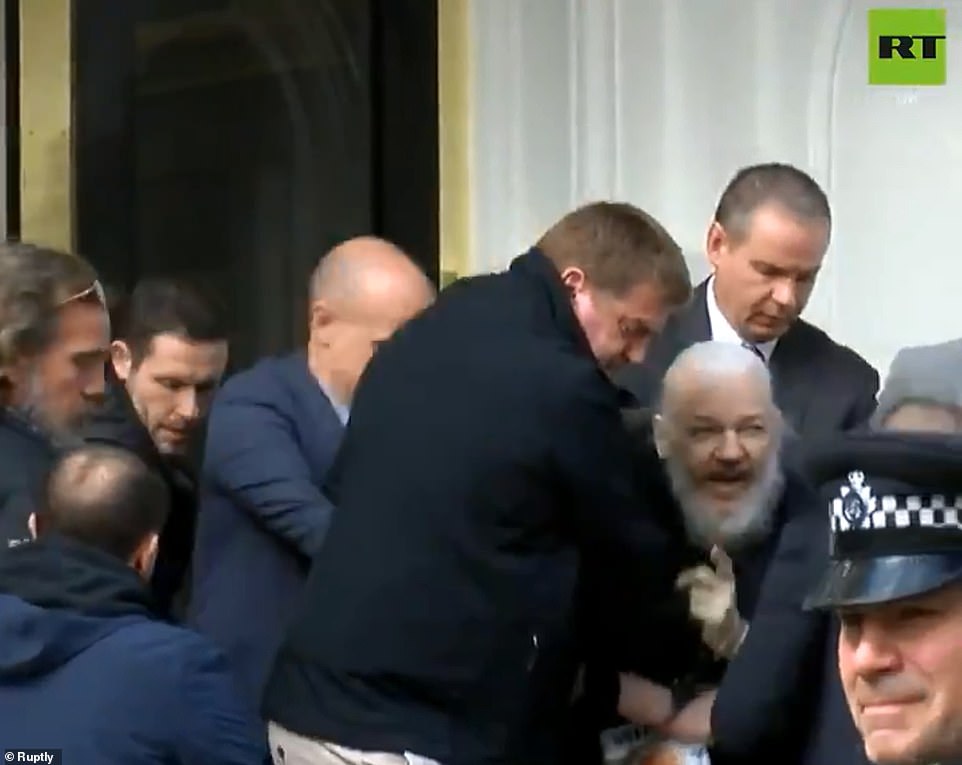
- Wikileaks founder dragged from Ecuadorian Embassy in handcuffs by large group of police officers yesterday
- He has not left embassy since 2012, when he was offered refuge from allegations of sexual assault in Sweden
- Arrest was for skipping bail that year and also for a US extradition request over computer hacking charges
- Ecuador said decision came after he behaved badly and interfered with its affairs during his seven-year stay
- Appeared at Westminster Magistrates Court where he was found guilty of breaching bail conditions in 2012
- He faces a further court hearing in May relating to his possible extradition to the US on the hacking charges
- But the US is reportedly set to file further charges in the coming days that could see him in jail for decades
- Corbyn told Government not to extradite Assange for ‘exposing evidence of atrocities in Iraq and Afghanistan’
Julian Assange is facing decades in an American prison for espionage after he was arrested and hauled kicking and screaming out of his Ecuadorian Embassy bolthole yesterday.
In extraordinary scenes, eight policemen had to drag the bearded and dishevelled WikiLeaks founder to a waiting police van as he ranted about Donald Trump and screamed ‘the UK has no civility’.
His arrest came after the Ecuadorian government ended his asylum status, saying it was tired of his ‘discourteous’ behaviour and poor personal hygiene, which reportedly included smearing faeces on the walls of the country’s London embassy.
As well as the prospect of a year in a UK jail for breaching bail, Assange faces extradition to the United States and a renewed rape investigation in Sweden. Following his arrest, the 47-year-old was charged by the American government with hacking 750,000 classified documents, which carries a five-year sentence.
But US authorities are reportedly set to file further charges in the coming days, including espionage, which can carry a 20-year sentence. As the country submitted an extradition request, a US senator yesterday boasted ‘he’s our property’.
Following his arrest, Assange was hauled to Westminster magistrates’ court yesterday afternoon where a judge branded him a ‘narcissist who cannot get beyond his own selfish interests’. He denied skipping bail in 2012 but was found guilty after the judge branded his defence ‘laughable’. Assange had tried to claim he breached his bail conditions because he couldn’t be guaranteed a fair trial in the UK.
The former hacker now faces a maximum sentence of one year in a British jail, likely to be Wandsworth prison in south London. This would see him serve six months before a fight over his extradition to the US begins. Experts say that process could take up to two years.
Meanwhile Swedish prosecutors said they would consider restarting the rape investigation which caused Assange to first seek refuge in the embassy. The alleged victim’s lawyer declared she would ‘do all we can’ to get the case reopened. A second woman, who accused Assange of sexual assault, said she was willing to appear as a witness.
Assange’s arrest came just 24 hours after Wikileaks had accused Ecuador of an ‘extensive spying operation’, adding that it assumed intelligence had been handed over to the Trump administration.
Mr Trump, who had declared ‘I love WikiLeaks’ during his 2016 campaign when the website released damaging emails concerning Hillary Clinton, said following Assange’s arrest that ‘I know nothing really about him’.