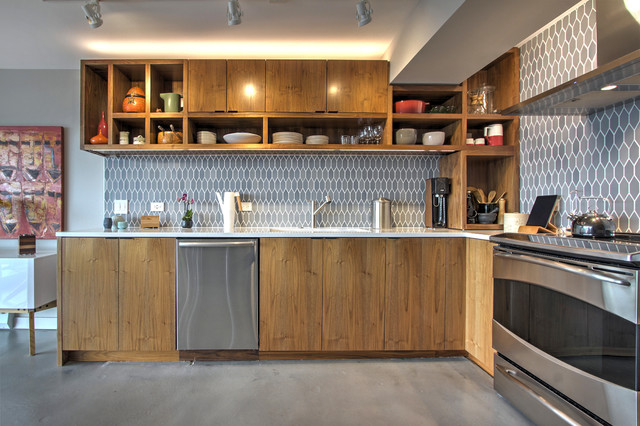
The standard height for upper cabinets has changed somewhat over the years. At one point the most common height was 18 inches above the countertop, but this number has started to creep up to 20 inches to give people a little extra breathing room. Go lower than 18 inches and you may find that certain small appliances don’t fit below the cabinets, or that the upper cabinets start to block your view of the countertop.
Finding the right balance will come down to a lot of personal preferences and situational factors, but here are some cases where raising the upper cabinets might be a good move.
When the home chefs are tall. Standard heights are just that: a standard height that works for a lot of people but isn’t necessarily best for everyone. If the people using the kitchen are on the taller side (say 5’10” and above), they’ll see the cabinets from a different angle than the “average” eye line.
Raising the upper cabinets a few more inches will ensure an unobstructed view of the counter and give a bit more elbow room for working.
But these conveniences are somewhat reduced if you have to struggle to get the pot into the sink. Having higher cabinets above the sink (installed at, say, 24 to 30 inches off the countertop) will ensure you have lots of room to work, no matter what new kitchen contraption you need to wash.
When you have a good, functional pantry wall in your kitchen already, it can be a smart choice to balance it out by reducing the size of your wall cabinets for a more open look. That way you have a place for everything you need without feeling like you’re working in a pantry closet.
Whether this material is a cool tile, a slab of stone or an exposed brick wall, raising the cabinets will let the backsplash become a point of focus, so much so that it might even catch your eye before the cabinets.
A wide stretch of crisp white-based marble slab (between the lowers and the very high uppers) balances out the dark cabinet finish to achieve a look that is rich but airy, and not overwhelming.
When you have a mirrored backsplash. A mirror backsplash makes an attractive style statement, but it can also make your kitchen feel significantly bigger. The effect is even stronger when you have higher upper cabinets, allowing for a taller stretch of mirror that reaches up higher into your eye line.
When your cabinet finish is a bold accent. Two-tone cabinets are a popular trend, and a fun way to add some personality to your kitchen without investing heavily in a look you might grow tired of. When choosing an especially bold finish or an exotic wood grain, using slimmer upper cabinets will balance the look so you get a controlled dose of color.
Lifting your cabinets 6 inches won’t magically knock down a wall, but it can make the entire kitchen feel a bit roomier and more open, without any serious reconstruction.
When you want to hide a hood fan. As the saying goes, if you can’t beat ’em, join ’em. Hood fans are often designed to sit a certain height above the counter, which can ruin the clean lines of modern cabinetry — if you let it. Rather than using cabinets at two different heights, keep the look elegantly simple by installing all the upper cabinets at the same height to create one single line straight across.
Hanging cabinets just 18 inches off the island counter can block your views to a neighboring space, ruining the “open” part of an “open concept.” However, cabinets starting above the eye line won’t shrink your perception of the space nearly as much. Using cabinets 48 to 54 inches above the counter instead will give you a good balance of extra storage and a sense of visual connection between the spaces.
This content was originally published here.