The Trump administration announced Wednesday that government scientists will no longer conduct research using aborted baby body parts. And taxpayer dollars will no longer be used to fund that research at one specific university.
The Department of Health and Services (HHS) will not renew its contract with the University of California, San Francisco following an investigation into UCSF’s research practices. The investigation was part of a broader audit to see if American taxpayer money is helping pay for research involving the body parts of aborted children.
Government-funded research is being allowed to continue under certain circumstances. The decision solely affects research on labs sponsored by the National Institute of Health. So if UCSF wants to continue experiments using aborted fetal tissue it must turn to private funding.
A Trump administration official also told Fox News that universities are free to explore using sources of fetal tissue other than aborted babies.
“It fits inside the wider context of the president’s pro-life agenda since he was sworn into office, So you’ve seen a consistent pattern of pro-life-focused decisions and policy decisions from the president over the last two and a half years,” an official told the network.
“This is consistent with that direction and there will be continued work on the pro-life agenda throughout the rest of the first term and the second term as well, and so we will always work to err on the side of life in all critical decisions that come to the Oval Office at the president’s direction,” the official said.
New tools are coming to fight robocalls, but don’t expect unwanted calls to disappear.
Political gridlock could derail bills aimed at beefing up enforcement and forcing phone companies to do more. The companies have been slow to act against such automated calls on their own. And even if companies do implement better technology, scammers and telemarketers will somehow get through in this never-ending arms race.
“We get things working really well. We’re flagging all these calls as scams. And then the scammers find a new way,” said Grant Castle, vice president of engineering at T-Mobile. “We have to adjust. It is a constant back-and-forth.”
Still, there’s hope that new efforts from the Federal Communications Commission and the industry should help you dodge many robocalls, even if they won’t go away completely. In a scheduled vote Thursday with big implications, the FCC is clarifying that phone companies can block many unwanted calls without asking customers first.
Phone scams have cost victims millions of dollars. And they disrupt institutions, not just your dinner. A hospital in Florida, the Moffitt Cancer Center, received 6,600 calls over 90 days faked to look as though they were coming from inside the hospital, diverting 65 hours of staff time from patient care.
The aggravation isn’t limited to scammers pretending to be from the IRS or Social Security. Call-blocker YouMail estimates that about a third of robocalls come from debt collectors and companies pitching cruises or insurance.
The robocall problem has exploded because cheap software makes it easy to make mass calls. Scammers don’t care if you’ve added your number to the government’s Do Not Call list.
Yet enforcement against illegal callers is negligible. Federal agencies have fined scammers hundreds of millions of dollars, but it’s been difficult to collect. Many of the callers are overseas. It’s hard to throw the fraudsters in jail.
“Ice pirate” Nicholas Sloane wants to cart a 125million-ton ‘berg across the sea – only to melt it down for drinking water. Sloane, 56, is a professional marine salvager who recently oversaw the refloating of capsized Italian cruise ship the Costa Concordia. And he now hopes to solve South Africa’s water crisis by nabbing an iceberg from the South Pole, Bloomberg reveals. Severe drought in 2017 led to Cape Town nearly running out of water, and the city – which Sloane calls home – still has restrictions of 70 litres per day. “My wife used to take a bath every night and a shower every morning. She told me, ‘You’d better do something’,” Sloane said. He now plans to harness and tow an enormous Antarctic iceberg, and then convert it into drinkable water. “To make it economically feasible, the iceberg will have to be big,” Sloane explained. He said it would need to be 3,281 feet long, 1,640 feet wide, 820 feet deep – and weigh around 125 million tonnes. “That would supply about 20% of Cape Town’s water needs for a year,” he added. Sloane has reportedly assembled a crack team of glaciologists, oceanographers and engineers to bag the ‘berg. And he’s even secured funding from a group of financiers to fund his ‘Southern Ice Project’. The entire mission is expected to cost upwards of $200million (£158million). This will largely be funded by two South African banks and a Swiss water tech firm called Water Vision AG, the report claims. Sloane now needs to secure an agreement with South Africa for the nation to buy the Antarctic water. “We’ll never get back to the days where water is flowing all over the Cape,” he said. If the taps run dry, the first day people will be standing in lines at watering points throughout the city. “The second day, if you don’t get your water, well, people are killed for that.”
Whether you’re sitting in your new RV or you’ve been RVing since you were a little kid, sometimes you’re at a loss for what to do in a smaller space when it’s raining outside. Don’t worry! We’ve got you covered with these three fun camping games to try!
1. SPOONS
The infamous game of SPOONS, where everyone fights to the death for a piece of silverware (not literally, but some wild games have gotten awfully close!). If your friends and family are hardcore card gamers, this is this the game for you.
1. Sit in a circle with one less spoon than there are participants in the middle of the circle. Each player gets 4 cards in their hands.
2. Pass around a deck of cards (one by one), with the goal of finding 4 of the same rank.
3. Once a set of 4 is found by a player, that player discreetly swipes a spoon from the middle.
4. As other players notice, the game erupts in chaos as everyone vies for a spoon.
One player will be left without a spoon, which means the losing player gets an “S” on the score sheet. If that person loses again, they get a “P.” Once the word has spelled out “SPOONS,” that player is out of the game until you’re only left with a winner.
2. Telepictionary
Ever heard of pictionary? Telephone? Put them together, and you’ve got “telepictionary”! Every player gets a pad of paper and a pencil at the beginning of this game. Each player picks a word that they desire to start out with. This word is a noun–examples being a cow, an RV, a fishbowl, etc.
1. Each player draws out their own word.
2. After 30 seconds, they must pass their pad of paper to the next person.
3. The person receives the drawing and tries to guess what the picture is by writing what they think the word is on the next piece of paper in the pad. After 30 seconds, they must pass the pad of paper to the next person (note: make sure the person cannot see the previous drawing when it is passed).
4. The next person receives the word and must draw a picture based on the word that was guessed before them.
Get the picture? It’s such a fun and simple game, and can be played over and over with a lot of laughs to go around!
3. Would You Rather…?
This one you won’t need anything for but your brains. It’s as easy as asking the question, “would you rather…?” and then adding something funny to the end. If you’re having some trouble coming up with questions, here are some fun questions to ask the other person:
1. Would you rather be an astronaut that discovers a way to live on the moon, or a scientist that discovers a way to recreate your favorite food out of thin air?
2. Would you rather be famous now and forgotten when you die, or unknown now and famous when you’re dead?
3. Would you rather be able to control water or fire?
That’s just a few to get you started!
Whether you’re bored of being shut inside or you’re just looking to have some fun, we hope this list of easy camping games will make for a fun game night with your fellow campers! If you’re looking to start your camping adventures in a new RV, please contact us today.
Turns out off-the-grid adventures aren’t kind to smaller (and/or electric) vehicles. Which is … what everyone is buying these days.
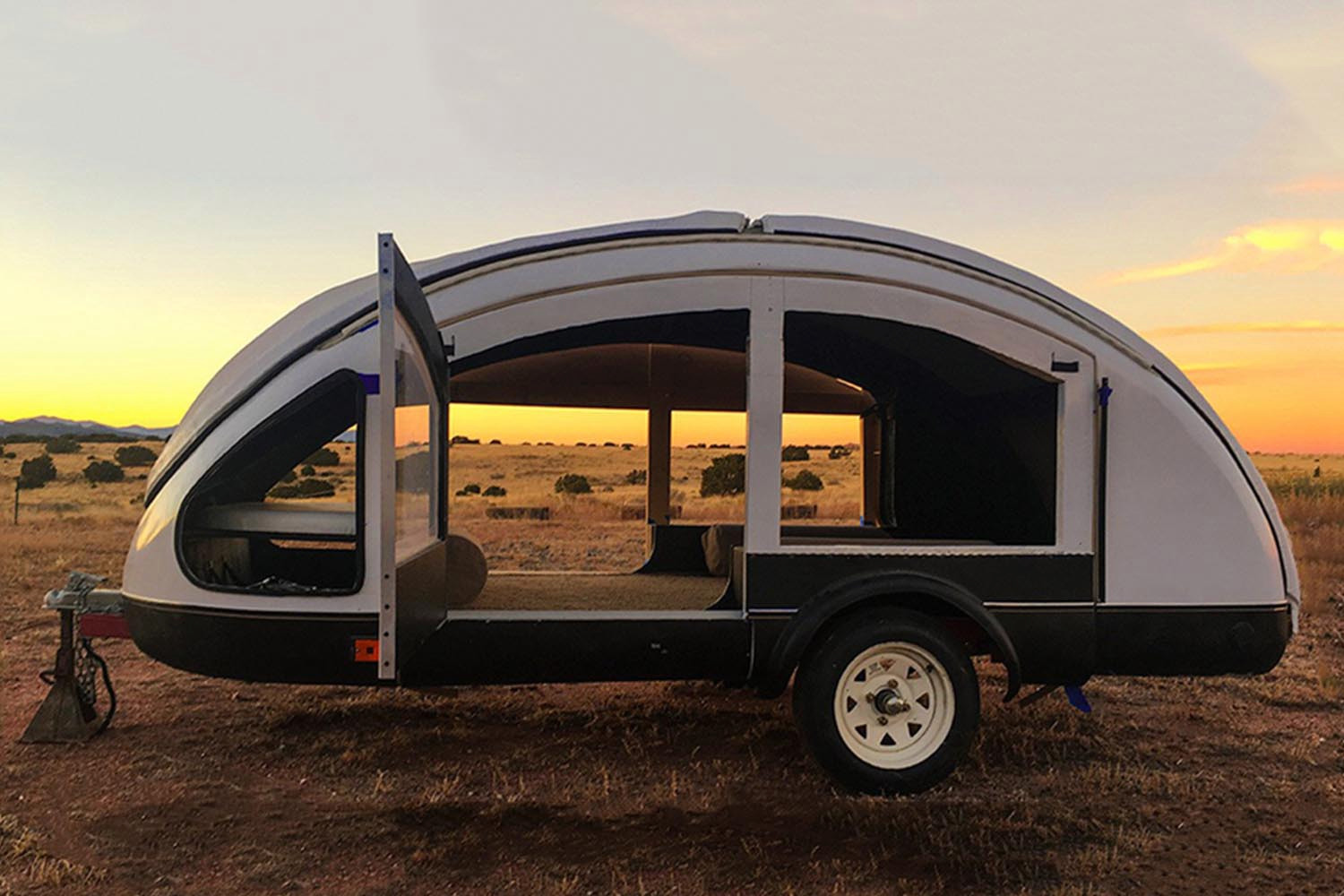
Thankfully, a company called Earth Traveler has created two futuristic teardrop trailers that are light as a feather, and available for preorder now. The Santa Fe-based company’s two new trailers both weigh under 300 lbs., and every unit is hand-built on the premises.
First, there’s the 250LX, which features a carbon-fiber shell and organic design that stems from “avian structure” — for your needs, that means it’s weatherproof, lightweight and aerodynamic, with pop-out walls on either side that resemble wings. Each one features a 46” x 48” skylight, two side doors and vented windows, insulated ceiling and walls and a removable foam mat floor.
If you want a bit more customization and an even cooler backstory, steer toward the Earth T300 — a slightly heavier model built from, in part, a fiberglass composite concocted from chicken feathers. Add-on options for this model include a front pop-up tent and side tents, a UV protection awning, flexible solar panels, LED strips and a suspension system for off-road tires. A kitchen station option is arriving soon.
Thanks to the arched roof, minimalist design and underfloor storage space, there’s plenty of room to use both Earth Traveler models for storage (bikes, camping gear, etc.) or to snugly sleep four.
You can reserve the T250LX now for $23,000 and change, a 25% savings. The T300 is just $7,500. Remember, these are handcrafted, so it could take up to 5-7 months to get your preferred model.
Can’t wait? A few other compact, lightweight trailers we’ve dug recently:
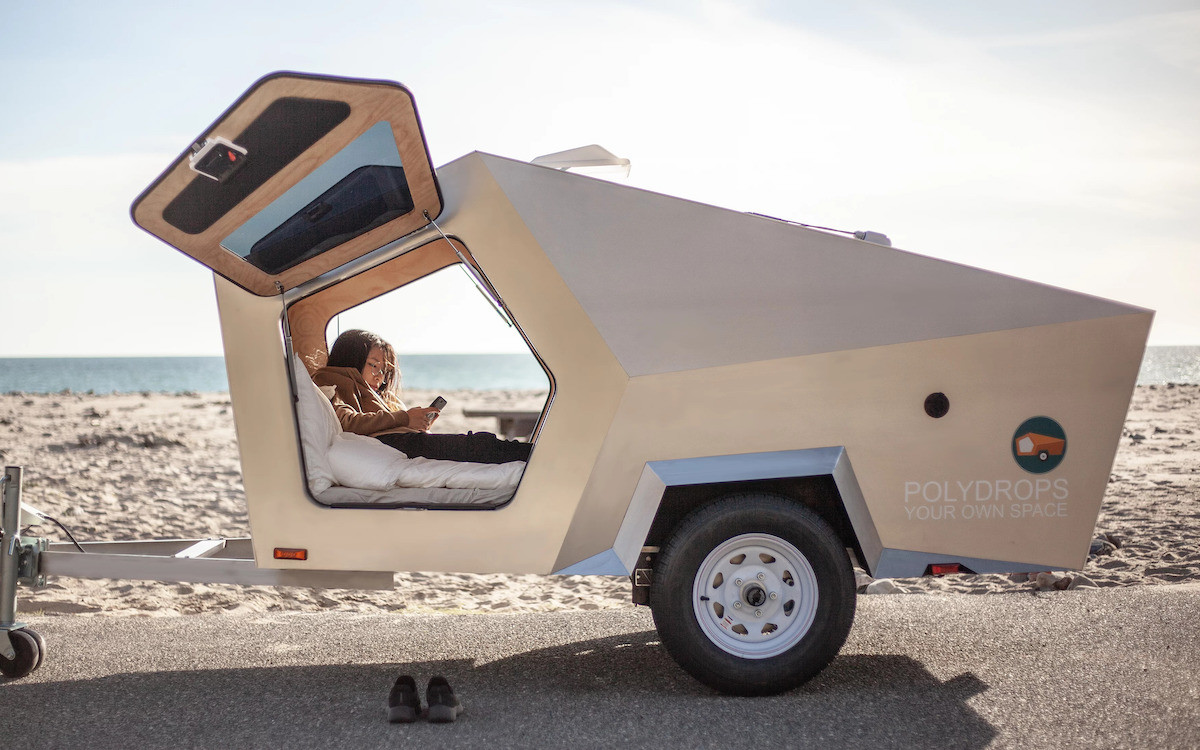
Polydrop: A new polygonal teardrop trailer that’s part spaceship, part micro-apartment and part Instagram gold mine.
Pika: The latest teardrop trailer drop from Colorado-based Timberleaf, the off-road-friendly Pika is ideal for thriving in hard-to-reach hinterlands and towable by most small station wagons.
Droplet: Bright, modern and able to fit a queen-sized bed and kitchen, the Drop is just 950 lbs.
Escapod: A new trailer company out of Utah building svelte teardrop campers that can go damn near anywhere without skimping on creature comforts. These handsome husks of lightweight aluminum and American steel are built to order and perfect for places where hotel rooms (or, hell, even an RV hookup) are hard to find.
Mink: Headed overseas this summer? The Reykjavík-based company offers a mini — and frankly, absolutely adorable — teardrop trailer that will instantly upgrade any Iceland road trip itinerary, with a kitchenette, storage, room for two people and built-in wifi.
Tiger Moth: From TAXA Outdoors, this modular camper is the company’s most lightweight and rugged option, the TM can offer you up to a week of off-grid living, thanks to a built-in electrical system, water system and (optional) solar panels.
Are you going camping for the first time? You will need a list of camping essentials you can’t do without.
Modern life is pretty comfortable. We have all the benefits of technology and modern convenience in our homes, we have nice cars to get us around our cities, we have heating, cooling, hot running water and many things that human beings have lived without for thousands of years.
You can get so used to all of this that it’s a surprise when the power goes out and you have to dig through the cupboards to find those candles so you can see what you’re doing!
Yet, there is something to be said for the ritual of unplugging, for stepping away from the mod cons and the rat race and for getting away for a few days or weeks. Camping is the best way to do this. But what if you’ve never been camping before?
Let’s explore a few camping essentials and just what you’ll need for a break in the bush:
Clothing Considerations
While it may seem like an obvious thing to consider early in your packing process, you would be amazed how many people turn up to camping tripscompletely unprepared for the climate and terrain.
Stylish shoes may look fantastic in your camping pics, but only if you’re ready for them to get destroyed by rough ground and mud. The same goes for most clothing that provides style over substance.
While it’s good to have some loose, comfortable clothing for hanging around the campsite, m0re trail-ready alternatives should be brought for hiking, rafting, and any ice cold nights where the sleeping bag just won’t cut it.
Food and Water
There are no grocery stores out in the bush. You need to pack enough water to last you for as many days as you’ll be away. A good rule of thumb is two liters per person per day in the colder months and three liters per person per day during summer.
Pack food too, but ensure that you use an Esky if you’re packing perishable items like meat and dairy. Plenty of fruit and nuts to snack on is also a good idea, as well as a few treats like chocolates or chips — after all, it’s not camping without some snacks.
Expect the Best, Prepare for the Worst
When you’re leaving the success of your trip up to the whims of nature, it’s best to have a backup plan if things go awry. Things can go wrong, with results ranging from mild annoyance to dire circumstances depending on your location and level of preparedness.
To combat many of these potential issues, extra supplies and clothes should be packed. Bringing an extra few days worth of food may seem excessive when you’re trying to pack for the trip to come, but if you find yourself in a tight spot, you’ll be glad that you went through that extra annoyance.
You can’t have camping without tents. Well, there’re caravans of course, but that’s cheating. So the most important one of the essentials you need to go camping is a good tent.
While your local discount store may sell tents in all shapes and sizes, these models usually don’t last beyond a few trips. You need something that will last and stand the test of time, so consider spending a bit and looking at it as an investment.
You can opt for anything from two-person swags to family-sized tents and what you need will depend on how many people you need to fit in and your budget.
Camping Mattress
Unless you want to sleep on the cold hard ground, you’ll need a mat or mattress. You can choose anything from a basic roll-up camping mat to a fully-fledged inflatable queen-sized mattress, it just depends on how comfortable you want to be.
Know What Plants to Avoid
Let’s face it – sometimes, it can feel like nature is out to get us. With a large number of dangerous plants spread out in the bushes and rainforests of the world, it’s essential that you try to do some research before you go out camping or hiking.
Keep in mind that, while you may be familiar with the common contenders, such as poison ivy and poison oak, each area is going to likely have local dangers that you may be less aware of.
Luckily, there is a number of resources online, and most parks and campsites will have their own information for those interested.
Shade and Shelter
As well as your tent, you’ll want a bit of shade during the day, especially if you’re camping in the warmer months. A small gazebo will do the trick just fine.
Consider getting one with walls because that pesky sun likes to move around all day. With that said, having a collection of shading options available is always a good idea. Just make sure that whatever you choose is up to the task of weather conditions start to turn.
A cotton sheet may protect you from the sun’s rays, but it would be quite as helpful once the torrential rain hits midway through your trip.
Cooking Stoves and Utensils
Unless you plan on eating cold and raw food, you’ll need something to cook with. Cast iron pans and pots can be used over a fire or you can use a portable gas stove for normal cookware.
Here’s a tip — buy some cheap cookware and utensils from an op shop or garage sale instead of packing your nice stuff, because they’re going to get battered and bruised from their time in the bush.
A picnic set can come in handy when it comes to bowls, plates, and cutlery. On that note…
Final Words on Camping Essentials
Speaking about camping essentials — you’ll need a tent of some sort, and then something to sleep on like a camping mat or mattress. Next are your food and water, and something to cook on and with.
Then, remember to plan for any potentially negative outcomes with extra supplies and a decent understanding of the nature around you. Finally, grab a gazebo so you’ve got some shelter and shade through the days.
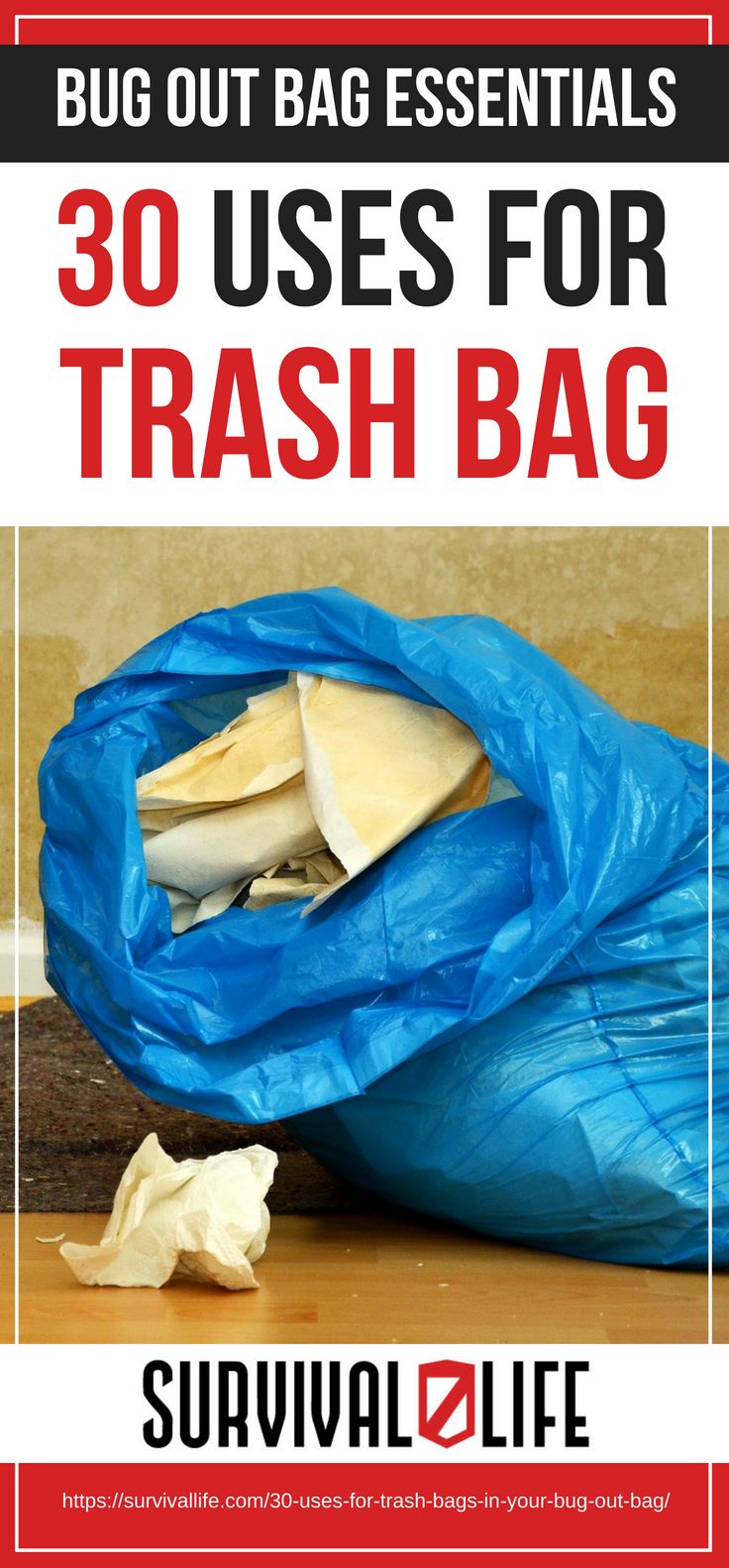
Knowing these uses for trash bags will make you save it a special place in your BOB, so check them all out now to know what these are!
Survival Uses For Trash Bags You Should Know By Now!
Practical and Survival Uses for Trash Bags
Deciding how to spend available funds in a preparedness budget, especially for a bug out bag is not an easy task. Multi-use items and under $5 survival items are always a favorite of wallet-conscious preppers.
Trash bags, even the brand-name sturdy ones definitely fall within the “reasonably priced” category, but when we look past the obvious uses for plastic bags, they become an even more advantageous contribution to our preps.
These hacks and uses for trash bags will fix it as one of your top essentials in an ultimate bug out bag!
Packing a tent or tarp for an emergency shelter is, of course, optimal–but such items take up a lot of space and are heavier as well. Even a one-person tent will not fit in a child’s backpack, but trash bags and some duct tape surely will.
You can make a garbage bag lean-to with some sticks for use in the desert or in any open and shadeless area.
3. Keeps Your Feet and Shoes Dry with Garbage Bag Shoes
Trash bags are also useful in keeping your shoes and feet dry. Open a trash bag, step inside and tie or secure with duct tape and keep rain and snow at bay.
Storing several trash bags for emergency booties and a poncho inside a get home bag or bug out bag takes up very little space and adds virtually no weight to the pack.
4. Reusable Water-Proof Storage Bags
Keep your spare socks, change of clothes, and blankets dry with trash bags. The trash bags used to store these items can be turned into a poncho, bootie, or emergency shelter in mere minutes.
5. Septic Disposal Containers
During either a short or long-term disaster, trash bags can be used to safely store waste when commodes are not working. The bags work equally well for sharps and bloody cloth or bandages used to treat wounded.
Preventing the spread of disease becomes even more important during a TEOTWAWKI scenario.
6. Makeshift Hats
Keep the rain off or your head with a makeshift trash bag hat. Simply wrap the trash bag over your head like you would a bandana.
7. Fly Screen/Bug Repellant
Make a fly screen for the front of your shelter with a trash bag — or two. Cut the trash bag into a sheet type form and then cut slits within a few inches of the top of the bag and you have a protective screen to keep the bugs away.
8. Ground Cover
Trash bags also make a great ground cover. If you are using a tarp, or another trash bag for shelter, placing another plastic bag onto the ground will prevent dampness from impacting your clothing.
The trash bag also offers another layer between you at bugs which will come out of the ground seeking food during the evening and early morning hours.
9. Thermal Underwear
Although not exactly soft, trash bags can make great thermal underwear under your clothing. Tape or tie piece of the bag around your legs, arms, and stomach beneath your clothing to prevent body heat from escaping quite so easily.
10. Container for Food Preparation
Sure, they will be a bit flimsy and perhaps messy, but you can use trash bags to mix food or drink ingredients. Only avoid using sharp objects in this business because you know what happens next.
11. Solar Water Still Accessory
You can also use trash bags as part of solar water still. A trash bag, a container, and greeneries will give you water in an area where there is none.
12. Trash Bag Life Jacket
Although US Coast Guard does not approve of it, there are reports of trash bags as effective life jackets — it is at least worth a shot during an emergency.
Tie the ends of the trash bag together and blow air into it to inflate, then secure the open ends together as well. Tape or tie the back into a life jacket shape and use it to help keep your, your pets, or your get home bag afloat.
13. Food Storage and Transport
You can also use trash bags to store and transport food. When you’re caught in a flood or crossing a body of water, you can keep your food dry and afloat with trash bags.
14. Pillow
Josh is a great friend letting me use one of his trash bags as a pillow. Living lavishly pic.twitter.com/VcdH9qwruJ
Give your head a somewhat soft place to rest during an overnight hike home by inflating trash bags and using them as a pillow. It isn’t much but a little comfort in a survival situation is a lot.
15. Water Container
Trash bags also make great emergency water container. Trash bags will hold a decent amount of weight but will need to be carried carefully so the plastic does not tear and the water spill out onto the ground.
16. Water-Proof Your Sleeping Bag with Trash Bags
Keep your sleeping bag and yourself dry and a little warmer by using trash bags as cover. To stay extra dry, slip into a sleeping bag like you would a potato sack for a race before getting into the sleeping bag as well.
17. Emergency Blanket Substitute
I want fuzzy socks, Thai food, and a warm blanket now. Instead I’m out here rocking this trash bag in soaked socks pic.twitter.com/a5UvLIIC4j
Mylar emergency blankets are inexpensive, lightweight, and take up little space, but trash bags make a good temporary substitute.
18. Sun Shade
Hook trash bags to branches, or taped into place, to make a temporary sun shade. After taking the hiking break, carefully fold the trash bag into a small square so it can be used again during the next break period.
19. Pressure Bandage for First Aid
Make a pressure bandage or a triangle bandage with trash bags. The trash bags can also simply be used to cover a traditional bandage to help protect the wound from exposure to dirt or the bandage from exposure to the rain.
20. Splinter Support for First Aid
Tie a splint with a trash bag, double the bag, or tape two together to make a sturdier splint.
21. Catch Basin for Water
In addition to being used as a makeshift water carrier, trash bags can also be used as a catch basin for water. Tie the bag to something mildly sturdy in an area exposed to the sky, or line a bucket or similar item with the bag, and capture enough water to keep yourself hydrated.
22. Patch
Trash bags can also be used as patching for leads in other food and water containers. The plastic bags can be taped to cover worn spots or tears in a bug out or get home bags too.
23. S.O.S. Signs
Use trash bags to signal help. Tie or secure a white trash bag to a rock in a visible spot to let others know where you are. It is always a good idea to carry a permanent marker and spray paint to write messages.
24. Disposable Plates
You can use trash bags to eat from. Find the most smooth and flat rock in the near vicinity and place a piece of the trash bag onto the rock for a clean eating surface.
25. Trail Markers
Use trash bags to tie onto trees for trail markers. This is one way to reuse trash bags which you have previously used for food storage, sleeping bag, and some of the items mentioned here.
26. Windsock
Make windsocks with trash bags. It could serve a couple of emergency functions other than telling the wind direction.
You can also use it as an S.O.S. sign or as hazard markers.
27. First Aid Liter
If an injured person, pet, or heavy gear needs to be moved, make a liter and line it with several trash bags.
28. Hazard Markers
Make a banner with trash bags to leave warning notes for others or to mark unsafe buildings. Tape, string, and marking materials will also be required.
29. Hot Shower
Fill trash bags up with water, set it in the sun for a while and then hang it from a sturdy branch to use for a shower. Heated water is also useful for cleaning wounds.
Make a temporary backpack with trash bags so the non-prepared person you come across during your trek home can help you carry the load. Remember, the person could run off with your stuff, but if they’re scared and unaware and you appear full of knowledge, the person will likely stick to you like glue.
This video from History will show you more uses for trash bags:
Trash bags are one of the most economical preppers’ “to do” list finds and literally, dozens of potential disaster uses. In addition to being easy on the budget, trash bags are lightweight yet durable and take up very little space in a bug out bag, INCH bag, and get home bag.
According to a study published in Current Biology in 2015, children raised without religion tend to be kinder than children brought up in very religious households.
The study was a collaborative effort between numerous academics from seven different universities that are spread out all over the world.
The team studied children from a variety of different background, including Christian, Muslim and non-religious, and found that among other things, children from religious households were more judgemental.
The study was titled, The Negative Association Between Religiousness and Children’s Altruism Across the World.
Three Children Sitting On Stairs, Aaqrabâte, Syria. Photo Credit: Samer Daboul / Pexels
“Overall, our findings … contradict the commonsense and popular assumption that children from religious households are more altruistic and kind towards others. More generally, they call into question whether religion is vital for moral development, supporting the idea that secularisation of moral discourse will not reduce human kindness – in fact, it will do just the opposite,” the researchers said in the study.
The research involved nearly 1,200 children between the ages of 5 and 12. The children were from a variety of different cultures, including children from the US, Canada, China, Jordan, Turkey, and South Africa. Of those who participated in the experiment, nearly 24% were Christian, 43% Muslim, and 27.6% non-religious. Children who were Jewish, Buddhist, Hindu, agnostic or other less ubiquitous religions were not statistically significant enough to have their results included.
In the study, the children put in situations where they would have an opportunity to share with others. They were also shown video footage of children fighting and pushing each other while researchers gauged their reactions.
The results of the study “robustly demonstrate that children from households identifying as either of the two major world religions (Christianity and Islam) were less altruistic than children from non-religious households,” according to the researchers.
Photo Credit: Pexels
The researchers also noted that older children who have been more indoctrinated into a particular religion “exhibit[ed] the greatest negative relations”.
The study also found that religious children are more likely to be judgemental and punitive towards other children.
“Religiousness was inversely predictive of children’s altruism and positively correlated with their punitive tendencies. Together these results reveal the similarity across countries in how religion negatively influences children’s altruism, challenging the view that religiosity facilitates prosocial behavior,” the study said.
“While it is generally accepted that religion contours people’s moral judgments and pro-social behaviour, the relation between religion and morality is a contentious one,” the study continued.
One aspect that was not covered in the study is that religious parents are often punitive with their children, and things like spanking are considered socially acceptable. There is a very good chance that this is the actual reason why children of religious parents have a harder time getting along with others.
Photo Credit: Pexels
Numerous studies have now shown the harmful effects of spanking and similar parenting strategies.
The United Nations Committee on the Rights of the Child issued a directive in 2006 calling physical punishment “legalized violence against children” that should be eliminated in all settings through “legislative, administrative, social and educational measures.” The treaty that established the committee has been supported by 192 countries, with only the United States and Somalia failing to ratify it.
Alan Kazdin, PhD, a Yale University psychology professor and director of the Yale Parenting Center and Child Conduct Clinic, says that spanking doesn’t even work like many parents think it does.
“You cannot punish out these behaviors that you do not want. There is no need for corporal punishment based on the research. We are not giving up an effective technique. We are saying this is a horrible thing that does not work,” Kazdin said.
It is also important to point out that there are mountains of scientific evidence proving that spanking is bad for the mental health and development of children, with absolutely no studies showing that it does any good.
The study showing that religious children are less altruistic is interesting, but it is incomplete, because it puts an overemphasis on the spiritual practice in the household, while disregarding the other important family dynamics that contribute to a child’s upbringing. However, there is certainly something to be said for how religious parents tend to have a more authoritarian parenting style, which undoubtedly causes these anti-social personality traits.
According to the leading researcher at Oxford University, Dr. Paul Kelley, waking up for work before 10 AM is the most common form of torture we’re experiencing daily.
The internal body clock or The Circadian Rhythm is the biological timers that mandate our bodily functions and the pre-programmed genetic cycle controls our perception of time, energy levels, brain functions, and hormone production.
Because of that, waking up before 10 o’clock is a way of torture to our body and affects the natural balance in the body negatively.
In his research, Kelley shows that people are not able to change their 24-hour rhythms and one cannot learn to wake up at a certain time. The heart and the liver have different patterns and they are supposed to shift between two and three hours.
During the early 20th century, when the working day of 8-hours was introduced together with the 24/7 factory productivity, no one thought about the natural human body clock.
Consequently, Dr. Paul Kelley shows that this can affect the emotional, physical, and performance systems which can damage our body. All of the workers should be starting at 10 AM. Additionally, he says that people have chronic sleep deprivation which is a worldwide issue.
Furthermore, one week with less than 6 hours of sleep during the night will lead to 711 different changes to the function of our genes.
Dr. Kelley thinks that effectiveness in the workplace should be improved if the simple changes of the starting time and ending time would be implemented.
Many neuroscientists alongside with Dr. Kelly show the importance of knowing the functionality of the body at different ages, specifically for the sleep cycles. Sleep deprivation can start when we’re in the ages of adolescence since teens are predisposed biologically to sleep sometime around midnight. Thus, the teens are not exactly awake until 10 AM in the morning, but because of their early morning schedule with schools, the teens lose about 10 hours of sleep during a week. Additionally, they have a habit to stay awake longer in the night during weekends so the constant readjusting to going to bed early and waking up early cycle which is designed for a 55-year old.
A British school listened to Dr. Kelley’s theory and implemented it in their school system. They started school at 10.00 AM instead of 8.30 AM After some time, many of the students showed significant results since their grades increased as well as their general productivity and attendance.
Because of this, if we choose to implement these changes in all sectors of our society, many people will become happier, more productive, healthy, and filled with joy and energy instead of being stressed, fatigued, and very addicted to coffee.
We may have suspected it already, but now the science backs it up: unmarried and childless women are the happiest subgroup in the population. And they are more likely to live longer than their married and child-rearing peers, according to a leading expert in happiness.
Speaking at the Hay festival on Saturday, Paul Dolan, a professor of behavioural science at the London School of Economics, said the latest evidence showed that the traditional markers used to measure success did not correlate with happiness – particularly marriage and raising children.
“Married people are happier than other population subgroups, but only when their spouse is in the room when they’re asked how happy they are. When the spouse is not present: fucking miserable,” he said.
“We do have some good longitudinal data following the same people over time, but I am going to do a massive disservice to that science and just say: if you’re a man, you should probably get married; if you’re a woman, don’t bother.”
Men benefited from marriage because they “calmed down”, he said. “You take less risks, you earn more money at work, and you live a little longer. She, on the other hand, has to put up with that, and dies sooner than if she never married. The healthiest and happiest population subgroup are women who never married or had children,” he said.
Dolan’s latest book, Happy Ever After, cites evidence from the American Time Use Survey (ATUS), which compared levels of pleasure and misery in unmarried, married, divorced, separated and widowed individuals. The study found that levels of happiness reported by those who were married was higher than the unmarried, but only when their spouse was in the room. Unmarried individuals reported lower levels of misery than married individuals who were asked when their spouse was not present.
Other studies have measured some financial and health benefits in being married for both men and women on average, which Dolan said could be attributed to higher incomes and emotional support, allowing married people to take risks and seek medical help.
However, Dolan said men showed more health benefits from tying the knot, as they took fewer risks. Women’s health was mostly unaffected by marriage, with middle-aged married women even being at higher risk of physical and mental conditions than their single counterparts.
Despite the benefits of a single, childless lifestyle for women, Dolan said that the existing narrative that marriage and children were signs of success meant that the stigma could lead some single women to feel unhappy.
“You see a single woman of 40, who has never had children – ‘Bless, that’s a shame, isn’t it? Maybe one day you’ll meet the right guy and that’ll change.’ No, maybe she’ll meet the wrong guy and that’ll change. Maybe she’ll meet a guy who makes her less happy and healthy, and die sooner.”