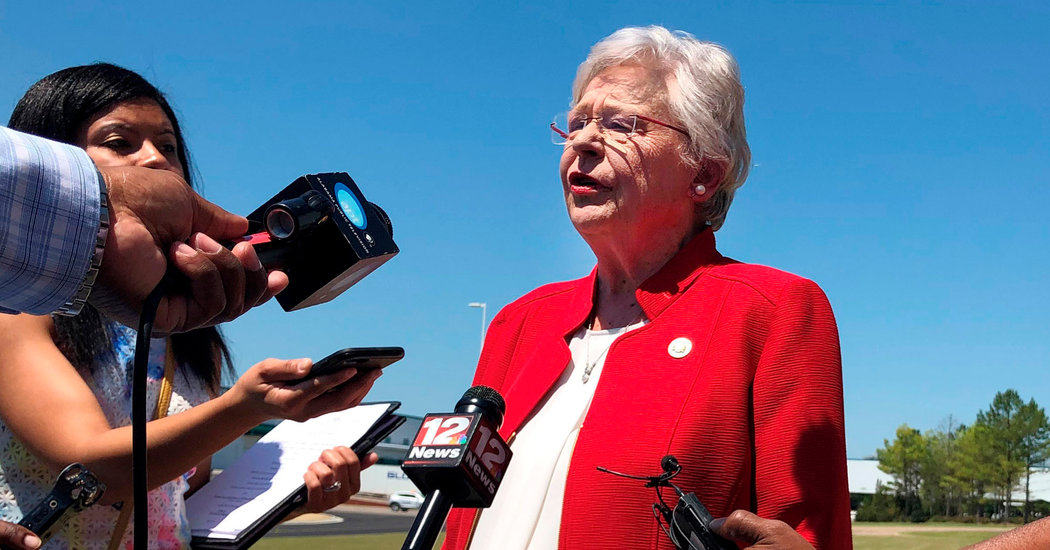
“Alabama will not stand for the loss of life in our state, and with this heinous crime, we must respond with punishment,” the statement said. “These four victims deserved a future, and Mr. Samra took that opportunity away from them and did so with no sense of remorse. This evening justice has been delivered to the loved ones of these victims, and it signals that Alabama does not tolerate murderous acts of any nature.”
Alabama currently has 176 more prisoners awaiting execution. All but two of them were convicted of murder; 65 have been on death row for more than 20 years.
While death penalty opponents like Ms. Cox wonder how Christian conservatives like the governor can oppose abortion but uphold execution, others say the two stances become coherent when viewed through a lens of innocence and guilt.
“In a sense, it’s perfectly comprehensible,” said Mark Silk, a professor of religion at Trinity College. “Their view is that unborn babies and fetuses are innocent life. They’ve done nothing to merit the death penalty. Whereas murderers have done something to merit the death penalty. It’s an eye for an eye, a tooth for a tooth. It’s how they look at the world.”
Professor Silk said that white evangelicals in particular, who make up more than half the electorate in Alabama, may run into difficulty when men or women “find their way to Jesus” while on death row.
“So much of evangelicalism has to do with conversion,” he said. “That’s such a core experience for them. A murderer or rapist finding their way to God is as powerful a manifestation of conversion that you can find.”
Ms. Cox said she found the argument that life is something to be protected only when it is innocent to be “flimsy.”
“People should be still held accountable, but there should be more nuance,” she said. “You are not the sum of the worst thing you’ve ever done.”
The Catholic Church’s teachings oppose both abortion and capital punishment on similar grounds.
“Pro-life values are meaningless when they are inconsistent,” said Krisanne Vaillancourt Murphy, executive director of the Catholic Mobilizing Network, a group working to end capital punishment. “The sanctity of human life applies to each and every person, innocent and guilty,” she said, adding that the church teaches that a person’s God-given dignity “is not lost even after the commission of very serious crimes.”
“As Pope Francis has said, ‘There is no just penalty that is not open to hope,’” Ms. Murphy said. “That is why the death penalty is neither Christian nor human.”
A scholar of evangelical Christianity said that most evangelicals in Alabama probably feel no tension between support for the death penalty and opposition to abortion.
“Most conservative evangelicals wouldn’t think twice about executing someone and then going to a pro-life march the next day,” said John Fea, a history professor at Messiah College. He said their views have often been shaped by the political battles that have raged over social issues in recent decades, so that, for example, they also tend to oppose spending tax money on government programs that might reduce the number of unwanted pregnancies.
Progressive evangelicals see the issues differently, Mr. Fea said, but “they are a minority in the state of Alabama and most of the evangelical South.”
The Southern Baptist Convention, the largest evangelical denomination, says its support of the death penalty has roots in biblical teachings. “Imposing the death penalty can help the murderer restore the broken relationship with their creator, not just with humankind,” says an article posted by an arm of the convention that addresses public issues. “While we have an interest in a criminal’s return to society, we should be even more concerned with the state of their soul.”
This content was originally published here.