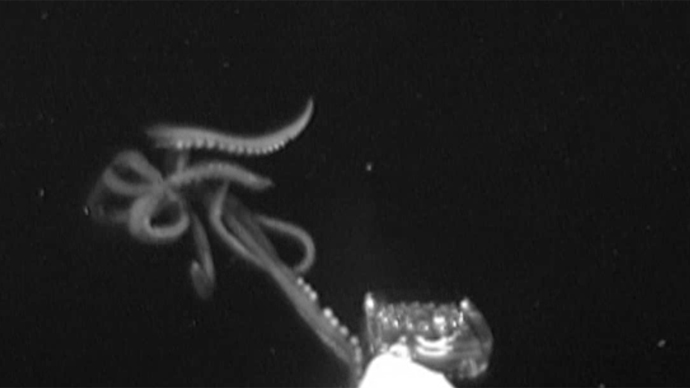
A rare, giant squid made an appearance on camera, delighting scientists who were exploring the deep waters in the Gulf of Mexico for a sighting of the elusive deep-sea creature.
Researchers working with NOAA’s Office of Ocean Exploration and Research spotted the giant squid just 100 miles off the coast of New Orleans on Wednesday. They identified it in video captured by Medusa, an underwater camera system that features a lighting system designed to mimic a bioluminescent jellyfish.
The expedition was part of the NOAA Journey into Midnight mission, which is investigating deep, dark areas of the Gulf of Mexico below 3,800 feet, known as the bathypelagic (midnight) zone.
“We knew immediately that it was a squid. It was also big, but because it was coming straight at the camera, it was impossible to tell exactly how big. But big – at least 3 to 3.7 meters (10 to 12 feet) long,” Duke University Professor Sonke Johnsen and Ocean Research & Conservation Association CEO Edie Widder said in a blog post.
Squid expert Michael Vecchione at the NOAA National Marine Fisheries Services – National Systematics Laboratory at the Smithsonian later said that he was “nearly certain” that the creature filmed was a juvenile giant squid.
Footage released by NOAA shows the giant squid approaching Medusa, its tentacles flaring as though it had mistaken the camera for an actual jellyfish and was preparing to attack.
After beginning to wrap its tentacles around Medusa, the squid appeared to have realized that something was not right and disappeared back into the dark depths of the ocean.
Researchers of the NOAA Journey into Midnight mission gather around to watch the squid video. (Photo Credit: Courtesy of Danté Fenolio)
The scientists said previous submersible dives had failed to film giant squid in the Gulf of Mexico.
“This suggests that the animal does not like the bright lights of ROVs and that stealth monitoring of the sort possible with the Medusa can allow us to see what has never been seen before,” Johnsen and Widder wrote.
In the blog post, the scientists also wrote that the squid was spotted in an area that was often depicted in old maps as containing “monsters” with warnings to sailors in the area.
“We did not find a monster. The giant squid is large and certainly unusual from our human perspective, but if the video shows anything of the animal’s character, it shows an animal surprised by its mistake, backing off after striking at something that at first must have seemed appealing but was obviously not food,” Widder and Johnsen said.
They added: “Our perspective as humans has changed. What were once monsters to be feared are now curious and magnificent creatures that delight. We like to feel that science and exploration has brought about this change, making the world less scary and more wondrous with each new thing we learn.”
Recovering the Medusa camera. (Photo Credit: Courtesy of Dante Fenolio)
The giant squid remains largely a mystery to scientists despite being the biggest invertebrate on Earth, according to National Geographic. The largest of these elusive giants ever found measured 59 feet in length and weighed nearly a ton.
Giant squid, along with their cousin, the colossal squid, have the largest eyes in the animal kingdom, measuring some 10 inches in diameter, National Geographic said.
Their inhospitable deep-sea habitat has made them uniquely difficult to study, and almost everything scientists know about them is from carcasses that have washed up on beaches or been hauled in by fishermen.
But in 2004, researchers in Japan took the first images ever of a live giant squid. And in late 2006, scientists with Japan’s National Science Museum caught and brought to the surface a live 24-foot female giant squid. In 2012, a research team collaborating with the Discovery Channel spotted another giant squid and filmed it in its natural habitat thousands of feet beneath the surface. Now, scientists have filmed the elusive giant squid — and in America’s “backyard,” too.
More on Geek.com:
This content was originally published here.