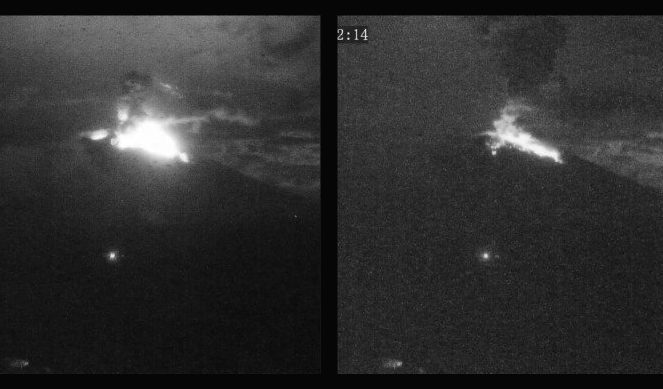
Bali’s Mount Agung continued its powerful eruptive uptick today at 01:40 a.m. local time, June 13 (17:40 UTC, June 12).
The Volcanic Ash Advisory Center (VAAC) Darwin has warned of a large volcanic ash plume rising to at least 30,000 feet (9.1 km), and moving in a westerly direction.
A secondary ash plume reportedly rose to 18,000 feet (5.5 km) soon after.
Mount Agung Bali Volcano, eruption 13.06.2019, 02:00 Bali Time pic.twitter.com/93wHj6cl0E
— Rita Bauer (@wischweg) June 12, 2019
The Aviation Color Code remains Red.
“The danger area is within a radius of 4 km (2.5 miles) from the summit,” said a BNPB spokesperson.
Mount Agung Bali Volcano, eruption 13.06.2019 pic.twitter.com/oJSi4os2py
— Rita Bauer (@wischweg) June 12, 2019
Eruption at #Agung volcano just now, at 01:38 local time 13th June. Its night in Bali, and Incandescence could be clearly observed. Now 10min. after the eruption, incandescence (hot material) can still be seen on the upper flanks of the summit. Sreenshot: from volcanoYT webcam pic.twitter.com/rdQ4KwUOPM
— Øystein Lund Andersen (@OysteinLAnderse) June 12, 2019
Agung is a GSM stratovolcano, easily capable of producing a level 5 eruption on the Volcanic Explosivity Index (VEI) — just as it did back in 1963 (during solar minimum of cycle 19) and 1843 (during the Dalton Minimum), according to .
And now, after five and a half decades of quiescence, the mountain is once again rocking — with this latest eruptive phase, which began in late 2017, already ranking as VEI 3.
Agung is one to watch as we continue our descent into this next Grand Solar Minimum.
A powerful pop (VEI 6+) will dramatically cool the planet, almost overnight.
BACKGROUND
Stratovolcano: 3142 m (10,308 ft)
Bali, Indonesia: -8.34°S / 115.51°E
Current status: ERUPTION WARNING
Eruption list: 1808, 1821(?), 1843, 1963-64 (large Plinian eruption on March 16, 1963), 2017
For more see VolcanoDiscovery.com
UPTICK
Seismic and Volcanic activity has been correlated to changes in our sun.
The recent global uptick in earthquakes and volcanic eruptions is likely attributed to the drop-off in solar activity, coronal holes, a waning magnetosphere, and the increase in Cosmic Rays penetrating silica-rich magma.
Check out these link for more info:
https://principia-scientific.org/do-cosmic-rays-trigger-earthquakes-volcanic-eruptions/
Grand Solar Minimum + Pole Shift
The post Mount Agung Blows to 30,000 feet (9.1 km), continuing it’s Powerful Eruptive Uptick appeared first on Electroverse.
This content was originally published here.