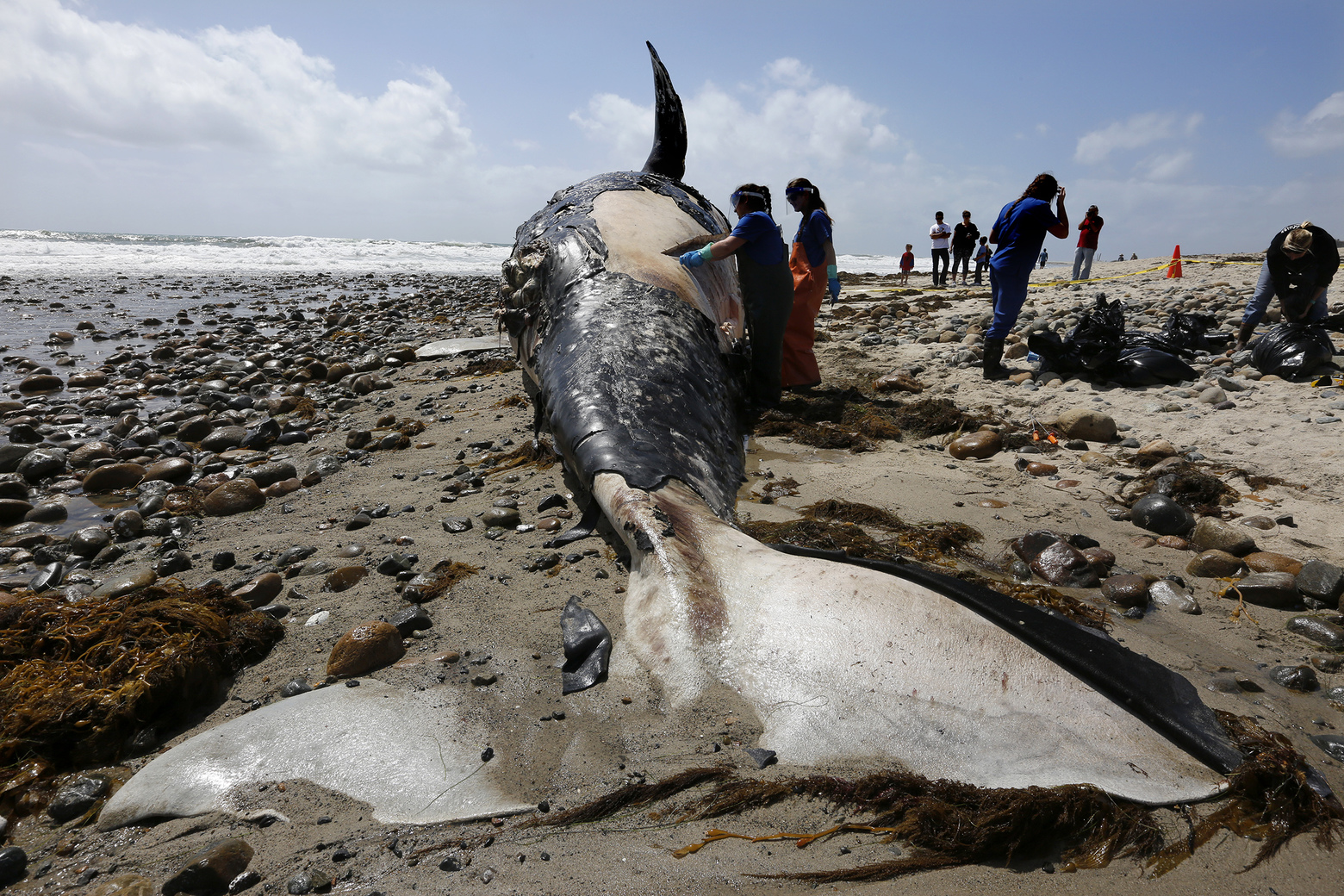
From Baja California to Puget Sound, scientists are seeing signs that gray whales are in distress. And they have no idea why.
Thirty-one dead gray whales have been spotted along the West Coast since January, the most for this time of year since 2000, when 86 whales died. Dozens more have shown visible signs of malnourishment, and sightings of mother-calf pairs are down sharply.
The gray whale death toll will probably climb through May as the animals continue their annual migration from their warm breeding lagoons in Mexico to their icy feeding grounds in the Arctic, said Justin Greenman, the assistant coordinator of stranded marine mammal response in California for the National Oceanic and Atmospheric Administration.
Experts said that, with about 27,000 gray whales thriving around the world, this year’s deaths probably don’t present a serious threat to the species. But the casualties can’t be ignored, either.
“It’s not like we’re ringing the alarm bell that this population is threatened or at risk,” said John Calambokidis, a biologist and co-founder of Cascadia Research who tracks gray whales in Washington state. “As a researcher, I feel that you want to at least understand what is going on.”
“If this continues at this pace through May, we would be alarmed,” she said.
In a typical year, scientists at the Marine Mammal Center in Sausalito see two or three dead gray whales. So far this year, they’ve counted seven, according to Dr. Padraig Duignan, the center’s chief pathologist.
Duignan performed necropsies on all of them and determined that four had died of malnutrition.
“Their skeleton seems to stick out more and more,” he said.
Emaciated whales are also turning up with greater frequency along the West Coast. These whales are more angular in appearance, and have less muscle mass behind their heads.